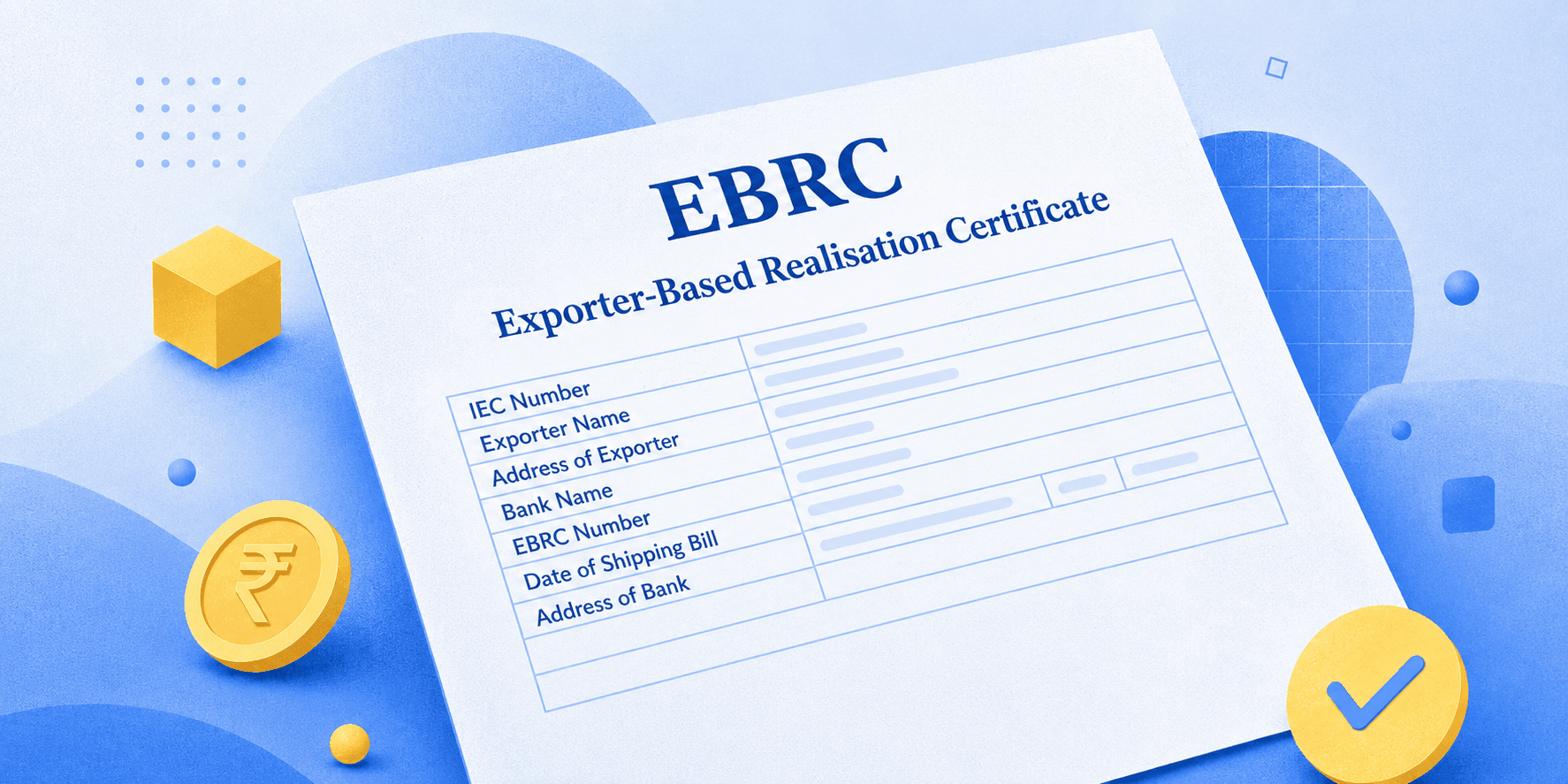

For Indian exporters, receiving an international payment is only part of completing an export transaction. You also need a clear record that the export proceeds were actually realised. An e-BRC (Electronic Bank Realisation Certificate) provides that digital proof by linking your foreign inward remittance to the relevant export transaction.
The DGFT eBRC is an important export-realisation document used across Foreign Trade Policy, tax, audit and compliance workflows. If you are searching for the eBRC full form, how to generate eBRC on the DGFT portal, or how to download an eBRC, this guide covers the complete process.
It explains what an e-BRC is, why the Bank Realisation Certificate matters for exporters, and how to generate, download and print an eBRC from the DGFT portal.
The DGFT eBRC is an important export-realisation document used across Foreign Trade Policy, tax, audit and compliance workflows. If you are searching for the eBRC full form, how to generate eBRC on the DGFT portal, or how to download an eBRC, this guide covers the complete process.
It explains what an e-BRC is, why the Bank Realisation Certificate matters for exporters, and how to generate, download and print an eBRC from the DGFT portal.
TL;DR
- eBRC full form: eBRC stands for Electronic Bank Realisation Certificate. It is digital proof that export proceeds have been realised against an export transaction.
- eBRC generation on DGFT: To generate an eBRC, log in to the DGFT portal, identify the inward remittance transmitted by your bank, map it to the relevant shipping bill, SOFTEX record or export invoice, and self-certify the eBRC.
- eBRC download: Once generated, you can retrieve and download the certificate through the DGFT eBRC repository under My Dashboard.
- The DGFT eBRC process and portal interface can change periodically, so always verify the current workflow and requirements on the live DGFT portal before filing.
Note on currency: The DGFT portal and the e-BRC process are updated from time to time, and the exact on-screen steps can change. This guide explains the process and what each stage does; always confirm the current steps and requirements on the official DGFT portal before you file.
What is an e-BRC?
For an Indian exporter, getting paid is only half the job; proving that the export proceeds were realised is the other half. That proof is the Bank Realisation Certificate, and its electronic version is the e-BRC.
The eBRC full form is Electronic Bank Realisation Certificate. It is generated through the Directorate General of Foreign Trade (DGFT) system and records the realisation of export proceeds against the relevant export transaction.
The electronic Bank Realisation Certificate replaced the older paper-based BRC process and gives exporters a digital, retrievable record of export realisation.
Under the current DGFT eBRC self-certification process, banks transmit inward-remittance data to DGFT electronically. The exporter then generates the e-BRC on the portal by linking that inward remittance to the relevant shipping bill, SOFTEX record or export invoice.
The result is a verifiable DGFT Bank Realisation Certificate that can be retrieved, downloaded and printed whenever proof of export realisation is required.
Why the e-BRC matters
The eBRC certificate is more than a digital receipt. It creates a recognised record connecting the foreign inward remittance with the underlying export and can support several export, tax and compliance workflows.
- Regulatory compliance. The e-BRC provides documented proof of export realisation that can support FEMA, banking and export-compliance reconciliation.
- Access to export incentives and scheme benefits. Proof of realisation can be relevant to Foreign Trade Policy benefits, Advance Authorisation, EPCG closure and other export-scheme processes.
- Financial credibility. A clear Bank Realisation Certificate trail helps validate international earnings when businesses need to demonstrate export turnover or payment history.
- Trade finance. Proof of realised export proceeds can form part of the documentation used in export-finance and banking workflows.
- Simpler documentation and audits. Because the electronic BRC is stored digitally, exporters can retrieve past certificates more easily during audits, reconciliations and scheme applications.
The exact role of an eBRC depends on the export, scheme or tax process involved, so it should not be treated as a universal prerequisite for every export benefit.
How to generate an e-BRC on the DGFT portal
If you are searching for how to generate eBRC online, the process starts with the inward remittance reported by your bank to DGFT.
Before you can complete an eBRC download, the certificate first needs to be generated through the DGFT eBRC portal.
The general flow is:
- Log in to the DGFT portal. Visit the official Directorate General of Foreign Trade website and sign in with your IEC-linked account. If you do not have an account, complete the applicable registration first.
- Go to the e-BRC section. Under Services, locate the eBRC / Bank Realisation Certificate service.
- Choose the eBRC generation option. Select the relevant option for generating or self-certifying an Electronic Bank Realisation Certificate rather than simply viewing existing certificates.
- Map the remittance to the export. Identify the inward-remittance data transmitted by your bank and link it to the correct shipping bill, SOFTEX record or export invoice.
- Check supporting details. Keep your IEC, export invoice details, remittance information, bank details and other applicable export records ready. Your FIRA/eFIRA can also form part of the remittance-documentation trail.
- Submit and track the eBRC. Review the mapped transaction and complete the self-certification process.
- Verify the eBRC details. Check the Bank Realisation Certificate number, currency, realised value, invoice or shipping-bill details and other transaction information before relying on the certificate.
Accuracy during eBRC generation is important because incorrect remittance-to-invoice or shipping-bill mapping can create reconciliation problems later.
How to download and print your e-BRC
Once the Electronic Bank Realisation Certificate has been generated, the next step is the eBRC download from DGFT.
The DGFT's own eBRC guidance places generated certificates in the Bills Repository under the user's dashboard.
To retrieve your certificate:
- Log in to the DGFT portal with your credentials.
- Open "My Dashboard" and go to Repositories.
- Open Bills Repositories, then Bank Realisations (e-BRC). This is where generated DGFT eBRC records can be searched.
- Set the relevant search criteria. Use the Bank Realisation number, issue-date range, shipping-bill details or other available filters to locate the certificate.
- Download the eBRC. Select the relevant record and save the Electronic Bank Realisation Certificate to your device.
For an eBRC print, locate the relevant certificate using the available search filters, open the generated record and use the available print/download functionality or your browser's PDF print option.
Keeping a digital copy of every eBRC certificate alongside the corresponding export invoice, shipping bill and foreign-remittance record can make later reconciliation much easier.
Common issues and how to fix them
Several issues can interrupt the DGFT eBRC generation or download process:
- Login trouble. Confirm that you are using the correct DGFT/IEC-linked credentials. Reset your password where required.
- Cannot find the e-BRC. Check your search parameters and confirm that the inward remittance is available in the DGFT system.
- IRM or remittance data is missing. If the payment has reached you but the corresponding inward-remittance message is not visible, check with the bank or payment provider responsible for reporting it.
- Incorrect invoice or shipping-bill mapping. Verify that the remittance has been linked to the correct export document before completing eBRC self-certification.
- Download or print not working. Check your browser, download permissions and pop-up settings, then retry the eBRC download.
- Still stuck. Use DGFT support for portal-level technical issues or unresolved discrepancies in the Bank Realisation Certificate data.
e-BRC and e-FIRA: how they connect
Exporters often compare eBRC vs FIRA, eBRC vs FIRC or ask whether all three documents mean the same thing. They do not.
A FIRA (Foreign Inward Remittance Advice) evidences the inward foreign remittance itself. In other words, it helps show that foreign money was received.
The e-BRC (Electronic Bank Realisation Certificate) goes a step further by recording export realisation through DGFT and linking the remittance with the relevant export transaction.
Put simply:
FIRA/eFIRA → evidence of the inward remittance
eBRC → DGFT record of export realisation against the export transaction
That distinction is important when maintaining an export compliance documentation trail.
Your cross-border collection setup can make this process easier. A payment provider that gives you clear remittance records and automated FIRA/eFIRA alongside invoice and transaction data gives your finance team cleaner information for eBRC generation and export reconciliation.
For a fuller explanation of the remittance side, see our guide on FIRC and how it works.