
Automated Clearing House (ACH) remains a preferred choice for businesses due to its cost-effectiveness and widespread use for domestic transactions in the US.
In 2024, the ACH payment volume reached 40.2 billion, a 7.2% increase from the previous year. Governed by Nacha, ACH facilitates secure and efficient direct deposits and payments, reaching all U.S. bank and credit union accounts.
Despite being slower than other payment methods like SWIFT or wire transfers, its affordability makes it an attractive business option, especially for recurring transactions.
In this blog, we will cover everything you need to know about ACH, how it functions, its advantages, and the different types of ACH payments.
The ACH, in its full form, Automated Clearing House, is managed by the National Automated Clearinghouse Association (Nacha). It is an electronic funds-transfer system that processes large volumes of credit and debit transactions. It is a versatile tool for conducting digital transactions, eliminating the need for paper checks or cash.
ACH is widely used for bill payments, salary transfers, and personal remittances. By automating and streamlining payment processes, ACH enables secure, efficient, and cost-effective transactions, making it a preferred method for businesses and individuals.
For example, A U.S. company may use ACH to transfer funds to a partner in Canada, which is part of the same ACH network, streamlining the process for businesses within North America.
ACH is used for various purposes, such as paying bills automatically (like electricity or phone bills), receiving pocket money or allowances, and transferring funds between different bank accounts.
ACH transfers are affordable, particularly for recurring payments or smaller amounts. However, they are slower than SWIFT or wire transfers and are not widely supported internationally.
ACH payments are ideal for situations where cost efficiency, security, and recurring payments are needed. They are particularly suited for:
Low-Cost Transactions: With lower fees than credit cards, ACH is great for high-volume or large-amount transfers.
ACH payments are trusted and widely used across various industries for their efficiency, security, and cost-effectiveness.
Also Read: How to Find Your ABA Routing Number?
There are two primary types of ACH transfers: ACH credits and ACH debits. The key difference between them is how the funds are transferred.
ACH credits push funds into an account, while ACH debits pull funds out of an account.
An ACH debit is a transaction initiated by the payment receiver, where funds are pulled from the payer's account. For example, when a customer sets up automatic payments for their monthly electricity bill, the merchant initiates an ACH debit to collect the payment directly from their bank account. ACH debit incurs lower fees and is for recurring payments, like bills
The payer provides their routing and account numbers to process an ACH debit.
While slightly less secure than ACH credits, ACH debits are still popular for businesses due to their speed and efficiency.
An ACH credit is an electronic payment initiated by the payer to transfer funds from their account to the payee’s account. It essentially acts as a digital check, eliminating the need for paper checks and bank visits.
Common examples include direct deposits from employers or government benefits and payments for bills or taxes. Known as "push" transactions, ACH credits take 1-2 business days to process. Businesses may also use ACH credits to pay vendors' invoices directly.
ACH payments have traditionally been processed over 3 - 4 business days. This time frame includes factors like the time it takes for a bank to send the ACH request, verify available funds, and await acceptance by the receiving bank.
Additionally, many banks process ACH transfers in batches, which may occur only a few times daily, potentially delaying processing if you miss the batch cutoff.
However, with recent improvements, some banks now offer same-day or next-day ACH transfers, reducing the processing time to as little as 1 - 2 business days, provided the payment is submitted before the day's cutoff. According to Nacha, same-day ACH payment volume grew nearly 67.5% in the third quarter of 2024.
ACH transfers offer businesses a cost-effective, secure, and efficient way to handle payments. Compared to traditional methods, they reduce processing fees, ensure timely transfers, and enhance cash flow management.
While ACH transfers are cost-effective and secure, they come with certain limitations. ACH payments are slower than other payment methods.
While ACH payments are limited to domestic transactions and may not support international payments, PayGlocal offers a robust solution for cross-border transactions. As a PCI DSS Level 1 certified platform, PayGlocal ensures the highest security standards for your transactions. In addition to security, PayGlocal provides faster processing times than traditional ACH transfers, with support for multiple currencies and alternative payment methods.
ACH is a crucial part of today’s payment landscape, streamlining and securing transactions for businesses and individuals. By bridging the gap between traditional banking and modern digital payment solutions, ACH enables businesses to manage payments efficiently and cost-effectively, for businesses looking to simplify global payments and ensure smooth, secure transactions.
With seamless integration, multi-currency support, and unparalleled payment success rates, PayGlocal is your go-to platform for all your international payment needs. Get started today!.
In 2024, the ACH payment volume reached 40.2 billion, a 7.2% increase from the previous year. Governed by Nacha, ACH facilitates secure and efficient direct deposits and payments, reaching all U.S. bank and credit union accounts.
Despite being slower than other payment methods like SWIFT or wire transfers, its affordability makes it an attractive business option, especially for recurring transactions.
In this blog, we will cover everything you need to know about ACH, how it functions, its advantages, and the different types of ACH payments.
What is the ACH?
The ACH, in its full form, Automated Clearing House, is managed by the National Automated Clearinghouse Association (Nacha). It is an electronic funds-transfer system that processes large volumes of credit and debit transactions. It is a versatile tool for conducting digital transactions, eliminating the need for paper checks or cash.
ACH is widely used for bill payments, salary transfers, and personal remittances. By automating and streamlining payment processes, ACH enables secure, efficient, and cost-effective transactions, making it a preferred method for businesses and individuals.
For example, A U.S. company may use ACH to transfer funds to a partner in Canada, which is part of the same ACH network, streamlining the process for businesses within North America.
How Does ACH Function?
ACH is used for various purposes, such as paying bills automatically (like electricity or phone bills), receiving pocket money or allowances, and transferring funds between different bank accounts.
- Initiation: The process starts when the originator (e.g., an employer or business) initiates a direct deposit or payment, which can be a debit or credit, on the ACH network.
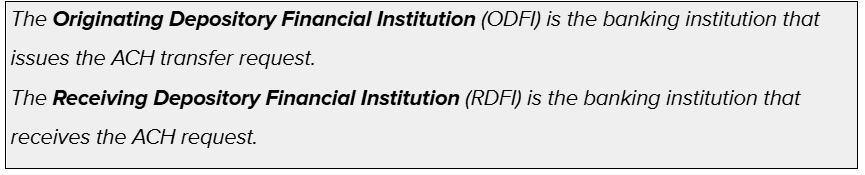
- Batching: The originator's bank (ODFI—Originating Depository Financial Institution) collects and groups multiple ACH requests into batches sent out at scheduled daily intervals.
- Processing: The ACH operator, such as the Federal Reserve or a clearinghouse, receives and sorts the transactions from the originating bank.
- Transaction Delivery: The sorted batch is sent to the recipient's bank, the Receiving Depository Financial Institution (RDFI).
- Finalization: The recipient's bank processes the transaction by debiting or crediting the recipient's account, completing the payment process.
ACH transfers are affordable, particularly for recurring payments or smaller amounts. However, they are slower than SWIFT or wire transfers and are not widely supported internationally.
When Should You Use ACH Payments?
ACH payments are ideal for situations where cost efficiency, security, and recurring payments are needed. They are particularly suited for:
- Recurring Payments: Perfect for automatic payments like utilities, rent, or subscriptions.
- Payroll Processing: Streamlines employee salary distributions for businesses.
Low-Cost Transactions: With lower fees than credit cards, ACH is great for high-volume or large-amount transfers.
- Consumer Bills and Taxes: ACH is commonly used to pay consumer bills, make tax payments, receive tax refunds, and contribute to retirement or investment accounts.
- Commercial and Charity Payments: Ideal for business purchases, charity donations, and university tuition payments.
- Personal Transactions: ACH facilitates fund transfers between family and friends, making it a reliable method for individual transactions.
Examples and Use Cases of ACH
ACH payments are trusted and widely used across various industries for their efficiency, security, and cost-effectiveness.
- Businesses: Employers use ACH for direct deposits, vendor payments, and automated customer billing.
- Individuals: Consumers use ACH for bill payments and peer-to-peer transfers via platforms like PayPal and Venmo.
- Government Agencies: ACH distributes benefits like social security payments and tax refunds.
- Financial Institutions: Banks and credit unions use ACH for account transfers and automated bill payments.
Also Read: How to Find Your ABA Routing Number?
What are the Types of ACH Transfer?
There are two primary types of ACH transfers: ACH credits and ACH debits. The key difference between them is how the funds are transferred.
ACH credits push funds into an account, while ACH debits pull funds out of an account.
1. ACH Debit
An ACH debit is a transaction initiated by the payment receiver, where funds are pulled from the payer's account. For example, when a customer sets up automatic payments for their monthly electricity bill, the merchant initiates an ACH debit to collect the payment directly from their bank account. ACH debit incurs lower fees and is for recurring payments, like bills
The payer provides their routing and account numbers to process an ACH debit.
While slightly less secure than ACH credits, ACH debits are still popular for businesses due to their speed and efficiency.
2. ACH Credit
An ACH credit is an electronic payment initiated by the payer to transfer funds from their account to the payee’s account. It essentially acts as a digital check, eliminating the need for paper checks and bank visits.
Common examples include direct deposits from employers or government benefits and payments for bills or taxes. Known as "push" transactions, ACH credits take 1-2 business days to process. Businesses may also use ACH credits to pay vendors' invoices directly.
ow Long Does it Take to Process ACH Payments?
ACH payments have traditionally been processed over 3 - 4 business days. This time frame includes factors like the time it takes for a bank to send the ACH request, verify available funds, and await acceptance by the receiving bank.
Additionally, many banks process ACH transfers in batches, which may occur only a few times daily, potentially delaying processing if you miss the batch cutoff.
However, with recent improvements, some banks now offer same-day or next-day ACH transfers, reducing the processing time to as little as 1 - 2 business days, provided the payment is submitted before the day's cutoff. According to Nacha, same-day ACH payment volume grew nearly 67.5% in the third quarter of 2024.
Benefits of ACH Transfer for Business
ACH transfers offer businesses a cost-effective, secure, and efficient way to handle payments. Compared to traditional methods, they reduce processing fees, ensure timely transfers, and enhance cash flow management.
- Cost-effective: ACH transfers typically have lower fees than credit cards or wire transfers, making them ideal for high-volume transactions.
- Efficient: Automating recurring payments via ACH reduces manual errors and administrative workload.
- Predictable: ACH payments follow a regular schedule, ensuring steady cash flow for better financial planning.
- Secure: ACH is more secure than checks, reducing fraud risks like theft or forgery by limiting the exposure of sensitive data.
- Faster than checks: While slower than some electronic payments, ACH is quicker than traditional check processing.
- Less paperwork: ACH eliminates the need to handle physical checks, simplify accounting, and supports sustainability efforts.
- Inclusive: ACH works with almost any bank account, even those not eligible for card transactions, expanding your customer base.
- Scalable: ACH grows with your business, handling increased transaction volumes without added complexity or cost.
Limitations of ACH Transfer in Business
While ACH transfers are cost-effective and secure, they come with certain limitations. ACH payments are slower than other payment methods.
- Authorization: ACH rules require explicit customer authorization for transactions, which businesses must maintain accurately to avoid issues.
- Data protection: Businesses must comply with regulations like the Gramm-Leach-bliley Act to protect customer data.
- Fraud risks: ACH payments are vulnerable to fraud, including phishing, requiring businesses to implement strong internal controls and employee training.
- Reversal rules: ACH payments can be reversed in cases of errors or unauthorized transactions, posing a potential risk of business revenue loss if not managed properly.
- Limited international support: Not all banks facilitate international ACH transfers, and some may limit the amount that can be sent internationally.
While ACH payments are limited to domestic transactions and may not support international payments, PayGlocal offers a robust solution for cross-border transactions. As a PCI DSS Level 1 certified platform, PayGlocal ensures the highest security standards for your transactions. In addition to security, PayGlocal provides faster processing times than traditional ACH transfers, with support for multiple currencies and alternative payment methods.
Conclusion
ACH is a crucial part of today’s payment landscape, streamlining and securing transactions for businesses and individuals. By bridging the gap between traditional banking and modern digital payment solutions, ACH enables businesses to manage payments efficiently and cost-effectively, for businesses looking to simplify global payments and ensure smooth, secure transactions.
With seamless integration, multi-currency support, and unparalleled payment success rates, PayGlocal is your go-to platform for all your international payment needs. Get started today!.