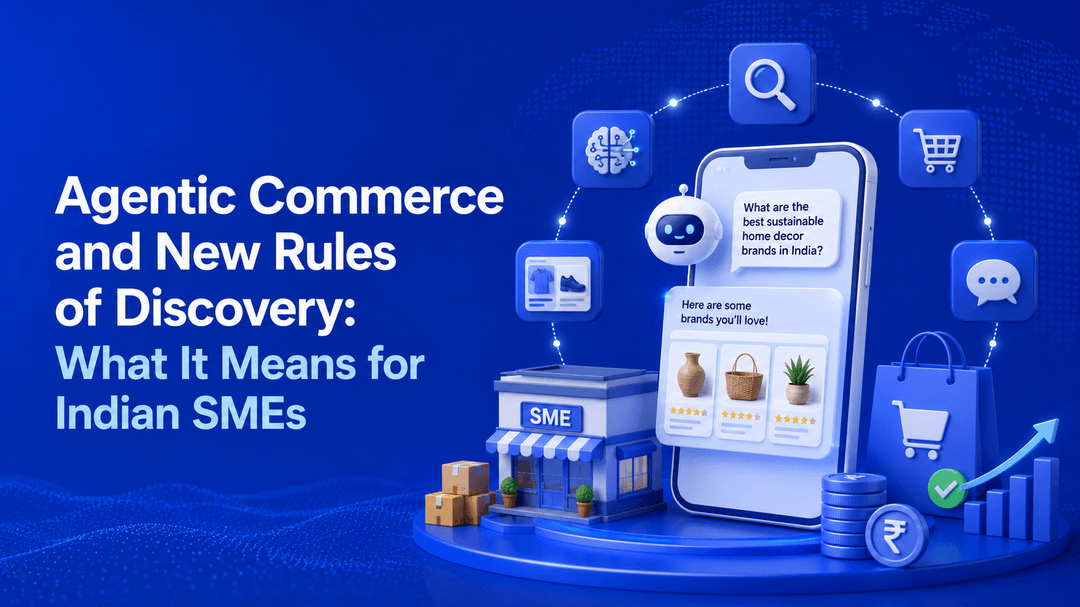

Agentic commerce is changing the rules of online discovery by enabling AI agents to find, evaluate, and purchase products based on intent. For Indian SMEs, it represents a new opportunity to compete globally on quality rather than visibility.
That has been the quiet tax on every ambitious small business: you could build something genuinely better and still lose to a competitor who simply outspent you on visibility.
The product was never the problem. Discovery was.
AI commerce is beginning to change that - and for Indian SMEs selling to the world, the shift is worth understanding early.
Agentic commerce is what happens when AI agents - not just human shoppers clicking through websites - help discover, evaluate, and complete purchases on a person's or a business's behalf.
The important word there is intent. Traditional e-commerce discovery is advertising-driven: whoever pays the most for placement gets seen first. Agentic discovery is intent-driven: whoever best matches the buyer's actual need gets surfaced first. That is a fundamentally different game, and it rewards a different set of things.
When discovery becomes intent-driven instead of advertisement-driven, the playing field changes shape; three things start to matter more than your ad spend:
An AI agent evaluating options on behalf of a buyer isn't swayed by a bigger banner.
It is looking for a genuinely superior product - better specs, better reviews, better value thus becomes an asset the agent can actually detect and act on. For the first time, being good is a distribution strategy, not just a marketing message.
Agents act on structured, accurate, machine-readable information: clear product attributes, honest specifications, real availability, transparent pricing, verifiable credentials. SMEs that keep clean, well-described catalogues and up-to-date information become far more "discoverable" to agents than businesses relying on a persuasive homepage alone. Good data is the new shelf position.
Discovery is only half the story. Once an agent finds you and decides to buy, the transaction has to actually clear — across borders, currencies, and compliance regimes — quickly and reliably.
If your checkout fails, your currency handling is clumsy, or your cross-border payment gets stuck in compliance friction, the sale evaporates no matter how well you were discovered. Infrastructure is where intent becomes revenue.
None of these three is about budget. All of them are about building well. That is precisely why AI commerce is such a meaningful shift for small and mid-sized businesses.
It is easy to get excited about AI commerce and stop at the discovery story. But for an Indian SME selling internationally, discovery is only the front door. The harder, less glamorous work happens after the buyer decides to pay.
A customer in the US, the EU, or the Gulf being matched to your product is a great start. Turning that match into money in your account means handling:
This is the unglamorous plumbing of global commerce. In an agentic world where discovery happens faster and at higher volume, weak plumbing becomes the bottleneck. The businesses that win won't just be found more often - they'll be able to collect on every opportunity, reliably.
This is the layer PayGlocal was built for. As an RBI-authorised cross-border payments company, we help Indian merchants, exporters, SaaS firms, freelancers, and SMEs collect payments from customers in 180+ countries - and help global businesses accept payments from Indian consumers through UPI, cards, and local methods.
The point of the platform is to make the "after discovery" part disappear as a problem:
In other words: if AI commerce is going to reward the quality of your product and data by sending more of the right buyers your way, PayGlocal makes sure your infrastructure is ready to turn that demand into settled, compliant revenue. More than 2,500 businesses - from fast-growing SMEs to platforms like MakeMyTrip - already build on it.
This isn't a solo bet. The wider payments industry is actively building the rails for agentic commerce, from AI-native discovery to agent-initiated transactions. Networks like Mastercard are investing in the standards and tooling that will let intelligent product discovery and agent-led payments operate safely at scale - and PayGlocal is glad to be engaging with that ecosystem as it takes shape.
The takeaway for a small business isn't the branding on the rails. It's the direction: commerce is moving toward a world where being discovered depends less on who shouts loudest and more on who genuinely fits the buyer's intent.
You don't need to wait for the future to arrive to prepare for it:
Treat your product data as a growth asset. Clean, structured, honest, machine-readable product information is what agents act on. Audit your catalogue the way you'd audit your finances.
Make your quality legible. Reviews, specifications, certifications, and clear value propositions are signals agents can use. Don't hide them behind design.
Fix your settlement layer before you scale demand. Success rates, multi-currency support, and cross-border compliance shouldn't be afterthoughts. They're the difference between demand and revenue.
Think globally by default. Intent-driven discovery doesn't respect borders. If your product is good, a buyer three time zones away is as reachable as one down the street - provided you can accept their payment.
For a long time, great products stayed invisible because discovery favoured the biggest budgets. Agentic commerce points toward something better: a future of payments and commerce where the quality of what you build, the honesty of your data, and the strength of your infrastructure decide who wins.
For Indian SMEs with global ambitions, that's not just an interesting trend. It's a genuinely more level playing field - and a future worth building toward.
Picture this. A small business in India makes something extraordinary - a hand-finished textile, a niche SaaS tool, a specialty ingredient. Somewhere across the world, a customer is looking for exactly that. For years, connecting the two came down to who could spend more. More on ads. More to rank higher on search. More to win the bidding war for attention. The quality of the product rarely decided the outcome. The size of the marketing budget did. Today, agentic commerce is completely changing that.
That has been the quiet tax on every ambitious small business: you could build something genuinely better and still lose to a competitor who simply outspent you on visibility.
The product was never the problem. Discovery was.
AI commerce is beginning to change that - and for Indian SMEs selling to the world, the shift is worth understanding early.
What Agentic Commerce actually is
Agentic commerce is what happens when AI agents - not just human shoppers clicking through websites - help discover, evaluate, and complete purchases on a person's or a business's behalf.
Instead of a buyer typing a query into a search bar and wading through sponsored results, an AI agent starts from intent. It understands what the buyer actually needs, searches across sources, compares real attributes - price, quality, availability, delivery terms, compliance - and surfaces the best match. The purchase, and increasingly the payment itself, can be completed in the same flow.
The important word there is intent. Traditional e-commerce discovery is advertising-driven: whoever pays the most for placement gets seen first. Agentic discovery is intent-driven: whoever best matches the buyer's actual need gets surfaced first. That is a fundamentally different game, and it rewards a different set of things.
Why this is good news for SMEs
When discovery becomes intent-driven instead of advertisement-driven, the playing field changes shape; three things start to matter more than your ad spend:
1. The quality of your product.
An AI agent evaluating options on behalf of a buyer isn't swayed by a bigger banner.
It is looking for a genuinely superior product - better specs, better reviews, better value thus becomes an asset the agent can actually detect and act on. For the first time, being good is a distribution strategy, not just a marketing message.
2. The quality of your data.
Agents act on structured, accurate, machine-readable information: clear product attributes, honest specifications, real availability, transparent pricing, verifiable credentials. SMEs that keep clean, well-described catalogues and up-to-date information become far more "discoverable" to agents than businesses relying on a persuasive homepage alone. Good data is the new shelf position.
3. The quality of your infrastructure.
Discovery is only half the story. Once an agent finds you and decides to buy, the transaction has to actually clear — across borders, currencies, and compliance regimes — quickly and reliably.
If your checkout fails, your currency handling is clumsy, or your cross-border payment gets stuck in compliance friction, the sale evaporates no matter how well you were discovered. Infrastructure is where intent becomes revenue.
None of these three is about budget. All of them are about building well. That is precisely why AI commerce is such a meaningful shift for small and mid-sized businesses.
The Catch: Discovery is worthless without settlement
It is easy to get excited about AI commerce and stop at the discovery story. But for an Indian SME selling internationally, discovery is only the front door. The harder, less glamorous work happens after the buyer decides to pay.
A customer in the US, the EU, or the Gulf being matched to your product is a great start. Turning that match into money in your account means handling:
- Payment success rates across unfamiliar issuing banks and payment methods, so approved buyers don't fail at checkout.
- Multiple currencies and local payment preferences, so international customers can pay the way they expect to.
- Cross-border compliance — RBI mandates, FIRA and EDPMS documentation, sanctions screening — handled inside the flow rather than as a month-end scramble.
- Fraud and risk checks that protect you without silently rejecting good customers.
This is the unglamorous plumbing of global commerce. In an agentic world where discovery happens faster and at higher volume, weak plumbing becomes the bottleneck. The businesses that win won't just be found more often - they'll be able to collect on every opportunity, reliably.
Where PayGlocal fits
This is the layer PayGlocal was built for. As an RBI-authorised cross-border payments company, we help Indian merchants, exporters, SaaS firms, freelancers, and SMEs collect payments from customers in 180+ countries - and help global businesses accept payments from Indian consumers through UPI, cards, and local methods.
The point of the platform is to make the "after discovery" part disappear as a problem:
- Higher transaction success rates through intelligent routing, so more approved buyers actually convert.
- Multi-currency acceptance and alternate payment methods, so international customers pay in the way that's natural to them.
- Compliance built into the payment flow - FIRA, EDPMS, sanctions screening - so growing globally doesn't mean drowning in paperwork.
- Fraud monitoring and risk tooling that protect revenue without punishing legitimate customers.
In other words: if AI commerce is going to reward the quality of your product and data by sending more of the right buyers your way, PayGlocal makes sure your infrastructure is ready to turn that demand into settled, compliant revenue. More than 2,500 businesses - from fast-growing SMEs to platforms like MakeMyTrip - already build on it.
Direction of the Industry
This isn't a solo bet. The wider payments industry is actively building the rails for agentic commerce, from AI-native discovery to agent-initiated transactions. Networks like Mastercard are investing in the standards and tooling that will let intelligent product discovery and agent-led payments operate safely at scale - and PayGlocal is glad to be engaging with that ecosystem as it takes shape.
The takeaway for a small business isn't the branding on the rails. It's the direction: commerce is moving toward a world where being discovered depends less on who shouts loudest and more on who genuinely fits the buyer's intent.
What SMEs can do now
You don't need to wait for the future to arrive to prepare for it:
Treat your product data as a growth asset. Clean, structured, honest, machine-readable product information is what agents act on. Audit your catalogue the way you'd audit your finances.
Make your quality legible. Reviews, specifications, certifications, and clear value propositions are signals agents can use. Don't hide them behind design.
Fix your settlement layer before you scale demand. Success rates, multi-currency support, and cross-border compliance shouldn't be afterthoughts. They're the difference between demand and revenue.
Think globally by default. Intent-driven discovery doesn't respect borders. If your product is good, a buyer three time zones away is as reachable as one down the street - provided you can accept their payment.
The future of commerce is a fairer one
For a long time, great products stayed invisible because discovery favoured the biggest budgets. Agentic commerce points toward something better: a future of payments and commerce where the quality of what you build, the honesty of your data, and the strength of your infrastructure decide who wins.
For Indian SMEs with global ambitions, that's not just an interesting trend. It's a genuinely more level playing field - and a future worth building toward.