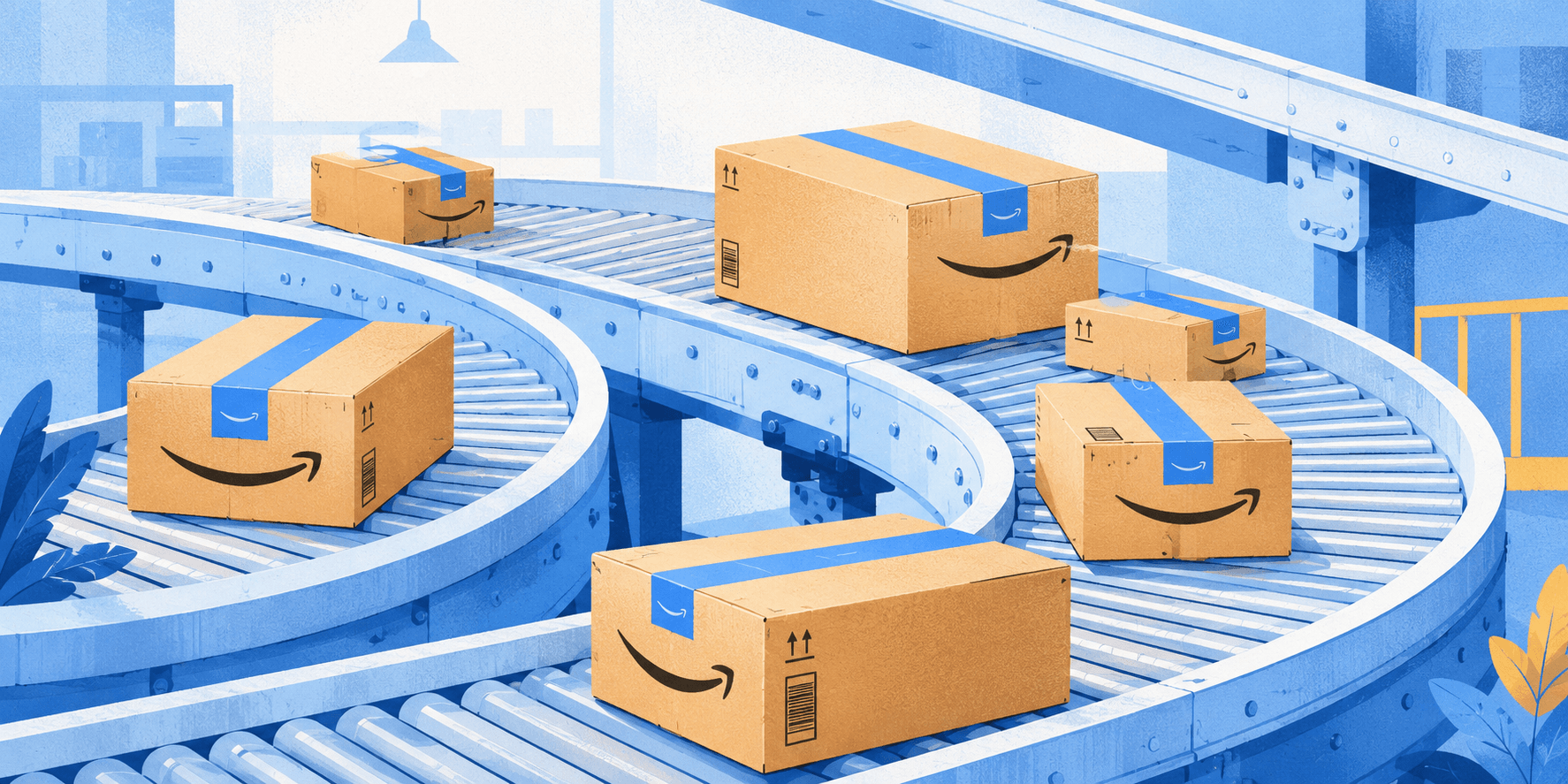

Every day, millions of products move through Amazon's fulfillment centers before reaching customers worldwide. Whether you're an Amazon FBA seller, an exporter, or simply curious about how Amazon delivers millions of orders so quickly, understanding how its global fulfillment network works gives you a clearer picture of modern ecommerce logistics.
This guide explains what Amazon fulfillment centers are, how Amazon chooses their locations, and why they matter for businesses selling internationally.
This guide explains what Amazon fulfillment centers are, how Amazon chooses their locations, and why they matter for businesses selling internationally.
TL;DR
- Amazon fulfillment centers are large warehouses that store, pack, and ship products, and they are the engine behind Amazon's fast, reliable delivery.
- The global network spans North America, Europe, Asia-Pacific, and beyond, with sites chosen for proximity to customers, transport links, labour, cost, and demand.
- For sellers, this network powers Fulfilment by Amazon (FBA). If you sell across borders, your payments infrastructure needs to keep pace with your logistics.
What are Amazon fulfillment centers?
Order something on Amazon in the morning and it can arrive the same day. That speed is not magic; it is a network of warehouses positioned close to where customers live. Those warehouses are Amazon's fulfillment centers.
Amazon fulfillment centers are large-scale warehouses where Amazon stores, processes, and ships products to customers. They are the foundation of Amazon's logistics, and the reason it can promise fast, dependable delivery across the world.
A few features define how they work:
- Strategic locations near major urban areas, which cut shipping time and cost.
- Advanced technology, with robotics, AI, and machine learning driving sorting, packing, and inventory management.
- High storage capacity, designed to hold huge volumes of products across many categories.
- Optimised operations across receiving, stowing, picking, packing, and shipping for rapid order fulfilment.
- Integration with FBA, so third-party sellers can store products and use Amazon's logistics to fulfil orders.
Their role in Amazon's supply chain
Fulfillment centers are the backbone of Amazon's supply chain, tying together everything from inventory to the moment a parcel reaches a doorstep. Their main jobs:
- Centralised inventory management. They act as hubs holding both Amazon's own stock and third-party sellers' products, keeping items accessible for quick processing and shorter delivery times.
- Speedy order fulfilment. Automation and AI accelerate picking, packing, and dispatch, which is what makes same-day and two-day delivery possible.
- Efficient shipping and distribution. Sited near major population centres, they shorten routes, cut costs, and lift customer satisfaction.
- Support for FBA. They let third-party sellers offload warehousing and shipping to Amazon and reach its global customer base.
- Reverse logistics for returns. They handle inspection, restocking, or disposal of returned goods, underpinning Amazon's customer-friendly returns.
- Flexibility across product types. They manage everything from small consumer goods to bulky furniture, giving the network versatility.
The net effect is a supply chain that moves stock closer to demand, so orders travel a shorter distance and arrive faster.
How Amazon chooses fulfillment center locations
Amazon does not place warehouses at random. Each site balances several factors that together shape cost, speed, and reliability:
- Proximity to major urban centres, for faster delivery and expedited options like same-day shipping.
- Access to transport infrastructure, including highways, ports, railroads, and airports for reliable domestic and international movement.
- Availability of skilled labour, since these centres need a large workforce for sorting, packing, and shipping.
- Real estate costs, favouring locations where large warehouse space is economically feasible.
- Local tax incentives, which governments often offer to attract large employers and which lower Amazon's operating costs.
- Customer demand in the region, assessed through data analytics on purchasing patterns and demand density.
- Sustainability considerations, with growing weight on renewable energy access, green building certifications, and a lower carbon footprint.
The same logic that puts a warehouse near its customers applies to payments: meeting local customer preferences matters, which is why offering payment in local currencies can be as important to a cross-border seller as fast shipping.
Where Amazon's fulfillment centers are located
Amazon operates one of the largest logistics networks in the world, with fulfillment centers spread across every major region. Rather than list individual facilities (Amazon opens, relocates, and closes sites frequently, so any fixed address list dates quickly), here is how the network is distributed. For live, exact facility details, Amazon's Seller Central and official site are the authoritative sources.
North America. The densest part of the network. The United States has fulfillment centers clustered around major metro and logistics hubs, including Arizona, California, Texas, New Jersey, and Pennsylvania. Canada concentrates around Alberta, British Columbia, and Ontario, and Mexico has a cluster near Mexico City.
South America. Brazil is the regional anchor, with centers serving the São Paulo, Rio de Janeiro, Minas Gerais, and other state markets, and Amazon has been expanding its footprint there. Colombia has fulfillment presence around Bogotá.
Europe. A mature, well-connected network across the United Kingdom (sites around the Midlands and Milton Keynes corridor), Germany (one of Amazon's largest European footprints), France, Spain, and Italy, linked by strong cross-border logistics.
Asia-Pacific. Japan has centers serving the Tokyo, Osaka, and Chiba regions; India operates fulfillment centers across major metros including Hyderabad, Bengaluru, and Mumbai; and Amazon has facilities across major Chinese cities and in Singapore as a regional hub.
Australia. A growing network centred on Sydney and Melbourne.
Africa. An emerging region for Amazon, with South African fulfillment presence around Johannesburg and Cape Town following Amazon's marketplace launch there.
Challenges and what comes next
The network is powerful, but not without strain, and its direction of travel is worth understanding.
Current challenges:
- High operational costs across labour, technology, and real estate, which pressure margins in high-demand regions.
- Labour shortages and turnover, especially in competitive job markets, which can dent efficiency.
- Sustainability scrutiny, over energy use, packaging waste, and emissions.
- Supply chain disruptions, from pandemics to geopolitical tension, that can delay inbound stock or outbound orders.
- Automation trade-offs, where advanced robotics improve throughput but add cost, failure points, and technological dependence.
Where it is heading:
- More automation, with robotics and AI driving faster, more precise fulfilment.
- Expansion into emerging markets, particularly across Africa and Latin America.
- Sustainability investment, in renewable energy and greener packaging.
- Smarter inventory placement, using predictive analytics to stock products closer to demand.
- Last-mile innovation, including drones, autonomous vehicles, and local delivery hubs.
What this means for cross-border sellers
If you sell through Amazon across borders, this network is what carries your product to the customer. The logistics side is largely handled for you through FBA. The part that stays yours to solve is getting paid.
When you sell into multiple countries, your money comes back in multiple currencies, through marketplace payouts, and with its own compliance and reconciliation overhead. That is where your payments setup has to be as deliberate as Amazon's warehouse placement. A [cross-border payments partner](/multi-currency-accounts) that lets you collect across currencies, settle in INR, and keep clean remittance documentation means your payments keep pace with your fulfilment, instead of becoming the bottleneck.
CTA: Selling on Amazon globally? See how PayGlocal helps you get paid across currencies