
A poorly integrated payment gateway leads to abandoned carts, lost sales, and declining revenue. These are not edge cases; they’re everyday risks for e-commerce businesses that rely on outdated or fragmented payment gateway systems.
Today’s buyers expect fast, secure, and seamless checkout experiences. And with global e-commerce payments projected to grow from $7.48 trillion in 2025 to $19.49 trillion by 2034 (CAGR of 11.22%), the pressure to modernize is only increasing.
Choosing the right payment gateway isn’t just a technical decision; it’s a growth lever. It streamlines checkout, improves customer trust, and directly impacts your bottom line.
An e-commerce payment gateway is a core technology that securely connects your online transactions with payment processors like Payglocal, RazorPay, etc. and banks, enabling safe and efficient cashless transactions. It encrypts and transmits sensitive data (like credit card details) between customers and merchants, safeguarding both parties from fraud.
Here’s why it matters:
An e-commerce payment gateway is your business’s trusted partner in securing and speeding up online payments.
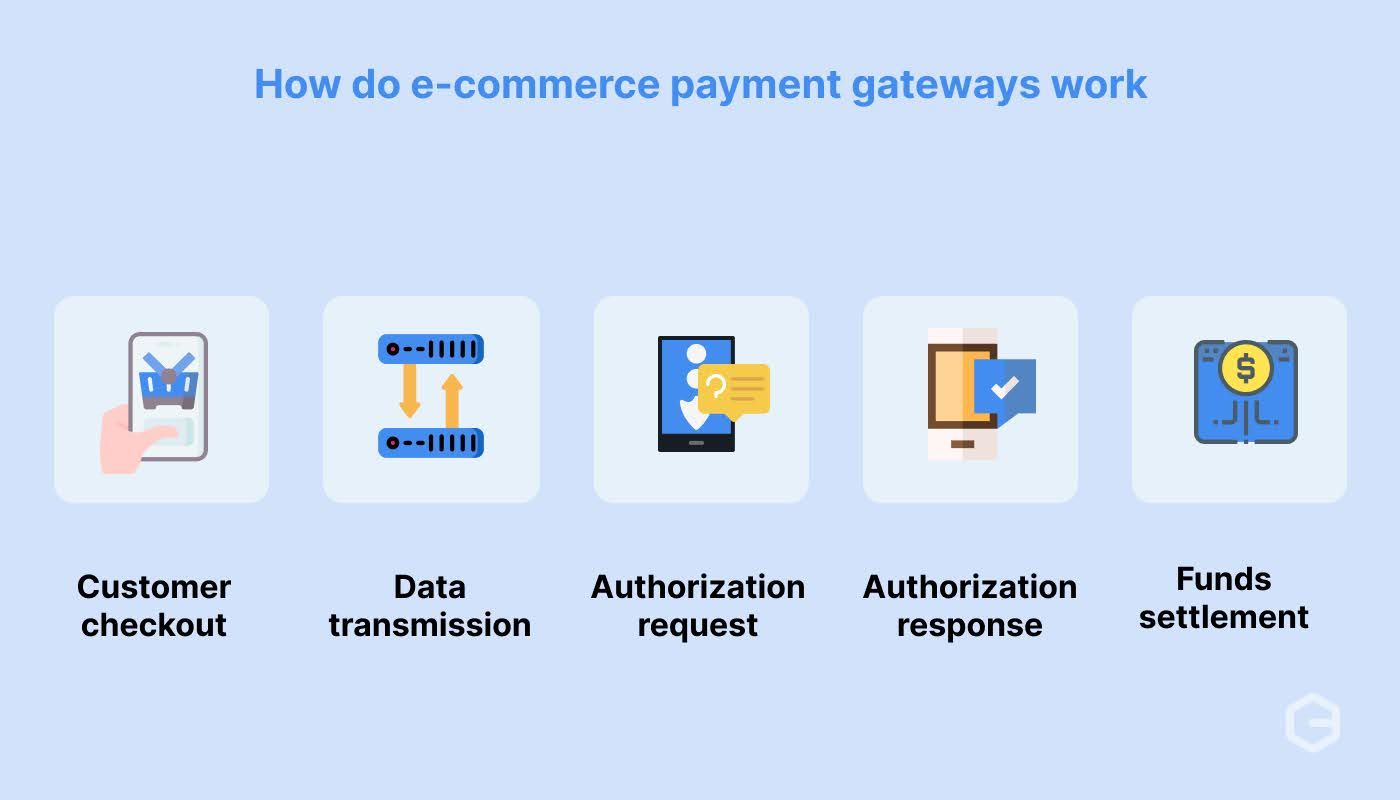
When a customer pays online, the payment gateway acts as the secure link between your website and the banks that handle the money. Here’s the process in simple steps:
1. Customer checkout
When customers select products and proceed to checkout, they enter their payment details (like credit card info) on your e-commerce website’s secure payment page. The site uses SSL encryption to protect this sensitive information.
2. Data transmission to the payment gateway
The encrypted payment details are sent securely to your payment gateway provider. The gateway acts as a secure bridge between your website and the payment processor.
3. Authorization request
The payment gateway forwards the transaction details to the payment processor, which is often your bank's acquiring processor. The processor then contacts the customer's card network or bank to verify whether funds are available and the transaction is legitimate. This verification process is a key step in ensuring the security and validity of the transaction.
4. Authorization response
The customer’s bank approves or declines the transaction and sends a response back through the card network to the payment processor, then to the payment gateway. This approval or decline is communicated to your website and the customer almost instantly (usually within 2-3 seconds).
5. Funds settlement
If approved, the payment processor batches transactions and transfers funds to your merchant account (a special account for holding payments before final deposit). The money then moves to your business bank account within 1-3 business days.
Note: Payment gateways charge fees for transactions, so it's important to factor in these costs when setting prices.
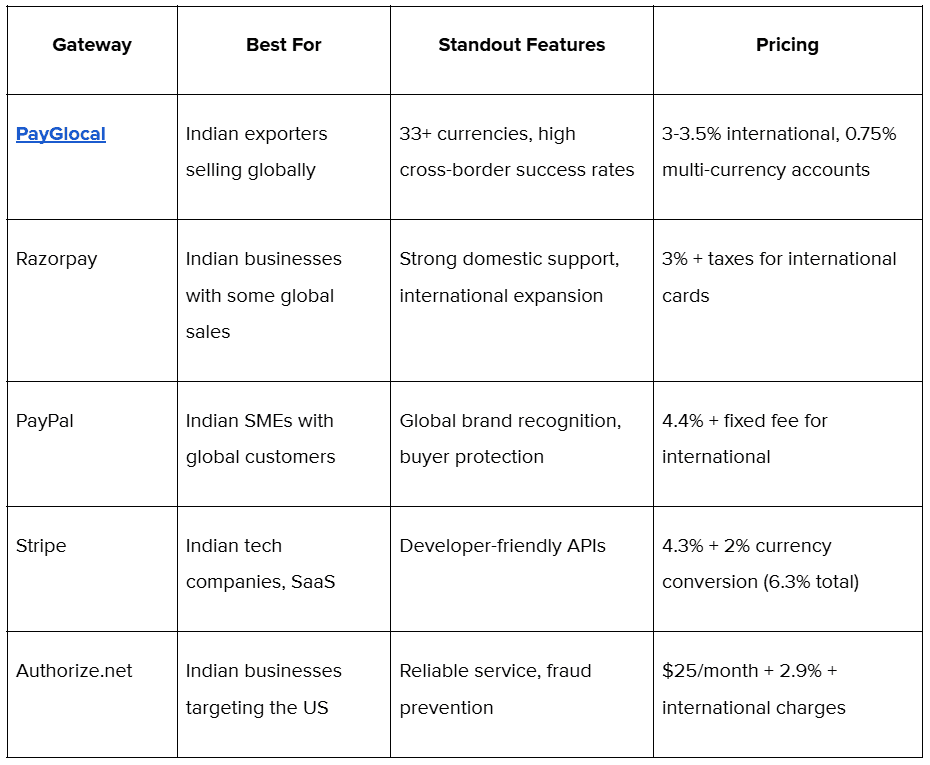
PayGlocal is a top e-commerce payment gateway that meets the needs of global businesses. It supports over 33 currencies, enabling Indian platforms to provide familiar payment options to customers in the US, Europe, and Southeast Asia.
Key features include:
Accepted payment methods: PayGlocal supports all major international credit and debit cards, including Visa, MasterCard, American Express, and Discover. The platform accepts payments in 33+ currencies from over 180 countries, making it ideal for global businesses.
Integration and ease of use: PayGlocal offers simple API integration with comprehensive documentation. The platform integrates with popular e-commerce platforms and provides dynamic checkout solutions that can be customized to match your brand.
Best for: Indian e-commerce businesses selling internationally, exporters, freelancers with global clients, and companies needing strong compliance features.
Pricing: 3-3.5% for international card transactions, 0.75% for multi-currency accounts, with 18% GST applicable. No extra monthly charges.
Razorpay is India's leading payment gateway that has expanded to support international transactions. While primarily known for domestic payments, Razorpay now enables Indian businesses to accept payments from global customers in over 100 currencies.
Key features:
Transparent pricing: No hidden FX markups or setup fees for international transactions.
Accepted payment methods: Razorpay supports major international credit and debit cards, UPI for domestic transactions, and various Indian digital wallets. For international transactions, it accepts payments in 100+ currencies from Visa, MasterCard, and American Express.
Integration and ease of use: Razorpay offers comprehensive APIs, plugins for major e-commerce platforms, and no-code solutions. The integration process is designed for Indian businesses with local support and documentation in multiple Indian languages.
Best for: Indian businesses that primarily serve domestic customers but want to expand internationally while maintaining strong local payment capabilities.
Pricing: 3% + 18% GST for international card transactions. PayPal transactions processed through Razorpay follow PayPal's own pricing structure.
PayPal’s Payflow supports a variety of payment options, including credit and debit cards, making it a flexible choice for both local and international transactions. While PayPal is well-established in the market, its standard pricing structure and additional service fees may not always be the most cost-effective for growing businesses.
Key features include:
Accepted payment methods: PayPal supports major international credit and debit cards, PayPal wallet payments, and Pay in 4 installment options. It accepts payments in 100+ currencies, making it suitable for Indian businesses selling globally.
Integration and ease of use: PayPal offers multiple integration options from simple payment buttons to advanced APIs. Indian businesses can easily set up international payment collection with minimal documentation requirements.
Best for: Indian small and medium enterprises and small businesses selling to global consumers who trust the PayPal brand, especially in North America and Europe.
Pricing: 4.4% + fixed fee per transaction for international payments, with currency conversion charges applying for foreign currency transactions.
Stripe is a popular payment gateway for mobile commerce, non-profits, and platforms. It is ideal for Indian online stores selling internationally, as well as for subscription-based and marketplace businesses. With support for over 135 currencies in 46 countries, it enables smooth cross-border payments.
Key features include:
Did You Know?
Starting May 2024, Stripe’s India operations moved to an invite-only model. To join, you’ll need to request an invite and await approval, making it a bit more exclusive compared to direct sign-ups.
Accepted payment methods: Stripe supports 135+ currencies and hundreds of international payment methods, including cards, digital wallets, bank transfers, and buy-now-pay-later options across different regions.
Integration and ease of use: Stripe requires more technical knowledge but offers extensive documentation. Indian businesses can integrate globally accepted payment methods with detailed API support and compliance tools.
Best for: Indian technology companies, SaaS businesses, marketplaces, and any business needing highly customized international payment flows.
Pricing: 4.3% processing fee + 2% currency conversion fee (total 6.3%) for international transactions to Indian businesses.
Authorize. net, a wholly owned subsidiary of Visa, is one of the oldest payment gateways that supports online, in-person, and manual payments. It offers features like virtual terminals, virtual POS, and automated recurring payments to help manage subscriptions and regular billing efficiently.
Key features include:
Accepted payment methods: Authorize. net accepts major international credit and debit cards, and some digital wallet payments. It primarily focuses on card-based transactions for global markets.
Integration and ease of use: Authorize. net requires setting up a US merchant account, which can be complex for Indian businesses. However, once established, it provides reliable international payment processing.
Best for: Established Indian businesses primarily targeting the US market and need reliable, traditional payment processing with strong fraud prevention.
Pricing: $25 monthly gateway fee plus 2.9% + $0.30 per transaction, with additional international surcharges and currency conversion fees.
Choosing the best e-commerce payment gateway isn’t just about fees; it’s about enhancing the customer experience and scaling your business.
Payment Processing Fees: Most gateways charge a percentage per transaction plus a fixed monthly fee. For example, selling a ₹4,000 product with a 3% fee means losing about ₹120 per sale, which adds up at scale. Identify payment gateways like PayGlocal that charge only when there’s a transaction.
Security Features: Look for PCI DSS compliance and features like SSL encryption, fraud detection, 3D Secure authentication, and chargeback protection to safeguard customer payment data.
Pro Tip: Choosing a payment gateway with low fees but high security and fraud detection costs can end up costing you more. Always balance pricing with robust fraud protection to safeguard your business and avoid unexpected expenses.
Payment Methods & Compatibility: Choose gateways that support multiple payment options, such as major credit/debit cards, e-wallets, BNPL, and contactless methods (Apple Pay, Google Pay). Check if the gateway can seamlessly integrate with your e-commerce platform via API.
International Payment Support: Select gateways that handle multiple currencies and international payments. Be mindful of currency conversion fees, since accepting payments in USD, GBP, or AUD may incur charges when funds are converted to INR.
Scalability & Support: Find a gateway that can handle increased transaction volumes as your business scales and provide quick and robust customer support to ensure uninterrupted sales.
Merchant Account Considerations: Some gateways require setting up your merchant account, which can involve setup fees and delays. Others offer aggregated merchant accounts that save time and money but may charge higher transaction fees. Choose based on your business size and transaction volume.
User Experience: A smooth, easy-to-use payment interface reduces cart abandonment and improves conversions. It also helps your business benefit from detailed transaction reports to analyze sales and detect fraud.
Local Payment Methods: Support for regional payment options increases trust and sales. For example, Alipay and WeChat Pay dominate China, while Trustly is popular in the Nordic countries. Select gateways that integrate several local payment methods for broader reach.
Choosing the right e-commerce payment gateway is essential to your business’s success. By ensuring secure payments, providing global coverage, and offering a seamless checkout experience, you’ll keep customers satisfied and transactions running smoothly.
With platforms like PayGlocal, you can optimize cross-border payments, increase conversions, and grow your e-commerce business with confidence. If managing complex payment systems and cross-border transactions feels overwhelming, PayGlocal offers a secure, cost-effective, unified platform tailored to simplify global payments.
With seamless checkout options and robust security features, PayGlocal ensures smooth payment processing and a superior customer experience.
Ready to experience hassle-free payment processing and accelerate your e-commerce growth?
Visit PayGlocal today to take control of your global payments with confidence.
Today’s buyers expect fast, secure, and seamless checkout experiences. And with global e-commerce payments projected to grow from $7.48 trillion in 2025 to $19.49 trillion by 2034 (CAGR of 11.22%), the pressure to modernize is only increasing.
Choosing the right payment gateway isn’t just a technical decision; it’s a growth lever. It streamlines checkout, improves customer trust, and directly impacts your bottom line.
Key takeaways
- E-commerce payment gateways process online transactions between customers and merchants securely.
- The best gateways offer high approval rates, multiple payment methods, and transparent pricing.
- Platforms like PayGlocal stand out for international transactions with support for 33+ currencies.
- Consider your business size, target markets, and integration needs when choosing a gateway.
What is an e-commerce payment gateway?
An e-commerce payment gateway is a core technology that securely connects your online transactions with payment processors like Payglocal, RazorPay, etc. and banks, enabling safe and efficient cashless transactions. It encrypts and transmits sensitive data (like credit card details) between customers and merchants, safeguarding both parties from fraud.
Here’s why it matters:
- Secure Data Transmission: Protects customer payment information with encryption.
- Supports Multiple Payment Methods: Enables you to accept credit/debit cards, UPI, wallets, and more.
- Multi-Currency Capability: Key for businesses selling internationally.
- Advanced Features: Fraud prevention tools and transaction analytics help manage payments efficiently.
An e-commerce payment gateway is your business’s trusted partner in securing and speeding up online payments.
How do e-commerce payment gateways work?
When a customer pays online, the payment gateway acts as the secure link between your website and the banks that handle the money. Here’s the process in simple steps:
1. Customer checkout
When customers select products and proceed to checkout, they enter their payment details (like credit card info) on your e-commerce website’s secure payment page. The site uses SSL encryption to protect this sensitive information.
2. Data transmission to the payment gateway
The encrypted payment details are sent securely to your payment gateway provider. The gateway acts as a secure bridge between your website and the payment processor.
3. Authorization request
The payment gateway forwards the transaction details to the payment processor, which is often your bank's acquiring processor. The processor then contacts the customer's card network or bank to verify whether funds are available and the transaction is legitimate. This verification process is a key step in ensuring the security and validity of the transaction.
4. Authorization response
The customer’s bank approves or declines the transaction and sends a response back through the card network to the payment processor, then to the payment gateway. This approval or decline is communicated to your website and the customer almost instantly (usually within 2-3 seconds).
5. Funds settlement
If approved, the payment processor batches transactions and transfers funds to your merchant account (a special account for holding payments before final deposit). The money then moves to your business bank account within 1-3 business days.
Note: Payment gateways charge fees for transactions, so it's important to factor in these costs when setting prices.
What are the top payment gateways for e-commerce businesses in India?
1. PayGlocal
PayGlocal is a top e-commerce payment gateway that meets the needs of global businesses. It supports over 33 currencies, enabling Indian platforms to provide familiar payment options to customers in the US, Europe, and Southeast Asia.
Key features include:
- Dynamic Checkout Experience: PayGlocal offers a highly customizable, fast, and secure checkout process designed to reduce cart abandonment. Its dynamic checkout adapts to different customer preferences.
- Supports Multiple Payment Methods: It supports various payment methods, including global cards, and 40+ local payment methods, such as GrabPay, Giropay, Klarna, Trustly, etc., enhancing customer trust and conversion rates.
- Fraud Prevention: With end-to-end encryption, embedded fraud prevention tools, and a zero-knowledge privacy-first architecture, PayGlocal prioritizes safeguarding sensitive payment data.
- Advanced Security: The built-in risk engine actively screens transactions to reduce fraud and chargebacks, a significant pain point for e-commerce platforms dealing with cross-border sales.
- Seamless Integration: PayGlocal integrates smoothly with your existing tech stack and platforms, ensuring minimal disruption. Its API-first approach allows easy implementation and supports ongoing updates without affecting business continuity.
- Compliance and Trust: PayGlocal meets stringent regulatory standards, including KYC and AML compliance. This gives your business and customers confidence in a secure and compliant payment ecosystem.
- Higher Approval Rates: PayGlocal's orchestration engine intelligently routes payments through multiple acquiring banks, ensuring higher approval rates even in challenging international markets. This directly addresses concerns about payment failures and boosts overall revenue.
- Pay-As-You-Go Pricing: There are no fixed charges, setup, monthly, or hidden fees. You pay only when your customers transact. You also have the option to create a custom pricing suited to your business needs and payment volumes.
Accepted payment methods: PayGlocal supports all major international credit and debit cards, including Visa, MasterCard, American Express, and Discover. The platform accepts payments in 33+ currencies from over 180 countries, making it ideal for global businesses.
Integration and ease of use: PayGlocal offers simple API integration with comprehensive documentation. The platform integrates with popular e-commerce platforms and provides dynamic checkout solutions that can be customized to match your brand.
Best for: Indian e-commerce businesses selling internationally, exporters, freelancers with global clients, and companies needing strong compliance features.
Pricing: 3-3.5% for international card transactions, 0.75% for multi-currency accounts, with 18% GST applicable. No extra monthly charges.
2. Razorpay
Razorpay is India's leading payment gateway that has expanded to support international transactions. While primarily known for domestic payments, Razorpay now enables Indian businesses to accept payments from global customers in over 100 currencies.
Key features:
- Domestic strength: Leading position in the Indian payment market with comprehensive local payment support.
- International expansion: Growing capabilities for cross-border transactions with multiple currency support.
- Real-time conversion: Currency conversion at interbank rates with automatic settlement in INR.
Transparent pricing: No hidden FX markups or setup fees for international transactions.
- Integrated platform: Complete payment stack including invoicing, subscriptions, and marketplace solutions.
Accepted payment methods: Razorpay supports major international credit and debit cards, UPI for domestic transactions, and various Indian digital wallets. For international transactions, it accepts payments in 100+ currencies from Visa, MasterCard, and American Express.
Integration and ease of use: Razorpay offers comprehensive APIs, plugins for major e-commerce platforms, and no-code solutions. The integration process is designed for Indian businesses with local support and documentation in multiple Indian languages.
Best for: Indian businesses that primarily serve domestic customers but want to expand internationally while maintaining strong local payment capabilities.
Pricing: 3% + 18% GST for international card transactions. PayPal transactions processed through Razorpay follow PayPal's own pricing structure.
3. PayPal
PayPal’s Payflow supports a variety of payment options, including credit and debit cards, making it a flexible choice for both local and international transactions. While PayPal is well-established in the market, its standard pricing structure and additional service fees may not always be the most cost-effective for growing businesses.
Key features include:
- Global customer trust - Buyers worldwide recognize and feel secure using PayPal, which reduces cart abandonment for international sales.
- Built-in dispute protection - Automatic buyer and seller protection programs handle payment disputes without requiring manual intervention.
- Quick international setup - Indian businesses can start accepting global payments within hours using simple integration options.
- Multiple payment options - Supports credit cards, PayPal wallets, and installment payments to match customer preferences across regions.
- Wide currency acceptance - Accepts payments in 100+ currencies with automatic conversion, making it easy for customers worldwide to pay in their local money.
Accepted payment methods: PayPal supports major international credit and debit cards, PayPal wallet payments, and Pay in 4 installment options. It accepts payments in 100+ currencies, making it suitable for Indian businesses selling globally.
Integration and ease of use: PayPal offers multiple integration options from simple payment buttons to advanced APIs. Indian businesses can easily set up international payment collection with minimal documentation requirements.
Best for: Indian small and medium enterprises and small businesses selling to global consumers who trust the PayPal brand, especially in North America and Europe.
Pricing: 4.4% + fixed fee per transaction for international payments, with currency conversion charges applying for foreign currency transactions.
4. Stripe
Stripe is a popular payment gateway for mobile commerce, non-profits, and platforms. It is ideal for Indian online stores selling internationally, as well as for subscription-based and marketplace businesses. With support for over 135 currencies in 46 countries, it enables smooth cross-border payments.
Key features include:
- Developer-first design: Extensive APIs and documentation allow tech teams to build custom payment flows that match exact business requirements.
- Global payment methods: Supports hundreds of local payment options worldwide, helping you accept payments in the way customers prefer in each region.
- Advanced subscription billing: Built-in tools for recurring charges, usage-based pricing, and complex billing scenarios that SaaS companies need.
- Real-time payment insights: Detailed analytics and reporting help identify payment trends and optimize conversion rates across different markets.
- Marketplace-ready features: Split payment functionality allows platforms to distribute money between multiple sellers and collect fees automatically.
Did You Know?
Starting May 2024, Stripe’s India operations moved to an invite-only model. To join, you’ll need to request an invite and await approval, making it a bit more exclusive compared to direct sign-ups.
Accepted payment methods: Stripe supports 135+ currencies and hundreds of international payment methods, including cards, digital wallets, bank transfers, and buy-now-pay-later options across different regions.
Integration and ease of use: Stripe requires more technical knowledge but offers extensive documentation. Indian businesses can integrate globally accepted payment methods with detailed API support and compliance tools.
Best for: Indian technology companies, SaaS businesses, marketplaces, and any business needing highly customized international payment flows.
Pricing: 4.3% processing fee + 2% currency conversion fee (total 6.3%) for international transactions to Indian businesses.
5. Authorize. net
Authorize. net, a wholly owned subsidiary of Visa, is one of the oldest payment gateways that supports online, in-person, and manual payments. It offers features like virtual terminals, virtual POS, and automated recurring payments to help manage subscriptions and regular billing efficiently.
Key features include:
- Proven stability: Over 20 years of consistent service with minimal downtime helps ensure your payment processing stays reliable during peak sales periods.
- Advanced fraud screening: Multiple layers of fraud detection reduce chargebacks and protect revenue from suspicious international transactions.
- US market focus: Deep integration with American banking systems and payment preferences makes it ideal for targeting US customers.
- Flexible recurring billing: Supports complex subscription models, installment plans, and automated retry logic for failed payments.
- Enterprise-grade support: Dedicated account management and 24/7 technical support help resolve payment issues quickly during critical business moments.
Accepted payment methods: Authorize. net accepts major international credit and debit cards, and some digital wallet payments. It primarily focuses on card-based transactions for global markets.
Integration and ease of use: Authorize. net requires setting up a US merchant account, which can be complex for Indian businesses. However, once established, it provides reliable international payment processing.
Best for: Established Indian businesses primarily targeting the US market and need reliable, traditional payment processing with strong fraud prevention.
Pricing: $25 monthly gateway fee plus 2.9% + $0.30 per transaction, with additional international surcharges and currency conversion fees.
How do you choose the best e-commerce payment gateway for your online marketplace?
Choosing the best e-commerce payment gateway isn’t just about fees; it’s about enhancing the customer experience and scaling your business.
Payment Processing Fees: Most gateways charge a percentage per transaction plus a fixed monthly fee. For example, selling a ₹4,000 product with a 3% fee means losing about ₹120 per sale, which adds up at scale. Identify payment gateways like PayGlocal that charge only when there’s a transaction.
Security Features: Look for PCI DSS compliance and features like SSL encryption, fraud detection, 3D Secure authentication, and chargeback protection to safeguard customer payment data.
Pro Tip: Choosing a payment gateway with low fees but high security and fraud detection costs can end up costing you more. Always balance pricing with robust fraud protection to safeguard your business and avoid unexpected expenses.
Payment Methods & Compatibility: Choose gateways that support multiple payment options, such as major credit/debit cards, e-wallets, BNPL, and contactless methods (Apple Pay, Google Pay). Check if the gateway can seamlessly integrate with your e-commerce platform via API.
International Payment Support: Select gateways that handle multiple currencies and international payments. Be mindful of currency conversion fees, since accepting payments in USD, GBP, or AUD may incur charges when funds are converted to INR.
Scalability & Support: Find a gateway that can handle increased transaction volumes as your business scales and provide quick and robust customer support to ensure uninterrupted sales.
Merchant Account Considerations: Some gateways require setting up your merchant account, which can involve setup fees and delays. Others offer aggregated merchant accounts that save time and money but may charge higher transaction fees. Choose based on your business size and transaction volume.
User Experience: A smooth, easy-to-use payment interface reduces cart abandonment and improves conversions. It also helps your business benefit from detailed transaction reports to analyze sales and detect fraud.
Local Payment Methods: Support for regional payment options increases trust and sales. For example, Alipay and WeChat Pay dominate China, while Trustly is popular in the Nordic countries. Select gateways that integrate several local payment methods for broader reach.
Conclusion
Choosing the right e-commerce payment gateway is essential to your business’s success. By ensuring secure payments, providing global coverage, and offering a seamless checkout experience, you’ll keep customers satisfied and transactions running smoothly.
With platforms like PayGlocal, you can optimize cross-border payments, increase conversions, and grow your e-commerce business with confidence. If managing complex payment systems and cross-border transactions feels overwhelming, PayGlocal offers a secure, cost-effective, unified platform tailored to simplify global payments.
With seamless checkout options and robust security features, PayGlocal ensures smooth payment processing and a superior customer experience.
Ready to experience hassle-free payment processing and accelerate your e-commerce growth?
Visit PayGlocal today to take control of your global payments with confidence.