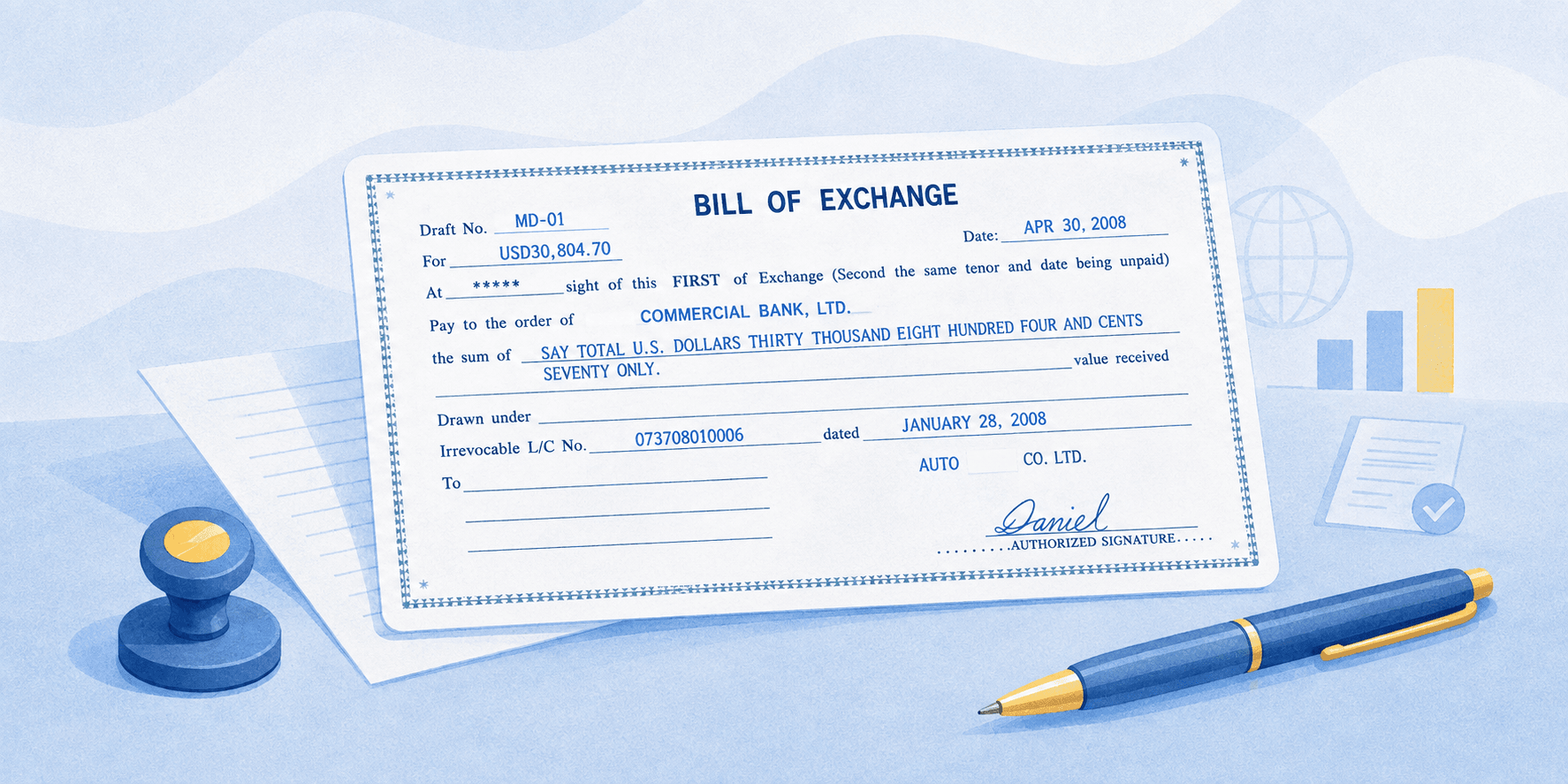

The commercial invoice tells the buyer what they owe. A bill of exchange formally directs the buyer to pay a stated amount to a named party, either on demand or later.
TL;DR
- Under Section 5 of the Negotiable Instruments Act, 1881, a bill of exchange is a written, unconditional order to pay a certain sum of money. It is not the same as an IOU or promissory note.
- The key roles are drawer, drawee and payee. Once the drawee accepts the bill, the drawee becomes the acceptor and is bound to pay according to the acceptance.
- Bills are better classified by four questions: inland or foreign, demand or usance, clean or documentary, and trade or accommodation.
- A bill of exchange creates and documents a payment obligation; the actual money can still be collected through a bank, trade-finance arrangement or cross-border payment provider.
Read a bill of exchange from top to bottom
1. The order to pay
A bill must contain an unconditional order, not merely a request or promise.
A simple formulation is:
Pay to the order of ABC Exports the sum of USD 20,000 sixty days after sight.
2. The drawer
The drawer creates and signs the bill.
3. The drawee
The drawee is the person directed to pay.
Issuing the bill does not by itself make the drawee liable. When the drawee signs assent, the drawee becomes the acceptor and is liable according to the acceptance.
4. The payee
The payee is the person to whom, or to whose order, payment is directed.
The payee can also be the drawer.
5. Amount and payment timing
It may be payable on demand/at sight or after a period such as 60 days after sight. Bills payable after sight have specific presentment and maturity rules.
6. Signature
The drawer must sign the instrument.
A simple bill of exchange format
| Field | Example |
|---|---|
| Date | 1 September 2026 |
| Drawer | ABC Exports Pvt. Ltd., India |
| Drawee | XYZ Imports Ltd., UK |
| Payee | ABC Exports Pvt. Ltd. or order |
| Amount | USD 20,000 |
| Payment term | 60 days after sight |
| Payment instruction | Unconditional order to pay |
| Drawer signature | Authorised signatory |
| Acceptance | Drawee's signed acceptance, where applicable |
Wording, stamping and banking requirements can vary, so use a format approved for the transaction.
Instead of memorising nine types, classify the bill four ways
For example, one export bill can be foreign + usance + documentary + trade.
Where is it drawn and payable?
Inland bill: Section 11 of the Negotiable Instruments Act defines an inland instrument based on where it is drawn/made and where it is payable or on whom it is drawn.
Foreign bill: Under Section 12, an instrument that does not meet the inland-instrument definition is a foreign instrument.
When is payment due?
Demand bill: Payable on demand or at sight. Section 19 covers instruments payable on demand.
Usance or time bill: Payable after a stated period, such as 30, 60 or 90 days. RBI's export-credit framework expressly recognises demand and usance export bills.
Are trade documents attached?
Documentary bill: Presented together with commercial or shipping documents, such as an invoice or bill of lading. In trade collections, document release can be linked to payment or acceptance.
Clean bill: Presented without the accompanying shipping or title documents.
Why was the bill created?
Trade bill: Arises from an underlying commercial sale of goods or services.
Accommodation bill: Drawn or accepted to provide financial accommodation rather than against an underlying trade sale.
What happens after an exporter draws the bill?
1. Drawer issues the bill
The exporter creates and signs the instrument.
2. Drawee accepts it, where acceptance is required
The buyer signs assent and becomes the acceptor. Bills payable after sight have specific presentment-for-acceptance rules under Section 61.
3. The bill may be negotiated or endorsed
A negotiable bill can be transferred by endorsement and delivery as permitted under the Act.
Eligible export bills may also be purchased, negotiated or discounted by a bank, subject to its terms and RBI rules.
4. The bill is presented for payment
At maturity—or on demand—the holder presents it for payment.
5. It is paid or dishonoured
If the acceptor does not pay, the bill can be dishonoured, triggering the Act's rules on liability and notice.
Bill of exchange vs invoice vs promissory note
| Document | What it does |
|---|---|
| Invoice | Records the commercial sale and amount payable |
| Bill of exchange | Orders a named party to pay a certain sum |
| Promissory note | Contains the maker's promise to pay |
| Letter of credit | A bank undertaking subject to its stated terms |
Where does PayGlocal fit?
A bill of exchange documents the commercial payment obligation. It does not itself move the money.
PayGlocal's Multi-Currency Accounts let businesses collect through local receiving details across 130+ global currencies from 180+ countries. Overseas buyers can pay through supported local rails, with funds converted and settled into the exporter's Indian bank account. PayGlocal currently advertises INR settlement within 24 hours and automated FIRA.
The bill defines who owes what and when; payment infrastructure handles collection, reconciliation and settlement.