
You just received a notification from your bank about IDPMS compliance. Or maybe you saw "IDPMS" mentioned in an email about your latest import payment. Either way, you're now wondering what it means and how it affects your business.
With Indian imports reaching $308.91 billion between April and July 2025 alone, more businesses than ever are dealing with global transactions and the compliance requirements that come with them.
IDPMS is an online system that tracks import payments in India. If you're importing goods and making payments to overseas suppliers, you need to know how this system works. So, let’s find out how it works and why it’s important for your business.
The full form of IDPMS is Import Data Processing and Monitoring System. This is an online platform created to monitor and process import transactions in India. The system tracks payments made to foreign suppliers and matches them against import delivery records.
The platform was launched to replace manual, time-consuming processes with a digital solution. Banks, customs authorities, and other stakeholders use IDPMS to ensure that foreign exchange outflows match the actual delivery of imported goods.
For instance, if your business imports machinery from Germany and pays $50,000, your bank records the transaction in IDPMS. The customs authorities later validate that the machinery actually arrived in India.
The system provides real-time visibility into import payment flows. This helps prevent situations where payments are made but goods never arrive, or where the payment amount doesn't match what was actually imported.
If you're importing goods into India, IDPMS directly affects how your payments are processed and tracked. Here's why this is important:
- Payment visibility: You can track where your payment stands at each stage, from initiation to final settlement. This reduces uncertainty about when your supplier will receive funds.
- Faster processing: Digital tracking means fewer manual checks and quicker validation. Your payments move through the system without getting stuck in paperwork.
- Penalty prevention: Non-compliance or mismatches in IDPMS records can trigger delays or penalties. Staying compliant keeps your import operations running without interruptions.
- Audit trail: The system creates a clear record of all import payments. This helps during audits or when you need to prove compliance with foreign exchange regulations.
For example, if you run an e-commerce business importing electronics, IDPMS ensures your payment of $100,000 is properly recorded and validated against the Bill of Entry (BOE) when your shipment clears customs.
Without proper IDPMS compliance, your payment could get flagged, causing delays that affect your inventory and sales.
Fraud reduction: By matching payments against actual imports, IDPMS helps identify discrepancies early. This protects your business from payment fraud or supplier issues.
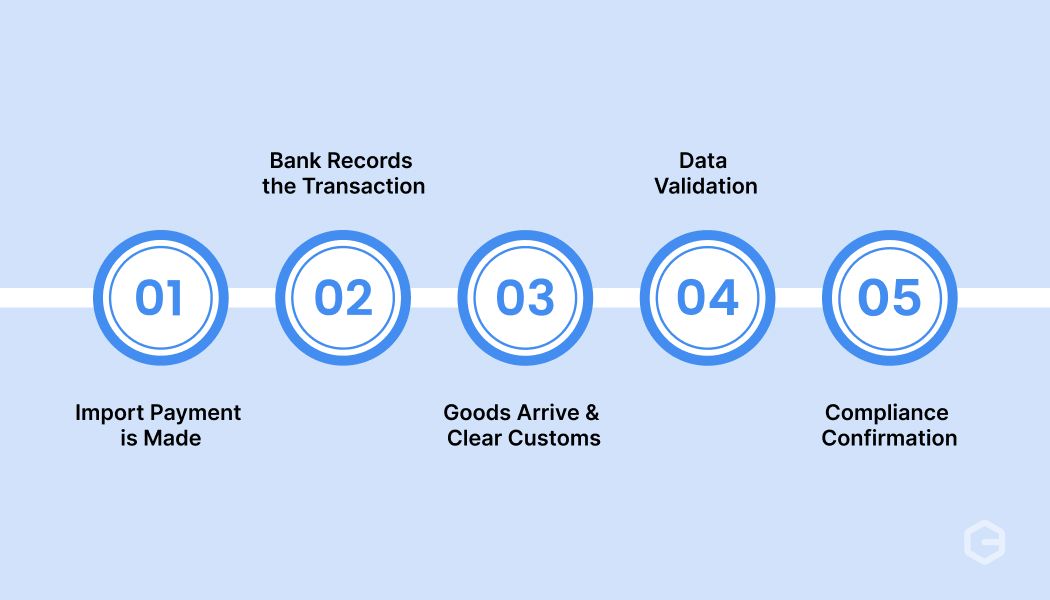
The IDPMS process involves multiple parties working together to validate import transactions. Your bank, customs authorities, and other regulatory bodies all play a role in ensuring payments match import records.
Here's the step-by-step flow:
1. Import payment is made: You initiate payment to your overseas supplier through your bank. This could be a wire transfer, letter of credit, or any other payment method for imports.
2. Bank records the transaction: Your bank enters the payment details into IDPMS. This includes information like payment amount, supplier details, invoice numbers, and expected delivery dates.
3. Goods arrive and clear customs: When your imported goods arrive in India, customs authorities process the shipment and create a Bill of Entry (BOE). This document contains details about what was imported and its declared value.
4. Data validation: IDPMS matches the payment data from your bank against the import data from customs. The system checks if the payment amount aligns with the value of goods actually received.
5. Compliance confirmation: Once the data matches, the transaction is marked as compliant in the system. If there are mismatches, the system flags the transaction for review, which could delay further processing.
For instance, if you paid $75,000 for textile imports but the BOE shows goods worth only $60,000, IDPMS will flag this mismatch. Your bank will then need to provide explanations or additional documentation to resolve the discrepancy.
IDPMS and EDPMS are systems that work together but serve different purposes. IDPMS focuses on imports, while EDPMS focuses on exports. Here's how they compare:
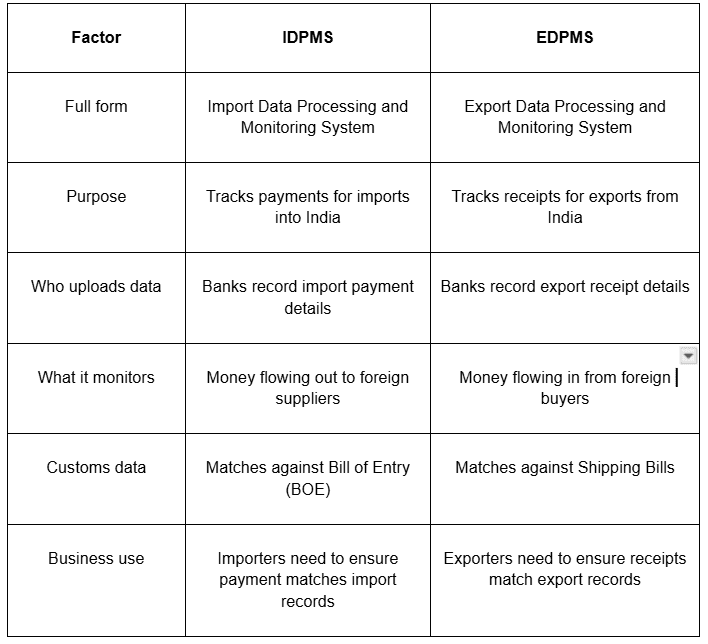
Both systems aim to create transparency in cross-border trade. IDPMS prevents situations where businesses pay for imports that never arrive. EDPMS ensures exporters receive payment for goods they've shipped. For instance, if you're both importing raw materials and exporting finished products, your transactions will be recorded in both systems.
The key difference is the direction of money flow. IDPMS monitors outflows (you paying suppliers abroad), while EDPMS monitors inflows (foreign customers paying you).
Working smoothly with IDPMS doesn't have to be complicated. Here are some effective best practices and tips to help you keep your import payments running smoothly.
- Work closely with your bank: It helps to give your bank all the correct information when you make import payments. Provide complete details about your supplier, invoice amounts, and expected delivery dates. Any errors at this stage can create problems later.
- Keep documentation organized: Maintain clear records of all import-related documents, including purchase orders, invoices, payment receipts, and shipping documents. You'll need these if any discrepancies arise in IDPMS.
- Monitor your outstanding remittances: Track which of your import payments are still pending goods delivery. Following up with suppliers when deliveries are delayed helps avoid long-outstanding remittances that can trigger questions.
- Check BOE accuracy: Work with your customs broker to make sure your Bill of Entry contains accurate information that matches your payment records. Double-checking supplier names, invoice numbers, and values before filing typically prevents mismatches.
- Respond quickly to bank queries: If your bank contacts you about IDPMS mismatches or missing documentation, responding promptly with the required information helps. Delays in providing clarifications extend the time your payments remain flagged.
- Review reports regularly: Check with your bank for IDPMS reports showing your outstanding imports. This helps you identify and resolve issues before they cause delays.
For example, if you're importing fabric worth $150,000 monthly, set up a system where your finance team verifies that each payment's details match the corresponding purchase order and expected BOE before funds are released. This proactive approach prevents most IDPMS issues.
Managing import payments across multiple currencies while ensuring IDPMS compliance can consume valuable time that your team should spend growing the business. You need payment solutions that handle compliance automatically while giving you full visibility into your funds.
PayGlocal provides an all-in-one payment platform designed for businesses managing international transactions. Whether you're importing raw materials monthly or making one-off equipment purchases from overseas suppliers, the platform simplifies how you collect and track international payments.
Here's how PayGlocal helps businesses handle imports:
- Multi-currency accounts: Accept payments in 33+ currencies from 180+ countries. Get local accounts in USD, GBP, EUR, and CAD that make it easier to receive funds from international clients or partners.
- Dynamic checkout:**Offer a fast, secure checkout experience customized for your global customers. Accept payments through international cards and alternative methods with seamless integration.
- Recurring payments:Automate subscription billing and recurring debits for ongoing import payments. Execute delayed shipments and unscheduled charges with network-compliant solutions.
- One platform management: Track all your payment statuses at every stage with frequent notifications. Manage multi-currency transactions from a single dashboard with complete transaction details.
- Sanction screening: Verify suppliers and transactions with privacy-first screening against 300+ global sources. Stay compliant with AML regulations while protecting sensitive business information.
PayGlocal makes the actual collection and management of global payments easy. You get the transparency and documentation you need to maintain compliance, plus the speed and efficiency that keeps your business moving.
IDPMS plays a key role in tracking import payments in India. The system brings transparency to international transactions by matching payments against actual goods delivery. For businesses importing products, staying compliant with IDPMS means fewer delays, no penalties, and smoother operations.
As you scale your import operations or expand into new markets, having a payment infrastructure that automatically handles compliance becomes even more important. Modern payment platforms like PayGlocal can give better visibility into your cash flows.
Ready to simplify how you handle international payments? Get started with PayGlocal today and experience faster, secure, and efficient payment collection.
Banks use IDPMS to record import payment details, while customs authorities provide import data for validation. Importers need to ensure their payment information is accurate in the system to avoid compliance issues.
ORM stands for Outstanding Import Remittance Monitoring. It tracks import payments that have been made but where goods haven't been delivered yet. The system monitors how long these payments remain outstanding to ensure goods eventually arrive.
BOE stands for Bill of Entry, the customs document filed when importing goods. IDPMS matches payment records against BOE details like values, supplier names, and invoice numbers to validate that payments match actual imports.
IDPMS applies to import transactions where payment is made to foreign suppliers. Once the system is notified and implemented, all outstanding import remittances from the notified date must be uploaded to IDPMS.
You need accurate payment records from your bank, purchase orders, supplier invoices, and the Bill of Entry from customs. Keep these documents organized to quickly resolve any queries about mismatches.
With Indian imports reaching $308.91 billion between April and July 2025 alone, more businesses than ever are dealing with global transactions and the compliance requirements that come with them.
IDPMS is an online system that tracks import payments in India. If you're importing goods and making payments to overseas suppliers, you need to know how this system works. So, let’s find out how it works and why it’s important for your business.
Key takeaways
- IDPMS full form: Import Data Processing and Monitoring System, an online platform that monitors import transactions and payments in India.
- Primary purpose: The system helps authorities track import payments to ensure foreign exchange flows align with goods delivery.
- Who uses it: Banks record import payment data, customs authorities provide import details, and businesses need to ensure their payments match import records.
- Main benefit: Digital tracking replaces manual processes, providing real-time visibility and reducing compliance delays.
- Payment solution: PayGlocal simplifies global payment collection with multi-currency accounts, automated compliance documentation, and transparent tracking for businesses managing international transactions.
What is IDPMS?
The full form of IDPMS is Import Data Processing and Monitoring System. This is an online platform created to monitor and process import transactions in India. The system tracks payments made to foreign suppliers and matches them against import delivery records.
The platform was launched to replace manual, time-consuming processes with a digital solution. Banks, customs authorities, and other stakeholders use IDPMS to ensure that foreign exchange outflows match the actual delivery of imported goods.
For instance, if your business imports machinery from Germany and pays $50,000, your bank records the transaction in IDPMS. The customs authorities later validate that the machinery actually arrived in India.
The system provides real-time visibility into import payment flows. This helps prevent situations where payments are made but goods never arrive, or where the payment amount doesn't match what was actually imported.
Why does IDPMS matter for your business?
If you're importing goods into India, IDPMS directly affects how your payments are processed and tracked. Here's why this is important:
- Payment visibility: You can track where your payment stands at each stage, from initiation to final settlement. This reduces uncertainty about when your supplier will receive funds.
- Faster processing: Digital tracking means fewer manual checks and quicker validation. Your payments move through the system without getting stuck in paperwork.
- Penalty prevention: Non-compliance or mismatches in IDPMS records can trigger delays or penalties. Staying compliant keeps your import operations running without interruptions.
- Audit trail: The system creates a clear record of all import payments. This helps during audits or when you need to prove compliance with foreign exchange regulations.
For example, if you run an e-commerce business importing electronics, IDPMS ensures your payment of $100,000 is properly recorded and validated against the Bill of Entry (BOE) when your shipment clears customs.
Without proper IDPMS compliance, your payment could get flagged, causing delays that affect your inventory and sales.
Fraud reduction: By matching payments against actual imports, IDPMS helps identify discrepancies early. This protects your business from payment fraud or supplier issues.
How does IDPMS work?
The IDPMS process involves multiple parties working together to validate import transactions. Your bank, customs authorities, and other regulatory bodies all play a role in ensuring payments match import records.
Here's the step-by-step flow:
1. Import payment is made: You initiate payment to your overseas supplier through your bank. This could be a wire transfer, letter of credit, or any other payment method for imports.
2. Bank records the transaction: Your bank enters the payment details into IDPMS. This includes information like payment amount, supplier details, invoice numbers, and expected delivery dates.
3. Goods arrive and clear customs: When your imported goods arrive in India, customs authorities process the shipment and create a Bill of Entry (BOE). This document contains details about what was imported and its declared value.
4. Data validation: IDPMS matches the payment data from your bank against the import data from customs. The system checks if the payment amount aligns with the value of goods actually received.
5. Compliance confirmation: Once the data matches, the transaction is marked as compliant in the system. If there are mismatches, the system flags the transaction for review, which could delay further processing.
For instance, if you paid $75,000 for textile imports but the BOE shows goods worth only $60,000, IDPMS will flag this mismatch. Your bank will then need to provide explanations or additional documentation to resolve the discrepancy.
What is the difference between IDPMS and EDPMS?
IDPMS and EDPMS are systems that work together but serve different purposes. IDPMS focuses on imports, while EDPMS focuses on exports. Here's how they compare:
Both systems aim to create transparency in cross-border trade. IDPMS prevents situations where businesses pay for imports that never arrive. EDPMS ensures exporters receive payment for goods they've shipped. For instance, if you're both importing raw materials and exporting finished products, your transactions will be recorded in both systems.
The key difference is the direction of money flow. IDPMS monitors outflows (you paying suppliers abroad), while EDPMS monitors inflows (foreign customers paying you).
How to work smoothly with IDPMS?
Working smoothly with IDPMS doesn't have to be complicated. Here are some effective best practices and tips to help you keep your import payments running smoothly.
- Work closely with your bank: It helps to give your bank all the correct information when you make import payments. Provide complete details about your supplier, invoice amounts, and expected delivery dates. Any errors at this stage can create problems later.
- Keep documentation organized: Maintain clear records of all import-related documents, including purchase orders, invoices, payment receipts, and shipping documents. You'll need these if any discrepancies arise in IDPMS.
- Monitor your outstanding remittances: Track which of your import payments are still pending goods delivery. Following up with suppliers when deliveries are delayed helps avoid long-outstanding remittances that can trigger questions.
- Check BOE accuracy: Work with your customs broker to make sure your Bill of Entry contains accurate information that matches your payment records. Double-checking supplier names, invoice numbers, and values before filing typically prevents mismatches.
- Respond quickly to bank queries: If your bank contacts you about IDPMS mismatches or missing documentation, responding promptly with the required information helps. Delays in providing clarifications extend the time your payments remain flagged.
- Review reports regularly: Check with your bank for IDPMS reports showing your outstanding imports. This helps you identify and resolve issues before they cause delays.
For example, if you're importing fabric worth $150,000 monthly, set up a system where your finance team verifies that each payment's details match the corresponding purchase order and expected BOE before funds are released. This proactive approach prevents most IDPMS issues.
Manage all your global payments easily with PayGlocal
Managing import payments across multiple currencies while ensuring IDPMS compliance can consume valuable time that your team should spend growing the business. You need payment solutions that handle compliance automatically while giving you full visibility into your funds.
PayGlocal provides an all-in-one payment platform designed for businesses managing international transactions. Whether you're importing raw materials monthly or making one-off equipment purchases from overseas suppliers, the platform simplifies how you collect and track international payments.
Here's how PayGlocal helps businesses handle imports:
- Multi-currency accounts: Accept payments in 33+ currencies from 180+ countries. Get local accounts in USD, GBP, EUR, and CAD that make it easier to receive funds from international clients or partners.
- Dynamic checkout:**Offer a fast, secure checkout experience customized for your global customers. Accept payments through international cards and alternative methods with seamless integration.
- Recurring payments:Automate subscription billing and recurring debits for ongoing import payments. Execute delayed shipments and unscheduled charges with network-compliant solutions.
- One platform management: Track all your payment statuses at every stage with frequent notifications. Manage multi-currency transactions from a single dashboard with complete transaction details.
- Sanction screening: Verify suppliers and transactions with privacy-first screening against 300+ global sources. Stay compliant with AML regulations while protecting sensitive business information.
PayGlocal makes the actual collection and management of global payments easy. You get the transparency and documentation you need to maintain compliance, plus the speed and efficiency that keeps your business moving.
Final thoughts
IDPMS plays a key role in tracking import payments in India. The system brings transparency to international transactions by matching payments against actual goods delivery. For businesses importing products, staying compliant with IDPMS means fewer delays, no penalties, and smoother operations.
As you scale your import operations or expand into new markets, having a payment infrastructure that automatically handles compliance becomes even more important. Modern payment platforms like PayGlocal can give better visibility into your cash flows.
Ready to simplify how you handle international payments? Get started with PayGlocal today and experience faster, secure, and efficient payment collection.
FAQs
1. Who needs to use IDPMS?
Banks use IDPMS to record import payment details, while customs authorities provide import data for validation. Importers need to ensure their payment information is accurate in the system to avoid compliance issues.
2. What is ORM in IDPMS?
ORM stands for Outstanding Import Remittance Monitoring. It tracks import payments that have been made but where goods haven't been delivered yet. The system monitors how long these payments remain outstanding to ensure goods eventually arrive.
3. What is BOE and why does it matter for IDPMS?
BOE stands for Bill of Entry, the customs document filed when importing goods. IDPMS matches payment records against BOE details like values, supplier names, and invoice numbers to validate that payments match actual imports.
4. Does IDPMS apply to all types of imports?
IDPMS applies to import transactions where payment is made to foreign suppliers. Once the system is notified and implemented, all outstanding import remittances from the notified date must be uploaded to IDPMS.
5. What documents do I need for IDPMS compliance?
You need accurate payment records from your bank, purchase orders, supplier invoices, and the Bill of Entry from customs. Keep these documents organized to quickly resolve any queries about mismatches.