
You've done the hard part: building a product that global customers want and closing the sale. But in 2026, the way those customers pay is shifting underneath your feet. If your checkout still relies on traditional banking routes or lacks local payment options, you are losing revenue to competitors who have already adopted the latest cross-border payment trends.
The global cross-border payment market is expected to grow from $397.37 billion in 2026 to $727.74 billion by 2034. But that growth is not just about volume. It is about speed, transparency, and smarter technology. The businesses that lead in this space are the ones that turn their payment stack into a growth lever rather than a back-office bottleneck.
In this guide, you will get a complete breakdown of the top 10 cross-border payment trends reshaping the industry this year and how to use them to collect payments faster and keep more of your margins.
Real-time payments are going global: Cross-border transfers are moving from days to minutes, with faster settlement becoming the new baseline.
From how customers pay at checkout to how funds settle across borders, every part of the payment process is changing. These shifts affect your fees, your approval rates, and how fast you actually receive money.
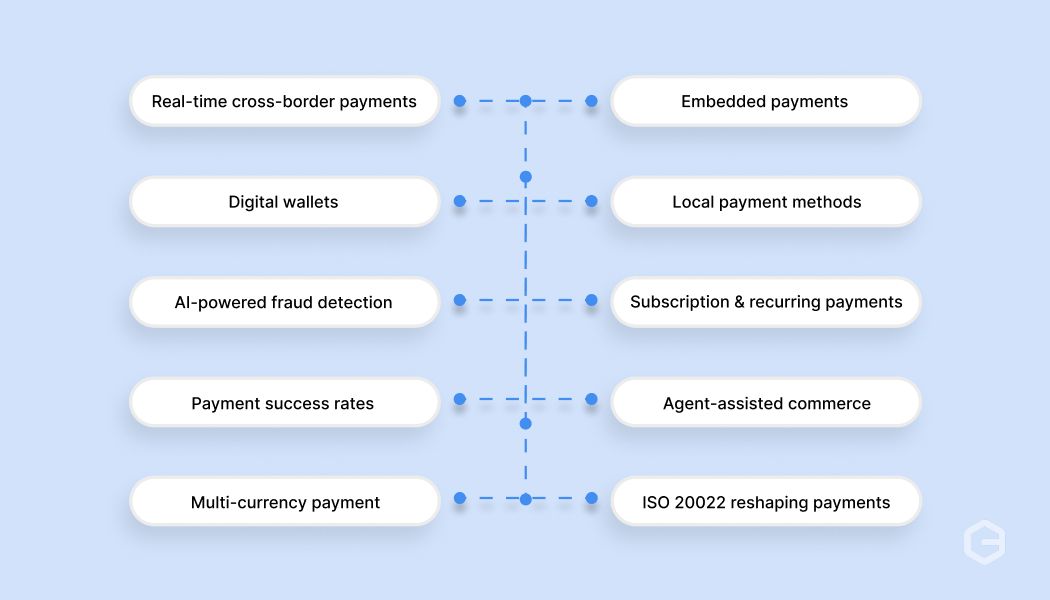
Here are the top 10 trends worth considering right now:
Waiting days for an international payment to clear is becoming a thing of the past. Payment networks are now connecting across borders to enable near-instant settlement. 90% of cross-border payments on the SWIFT network now reach the destination bank within an hour.
For your business, this means faster access to funds and less time chasing pending transactions. It also means your customers expect quicker confirmation when they pay. If your current provider still takes two to three days to settle, you are already behind.
In many markets, customers do not reach for a credit card anymore. They use digital wallets like Apple Pay, Google Pay, or local options they already trust. Global digital wallet transactions are projected to grow from 752 billion in 2023 to 1.4 trillion by 2028.
For instance, if you sell to customers in the US, UK, or Southeast Asia, offering wallet-based checkout can directly increase your conversion rates. Customers pay with one tap, without entering card details each time. A checkout that does not support wallets is leaving money on the table.
Fraud in cross-border payments is a real and growing problem. 90% of consumers expect strong fraud and security measures from payment providers. 75% of Gen Z shoppers have stopped a cross-border payment because of fraud concerns.
AI and machine learning now analyze transaction patterns in real time, flagging suspicious activity before it causes damage. Older, rule-based fraud systems block too many real customers. AI-driven systems are better at telling the difference between a genuine buyer and a fraudulent one, which means fewer false declines and more completed sales for your business.
Tip: Ask your payment provider how their fraud system works. If they rely only on static rules and manual reviews, you are likely losing real customers to false declines.
It is not enough to accept international payments. The real question is how many of those payments actually go through. Most businesses do not realize how much revenue they lose to silent payment failures. Transactions get declined due to issuer restrictions, incorrect card data, or routing through low-performing paths. These failures add up fast, especially at high transaction volumes.
A failed transaction means lost revenue, frustrated customers, and wasted marketing spend. Even a small increase in approval rates can significantly boost monthly sales. Therefore, businesses are now picking payment partners based on approval performance, not just pricing.
Global customers want to see prices and pay in their own currency. Offering multi-currency acceptance removes friction at checkout and builds trust. It also reduces chargebacks caused by unexpected currency conversion fees.
If you sell to customers in multiple countries, accepting payments in their local currency is no longer a nice-to-have. It is expected. The right setup lets you collect in 30+ currencies while settling in your preferred currency back home. This also helps your customers feel more confident completing a purchase.
Embedded finance means payment tools built directly into the software businesses already use. Instead of switching between your e-commerce platform, banking portal, and accounting tool, payments happen inside your existing workflow.
For instance, an exporter using a Shopify store can have cross-border payment collection, compliance documents, and settlement tracking all in one place. This saves time and reduces errors in reconciliation. The trend is moving toward unified stacks where payment data flows directly into ERPs and accounting software, eliminating manual reconciliation.
Note: Embedded payments are not just for large enterprises. Many fintech providers now offer plug-and-play integrations that work with popular e-commerce platforms and business tools out of the box.
Credit cards are not the default everywhere. In many countries, bank transfers, local wallets, or region-specific methods are how people prefer to pay. Offering these local payment methods can open up markets that were previously hard to reach.
For example, accepting local payment methods in markets across Europe, Southeast Asia, or the Middle East can noticeably lift your checkout conversion rate. A customer who sees a familiar payment option is far more likely to complete a purchase than one forced to use an unfamiliar method.
SaaS companies, ed-tech platforms, and membership-based businesses need reliable recurring payments from international customers. The recurring payments market is expected to reach USD 394 billion by 2034, growing at a 9.8% CAGR. Setting up standing instructions on global cards lets you collect subscription fees on schedule without chasing manual payments each cycle.
This is especially important for businesses with customers in the US, UK, or Canada, where card-based subscriptions are the norm. A recurring payment setup that handles international cards well can directly improve your retention and cash flow predictability.
Tip: If you offer subscriptions to global customers, check whether your payment partner supports standing instructions on international cards. Without this, you may face frequent payment failures on renewal dates.
AI agents are starting to play a role in how people buy online. According to BCG, more than $1 trillion of e-commerce spending could be agent-assisted. That represents nearly half of all e-commerce spending today.
What does this mean for you? In the near future, AI-powered shopping agents could handle product discovery, comparison, and even checkout on behalf of your customers. Payment systems need to be ready for these automated flows, with secure APIs and fast authorization. This is still early, but it is worth watching closely.
The infrastructure behind cross-border payments is getting a major upgrade. ISO 20022, a global messaging standard for financial transactions, is replacing older formats used by banks and payment networks. It carries richer, more structured data with each transaction. This means fewer errors, faster processing, and smoother compliance checks across borders.
At the same time, central bank digital currencies (CBDCs) are moving from research to early adoption. CBDCs are digital versions of national currencies issued and backed by central banks. Several countries are now piloting or launching CBDCs to make cross-border settlement faster and cheaper by reducing the number of intermediaries involved.
Note: These trends are not happening in isolation. The businesses that benefit most are the ones that choose a payment partner capable of keeping up with all of them at once.
If you are still dealing with high failure rates, limited currency support, or scattered payment tools, these shifts will only make those problems bigger.
PayGlocal is built for Indian businesses selling to the world. Here’s how it can help you with the trends that matter most:
PayGlocal handles the complexity of global payments so you can focus on growing your business. With no fixed costs and no hidden fees, you pay only when you transact.
Cross-border payments are moving toward speed, transparency, and better customer experience. The 10 trends covered in this guide are not predictions for a distant future. They are happening now, and they affect how your business gets paid every day.
The businesses that act early, by choosing the right tools and partners, will collect more, lose less, and grow faster. Waiting means falling behind competitors who have already adopted the latest technology.
Get started with PayGlocal today and give your global payments the upgrade they need.
The global cross-border payment market is expected to grow from $397.37 billion in 2026 to $727.74 billion by 2034. But that growth is not just about volume. It is about speed, transparency, and smarter technology. The businesses that lead in this space are the ones that turn their payment stack into a growth lever rather than a back-office bottleneck.
In this guide, you will get a complete breakdown of the top 10 cross-border payment trends reshaping the industry this year and how to use them to collect payments faster and keep more of your margins.
Key takeaways
Real-time payments are going global: Cross-border transfers are moving from days to minutes, with faster settlement becoming the new baseline.
- Digital wallets are leading checkout: Customers worldwide prefer paying through wallets they already trust, with wallet transactions projected to double by 2028.
- AI is reshaping fraud prevention: Machine learning now spots suspicious transactions faster and more accurately than manual reviews ever could.
- Payment success rates decide revenue: Businesses are choosing payment partners based on how many transactions actually go through, not just price.
- Multi-currency acceptance is now expected: Buyers want to pay in their local currency, and sellers need global payment platforms like PayGlocal.
What are the top cross-border payment trends in 2026?
From how customers pay at checkout to how funds settle across borders, every part of the payment process is changing. These shifts affect your fees, your approval rates, and how fast you actually receive money.
Here are the top 10 trends worth considering right now:
1. Real-time cross-border payments are becoming standard
Waiting days for an international payment to clear is becoming a thing of the past. Payment networks are now connecting across borders to enable near-instant settlement. 90% of cross-border payments on the SWIFT network now reach the destination bank within an hour.
For your business, this means faster access to funds and less time chasing pending transactions. It also means your customers expect quicker confirmation when they pay. If your current provider still takes two to three days to settle, you are already behind.
2. Digital wallets are taking over global checkout
In many markets, customers do not reach for a credit card anymore. They use digital wallets like Apple Pay, Google Pay, or local options they already trust. Global digital wallet transactions are projected to grow from 752 billion in 2023 to 1.4 trillion by 2028.
For instance, if you sell to customers in the US, UK, or Southeast Asia, offering wallet-based checkout can directly increase your conversion rates. Customers pay with one tap, without entering card details each time. A checkout that does not support wallets is leaving money on the table.
3. AI-powered fraud detection is now a baseline
Fraud in cross-border payments is a real and growing problem. 90% of consumers expect strong fraud and security measures from payment providers. 75% of Gen Z shoppers have stopped a cross-border payment because of fraud concerns.
AI and machine learning now analyze transaction patterns in real time, flagging suspicious activity before it causes damage. Older, rule-based fraud systems block too many real customers. AI-driven systems are better at telling the difference between a genuine buyer and a fraudulent one, which means fewer false declines and more completed sales for your business.
Tip: Ask your payment provider how their fraud system works. If they rely only on static rules and manual reviews, you are likely losing real customers to false declines.
4. Payment success rates are a competitive differentiator
It is not enough to accept international payments. The real question is how many of those payments actually go through. Most businesses do not realize how much revenue they lose to silent payment failures. Transactions get declined due to issuer restrictions, incorrect card data, or routing through low-performing paths. These failures add up fast, especially at high transaction volumes.
A failed transaction means lost revenue, frustrated customers, and wasted marketing spend. Even a small increase in approval rates can significantly boost monthly sales. Therefore, businesses are now picking payment partners based on approval performance, not just pricing.
5. Multi-currency payment acceptance matters more than ever
Global customers want to see prices and pay in their own currency. Offering multi-currency acceptance removes friction at checkout and builds trust. It also reduces chargebacks caused by unexpected currency conversion fees.
If you sell to customers in multiple countries, accepting payments in their local currency is no longer a nice-to-have. It is expected. The right setup lets you collect in 30+ currencies while settling in your preferred currency back home. This also helps your customers feel more confident completing a purchase.
6. Embedded payments are replacing manual workflows
Embedded finance means payment tools built directly into the software businesses already use. Instead of switching between your e-commerce platform, banking portal, and accounting tool, payments happen inside your existing workflow.
For instance, an exporter using a Shopify store can have cross-border payment collection, compliance documents, and settlement tracking all in one place. This saves time and reduces errors in reconciliation. The trend is moving toward unified stacks where payment data flows directly into ERPs and accounting software, eliminating manual reconciliation.
Note: Embedded payments are not just for large enterprises. Many fintech providers now offer plug-and-play integrations that work with popular e-commerce platforms and business tools out of the box.
7. Local payment methods are driving conversion in new markets
Credit cards are not the default everywhere. In many countries, bank transfers, local wallets, or region-specific methods are how people prefer to pay. Offering these local payment methods can open up markets that were previously hard to reach.
For example, accepting local payment methods in markets across Europe, Southeast Asia, or the Middle East can noticeably lift your checkout conversion rate. A customer who sees a familiar payment option is far more likely to complete a purchase than one forced to use an unfamiliar method.
8. Subscription and recurring payments are crossing borders
SaaS companies, ed-tech platforms, and membership-based businesses need reliable recurring payments from international customers. The recurring payments market is expected to reach USD 394 billion by 2034, growing at a 9.8% CAGR. Setting up standing instructions on global cards lets you collect subscription fees on schedule without chasing manual payments each cycle.
This is especially important for businesses with customers in the US, UK, or Canada, where card-based subscriptions are the norm. A recurring payment setup that handles international cards well can directly improve your retention and cash flow predictability.
Tip: If you offer subscriptions to global customers, check whether your payment partner supports standing instructions on international cards. Without this, you may face frequent payment failures on renewal dates.
9. Agent-assisted commerce is entering payments
AI agents are starting to play a role in how people buy online. According to BCG, more than $1 trillion of e-commerce spending could be agent-assisted. That represents nearly half of all e-commerce spending today.
What does this mean for you? In the near future, AI-powered shopping agents could handle product discovery, comparison, and even checkout on behalf of your customers. Payment systems need to be ready for these automated flows, with secure APIs and fast authorization. This is still early, but it is worth watching closely.
10. ISO 20022 and central bank digital currencies are reshaping payment processes
The infrastructure behind cross-border payments is getting a major upgrade. ISO 20022, a global messaging standard for financial transactions, is replacing older formats used by banks and payment networks. It carries richer, more structured data with each transaction. This means fewer errors, faster processing, and smoother compliance checks across borders.
At the same time, central bank digital currencies (CBDCs) are moving from research to early adoption. CBDCs are digital versions of national currencies issued and backed by central banks. Several countries are now piloting or launching CBDCs to make cross-border settlement faster and cheaper by reducing the number of intermediaries involved.
Note: These trends are not happening in isolation. The businesses that benefit most are the ones that choose a payment partner capable of keeping up with all of them at once.
Get paid globally faster in 180+ countries with PayGlocal
If you are still dealing with high failure rates, limited currency support, or scattered payment tools, these shifts will only make those problems bigger.
PayGlocal is built for Indian businesses selling to the world. Here’s how it can help you with the trends that matter most:
- Multi-currency accounts: Collect payments locally in USD, GBP, EUR, CAD, and globally in 33 currencies from 180+ countries.
- Global payment methods: Accept 40+ local payment methods so customers pay the way they prefer.
- Card payments: High approval rates on international credit and debit cards with smart payment routing.
- Recurring payments: Manage subscriptions and standing instructions on global cards from one platform.
- One platform: Set up, track, and settle all your international payments from a single dashboard.
PayGlocal handles the complexity of global payments so you can focus on growing your business. With no fixed costs and no hidden fees, you pay only when you transact.
Final thoughts
Cross-border payments are moving toward speed, transparency, and better customer experience. The 10 trends covered in this guide are not predictions for a distant future. They are happening now, and they affect how your business gets paid every day.
The businesses that act early, by choosing the right tools and partners, will collect more, lose less, and grow faster. Waiting means falling behind competitors who have already adopted the latest technology.
Get started with PayGlocal today and give your global payments the upgrade they need.