

Businesses with multiple GST registrations often share resources across locations. A head office may handle finance for several branches, a central IT team may support offices across states, or one unit may provide administrative services to another.
Under GST, however, those registrations cannot always be treated as one entity.
Where a business has more than one GST registration, each registration is treated as a distinct person under Section 25 of the CGST Act. Supplies of goods or services between these distinct persons can therefore attract GST even when no money actually changes hands.
This is where cross charge under GST becomes relevant.
But there is an important distinction businesses need to understand in 2026: cross charge and Input Service Distributor (ISD) are not interchangeable mechanisms for distributing common third-party input service credit anymore. From 1 April 2025, the ISD mechanism became mandatory in specified cases involving input services received by one office for or on behalf of distinct GST registrations.
Here is what that means for businesses with multiple GSTINs.
Under GST, however, those registrations cannot always be treated as one entity.
Where a business has more than one GST registration, each registration is treated as a distinct person under Section 25 of the CGST Act. Supplies of goods or services between these distinct persons can therefore attract GST even when no money actually changes hands.
This is where cross charge under GST becomes relevant.
But there is an important distinction businesses need to understand in 2026: cross charge and Input Service Distributor (ISD) are not interchangeable mechanisms for distributing common third-party input service credit anymore. From 1 April 2025, the ISD mechanism became mandatory in specified cases involving input services received by one office for or on behalf of distinct GST registrations.
Here is what that means for businesses with multiple GSTINs.
TL;DR
- Cross charge under GST applies when one GST-registered unit supplies goods or services to another registration of the same business.
- GST registrations under the same PAN are treated as distinct persons, so certain inter-unit supplies can be taxable even without consideration.
- From 1 April 2025, an office receiving input-service invoices for or on behalf of distinct persons must follow the ISD mechanism to distribute the related ITC.
- Cross charge remains relevant for actual inter-unit supplies, including internally generated services such as centralised IT, finance or administrative support.
What is cross charge under GST?
Cross charge under GST is the practice of accounting for a supply made by one GST-registered unit of a business to another GST registration of the same business.
Suppose a company has:
- a head office registered in Maharashtra; and
- a branch registered in Karnataka.
The Maharashtra head office has a central finance team that provides accounting and reporting support to the Karnataka branch.
Although both offices belong to the same legal business, their separate GST registrations make them distinct persons for GST purposes. Supplies between distinct persons made in the course or furtherance of business are treated as supplies under Schedule I of the CGST Act, even when they are made without consideration.
Cross charge is therefore commonly used to account for services such as:
- centralised finance and accounting;
- IT support;
- human resources;
- legal and compliance support;
- management or administrative services;
- procurement support; and
- other internally generated services supplied by one registered unit to another.
The same distinct-person principle can also apply to goods transferred between separate GST registrations, although these transactions are often referred to as stock or branch transfers.
Why is cross charge required under GST?
Without the concept of distinct persons, businesses could move taxable goods or provide services between GST registrations without appropriately accounting for GST.
The GST framework instead looks at each registration separately.
For example, imagine a company has offices in Bengaluru, Mumbai and Delhi, while its central technology team operates from Bengaluru.
If that team develops and maintains systems used by the Mumbai and Delhi offices, there may be an internally generated service from the Bengaluru GST registration to the other registrations.
Cross charge helps the business:
- identify which registration is supplying the service;
- determine the appropriate value of the supply;
- account for the applicable GST;
- report the transaction under the correct GSTIN; and
- allow the recipient registration to claim eligible input tax credit, subject to the normal ITC conditions.
The key question is therefore not simply whether the offices belong to the same company. It is whether one distinct GST-registered person is making a supply to another distinct person.
When does cross charge apply?
Cross charge may become relevant when one registered unit actually provides goods or services to another registered unit of the same organisation.
1. Internally generated services
This is one of the most common cross-charge situations.
For example, a head office may maintain:
- a common HR team;
- a technology department;
- a finance and accounts function;
- a central legal team; or
- a management team
that performs activities for branch offices registered under separate GSTINs.
These are different from services purchased from an outside vendor on behalf of several registrations.
2. Inter-branch supply of goods
Goods transferred between distinct GST registrations can also constitute a supply even when there is no conventional sale between the branches.
The applicable GST treatment depends on factors such as the location of the registrations and the nature of the supply.
3. Services provided by one branch to another
Cross charge is not restricted to head-office-to-branch transactions.
If one branch provides a service to another branch and the two have separate GST registrations, the same distinct-person principles may apply.
Cross charge example
Consider a company with:
- its head office in Maharashtra; and
- a branch office in Karnataka.
The Maharashtra office runs a central technology team that manages internal systems used by the Karnataka branch.
Because the offices have separate GST registrations, the service provided by the Maharashtra office to the Karnataka branch is between distinct persons.
The business would need to evaluate:
- whether a taxable supply exists;
- how the service should be valued under GST;
- the appropriate tax treatment; and
- whether the Karnataka registration is eligible to claim ITC.
This is different from a situation where a third-party software company sends one invoice to the head office for software used by both locations. For common third-party input services received for or on behalf of distinct persons, the ISD rules need to be considered instead.
How does cross charge work under GST?
The process usually involves the following steps.
Identify the supply
First determine whether one GST registration has actually supplied goods or services to another.
This is especially important for shared functions because not every accounting allocation automatically represents the same GST transaction.
Identify the recipient GSTIN
Determine which registered unit receives or benefits from the supply.
Where several branches receive the service, the business should have a reasonable and consistent basis for identifying the relevant recipients.
Determine the value of supply
Transactions between distinct persons are subject to the GST valuation rules, particularly Rule 28 of the CGST Rules.
The valuation treatment can differ depending on whether the recipient registration is eligible for full input tax credit.
Apply the appropriate GST
The nature of the transaction, locations of the supplier and recipient and place-of-supply rules determine whether CGST and SGST/UTGST or IGST applies.
Report the transaction
Where an invoice is issued, the supplier registration should report the transaction in the applicable GST returns. The recipient can claim ITC only where it is otherwise eligible and the applicable ITC conditions are satisfied.
There does not necessarily need to be a conventional cash payment between the two offices for GST to become relevant. Schedule I can treat a supply between distinct persons as taxable even without consideration.
How is the value of a cross charge determined?
Valuation is one of the most important parts of cross charging.
Rule 28 of the CGST Rules deals with valuation of supplies between distinct or related persons.
As a general principle, the open market value of the supply is relevant.
However, there is an important relaxation where the recipient is eligible for full input tax credit.
CBIC Circular No. 199/11/2023-GST clarified that where the recipient branch is eligible for full ITC, the value declared in the invoice by the head office can be treated as the open market value.
The circular also clarified that, in such cases, it is not necessary for every individual cost component—such as employee salary cost—to be included in the invoice value.
For internally generated services where full ITC is available, the circular goes further: if the head office has not issued an invoice for a particular service, the value may be deemed to have been declared as nil and treated as the open market value under the second proviso to Rule 28.
Where full ITC is not available, businesses need to pay closer attention to valuation. Circular 199 also clarifies that the salary cost of head-office employees involved in providing internally generated services does not mandatorily have to be included while computing the taxable value.
Because valuation depends heavily on the facts of the transaction and ITC eligibility of the recipient, businesses should document the methodology they use rather than applying a standard percentage across every branch.
Cross charge vs Input Service Distributor: what changed from 1 April 2025?
This is where older explanations of cross charge under GST can now be misleading.
Until 31 March 2025, businesses had greater flexibility in deciding whether to use ISD or raise invoices for certain common third-party input services.
That position changed from 1 April 2025.
Section 20 of the CGST Act now states that an office receiving invoices for input services for or on behalf of distinct persons is required to register as an Input Service Distributor and distribute the associated ITC through the prescribed ISD mechanism.
So, in 2026, the practical distinction looks like this:
| Cross charge | Input Service Distributor | |
|---|---|---|
| Primary purpose | Account for supplies between distinct GST registrations | Distribute ITC on input services received for or on behalf of distinct persons |
| Typical example | HO's internal IT team provides support to branches | External software vendor invoices HO for a service used by multiple branches |
| Is there an underlying inter-unit supply? | Yes | ISD itself only distributes eligible input-service credit |
| GST document | Tax invoice or other applicable documentation depending on the transaction | ISD invoice/document for distribution of ITC |
| Valuation required? | Yes, where applicable under Rule 28 | Credit is distributed according to ISD rules |
| Position from 1 April 2025 | Continues to apply to actual supplies between distinct persons | Mandatory where Section 20 applies to input-service invoices received for/on behalf of distinct persons |
The two mechanisms therefore solve different GST problems.
Cross charge deals with a supply between registrations.
ISD deals with the distribution of input tax credit arising from qualifying third-party input services.
An example: cross charge or ISD?
Suppose a company has a head office in Mumbai and branches in Delhi and Bengaluru.
Scenario 1: external software subscription
A software provider issues an invoice to the Mumbai office for a platform used by all three locations.
The invoice relates to an input service received for multiple distinct persons.
From 1 April 2025, the ITC attributable to the distinct registrations should be distributed through the applicable ISD mechanism under Section 20 and Rule 39. Rule 39 prescribes, among other things, how credit attributable to one, multiple or all recipients is distributed.
Scenario 2: Mumbai's internal IT team
The Mumbai office employs its own IT team, which manages infrastructure and provides technical support to the Delhi and Bengaluru branches.
Here, the business is dealing with an internally generated service between distinct registrations rather than simply distributing ITC from an external supplier invoice.
Cross-charge principles and the valuation clarification in Circular 199/11/2023-GST become relevant.
That distinction is one of the easiest ways to understand when ISD and cross charge should be considered.

What documentation should businesses maintain for cross charge?
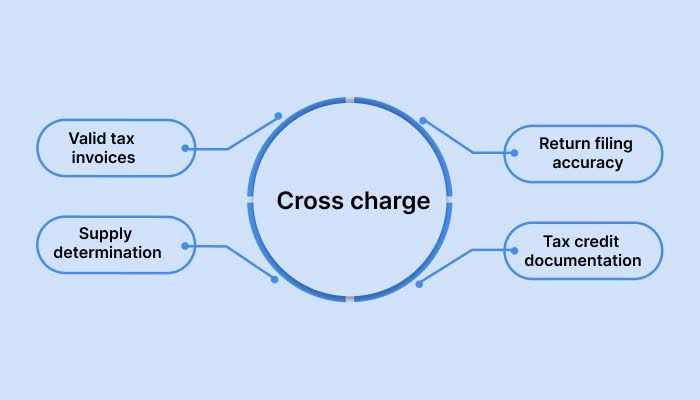
Good documentation becomes particularly important when the same business operates across several GST registrations.
Businesses should consider maintaining:
Tax invoices
Where a tax invoice is required, it should contain the applicable GST particulars, including the GSTINs of the supplier and recipient, description of the supply, taxable value, tax rate and tax amount.
Valuation records
Maintain a clear record of how the value of internally supplied services or goods was determined.
This becomes particularly important where the recipient is not entitled to full ITC.
Cost-allocation methodology
Where a shared internal function benefits several branches, document the basis used to allocate the service between those branches.
Depending on the nature of the service, this could use factors such as:
- turnover;
- employee count;
- actual utilisation;
- transaction volumes; or
- another commercially reasonable allocation key.
The method should reflect the nature of the service rather than simply using the easiest available percentage.
GST return records
Keep the supplier's outward-supply reporting consistent with the records and ITC position of the recipient GSTIN.
ISD records
Where Section 20 applies, businesses should separately maintain the required ISD registration, credit-distribution documents and GSTR-6 compliance.
An ISD is required to distribute the available credit according to Rule 39 and furnish the relevant details through FORM GSTR-6.
Common cross charge mistakes businesses should avoid
Cross charge can become complicated when accounting treatment and GST treatment are assumed to be the same thing.
1. Treating every shared cost as a cross charge
A third-party cost allocated between branches may fall under the ISD framework rather than cross charge, particularly after the April 2025 amendments.
Start by asking what created the cost: an external input service or an internally generated supply?
2. Using the old ISD rules
Articles written before April 2025 may say that businesses can choose between ISD and cross charge for common third-party input-service credit.
That position should no longer be relied upon for periods after the amended Section 20 became effective.
3. Assuming all cross charges attract 18% GST
There is no universal GST rate for every cross charge.
The applicable rate follows the classification and GST treatment of the underlying supply.
4. Assuming ITC is always fully available
A cross charge does not automatically guarantee full input tax credit.
The recipient's ITC remains subject to the eligibility conditions and restrictions under GST law.
5. Ignoring valuation
Businesses should not simply transfer accounting costs and assume that the same figure automatically satisfies GST valuation requirements.
Rule 28 and the recipient's ITC eligibility need to be considered.
How cross charge affects businesses receiving international payments
Cross charge under GST primarily concerns transactions between GST registrations within the same organisation. It does not determine how an Indian business receives payments from customers overseas.
However, businesses with multiple GST registrations often need both processes to work together operationally.
For example, an exporter may receive payments from international customers through one business unit while maintaining finance, technology or administrative teams in another registered location.
Keeping payment records, invoices and settlement data organised can make it easier for finance teams to reconcile revenue and determine how costs should be allocated across the organisation.
PayGlocal helps Indian businesses manage domestic and international payment collections through a single payments infrastructure.
Businesses can use PayGlocal to:
- collect international payments from customers across markets;
- accept payments through international cards and other supported global payment methods;
- manage payment and transaction information centrally; and
- access payment records that support reconciliation across finance operations.
For businesses collecting across currencies, multi-currency payment solutions can also help simplify how international collections are managed.
Your payment platform does not determine the GST treatment of an inter-unit cross charge, but cleaner payment and reconciliation data can make the underlying finance operation considerably easier to manage.
Final thoughts
Cross charge under GST becomes important because separate GST registrations of the same organisation are treated as distinct persons.
When one registration actually supplies goods or services to another, businesses need to consider the taxability, valuation, documentation and ITC implications of that transaction.
The biggest change to remember in 2026 is the distinction between internally generated supplies and common third-party input services.
From 1 April 2025, businesses can no longer rely on the older position that allowed them to choose freely between cross charge and ISD for distributing ITC on common third-party input services. Where Section 20 applies, the credit must now be handled through the ISD mechanism.
Cross charge, meanwhile, continues to play an important role where one distinct registration actually supplies goods or services to another.
For businesses operating across multiple locations, keeping the two mechanisms separate is the first step towards getting the GST treatment right.