

India's economy is growing rapidly at 6.5% ,creating significant opportunities for businesses ready to scale.Smart companies are capturing this growth wave by expanding strategically. Growth is not optional if you want your business to succeed in this environment.
But every business faces different challenges when scaling. Some struggle with cash flow. Others can't find the right talent or enter new markets. The path to expansion looks different for everyone, but the core principles stay the same.
In this guide, we cover 12 effective strategies that help firms grow and expand. You'll find what works, why it matters, and how to implement each approach in your business. By the end, you'll have a clear roadmap for sustainable growth. So, let’s get started.
Business growth and expansion can occur through increased sales to existing customers, finding new customers, or developing new products and services.
Expansion typically involves entering new markets, launching additional product lines, or scaling operations to serve more customers. For instance, a software company that adds new features for different industries is expanding its product offerings.
The difference between growth and expansion is scope. Growth often happens within your current market and customer base. Expansion involves moving beyond your current boundaries into new regions, customer segments, or business areas.
Companies that don't grow face serious risks in the current competitive environment. Some of the key reasons why growth matters for your business:
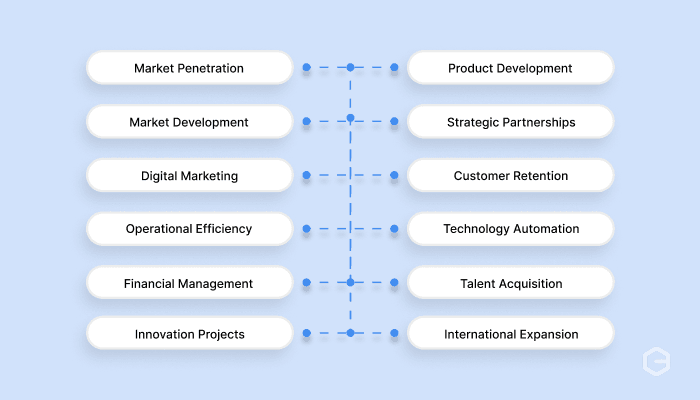
Multiple factors contribute to business growth, but they fall into strategic and operational categories. Strategic factors determine your direction and market positioning. Operational factors determine how well you execute your plans.
The most effective growth strategies combine different approaches based on your business stage and resources:
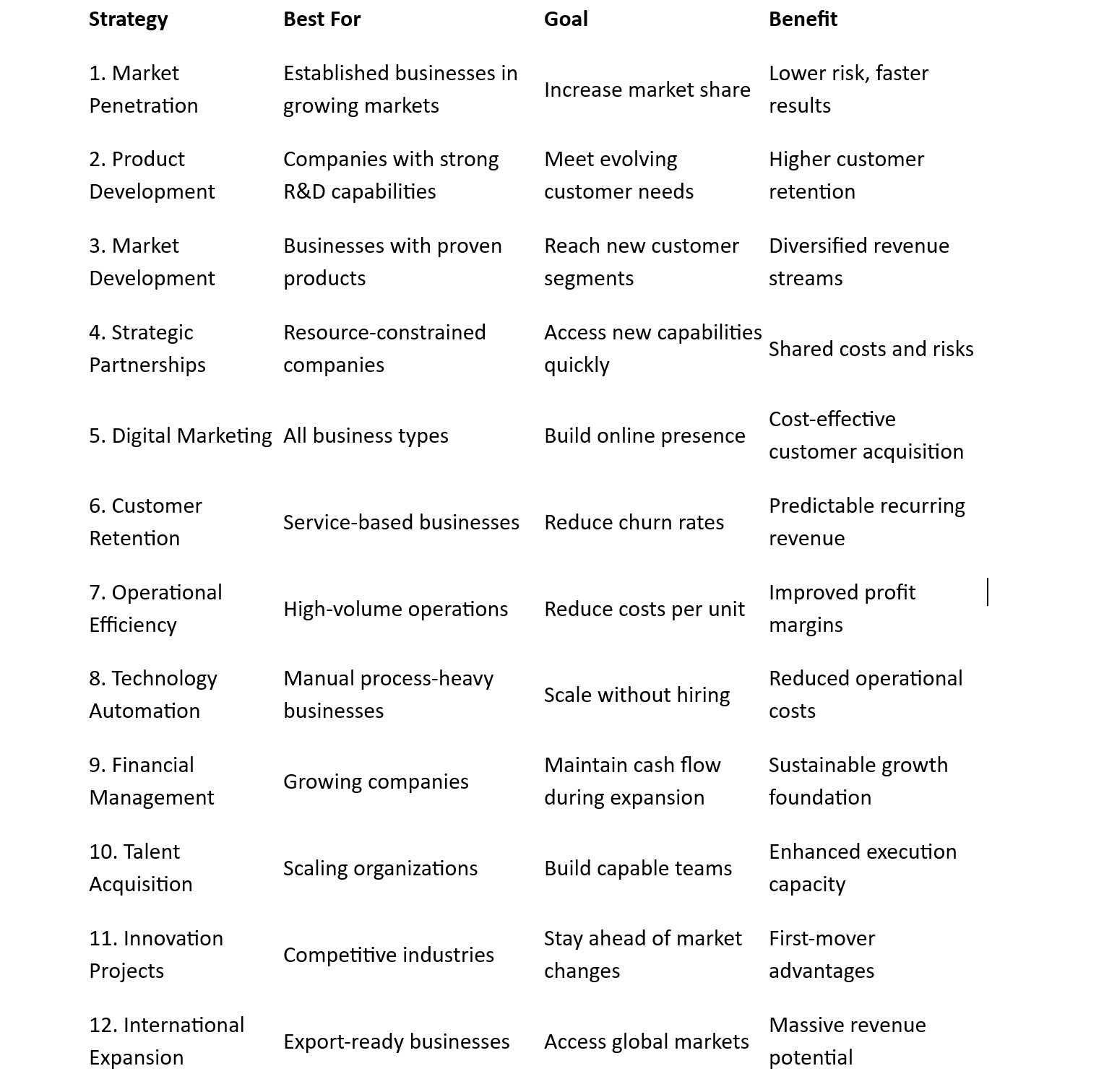
The key is choosing strategies that match your resources, market conditions, and risk tolerance. Let’s take a detailed look at each of these strategies.
Market penetration involves gaining a larger share of your existing market by selling more to current customers or attracting competitors' customers. This approach works best when your market still has growth potential and you can compete effectively on price, quality, or service.
Example: A B2B software company can increase market penetration by upselling additional features to existing clients, improving its sales process to close more prospects, or launching targeted campaigns to win customers from competitors.
Implementation Tips:
Market development involves expanding your existing products into new customer segments or geographic areas. This strategy works when your product solves problems for audiences you haven't reached yet or when you can adapt your offering for new markets.
Example: A company selling project management software to marketing agencies can develop the education market by highlighting features that help schools manage curricula and student projects. The core product stays the same, but messaging and distribution change.
Implementation Tips:
Product development creates new offerings or improves existing ones to meet changing customer needs and stay competitive. This strategy helps you capture more value from existing customers while attracting new ones who need different solutions.
Example: An accounting software company can develop mobile apps for field workers, add AI-powered features for faster data entry, or create industry-specific versions for restaurants or retail businesses.
Implementation Tips:
Strategic partnerships let you access resources, markets, and capabilities you don't have alone. The right partners help you grow faster and more efficiently than building everything yourself, while sharing risks and costs.
Example: A payment processing company can partner with ecommerce platforms to become the default payment option for the platform's merchants. Both companies benefit from the integration while serving customers better.
Implementation Tips:
Strong financial management ensures your growth creates value rather than destroying it. Many businesses fail not from lack of revenue but from poor cash flow management during expansion periods.
Example: A growing ecommerce business needs working capital to buy inventory before selling it. If customer payments take 30 days but supplier payments are due in 15 days, the company needs cash to bridge the gap. This requirement grows with sales volume.
Implementation Tips:
Technology lets you grow revenue without proportionally growing headcount. The right tools handle repetitive tasks, provide data for better decisions, and improve customer experience while reducing operational costs.
Example: A consulting firm can use project management software to handle client communication, automated invoicing to reduce billing errors, and time tracking tools to improve project profitability without hiring administrative staff.
Implementation Tips:
Retaining existing customers costs less than acquiring new ones and provides more predictable revenue. Loyal customers also buy more over time and refer others, creating compound growth benefits for your business.
Example: A subscription software company can reduce churn by improving onboarding, providing proactive customer support, and regularly adding features that increase the product's value to existing users.
Implementation Tips:
Digital marketing provides cost-effective ways to reach larger audiences and track results more accurately than traditional marketing methods. Online channels also let you target specific customer segments and adjust campaigns based on performance data.
Example: A B2B services company can use content marketing to attract prospects through search engines, social media advertising to reach decision-makers at target companies, and email marketing to nurture leads until they're ready to buy.
Implementation Tips:
Operational efficiency lets you serve more customers without proportionally increasing costs. Better processes also improve quality and customer satisfaction while reducing errors and waste.
Example: A manufacturing company can implement lean production methods to reduce waste, use inventory management software to optimize stock levels, and cross-train employees to handle multiple functions during busy periods.
Implementation Tips:
Your team determines how fast you can grow and how well you execute growth strategies. Hiring the right people and creating systems that help them succeed becomes critical as your business scales.
Example: A growing consulting firm needs to hire experienced consultants who can work independently, develop junior staff through mentorship programs, and create knowledge management systems so expertise isn't lost when people leave.
Implementation Tips:
Innovation keeps you ahead of competitors and helps you adapt to changing market conditions. Regular investment in new ideas, technologies, and approaches ensures your business remains relevant as customer needs evolve.
Example: A software company can invest in artificial intelligence features, explore new integration possibilities, or research emerging technologies that can improve their product's performance or create new revenue opportunities.
Implementation Tips:
International expansion opens massive new markets but requires careful planning and execution. Different countries have unique regulations, customer preferences, and competitive landscapes that affect your success.
Example: An ecommerce company expanding to Europe needs to comply with GDPR privacy regulations, accept local payment methods like SEPA transfers, and adapt marketing messages for different cultural contexts while managing currency fluctuations.
Implementation Tips:
Growth often means serving customers beyond your home market, but international expansion introduces payment complexities that slow you down. Customers abandon purchases when payment options feel unfamiliar or unreliable. Currency conversion issues create friction. Compliance requirements vary by country.
Most businesses either avoid international markets or lose significant revenue to payment problems. Building your own global payment infrastructure takes years and costs a lot. Using basic payment processors limits your growth because they don't handle the complexities of global commerce.
PayGlocal gives you enterprise-grade international payment capabilities from day one:
With PayGlocal, you can focus on growth while the platform handles payment complexity, compliance, and currency management.
Growth requires both smart strategy and strong execution. The most successful businesses combine multiple approaches rather than relying on a single growth method. Start with strategies that use your existing strengths, then expand into higher-risk areas as you build capabilities and resources.
International markets offer the biggest growth opportunities for Indian businesses, but payment complexity stops many companies from capturing this potential. The right payment infrastructure makes global expansion as simple as serving domestic customers.
Companies that act now, while others hesitate, will capture market share that becomes harder to win later. Global customers expect seamless payment experiences. Get started with PayGlocal today and start accepting international payments easily.
But every business faces different challenges when scaling. Some struggle with cash flow. Others can't find the right talent or enter new markets. The path to expansion looks different for everyone, but the core principles stay the same.
In this guide, we cover 12 effective strategies that help firms grow and expand. You'll find what works, why it matters, and how to implement each approach in your business. By the end, you'll have a clear roadmap for sustainable growth. So, let’s get started.
Key takeaways
- Business growth and expansion: It means increasing your company's revenue, market share, or geographical reach through strategic decisions and consistent execution over time.
- Why growth matters: Companies that don't grow lose market share to competitors, miss new opportunities, and struggle to attract talent or investment in competitive markets.
- Core growth strategies: Market penetration captures more existing customers, product development creates new offerings, and international expansion opens global revenue streams.
- Success factors: Strong financial systems, technology automation, customer retention programs, and strategic partnerships accelerate growth while reducing risks and costs.
- Global payment solution: PayGlocal provides multi-currency accounts, local payment methods, and instant compliance documentation that makes international expansion simple for growing businesses.
What is business growth and expansion?
Business growth and expansion can occur through increased sales to existing customers, finding new customers, or developing new products and services.
Expansion typically involves entering new markets, launching additional product lines, or scaling operations to serve more customers. For instance, a software company that adds new features for different industries is expanding its product offerings.
The difference between growth and expansion is scope. Growth often happens within your current market and customer base. Expansion involves moving beyond your current boundaries into new regions, customer segments, or business areas.
Why is business growth important for long-term success?
Companies that don't grow face serious risks in the current competitive environment. Some of the key reasons why growth matters for your business:
- Market share protection: Growing companies capture larger portions of their markets and become harder for competitors to displace.
- Revenue stability: Multiple revenue streams and larger customer bases provide protection against market downturns or customer losses.
- Cost efficiency: Larger operations spread fixed costs across more customers, improving profit margins and competitive positioning.
- Investment attraction: Growing businesses attract better talent, partners, and funding opportunities than stagnant ones.
- Innovation capacity: Growth provides resources for research, development, and innovation that keep you ahead of market changes.
- Economic resilience: Diverse revenue sources and larger scale help businesses survive economic challenges and industry disruptions.
What helps a firm to grow and expand?
Multiple factors contribute to business growth, but they fall into strategic and operational categories. Strategic factors determine your direction and market positioning. Operational factors determine how well you execute your plans.
The most effective growth strategies combine different approaches based on your business stage and resources:
The key is choosing strategies that match your resources, market conditions, and risk tolerance. Let’s take a detailed look at each of these strategies.
1.Market penetration strategies
Market penetration involves gaining a larger share of your existing market by selling more to current customers or attracting competitors' customers. This approach works best when your market still has growth potential and you can compete effectively on price, quality, or service.
Example: A B2B software company can increase market penetration by upselling additional features to existing clients, improving its sales process to close more prospects, or launching targeted campaigns to win customers from competitors.
Implementation Tips:
- Improve customer retention: Reduce churn by addressing common complaints, improving onboarding, and providing better customer support to keep existing customers longer.
- Increase purchase frequency: Encourage customers to buy more often through loyalty programs, subscription models, or regular communication about new offerings.
- Expand within accounts: Sell additional products or services to existing customers by identifying unmet needs and cross-selling complementary solutions.
- Better positioning: Research competitors’ limitations and position your superior value proposition to win more customers through targeted marketing campaigns.
- Pricing optimization: Test different pricing strategies to find the sweet spot that maximizes revenue while remaining competitive in your market.
2.Market development approaches
Market development involves expanding your existing products into new customer segments or geographic areas. This strategy works when your product solves problems for audiences you haven't reached yet or when you can adapt your offering for new markets.
Example: A company selling project management software to marketing agencies can develop the education market by highlighting features that help schools manage curricula and student projects. The core product stays the same, but messaging and distribution change.
Implementation Tips:
- Geographic expansion: Enter new cities, states, or countries where demand exists for your products but competition is limited or weak.
- Customer segment expansion: Identify new industries or customer types that can benefit from your existing products with minimal modifications or new positioning.
- Channel development: Partner with distributors, resellers, or online marketplaces to reach customers in markets you can't serve directly.
- Demographic targeting: Adapt your marketing and sales approach to reach different age groups, income levels, or business sizes than your current customer base.
- Use case expansion: Promote alternative uses and applications for your product that serve different needs or solve different problems for new customer groups.
3.Product development initiatives
Product development creates new offerings or improves existing ones to meet changing customer needs and stay competitive. This strategy helps you capture more value from existing customers while attracting new ones who need different solutions.
Example: An accounting software company can develop mobile apps for field workers, add AI-powered features for faster data entry, or create industry-specific versions for restaurants or retail businesses.
Implementation Tips:
- Feature enhancement: Add capabilities that customers request most frequently or that address common pain points in your current product offering.
- Product line extension: Create variations of your core product for different customer segments, price points, or use cases while leveraging existing technology.
- Innovation projects: Invest in research and development to create breakthrough products that give you a first-mover advantage in emerging markets.
- Customer co-creation: Work directly with key customers to develop solutions that meet their specific needs while creating products others will want.
- Technology integration: Add modern technologies like AI, automation, or mobile capabilities to existing products to improve performance and user experience.
4.Strategic partnership formation
Strategic partnerships let you access resources, markets, and capabilities you don't have alone. The right partners help you grow faster and more efficiently than building everything yourself, while sharing risks and costs.
Example: A payment processing company can partner with ecommerce platforms to become the default payment option for the platform's merchants. Both companies benefit from the integration while serving customers better.
Implementation Tips:
- Distribution partnerships: Work with companies that already serve your target customers to get your products in front of qualified prospects faster.
- Technology integrations: Connect your product with popular tools your customers already use to reduce friction and increase your value proposition.
- Co-marketing agreements: Share marketing costs and audiences with complementary businesses to reach more prospects at a lower cost per acquisition.
- Referral programs: Create incentive systems that encourage partners to recommend your services to their customers in exchange for commissions or reciprocal referrals.
- Joint ventures: Combine resources with partners to pursue opportunities neither company could handle alone, sharing both investment and returns.
5.Financial management optimization
Strong financial management ensures your growth creates value rather than destroying it. Many businesses fail not from lack of revenue but from poor cash flow management during expansion periods.
Example: A growing ecommerce business needs working capital to buy inventory before selling it. If customer payments take 30 days but supplier payments are due in 15 days, the company needs cash to bridge the gap. This requirement grows with sales volume.
Implementation Tips:
- Cash flow forecasting: Predict cash needs for different growth scenarios so you can arrange financing before running short on working capital.
- Cost structure analysis: Track which expenses scale with revenue versus fixed costs to identify where growth improves efficiency and where it adds burden.
- Working capital management: Optimize payment terms with customers and suppliers to minimize the cash you need to fund operations as you grow.
- Investment prioritization: Allocate resources to growth initiatives with the highest return on investment while maintaining financial stability and operational quality.
- Performance monitoring: Track key financial metrics like gross margin, customer acquisition cost, and lifetime value to ensure growth remains profitable.
6.Technology and automation implementation
Technology lets you grow revenue without proportionally growing headcount. The right tools handle repetitive tasks, provide data for better decisions, and improve customer experience while reducing operational costs.
Example: A consulting firm can use project management software to handle client communication, automated invoicing to reduce billing errors, and time tracking tools to improve project profitability without hiring administrative staff.
Implementation Tips:
- Process automation: Identify repetitive manual tasks and replace them with software solutions that work faster and more accurately than human workers.
- Data analytics tools: Use reporting and analytics platforms to make data-driven decisions about marketing, sales, operations, and customer service improvements.
- Customer relationship management: Implement CRM systems to track customer interactions, automate follow-up communications, and identify sales opportunities more effectively.
- Cloud infrastructure: Move to cloud-based solutions that scale automatically with your business growth without requiring upfront infrastructure investments.
- Integration platforms: Connect different software tools so data flows automatically between systems, reducing manual data entry and improving accuracy.
7.Customer retention and loyalty programs
Retaining existing customers costs less than acquiring new ones and provides more predictable revenue. Loyal customers also buy more over time and refer others, creating compound growth benefits for your business.
Example: A subscription software company can reduce churn by improving onboarding, providing proactive customer support, and regularly adding features that increase the product's value to existing users.
Implementation Tips:
- Onboarding optimization: Create systematic processes that help new customers achieve success quickly, reducing early churn and increasing satisfaction.
- Regular communication: Stay in touch with customers through newsletters, updates, and check-ins to maintain relationships and identify problems early.
- Value-added services: Provide additional benefits like training, consulting, or exclusive content that make your offering more valuable than alternatives.
- Feedback systems: Regularly collect and act on customer feedback to improve your products and services while showing customers you value their input.
- Loyalty rewards: Create programs that give long-term customers special pricing, early access to new features, or other benefits that encourage continued business.
8.Digital marketing and online presence
Digital marketing provides cost-effective ways to reach larger audiences and track results more accurately than traditional marketing methods. Online channels also let you target specific customer segments and adjust campaigns based on performance data.
Example: A B2B services company can use content marketing to attract prospects through search engines, social media advertising to reach decision-makers at target companies, and email marketing to nurture leads until they're ready to buy.
Implementation Tips:
- Search engine optimization: Create content that ranks well in Google for keywords your target customers search when looking for solutions like yours.
- Content marketing: Publish helpful articles, guides, and resources that establish your expertise while attracting prospects who are researching solutions.
- Social media advertising: Use platforms like LinkedIn, Facebook, or Instagram to reach specific audiences based on demographics, interests, or job titles.
- Email marketing: Build email lists of prospects and customers, then send regular communications that provide value while promoting your products or services.
- Online advertising: Run targeted ads on Google, industry websites, or social platforms to reach people actively looking for your type of solution.
9.Operational efficiency improvements
Operational efficiency lets you serve more customers without proportionally increasing costs. Better processes also improve quality and customer satisfaction while reducing errors and waste.
Example: A manufacturing company can implement lean production methods to reduce waste, use inventory management software to optimize stock levels, and cross-train employees to handle multiple functions during busy periods.
Implementation Tips:
- Process documentation: Write down your standard operating procedures so work can be done consistently regardless of who performs the tasks.
- Workflow optimization: Analyze current processes to identify bottlenecks, redundancies, or unnecessary steps that slow down operations or increase costs.
- Quality control systems: Implement checks and balances that catch errors before they reach customers, reducing complaints and rework costs.
- Resource allocation: Ensure people, equipment, and materials are used efficiently by tracking utilization rates and adjusting assignments based on demand.
- Continuous improvement: Regularly review and update processes based on employee feedback, customer complaints, and performance data to maintain efficiency gains.
10.Human resources and talent acquisition
Your team determines how fast you can grow and how well you execute growth strategies. Hiring the right people and creating systems that help them succeed becomes critical as your business scales.
Example: A growing consulting firm needs to hire experienced consultants who can work independently, develop junior staff through mentorship programs, and create knowledge management systems so expertise isn't lost when people leave.
Implementation Tips:
- Strategic hiring: Recruit people who can handle increasing responsibility and work independently rather than requiring constant supervision as you grow.
- Employee development: Invest in training and skill development so your current team can take on new challenges and advance within your organization.
- Performance management: Create clear expectations, regular feedback, and recognition systems that motivate people to contribute to growth objectives.
- Culture building: Establish values and practices that help people work together effectively, especially as you add new team members from different backgrounds.
- Succession planning: Identify and develop internal candidates who can step into leadership roles as your organization grows and creates new positions.
11.Innovation and research development
Innovation keeps you ahead of competitors and helps you adapt to changing market conditions. Regular investment in new ideas, technologies, and approaches ensures your business remains relevant as customer needs evolve.
Example: A software company can invest in artificial intelligence features, explore new integration possibilities, or research emerging technologies that can improve their product's performance or create new revenue opportunities.
Implementation Tips:
- Customer research: Study how your customers' needs are changing and what new problems they face that your business could solve with new offerings.
- Technology monitoring: Stay informed about new technologies, tools, and methods that could improve your operations or create new product possibilities.
- Experimentation programs: Allocate time and resources for testing new ideas, features, or business models without risking your core operations.
- External partnerships: Work with universities, research institutions, or technology companies to access expertise and resources you don't have internally.
- Innovation incentives: Create programs that encourage employees to suggest improvements, new ideas, or better ways of doing things while rewarding successful innovations.
12.International expansion planning
International expansion opens massive new markets but requires careful planning and execution. Different countries have unique regulations, customer preferences, and competitive landscapes that affect your success.
Example: An ecommerce company expanding to Europe needs to comply with GDPR privacy regulations, accept local payment methods like SEPA transfers, and adapt marketing messages for different cultural contexts while managing currency fluctuations.
Implementation Tips:
- Market research: Study target countries to confirm demand exists, identify local competitors, and learn about regulations that affect your business model.
- Localization planning: Adapt your products, services, and marketing for local languages, cultures, and preferences rather than simply translating existing materials.
- Compliance management: Work with local legal experts to ensure you meet all regulatory requirements for taxes, employment, data protection, and business operations.
- Payment infrastructure: Set up systems to accept local payment methods and handle multiple currencies while managing foreign exchange risks effectively.
- Local partnerships: Consider working with local distributors, partners, or employees who understand the market and can help you navigate cultural and business differences.
Scale globally and get paid faster with PayGlocal
Growth often means serving customers beyond your home market, but international expansion introduces payment complexities that slow you down. Customers abandon purchases when payment options feel unfamiliar or unreliable. Currency conversion issues create friction. Compliance requirements vary by country.
Most businesses either avoid international markets or lose significant revenue to payment problems. Building your own global payment infrastructure takes years and costs a lot. Using basic payment processors limits your growth because they don't handle the complexities of global commerce.
PayGlocal gives you enterprise-grade international payment capabilities from day one:
- Multi-currency accounts: Collect payments in 33+ currencies from 180+ countries while receiving settlements in INR with transparent exchange rates.
- Dynamic checkout experience: Provide payment flows optimized for different countries and customer preferences to maximize conversion rates.
- Global payment methods: Accept 40+ payment methods beyond cards to reach customers in markets with different payment preferences.
- Sanction screening capabilities: Screen transactions against global watchlists to maintain compliance and protect your business from regulatory risks.
- One platform for everything: Manage all international payments from a single dashboard with real-time tracking and detailed reporting.
With PayGlocal, you can focus on growth while the platform handles payment complexity, compliance, and currency management.
Final thoughts
Growth requires both smart strategy and strong execution. The most successful businesses combine multiple approaches rather than relying on a single growth method. Start with strategies that use your existing strengths, then expand into higher-risk areas as you build capabilities and resources.
International markets offer the biggest growth opportunities for Indian businesses, but payment complexity stops many companies from capturing this potential. The right payment infrastructure makes global expansion as simple as serving domestic customers.
Companies that act now, while others hesitate, will capture market share that becomes harder to win later. Global customers expect seamless payment experiences. Get started with PayGlocal today and start accepting international payments easily.