Did you know that Escrow has processed over $7.5 billion in transactions and is trusted by more than 3 million customers worldwide?
Escrow is a service offered by banks or specialized escrow companies to deal with secure funds. Whether it's buying a property, selling merchandise, or dealing with high-value items, escrow payments play a crucial role in ensuring safety, trust, and a secure way to protect both parties in financial transactions.
In this blog, we’ll explore how escrow works, the different types of escrow accounts, and the specific ways it protects both buyers and sellers.
Key takeaways:
Escrow payments provide a structured and secure method for managing high-stakes transactions by involving a neutral third party.
Escrow serves as a trusted intermediary, holding funds until the agreed terms between buyer and seller are met, which helps reduce fraud and disputes.
It plays a critical role in complex deals, such as real estate, cross-border trade, and corporate agreements, by aligning conditions, timelines, and compliance requirements.
Different types of escrow accounts (real estate, mortgage, online transactions, and stock options) make it adaptable across industries and use cases.
Escrow enhances transparency, mitigates risk, and boosts buyer-seller confidence by documenting every stage of the transaction process.
What is escrow, and how does it work?
Escrow serves as a safety net in a financial transaction. It’s when a neutral third party holds money or assets while two parties (groups) are completing a transaction. This third party is called an escrow agent, who makes sure that the money is not given to anyone until all the agreed-upon conditions are met.
How does an escrow payment work?
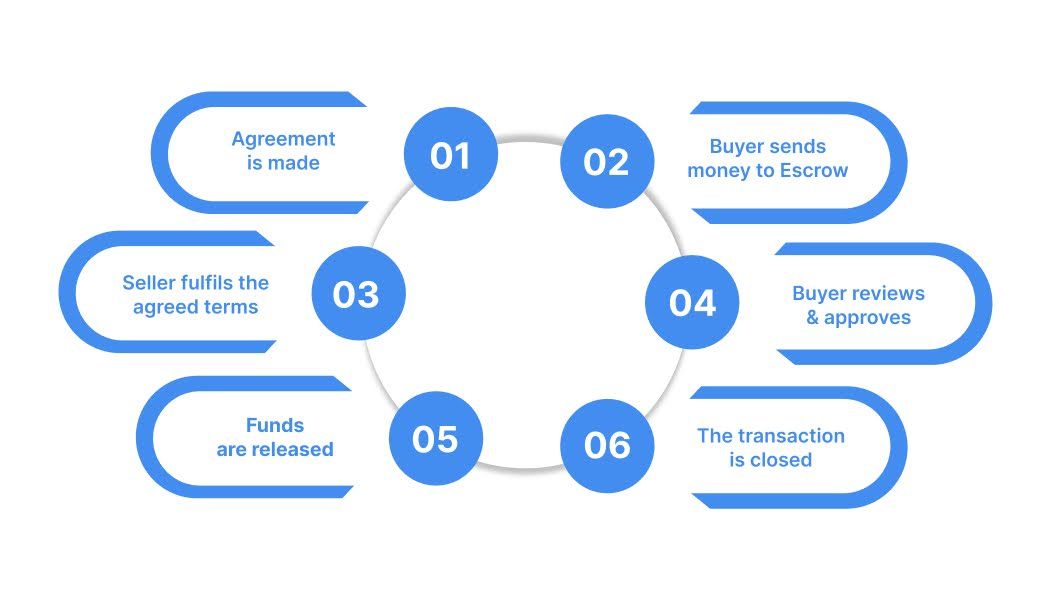
Here is a mechanism of how the Escrow payment process works.
Step 1: Agreement is made
Buyer and seller agree on the terms of the deal (like price, delivery, conditions, etc.).
Step 2: Buyer sends money to Escrow
The buyer deposits the payment into a secure escrow account, rather than sending it directly to the seller.
Step 3: Seller fulfils the agreed terms
The seller delivers the product, service, or asset as specified in the agreement (e.g., a house, goods, or a service).
Step 4: Buyer reviews & approves
The buyer checks if everything is in order, inspects a house, or verifies a product delivery.
Step 5: Funds are released
Once the buyer is satisfied, the escrow agent releases the money to the seller.
Step 6: The transaction is closed
Both parties complete the deal securely, reducing the risk of fraud or non-fulfilment.
In short, escrow ensures both parties fulfil their obligations before any money changes hands, thus protecting everyone involved.
What are the benefits of using an escrow payment?
Escrow payments have experienced a surge in recent times, with the services expected to reach $12.4 billion globally by 2028. Having said that, let’s take a look at some of the benefits of escrow payments and why they have been revered so much.
Enhanced security: Escrow ensures the security of both the buyer and seller against fraud and non-delivery by holding funds with a trusted third party (or a bank) until all conditions of the deal are met.
Risk mitigation in complex transactions: Escrow helps reduce risks in transactions like trade, M&A (Mergers and Acquisitions), FDI (Foreign Direct Investment), and freelancing by reassuring both parties that their assets or funds are in safe hands.
Regulatory compliance: Escrow payments comply with key regulations, including FEMA, tax laws, and AML (Anti-Money Laundering) laws, particularly in international transactions.
Trust and reliability in cross-border deals: In international transactions, escrow provides a neutral third-party mechanism that fosters trust, ensuring the deal is executed according to the expectations of all parties.
With the benefits discussed, it is clear how escrow offers protection, security, and trust for both parties involved. So, what are the different types of escrow accounts that cater to various needs? Let’s discuss some use cases.
What are the different types of escrow accounts?
An escrow account is created by an escrow agency, with both the buyer and seller (or their legal representatives) listed as joint account holders. These accounts are useful in many situations, both professionally and personally.
1. Escrow in real estate transactions
In real estate transactions, an escrow account ensures all conditions are met before finalizing the sale. There are two primary types of escrow accounts in this context:
A. Real Estate (Pre-Closing) Escrow account: This account holds funds, instructions, and necessary documents during the home-buying process. It safeguards both buyer and seller by ensuring that no funds or property change hands until all contractual obligations are fulfilled.
For example, if a home inspection reveals that repairs are needed, the escrow holds the money until those repairs are completed.
Here is a video that explains escrow in real estate transactions.
What Is Escrow?
B. Mortgage Escrow (impound) account: Established by the lender, this account collects monthly instalments from the homeowner to cover property taxes and homeowners' insurance premiums.
By including these costs in the monthly mortgage payment, the lender ensures timely payment of these obligations, further reducing the risk of debt or loss due to unpaid taxes or insurance lapses.
2. Escrow in online transactions
In online transactions, escrow makes it safer for both buyers and sellers. Many people worry about paying online before receiving a product, especially if it turns out to be faulty or doesn’t arrive at all. To solve this, platforms use escrow accounts where the payment is held until the order is delivered and verified.
Take Flipkart, for example. It doesn’t manufacture most of the items it sells, but it connects buyers with different sellers. When you place an order, your payment goes into an escrow account.
Once the product is delivered and confirmed, Flipkart releases the payment to the seller, deducting a commission. This process protects buyers, supports genuine sellers, and builds trust in online shopping.
3. Escrow in B2B transactions
In B2B marketplaces, buyers often place large orders and naturally want assurance that they will receive high-quality goods. An escrow account provides a safe middle ground, holding funds until the buyer receives and approves the goods.
Let’s take an example: A buyer orders 1,000 custom chairs. The payment goes into escrow. Upon delivery, the buyer finds that 100 chairs are damaged. In this case, the buyer can submit a claim, such as a refund or return request, before the escrow holding period ends.
If the supplier refuses to comply, the escrow arrangement provides a framework for resolving disputes and safeguarding the buyer’s investment. This way, buyers can address quality issues without financial risk, making the transaction smoother and more secure. Refer to our guide on export payment terms to explore your options and make better-informed decisions.
For buyers and sellers involved in cross-border B2B transactions, PayGlocal can be an ideal partner. By handling currency exchanges for over 180 countries and ensuring fast, secure payments, PayGlocal helps simplify global deals while maintaining high compliance standards.
4. Escrow in the stock market
Escrow is also used in the stock market, particularly for stock bonuses or options awarded to executives or shareholders.
For example, in corporate settings, stock bonuses or options are sometimes placed in escrow until certain conditions are met, such as the shareholder remaining with the company for a set period. Thereby releasing the stock only under agreed-upon terms, aligning the interests of both the company and the individual receiving the bonus.
These different types of escrow accounts demonstrate the versatility of escrow across various industries, including real estate, online sales, and the stock market. But beyond just the types, it’s essential to understand how escrow safeguards both parties involved in the process.
How does escrow protect both parties in financial transactions?
Escrow is not just about holding funds. It is a neutral system that is designed to protect both parties by ensuring trust, fairness, and compliance at every stage of a transaction. The table below provides a detailed breakdown.
Knowing how escrow protects both parties gives a clear picture of its value in high-stakes transactions. But protection only works when there are clear rules in place.
Under what conditions are escrow funds released?
The escrow funds are released only if both parties agree that all the conditions in the escrow agreement have been satisfied, such as the delivery of goods or the successful completion of inspections. Here are some other conditions under which the escrow funds could be released.
Satisfaction of specific conditions: Funds may be released upon meeting specific conditions, such as inspection approvals or proof of payment.
Approval from all parties: Escrow funds can be released when both parties agree to the terms and confirm that all conditions have been met.
Time-based conditions: Certain agreements specify a time frame within which funds must be released, such as after a long-stop date in high-yield bond transactions or within 30 to 60 days in real estate deals.
Verification of performance: Escrow agents may require verification that all contractual conditions are satisfied before releasing funds, although they typically rely on pre-agreed certificates for confirmation.
Inspection period expiry: In online escrow transactions, funds are released if the inspection period expires without any disputes raised by the buyer.
Knowing when and how escrow funds are released helps clarify the process and builds confidence for both parties involved. But like any system, escrow has its limitations.
If you're looking for a smoother, faster alternative to escrow, PayGlocal offers a solution with real-time international payments, lower fees, and seamless currency conversion.
How PayGlocal simplifies global payments
PayGlocal is a next-generation cross-border payment platform designed to streamline international transactions while maintaining the security and trust businesses expect from escrow services.
Unlike traditional escrow, which involves holding funds, paperwork, and waiting periods, PayGlocal accelerates payment cycles without compromising on regulatory compliance or payment protection. Here’s how PayGlocal addresses common challenges faced with traditional escrow systems:
Dynamic checkout: Create a frictionless payment experience tailored to your customers' currency, language, and region. PayGlocal’s smart checkout adapts in real-time, increasing the likelihood of completed transactions and reducing cart abandonment in global e-commerce.
Card payments: Accept all major international credit and debit cards securely. Whether your customer is in the U.S., Europe, or Southeast Asia, PayGlocal ensures seamless payment authorization and settlement with bank-grade security.
Global payment methods: Let your customers pay the way they prefer. PayGlocal supports payment methods across 180+ countries, including local wallets, net banking, and bank transfers, enabling a broader reach and increased trust with international buyers.
Recurring payments: Set up automatic billing for subscriptions, retainers, or milestone-based payments. With PayGlocal, you can streamline repeat transactions, reduce delays, and improve your cash flow with predictable income.
Multi-currency account: Receive and hold funds in 130+ global currencies directly through your PayGlocal account. This feature reduces the need for frequent conversions, saving on forex fees and giving you more control over when and how you convert funds.
One platform for global transactions: Manage your entire international payment workflow, tracking, reconciliation, compliance, and customer support through one intuitive dashboard. No need to juggle multiple tools or systems.
Sanction screening (SamruddhiX): Ensure every transaction complies with global regulatory frameworks. PayGlocal’s proprietary tool, SamruddhiX, automatically screens payments for AML, KYC, and sanction-list violations, helping you avoid legal risks and delays.
By eliminating delays, lowering costs, and offering complete transparency, PayGlocal serves as a smarter, faster alternative to escrow, especially for global sellers, freelancers, and exporters who value speed and compliance equally.
To wrap things up, here’s a quick recap of what makes escrow valuable and when alternatives are more effective.
Conclusion
Escrow is more than just a safety net; it's a crucial mechanism that ensures fairness, trust, and security in transactions. By holding funds or assets with a neutral third party, escrow guarantees that both parties meet their obligations before money or goods are exchanged.
Whether it's a real estate deal, an online purchase, or a business transaction, escrow helps mitigate risks such as fraud, non-payment, or incomplete agreements.
While escrow offers a reliable framework for managing high-value transactions, it isn’t the most efficient solution in cross-border scenarios where delays, currency conversion issues, and regulatory complexities can disrupt cash flow and trust.
PayGlocal bridges this gap with a faster, more intelligent alternative. Explicitly designed for global commerce, it helps businesses to accept international payments in 33+ currencies across 180+ countries with features such as:
Dynamic checkout
Real-time currency conversion
Built-in compliance tool (SamruddhiX)
For exporters, freelancers, and global sellers seeking a secure, scalable, and efficient way to manage cross-border payments, PayGlocal provides the reliability of escrow, without the wait. Get Started Today!