
The Goods and Services Tax (GST) system is a key component of India's taxation framework, and understanding which goods and services are exempt from GST can lead to savings and benefits for businesses. Examples of goods or services for which GST is not applicable include basic food items, healthcare services, education, and some financial services.
The Ministry of Finance reports that gross GST collections for the financial year 2024-2025 have already touched ₹44,825 crore, underscoring GST's growing significance in India’s economy. This sharp rise in collections makes it even more critical for businesses to stay informed about GST exemptions to comply with and manage tax obligations.
Are you aware of the GST exemptions that could benefit your business? Keep reading to find out how these exemptions work, the latest updates from the 55th GST Council Meeting in December 2024, and how you can use this knowledge to optimize your financial strategy.
GST exemption means that certain goods and services are not subject to Goods and Services Tax (GST). This means businesses don’t have to charge GST on these items, and consumers don’t pay GST on them.
GST exemptions can change over time and differ across countries. Both the Central and State Governments have the authority to provide these exemptions. In simple terms, GST exemption is like a "free pass" from the regular tax system for specific goods or services.
Here are some conditions under which the Central or State Governments in India may grant GST exemptions to ease the tax burden on essential goods and services or support particular sectors.
Knowing these exemptions will help businesses engage in cross-border transactions. Exports are generally zero-rated under GST, meaning no tax is levied, but input tax credits can be claimed.
GST exemptions refer to goods and services that are not subject to GST. These exemptions are divided into 4 main categories.
This exemption applies to specific suppliers, those involved in non-profit or public welfare activities, regardless of the goods or services they provide.
Example: Charitable organizations are exempt from GST if they are registered under Section 12AA of the Income Tax Act and provide services related to healthcare, education for disadvantaged groups, or environmental preservation.
Certain goods and services are exempt from GST regardless of the supplier due to their essential nature. This focuses on the type of supply rather than the entity providing it.
Example: Pre-school and primary education are exempt, but higher education and online courses are taxed at 18%. Healthcare services are exempt, but cosmetic surgeries are taxed. Basic food items like fruits and vegetables are exempt, while packaged versions attract GST.
An absolute exemption means a supply is entirely exempt from GST without any conditions or limitations.
Example: Utility companies’ transmission and distribution of electricity, and essential food items like fresh milk, fruits, and basic cereals, enjoy absolute exemption to ensure affordability for all income groups.
This type of exemption is subject to certain conditions or restrictions. The exemption may apply fully or partially based on specific criteria, such as limits on supply value or the nature of usage.
Example: Hospital room charges are exempt from GST if the daily charge does not exceed ₹5,000, while rooms exceeding this limit attract 5% GST. However, ICU, CCU, ICCU, and NICU rooms remain completely exempt regardless of charges.
These exemptions are designed to keep essential services affordable, support key sectors, and promote fair taxation. It’s all about making the tax system work for the economy.
List of exempted goods from GST in 2025
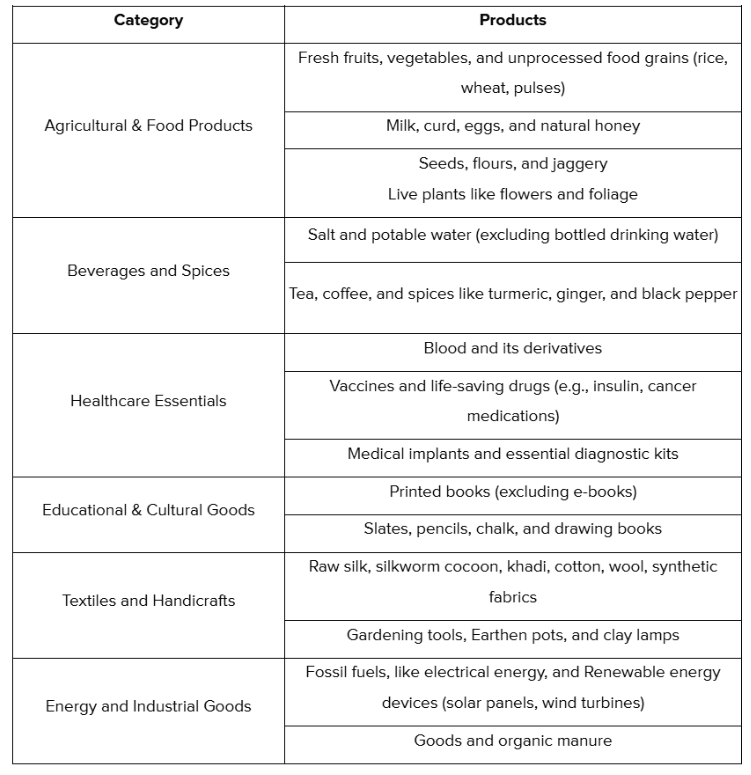
Agricultural products, healthcare items, educational materials, and more are exempt from GST, which helps to reduce the tax burden on major sectors.
Agricultural products, healthcare items, educational materials, and more are exempt from GST, which helps to reduce the tax burden on major sectors.
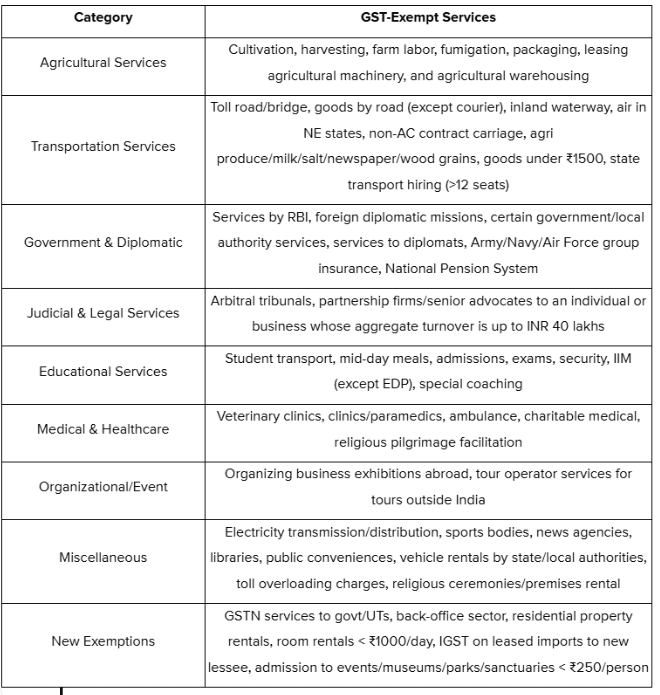
The following services are exempt from GST to promote public welfare, ease the burden on essential sectors, and boost economic growth. These exemptions cover various services, including agricultural, transportation, judicial, medical, and educational services.
These exemptions cover a wide range of services, but what constitutes an "exempt supply" under GST helps clarify how these exemptions apply across different industries and sectors.
Here is a complete list of Exempted Goods Under GST
List-of-exempted-goods-under-gst-pdf-1.pdf
An exempt supply under GST means goods or services that aren’t taxed. This includes items with zero percent GST, fully exempted goods, or non-taxable products like alcohol. Here is a breakdown of the categories.
No GST is required to be paid on these supplies. However, an input tax credit related to exempt supplies cannot be claimed or used to offset GST liability.
Note: Although zero-rated supplies don’t charge GST, businesses can’t claim back any tax paid on exempt supplies (like on healthcare or education services). Zero-rated supplies, such as exports, are different from items with no tax rate.
Also Read: Understanding Types of GST: IGST, CGST, SGST, and UTGST in India
The government provides several GST exemptions for startups under the law to promote growing new-age companies and small businesses. Based on turnover and income levels, startups can benefit from several GST exemptions.
Many small businesses face difficulties with international transactions, currency conversion, and ensuring GST compliance. PayGlocal provides a seamless solution for these businesses dealing with exports or cross-border sales.
All supplies fall under Taxable, which is regular, Nil-Rated, Zero-Rated supplies, and Non-Taxable category, which is Exempt supplies and Non-GST supplies. Here’s a quick breakdown of each category.
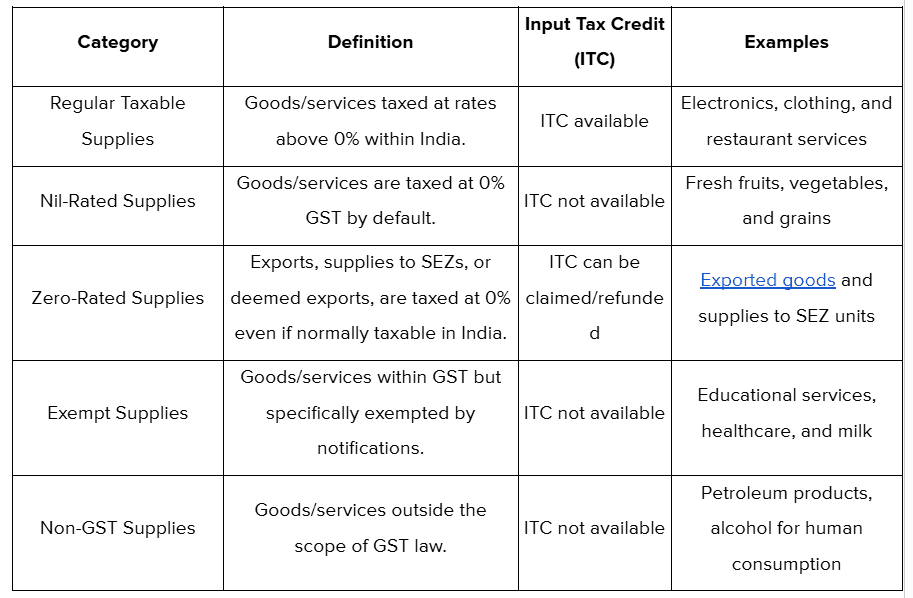
The different GST supply categories, such as Exempt, Nil Rated, Zero Rated, and Non-GST supplies, are crucial for businesses to manage their tax obligations effectively. Recent changes to the exemption rules provide further clarity and guidance on how these categories are applied.
The recent recommendations from the 55th GST Council meeting provide valuable insights for those in sectors such as healthcare, insurance, and payment services.
Being familiar with GST exemptions is important for businesses to maintain compliance and achieve financial relief. Identifying exempt goods and services helps reduce the tax burden on essential services and supports critical sectors like healthcare, agriculture, and education. For small businesses and start-ups, staying updated on these exemptions is key for effective financial planning.
For businesses involved in cross-border transactions or international sales, PayGlocal offers simple payment solutions, making it easier to handle GST-exempt goods and services in global transactions. Whether you're a small business or a start-up, PayGlocal helps you manage payments and stay compliant, so you can focus on growing your business. Get Started Today!
Goods are exempt from GST for several reasons, including ensuring that essential products remain affordable and accessible to all, particularly lower-income groups. This also helps support the overall welfare and health of the population.
No, exports are classified as zero-rated supplies, meaning they are taxed at 0%, and exporters are eligible to claim a refund for input taxes.
Yes, GST does not apply to agricultural training services provided by recognized agencies.
Yes, non-AC public transport services, including rail, metro, and buses, are exempt from GST to help keep commuting costs affordable.
The Ministry of Finance reports that gross GST collections for the financial year 2024-2025 have already touched ₹44,825 crore, underscoring GST's growing significance in India’s economy. This sharp rise in collections makes it even more critical for businesses to stay informed about GST exemptions to comply with and manage tax obligations.
Are you aware of the GST exemptions that could benefit your business? Keep reading to find out how these exemptions work, the latest updates from the 55th GST Council Meeting in December 2024, and how you can use this knowledge to optimize your financial strategy.
What is GST exemption?
GST exemption means that certain goods and services are not subject to Goods and Services Tax (GST). This means businesses don’t have to charge GST on these items, and consumers don’t pay GST on them.
GST exemptions can change over time and differ across countries. Both the Central and State Governments have the authority to provide these exemptions. In simple terms, GST exemption is like a "free pass" from the regular tax system for specific goods or services.
GST exemption rules 2025: What’s covered?
Here are some conditions under which the Central or State Governments in India may grant GST exemptions to ease the tax burden on essential goods and services or support particular sectors.
- Purpose of GST Exemptions: GST exemptions are granted to promote social welfare and economic development or support essential sectors. For instance, exemptions on healthcare and education services make these critical services more accessible to the public.
- Focus on Social Welfare and Key Sectors: Exemptions are formalized through official notifications issued by the Central or State Governments. These notifications specify the exempt goods or services and any conditions that may be attached. Businesses must refer to these to determine applicability.
- Exemptions Through Official Notifications: The GST Council, comprising the Union Finance Minister and State Finance Ministers, plays an important role in recommending exemptions. Their recommendations ensure that exemptions are aligned with national economic policies and objectives.
- Exemptions via Special Government Orders: Exemptions can be granted through special orders issued by the government, especially when immediate relief is required in exceptional situations.
- Absolute Exemptions Without Conditions: When an absolute exemption is applied, the activity is fully exempt from GST without any conditions, such as the transmission or distribution of electricity.
Knowing these exemptions will help businesses engage in cross-border transactions. Exports are generally zero-rated under GST, meaning no tax is levied, but input tax credits can be claimed.
Types of GST exemption in India
GST exemptions refer to goods and services that are not subject to GST. These exemptions are divided into 4 main categories.
1. Supplier-based exemption
This exemption applies to specific suppliers, those involved in non-profit or public welfare activities, regardless of the goods or services they provide.
Example: Charitable organizations are exempt from GST if they are registered under Section 12AA of the Income Tax Act and provide services related to healthcare, education for disadvantaged groups, or environmental preservation.
2. Supply-based exemption
Certain goods and services are exempt from GST regardless of the supplier due to their essential nature. This focuses on the type of supply rather than the entity providing it.
Example: Pre-school and primary education are exempt, but higher education and online courses are taxed at 18%. Healthcare services are exempt, but cosmetic surgeries are taxed. Basic food items like fruits and vegetables are exempt, while packaged versions attract GST.
3. Absolute exemption
An absolute exemption means a supply is entirely exempt from GST without any conditions or limitations.
Example: Utility companies’ transmission and distribution of electricity, and essential food items like fresh milk, fruits, and basic cereals, enjoy absolute exemption to ensure affordability for all income groups.
4. Conditional or partial exemption
This type of exemption is subject to certain conditions or restrictions. The exemption may apply fully or partially based on specific criteria, such as limits on supply value or the nature of usage.
Example: Hospital room charges are exempt from GST if the daily charge does not exceed ₹5,000, while rooms exceeding this limit attract 5% GST. However, ICU, CCU, ICCU, and NICU rooms remain completely exempt regardless of charges.
These exemptions are designed to keep essential services affordable, support key sectors, and promote fair taxation. It’s all about making the tax system work for the economy.
List of exempted goods from GST in 2025
Agricultural products, healthcare items, educational materials, and more are exempt from GST, which helps to reduce the tax burden on major sectors.
List of exempted goods from GST in 2025
Agricultural products, healthcare items, educational materials, and more are exempt from GST, which helps to reduce the tax burden on major sectors.
List of exempted services from GST in 2025
The following services are exempt from GST to promote public welfare, ease the burden on essential sectors, and boost economic growth. These exemptions cover various services, including agricultural, transportation, judicial, medical, and educational services.
These exemptions cover a wide range of services, but what constitutes an "exempt supply" under GST helps clarify how these exemptions apply across different industries and sectors.
Here is a complete list of Exempted Goods Under GST
List-of-exempted-goods-under-gst-pdf-1.pdf
What is an exempt supply under GST?
An exempt supply under GST means goods or services that aren’t taxed. This includes items with zero percent GST, fully exempted goods, or non-taxable products like alcohol. Here is a breakdown of the categories.
- Goods or services that are subject to a zero percent (0%) tax rate, meaning businesses do not collect GST, but they can claim tax refunds for any GST paid on inputs. This generally applies to exports and supplies to Special Economic Zones (SEZs).
- Items that have been fully or partially exempted from Central or Integrated GST through official notifications modifying Section 11 of the CGST Act or Section 6 of the IGST Act.
- Non-taxable goods or services as outlined in Section 2 (78), meaning those not covered under the GST framework (such as alcoholic beverages).
No GST is required to be paid on these supplies. However, an input tax credit related to exempt supplies cannot be claimed or used to offset GST liability.
Note: Although zero-rated supplies don’t charge GST, businesses can’t claim back any tax paid on exempt supplies (like on healthcare or education services). Zero-rated supplies, such as exports, are different from items with no tax rate.
Also Read: Understanding Types of GST: IGST, CGST, SGST, and UTGST in India
GST exemption for start-ups and small businesses
The government provides several GST exemptions for startups under the law to promote growing new-age companies and small businesses. Based on turnover and income levels, startups can benefit from several GST exemptions.
- Quarterly filing option: Small businesses with income below ₹5 crore (annual turnover) can opt for a quarterly GST filing system.
- GST exemption based on turnover: Businesses with a turnover below ₹50 lakh are recognized as GST-exempt.
- Exemption from e-invoicing: Small businesses are exempt from e-invoicing under GST unless their turnover exceeds ₹50 crore, in which case, e-invoicing becomes mandatory.
- Composition scheme for small businesses: Businesses with an annual turnover of around ₹1.5 crore can avail of the composition scheme, paying tax at a fixed rate of 6%.
Many small businesses face difficulties with international transactions, currency conversion, and ensuring GST compliance. PayGlocal provides a seamless solution for these businesses dealing with exports or cross-border sales.
Differences among GST supply categories
All supplies fall under Taxable, which is regular, Nil-Rated, Zero-Rated supplies, and Non-Taxable category, which is Exempt supplies and Non-GST supplies. Here’s a quick breakdown of each category.
The different GST supply categories, such as Exempt, Nil Rated, Zero Rated, and Non-GST supplies, are crucial for businesses to manage their tax obligations effectively. Recent changes to the exemption rules provide further clarity and guidance on how these categories are applied.
Recent changes in GST exemption policies
The recent recommendations from the 55th GST Council meeting provide valuable insights for those in sectors such as healthcare, insurance, and payment services.
- GST Exemption for Gene Therapy: GST has been fully exempted on gene therapy, making advanced medical treatments more affordable for patients.
- No GST on Penal Charges by Banks/NBFCs: Penal charges for loan non-compliance collected by banks and NBFCs are exempt from GST.
- Exemption for Agricultural Supplies: Supplies of dried black pepper and raisins by agriculturists remain exempt from GST to support small and marginal farmers.
- Reduced GST on Fortified Rice Kernel (FRK): GST rate on FRK reduced to 5%.
- Compensation Cess Relief for Merchant Exporters: Compensation cess on supplies to merchant exporters reduced to 0.1%.
- No GST on Individual-to-Individual Used EV Sales: Used electric vehicles sold between individuals are exempt from GST.
- Clarification on SEZ/FTWZ Storage: Goods stored in SEZs/FTWZs will not be taxed until exported or moved to the domestic market.
Conclusion
Being familiar with GST exemptions is important for businesses to maintain compliance and achieve financial relief. Identifying exempt goods and services helps reduce the tax burden on essential services and supports critical sectors like healthcare, agriculture, and education. For small businesses and start-ups, staying updated on these exemptions is key for effective financial planning.
For businesses involved in cross-border transactions or international sales, PayGlocal offers simple payment solutions, making it easier to handle GST-exempt goods and services in global transactions. Whether you're a small business or a start-up, PayGlocal helps you manage payments and stay compliant, so you can focus on growing your business. Get Started Today!
FAQs
1. Why are some goods exempt from GST?
Goods are exempt from GST for several reasons, including ensuring that essential products remain affordable and accessible to all, particularly lower-income groups. This also helps support the overall welfare and health of the population.
2. Is GST applicable to exports?
No, exports are classified as zero-rated supplies, meaning they are taxed at 0%, and exporters are eligible to claim a refund for input taxes.
3. Are agricultural training programs exempt from GST?
Yes, GST does not apply to agricultural training services provided by recognized agencies.
4. Is public transport exempt from GST?
Yes, non-AC public transport services, including rail, metro, and buses, are exempt from GST to help keep commuting costs affordable.