
India's service exports reached $387.5 billion in 2024-25. This represents the actual revenue flowing into the country from clients worldwide.
The growing service exports industry indicates that global companies trust Indian service providers more than ever. They're expanding their partnerships, increasing project sizes, and looking for new providers who can deliver quality work reliably.
Let’s take a detailed look at the service export industry in India and find out which sectors drive growth, where demand comes from, and how you can efficiently accept international payments to grow your business globally.
India's service exports refer to services provided by Indian businesses and professionals to clients in other countries. These include IT services, consulting, financial advisory, healthcare, education, and professional services delivered across borders.
Unlike merchandise exports, which involve shipping physical products, service exports are intangible. When your software company builds an application for a client in London, that's a service export. When a consultant advises a business in Dubai, that counts too. The value comes from expertise and specialized skills rather than manufactured goods.
What makes this sector notable is the growth pattern. Service exports expanded from $152 billion in 2013-14 to $387.5 billion in 2024-25. This growth reflects India's competitive position in the global services market.
India’s service export market has grown consistently over the years. Services exports grew 13.6% in 2024-25 from the previous year. In March 2025 alone, services exports stood at $35.6 billion, reflecting an 18.6% year-on-year growth. Here's what drives this fast growth of the market size:
Diverse sector base: Computer services and business services together account for around 70% of service exports. The remaining 30% comes from financial services, professional consulting, and other categories.
Global client reach: Indian service providers serve clients across 180+ countries. This geographical spread means your potential client base spans multiple markets and time zones.
Strong sector performance: The service sector grew 8.3% from FY23 to FY25, outpacing many other sectors during uncertain economic times.
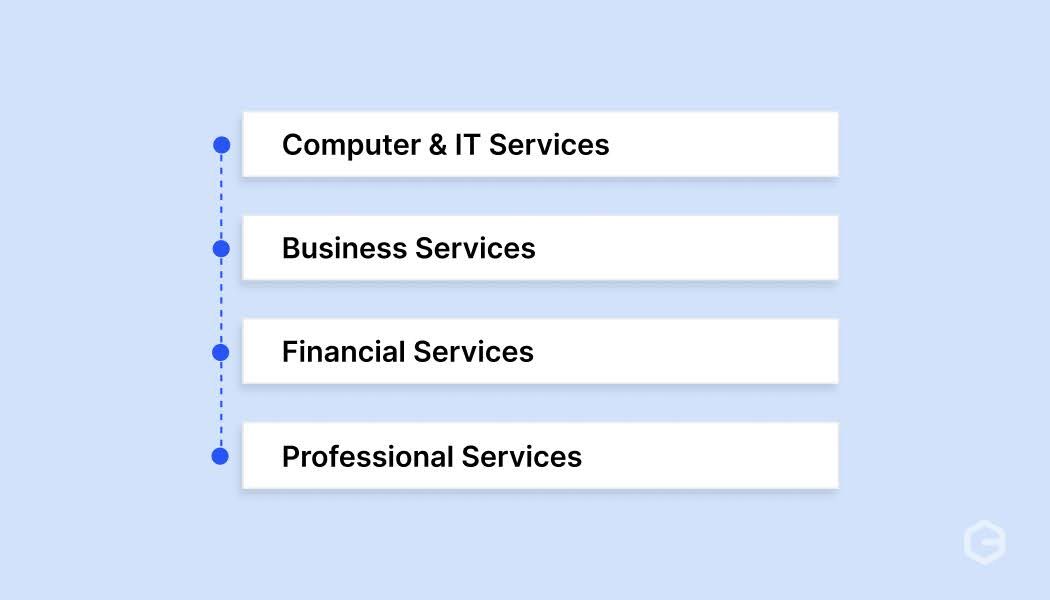
Several major sectors contribute to India's service export performance. Each has distinct characteristics and serves different global markets.
Here are the main sectors that power India's service exports:
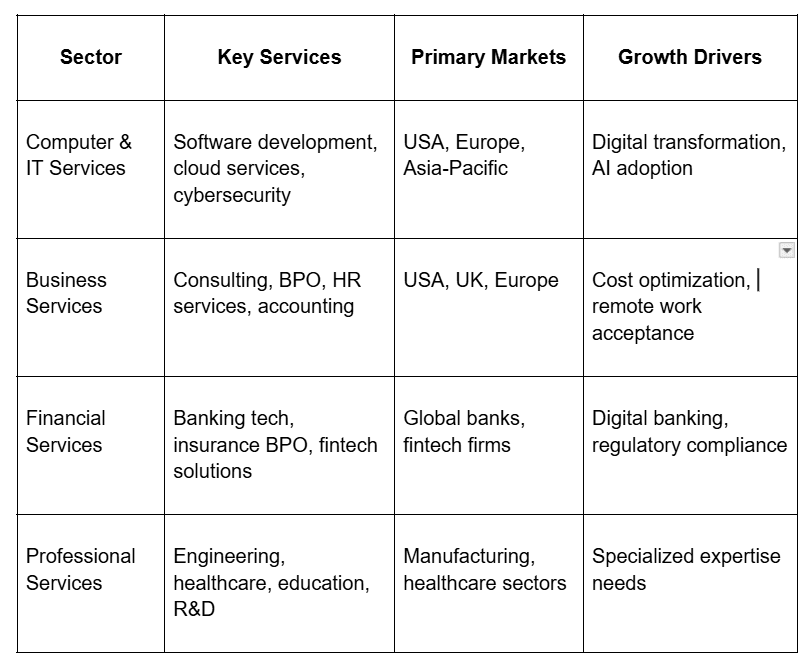
Let's look at what makes each sector successful.
Computer services represent the largest category within India's service exports. This includes software development, cloud services, IT consulting, data analytics, and cybersecurity. Indian IT companies serve clients across industries from banking to healthcare to retail.'
The sector benefits from India's technical education system and English-speaking workforce. Companies can scale teams quickly to meet client needs.
Business process management and professional services form another major category. This covers consulting, market research, human resources, legal process outsourcing, and accounting services. Many global companies now have dedicated teams in India handling various business functions.
The competitive advantage comes from cost efficiency paired with quality output. A finance team in Mumbai can handle month-end closing for a company in New York at a fraction of the cost while maintaining accuracy and timeliness.
Financial services exports include banking technology, insurance BPO, wealth management support, and fintech solutions. Global banks and insurance companies use Indian providers for transaction processing, risk analytics, and customer service operations.
India's fintech ecosystem adds another dimension. Indian companies develop financial products and services that are being adopted internationally. Payment solutions, lending platforms, and wealth management tools created in India now serve global markets.
Engineering services, architecture, healthcare services, and education round out the major categories. Indian engineers support global manufacturing companies with design and testing services. Medical tourism brings international patients to Indian hospitals. Online education platforms teach students worldwide.
Each sector has its own growth drivers. IT services benefit from digital transformation initiatives. Business services grow as companies optimize operations. Financial services expand with fintech innovation. Professional services see demand from specialized expertise needs.
The diversity provides stability. When one sector faces headwinds, others maintain momentum. For your business, opportunities exist across multiple domains. Pick the sector that matches your capabilities and start building your international client base.
Indian service providers serve clients globally, but certain markets account for larger shares of exports.
India's position as a top service exporter comes from several factors working together. These create advantages that are difficult for other markets to replicate quickly.
Cost efficiency with quality: Indian service providers offer significant cost savings compared to providers in developed markets. A company hiring developers or consultants in India pays less than hiring similar talent in the USA or Europe. The key is that lower cost comes with maintained quality standards. Clients get value, not just cheaper prices.
English proficiency: India has a large English-speaking population. This creates a natural fit for serving English-speaking markets. Your teams can communicate directly with clients in the USA, UK, Australia, and other markets without language barriers that affect some other service delivery locations.
Technical talent pipeline: India produces a large number of engineering and technical graduates annually. This creates a talent pool for service companies to hire from. You can scale teams to meet client needs without facing the talent shortages common in smaller markets.
Time zone flexibility: India's time zone provides some overlap with both European and American markets. With schedule adjustments, teams can support clients across different regions. This flexibility allows for faster response times and better client service.
Digital infrastructure: India has invested in digital connectivity and cloud infrastructure. High-speed internet is widely available in major cities. This infrastructure supports modern service delivery, including remote work and cloud collaboration.
* GCC ecosystem: India hosts over 1700 Global Capability Centers employing up to 1.9 million professionals as of FY24. These centers represent long-term commitments by global companies. They validate India's capabilities and create demonstration effects that attract more business.
Track record: Years of consistent service delivery have built trust. When you tell a potential client you're based in India, it signals capability. This trust took years to build, but now accelerates new business development.
These factors create the foundation. Individual businesses still need to execute well on client delivery, relationship management, and operations, including payment acceptance.
Efficiently accepting payments matters more than many service exporters realize. When clients can pay you easily and funds reach your account quickly with proper documentation, your operations run smoothly.
However, with traditional payment methods, you often face delays, high fees, and complex currency conversion, which slow cash flow and increase administrative work. You need a payment infrastructure that matches your service delivery quality. That’s where PayGlocal comes in.
Here’s how PayGlocal can help you:
With PayGlocal, your clients pay in their preferred currency and via their preferred method. You receive funds in INR in your Indian account, and compliance documentation, such as FIRC generation, happens automatically. So, you can focus on growing your business while ensuring better payment acceptance processes.
India's service export sector reached $387.5 billion in 2024-25, representing significant economic activity and opportunity. Global clients seek Indian service providers across IT, business services, consulting, and professional categories. The market exists, and demand is proven.
Start by delivering quality services to your international clients. Then set up payment systems that work smoothly across different countries and currencies.
PayGlocal handles the payment processes so you can focus on serving clients. You get local accounts in major currencies, instant compliance documents, and clear tracking from payment to settlement.
Get started with PayGlocal today and make your global payment acceptance fast, secure, and efficient.
The growing service exports industry indicates that global companies trust Indian service providers more than ever. They're expanding their partnerships, increasing project sizes, and looking for new providers who can deliver quality work reliably.
Let’s take a detailed look at the service export industry in India and find out which sectors drive growth, where demand comes from, and how you can efficiently accept international payments to grow your business globally.
Key takeaways
- IT-BPM sector dominates: Computer services and business services account for around 70% of India's services exports, with IT services representing the largest single category.
- Global position strengthens: India ranks 7th globally in service exports with a 4.3% market share, up from 1.9% in 2005.
- GCC hub advantage: India hosts over 1700 Global Capability Centers employing nearly 1.9 million professionals as of FY24.
- Strong sector performance: The services sector grew by 8.3% from FY23 to FY25, maintaining a steady growth momentum.
- Multi-currency payments matter: Service exporters need payment solutions like PayGlocal that offer local accounts in USD, GBP, EUR, and CAD to collect from international clients seamlessly.
What are India's service exports?
India's service exports refer to services provided by Indian businesses and professionals to clients in other countries. These include IT services, consulting, financial advisory, healthcare, education, and professional services delivered across borders.
Unlike merchandise exports, which involve shipping physical products, service exports are intangible. When your software company builds an application for a client in London, that's a service export. When a consultant advises a business in Dubai, that counts too. The value comes from expertise and specialized skills rather than manufactured goods.
What makes this sector notable is the growth pattern. Service exports expanded from $152 billion in 2013-14 to $387.5 billion in 2024-25. This growth reflects India's competitive position in the global services market.
How fast is India's service export market growing?
India’s service export market has grown consistently over the years. Services exports grew 13.6% in 2024-25 from the previous year. In March 2025 alone, services exports stood at $35.6 billion, reflecting an 18.6% year-on-year growth. Here's what drives this fast growth of the market size:
Diverse sector base: Computer services and business services together account for around 70% of service exports. The remaining 30% comes from financial services, professional consulting, and other categories.
Global client reach: Indian service providers serve clients across 180+ countries. This geographical spread means your potential client base spans multiple markets and time zones.
Strong sector performance: The service sector grew 8.3% from FY23 to FY25, outpacing many other sectors during uncertain economic times.
What sectors drive India's service exports?
Several major sectors contribute to India's service export performance. Each has distinct characteristics and serves different global markets.
Here are the main sectors that power India's service exports:
Let's look at what makes each sector successful.
Computer and IT services
Computer services represent the largest category within India's service exports. This includes software development, cloud services, IT consulting, data analytics, and cybersecurity. Indian IT companies serve clients across industries from banking to healthcare to retail.'
The sector benefits from India's technical education system and English-speaking workforce. Companies can scale teams quickly to meet client needs.
Business services
Business process management and professional services form another major category. This covers consulting, market research, human resources, legal process outsourcing, and accounting services. Many global companies now have dedicated teams in India handling various business functions.
The competitive advantage comes from cost efficiency paired with quality output. A finance team in Mumbai can handle month-end closing for a company in New York at a fraction of the cost while maintaining accuracy and timeliness.
Financial services
Financial services exports include banking technology, insurance BPO, wealth management support, and fintech solutions. Global banks and insurance companies use Indian providers for transaction processing, risk analytics, and customer service operations.
India's fintech ecosystem adds another dimension. Indian companies develop financial products and services that are being adopted internationally. Payment solutions, lending platforms, and wealth management tools created in India now serve global markets.
Professional and technical services
Engineering services, architecture, healthcare services, and education round out the major categories. Indian engineers support global manufacturing companies with design and testing services. Medical tourism brings international patients to Indian hospitals. Online education platforms teach students worldwide.
Each sector has its own growth drivers. IT services benefit from digital transformation initiatives. Business services grow as companies optimize operations. Financial services expand with fintech innovation. Professional services see demand from specialized expertise needs.
The diversity provides stability. When one sector faces headwinds, others maintain momentum. For your business, opportunities exist across multiple domains. Pick the sector that matches your capabilities and start building your international client base.
Where does India export services?
Indian service providers serve clients globally, but certain markets account for larger shares of exports.
- USA: The USA is India's largest service export market. American companies across industries use Indian service providers for IT development, business processes, and consulting. The comfort level with India-based delivery models continues to increase. Technology hubs like Silicon Valley, New York, and Boston generate consistent demand.
- UK: The UK is another significant market. British companies seek cost-efficient solutions while maintaining quality standards. London's position as a global financial center creates ongoing opportunities in financial services. UK firms have shown increased interest in flexible service delivery models.
- European Union: The European Union countries collectively form a major market. Germany, France, and the Netherlands are among the top destinations for Indian exports. Manufacturing companies use Indian engineering services. Banks leverage India's financial services expertise. Digital transformation initiatives across Europe drive IT services demand.
- UAE and Middle East: The UAE and broader Middle East region show strong growth. Economic diversification efforts in the Gulf countries create demand for technology implementation, business consulting, and professional services. Many Indian service providers use Dubai as a regional hub.
- Singapore: Singapore acts as both a market and a gateway to Southeast Asia. Financial services and technology consulting see strong demand. The country's role as a regional business hub makes it attractive for serving broader ASEAN markets.
Why does India lead in service exports?
India's position as a top service exporter comes from several factors working together. These create advantages that are difficult for other markets to replicate quickly.
Cost efficiency with quality: Indian service providers offer significant cost savings compared to providers in developed markets. A company hiring developers or consultants in India pays less than hiring similar talent in the USA or Europe. The key is that lower cost comes with maintained quality standards. Clients get value, not just cheaper prices.
English proficiency: India has a large English-speaking population. This creates a natural fit for serving English-speaking markets. Your teams can communicate directly with clients in the USA, UK, Australia, and other markets without language barriers that affect some other service delivery locations.
Technical talent pipeline: India produces a large number of engineering and technical graduates annually. This creates a talent pool for service companies to hire from. You can scale teams to meet client needs without facing the talent shortages common in smaller markets.
Time zone flexibility: India's time zone provides some overlap with both European and American markets. With schedule adjustments, teams can support clients across different regions. This flexibility allows for faster response times and better client service.
Digital infrastructure: India has invested in digital connectivity and cloud infrastructure. High-speed internet is widely available in major cities. This infrastructure supports modern service delivery, including remote work and cloud collaboration.
* GCC ecosystem: India hosts over 1700 Global Capability Centers employing up to 1.9 million professionals as of FY24. These centers represent long-term commitments by global companies. They validate India's capabilities and create demonstration effects that attract more business.
Track record: Years of consistent service delivery have built trust. When you tell a potential client you're based in India, it signals capability. This trust took years to build, but now accelerates new business development.
These factors create the foundation. Individual businesses still need to execute well on client delivery, relationship management, and operations, including payment acceptance.
Get paid easily from global clients with PayGlocal
Efficiently accepting payments matters more than many service exporters realize. When clients can pay you easily and funds reach your account quickly with proper documentation, your operations run smoothly.
However, with traditional payment methods, you often face delays, high fees, and complex currency conversion, which slow cash flow and increase administrative work. You need a payment infrastructure that matches your service delivery quality. That’s where PayGlocal comes in.
Here’s how PayGlocal can help you:
- Multi-currency accounts: Open local accounts in USD, GBP, EUR, and CAD. Your clients pay as if you're a local business, which speeds up processing and increases their comfort level.
- Instant FIRC generation: Get your FIRC (Foreign Inward Remittance Certificate) in your inbox after settlement. No need to wait weeks for compliance documents or paperwork.
- Recurring payment setup: Configure subscriptions for retainer clients or SaaS services. Automatic processing ensures consistent cash flow without manual follow-ups each month.
- Sanction screening: Built-in compliance checks ensure all transactions meet regulatory requirements with automated screening against global sanction lists.
- Zero fixed costs: Pay only on transactions. No setup fees, no platform charges, no documentation fees.
With PayGlocal, your clients pay in their preferred currency and via their preferred method. You receive funds in INR in your Indian account, and compliance documentation, such as FIRC generation, happens automatically. So, you can focus on growing your business while ensuring better payment acceptance processes.
Final thoughts
India's service export sector reached $387.5 billion in 2024-25, representing significant economic activity and opportunity. Global clients seek Indian service providers across IT, business services, consulting, and professional categories. The market exists, and demand is proven.
Start by delivering quality services to your international clients. Then set up payment systems that work smoothly across different countries and currencies.
PayGlocal handles the payment processes so you can focus on serving clients. You get local accounts in major currencies, instant compliance documents, and clear tracking from payment to settlement.
Get started with PayGlocal today and make your global payment acceptance fast, secure, and efficient.