
International commerce works better when payment feels familiar. Customers trust prices in currencies they use daily. When they reach checkout and see unfamiliar currency, they pause, calculate exchange rates, and often abandon the purchase. That’s when you need a multi-currency pricing (MCP) system for your business.
India’s exports reached $73.99 billion in November 2025, growing 15.52% from the previous year. This shows that, year over year, more businesses are selling globally, which means more checkout moments where showing the right currency makes a big difference.
This guide breaks down in detail what multi-currency pricing is, the top benefits, examples, and effective implementation tips.
Multi-currency pricing is a payment strategy that displays product prices in the customer's local currency throughout the shopping experience. Instead of showing USD to every visitor, your store speaks the local language of finance: a customer in France sees EUR, a shopper in Japan sees JPY, and a buyer in the UK sees GBP.
The customer browses, adds items to the cart, and completes payment in their chosen currency. You receive the funds in your home currency. For instance, if your business operates in INR, you receive INR regardless of which currency the customer used.
Multi-currency pricing works through your payment gateway. The gateway handles the currency display and conversion behind the scenes. You set prices in multiple currencies or let the system convert based on exchange rates you approve.
Until a few years ago, international customers were fine with paying in unfamiliar currencies. But now things have changed. Buyers can today compare prices across multiple currencies in seconds and often choose sellers that accept payments in their local currency.
Here are some of the top benefits of setting up multi-currency pricing:
Customers complete more purchases when they see prices in familiar currencies. Cart abandonment drops when customers understand exactly what they pay without doing mental math or worrying about exchange rates.
International approval rates improve because transactions are processed as local currency payments rather than foreign transactions that trigger additional fraud checks.
Showing prices in local currency from the first product page builds confidence. Customers trust businesses that speak their financial language. They do not worry about surprise fees or unclear final costs.
This transparency reduces support questions about pricing and billing. Customers know what they pay before clicking the buy button.
You receive all payments in your home currency. Your accounting system records revenue in one currency. You avoid juggling multiple currency accounts or complex reconciliation processes.
Settlement happens in INR, USD, or your chosen currency, regardless of how many different currencies your customers use. This simplifies financial reporting and cash flow management.
Customers abandon carts when they encounter unexpected costs or confusion at checkout. Multi-currency pricing removes this friction point by displaying clear local prices throughout the journey.
For instance, a UK customer sees GBP prices on product pages, in the cart, and at checkout. No surprises. No reason to abandon the purchase due to currency confusion.
Businesses that offer local currency pricing stand out from competitors who force international customers to pay in foreign currencies. This matters especially in markets where customers have strong preferences for local payment experiences.
You can price strategically in each market, matching local competition or adjusting for regional purchasing power. This flexibility helps you compete more effectively than using a single global price converted automatically.
The importance of multi-currency pricing depends on your business model, customer geography, and how often you process cross-border transactions. Here are some common examples of how MCP plays out across different types of businesses that benefit most.
An Indian clothing brand sells to customers in the US, UK, and Europe. Product pages show USD prices to American visitors, GBP to UK customers, and EUR to European shoppers. A dress priced at ₹4,000 displays as $50 in the US, £38 in the UK, and €45 in Europe based on the brand's pricing strategy for each market.
The customer in London sees £38 throughout browsing and checkout. Their bank statement shows a £38 charge. The Indian merchant receives ₹4,000 after settlement, matching their base currency pricing. For online retail, this local pricing removes the comparison barrier that drives shoppers to competitors who already show familiar prices.
A project management software company based in India charges monthly subscriptions. US customers pay $29 per month, UK customers pay £25, and European customers pay €27. The pricing reflects local market rates rather than direct currency conversion.
When a UK customer subscribes, they see £25 on the pricing page, in their account dashboard, and on monthly invoices. Recurring charges appear as £25 on their card statement. For SaaS businesses, local currency billing reduces failed recurring payments because the transaction processes as a domestic charge rather than a foreign one.
A digital marketing agency in India serves clients in multiple countries. They invoice US clients in USD, Australian clients in AUD, and Canadian clients in CAD. For instance, a $5,000 project for a US client and a $6,500 CAD project for a Canadian client both settle to the agency's INR account.
Clients receive invoices in familiar currencies, which speeds up approval and removes disputes over exchange rates. For service businesses, multi-currency invoicing makes your operation look established and professional to international clients.
Hotels and travel platforms attract international customers who research and compare prices across providers. A traveler from Germany searching for hotels in India is far more likely to complete a booking when they see EUR pricing during the research phase.
If pricing only appears in INR, the traveler has to calculate costs manually, and that extra step often pushes them toward a competitor that already shows prices in EUR.
Businesses shipping products internationally gain a clear advantage when buyers see pricing in their home currency on invoices and payment pages.
For example, an Indian auto parts exporter quoting a UK distributor in GBP removes the mental math from the buying decision and makes your quote directly comparable to local suppliers.
Multi-vendor platforms serving global buyers and sellers create smoother experiences by letting each party transact in preferred currencies. The platform handles conversion and settlement automatically. For instance, a marketplace connecting Indian artisans with buyers in the US, Europe, and the Middle East can show local prices to each buyer while settling with each seller in INR.
Tip: Start with currencies from your top markets rather than enabling all available currencies at once. Focus on quality implementation for key markets before expanding.
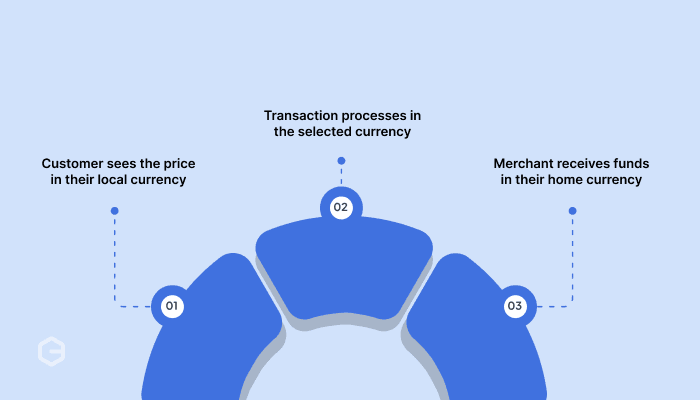
Multi-currency pricing happens automatically behind the scenes. The system follows three main steps to bridge the gap between your customer’s local currency and your bank account.
When a customer visits your site, the system detects their location through browser settings or manual currency selection. Product pages, category pages, and the shopping cart display prices in the detected local currency.
For example, a customer in Germany sees EUR prices immediately. They do not need to mentally convert from USD or wait until checkout to understand the cost.
When the customer clicks pay, the transaction processes in the currency they selected. Their bank sees a charge in EUR, not a foreign currency that triggers additional fees or alerts.
The payment gateway handles the authorization in the local currency. Card networks process the transaction as a local currency payment, which often results in higher approval rates compared to cross-border currency conversions.
After the transaction completes, the payment provider converts the funds to your settlement currency. You receive INR, USD, or whichever currency you specified for settlement.
Your bank statement shows deposits in your home currency. You avoid managing multiple currency accounts or dealing with complex reconciliation. The conversion happens automatically based on the exchange rate agreed with your payment provider.
Businesses often confuse multi-currency pricing and dynamic currency conversion approaches because both involve multiple currencies. But the customer experience and business impact differ significantly.
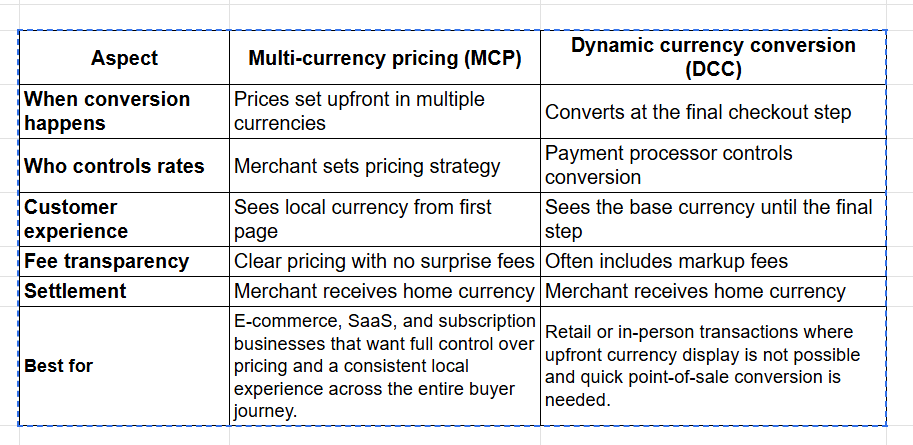
Note: Most payment gateways support both MCP and DCC, but you need to configure which option to offer. Choose MCP for a better customer experience and transparent pricing.
Payment providers charge different fees for multi-currency processing, and these costs directly impact your profit margins. Once you know how the fee structure works, you can choose the right provider and set prices that maintain profitability across all currencies.
Most providers charge a percentage fee per transaction. This ranges generally from 2% to 4%, depending on the provider, your volume, and the currencies involved. Some providers add a separate foreign exchange markup on top of transaction fees, typically 1% to 3% above the mid-market exchange rate.
For example, a provider might charge 3% transaction fee plus 2% FX markup. On a $100 transaction, you pay $5 in total fees. Compare this structure across providers to find transparent pricing that matches your transaction patterns.
Some payment providers charge monthly platform fees or one-time setup costs. These fixed costs matter more for lower-volume businesses. High-volume businesses often negotiate lower per-transaction fees in exchange for monthly minimums.
Look for providers with pay-as-you-grow models if you are just starting international sales. Fixed monthly fees eat into margins when transaction volume is low.
Check how much providers charge to settle funds into your home currency bank account. The payment settlement fee is typically charged as a flat fee per payout, a percentage of the settled amount, or a combination of both.
Frequent settlements with per-transaction settlement fees add up quickly. Consolidating settlements reduces these costs but delays access to funds.
Currency conversion timing is one of the most overlooked cost factors. Providers that convert at the time of transaction lock in a predictable rate. But providers that convert at settlement time put you at risk of exchange rate movement between the sale and the payout. For businesses processing high volumes, even a small rate shift can add up.
Refund processing fees also vary. Some providers charge the same fee for refunds as for original transactions. Others waive refund fees. This matters for businesses with high return rates.
Note: Always ask potential payment providers for their complete fee schedule. Compare the total cost of processing transactions in your target currencies to get a complete picture of the fee structure.
Implementation success depends on choosing compatible technology and making smart decisions about pricing strategy before you go live. Rushing the setup without planning creates problems that are harder to fix later.
Your payment gateway must handle transactions in the currencies you want to offer. Verify they support authorization in each target currency and settlement in your home currency.
Check their currency coverage, conversion rate transparency, and settlement timeframes. Some providers support 100+ currencies. Others focus on major currencies like USD, EUR, GBP, and JPY.
Decide how to price products in each currency. You can use real-time exchange rates, set fixed prices that you update periodically, or price strategically based on local market conditions.
For example, you might charge 100 USD, 85 EUR, and 75 GBP for the same product, adjusting for local purchasing power and competition rather than using direct conversion.
Implement location detection to show the right currency automatically. Use IP geolocation, browser language settings, or a combination of methods.
Add a manual currency selector so customers can switch currencies if needed. This helps travelers or anyone whose location gets detected incorrectly.
Process test transactions in each currency you offer. Verify prices display correctly, payments process smoothly, and settlement reaches your account in the expected currency.
Test edge cases like currency switching mid-session, checkout abandonment and return, and refund processing in different currencies.
The landscape of multi-currency pricing in 2026 is moving away from static display tools toward intelligent, automated systems. As cross-border trade becomes more fragmented, businesses are using technology to eliminate the complexity of global commerce.
Payment providers are building systems that automatically adjust currency pricing based on conversion data, local competition, and exchange rate movements. Instead of manually reviewing prices quarterly, the system optimizes pricing in real-time to maximize conversions while protecting margins. These tools analyze which price points convert best in each market and suggest adjustments.
Multi-currency pricing increasingly connects with local payment methods beyond cards. Customers in countries with low card adoption can pay in local currency through bank transfers, digital wallets, or country-specific payment networks. This combination of local currency display and local payment methods creates the most friction-free experience.
More providers now offer real-time exchange rate updates instead of daily or weekly rate refreshes. This reduces currency risk for businesses and ensures customers always see current pricing. Real-time integration works especially well for businesses selling high-value items where exchange rate swings matter more. The system adjusts displayed prices automatically as rates move, protecting your margins without manual intervention.
Payment systems now remember customer currency preferences across sessions and devices. A returning customer from Canada automatically sees CAD pricing without selecting currency again. This personalization extends to saved payment methods, shipping preferences, and checkout flow customization based on the customer's country. The entire experience adapts to create a local feel for international customers.
Most businesses struggle with multi-currency implementation because payment infrastructure is complex, and providers create friction through hidden fees or limited currency support. Poor systems cost you revenue through declined transactions and abandoned carts.
PayGlocal helps businesses accept international payments in local currencies while settling in their home currency. Here is what you get:
PayGlocal handles the complexity of multi-currency pricing so you can focus on growing international sales.
International customers buy from brands that speak their financial language. Every time a shopper has to pause and calculate a conversion, you risk losing a sale you already worked hard to earn through marketing and product innovation. Currency confusion isn’t just a minor inconvenience; it is often the final hurdle that leads to an abandoned cart.
Multi-currency pricing eliminates this hesitation by providing total transparency from the first click to the final payment. When a customer sees a familiar price tag, it builds an immediate sense of trust and professionalism. They aren't just buying a product; they are enjoying a localized experience that feels secure and predictable.
Implementation requires choosing the right payment infrastructure and setting clear pricing strategies for each market. Once set up, multi-currency pricing operates automatically while you focus on serving customers and growing sales.
Ready to accept payments in multiple currencies? Get started with PayGlocal today to see how it can help you grow international revenue.
India’s exports reached $73.99 billion in November 2025, growing 15.52% from the previous year. This shows that, year over year, more businesses are selling globally, which means more checkout moments where showing the right currency makes a big difference.
This guide breaks down in detail what multi-currency pricing is, the top benefits, examples, and effective implementation tips.
Key Takeaways
- Local currency display: Customers see prices in EUR, GBP, JPY, or their preferred currency throughout the shopping experience, not just at checkout.
- Single currency settlement: You receive funds in your base currency while customers pay in theirs, simplifying your accounting and eliminating the need for multiple international bank accounts.
- MCP differs from DCC: Multi-currency pricing sets prices upfront, while DCC converts at the last second, often with higher fees and less transparency.
- Industry-specific applications: E-commerce stores show local prices on product pages, SaaS businesses charge subscriptions in local currencies, and service exporters invoice international clients in familiar currencies.
- Seamless multi-currency infrastructure: PayGlocal helps businesses accept payments in 33+ currencies while settling in their home currency, simplifying international commerce without the complexity of managing multiple accounts.
What is Multi-Currency Pricing?
Multi-currency pricing is a payment strategy that displays product prices in the customer's local currency throughout the shopping experience. Instead of showing USD to every visitor, your store speaks the local language of finance: a customer in France sees EUR, a shopper in Japan sees JPY, and a buyer in the UK sees GBP.
The customer browses, adds items to the cart, and completes payment in their chosen currency. You receive the funds in your home currency. For instance, if your business operates in INR, you receive INR regardless of which currency the customer used.
Multi-currency pricing works through your payment gateway. The gateway handles the currency display and conversion behind the scenes. You set prices in multiple currencies or let the system convert based on exchange rates you approve.
What are the benefits of multi-currency pricing for businesses?
Until a few years ago, international customers were fine with paying in unfamiliar currencies. But now things have changed. Buyers can today compare prices across multiple currencies in seconds and often choose sellers that accept payments in their local currency.
Here are some of the top benefits of setting up multi-currency pricing:
Higher International Conversion Rates
Customers complete more purchases when they see prices in familiar currencies. Cart abandonment drops when customers understand exactly what they pay without doing mental math or worrying about exchange rates.
International approval rates improve because transactions are processed as local currency payments rather than foreign transactions that trigger additional fraud checks.
Transparent Pricing Builds Customer Trust
Showing prices in local currency from the first product page builds confidence. Customers trust businesses that speak their financial language. They do not worry about surprise fees or unclear final costs.
This transparency reduces support questions about pricing and billing. Customers know what they pay before clicking the buy button.
Simplified Accounting and Settlement
You receive all payments in your home currency. Your accounting system records revenue in one currency. You avoid juggling multiple currency accounts or complex reconciliation processes.
Settlement happens in INR, USD, or your chosen currency, regardless of how many different currencies your customers use. This simplifies financial reporting and cash flow management.
Reduced Cart Abandonment
Customers abandon carts when they encounter unexpected costs or confusion at checkout. Multi-currency pricing removes this friction point by displaying clear local prices throughout the journey.
For instance, a UK customer sees GBP prices on product pages, in the cart, and at checkout. No surprises. No reason to abandon the purchase due to currency confusion.
Competitive Advantage in Global Markets
Businesses that offer local currency pricing stand out from competitors who force international customers to pay in foreign currencies. This matters especially in markets where customers have strong preferences for local payment experiences.
You can price strategically in each market, matching local competition or adjusting for regional purchasing power. This flexibility helps you compete more effectively than using a single global price converted automatically.
How do different businesses use multi-currency pricing?
The importance of multi-currency pricing depends on your business model, customer geography, and how often you process cross-border transactions. Here are some common examples of how MCP plays out across different types of businesses that benefit most.
E-commerce and Online Retail
An Indian clothing brand sells to customers in the US, UK, and Europe. Product pages show USD prices to American visitors, GBP to UK customers, and EUR to European shoppers. A dress priced at ₹4,000 displays as $50 in the US, £38 in the UK, and €45 in Europe based on the brand's pricing strategy for each market.
The customer in London sees £38 throughout browsing and checkout. Their bank statement shows a £38 charge. The Indian merchant receives ₹4,000 after settlement, matching their base currency pricing. For online retail, this local pricing removes the comparison barrier that drives shoppers to competitors who already show familiar prices.
SaaS and Subscription Businesses
A project management software company based in India charges monthly subscriptions. US customers pay $29 per month, UK customers pay £25, and European customers pay €27. The pricing reflects local market rates rather than direct currency conversion.
When a UK customer subscribes, they see £25 on the pricing page, in their account dashboard, and on monthly invoices. Recurring charges appear as £25 on their card statement. For SaaS businesses, local currency billing reduces failed recurring payments because the transaction processes as a domestic charge rather than a foreign one.
Digital Services and Freelancers
A digital marketing agency in India serves clients in multiple countries. They invoice US clients in USD, Australian clients in AUD, and Canadian clients in CAD. For instance, a $5,000 project for a US client and a $6,500 CAD project for a Canadian client both settle to the agency's INR account.
Clients receive invoices in familiar currencies, which speeds up approval and removes disputes over exchange rates. For service businesses, multi-currency invoicing makes your operation look established and professional to international clients.
Travel and Hospitality
Hotels and travel platforms attract international customers who research and compare prices across providers. A traveler from Germany searching for hotels in India is far more likely to complete a booking when they see EUR pricing during the research phase.
If pricing only appears in INR, the traveler has to calculate costs manually, and that extra step often pushes them toward a competitor that already shows prices in EUR.
Exporters of Goods
Businesses shipping products internationally gain a clear advantage when buyers see pricing in their home currency on invoices and payment pages.
For example, an Indian auto parts exporter quoting a UK distributor in GBP removes the mental math from the buying decision and makes your quote directly comparable to local suppliers.
Marketplaces and Platforms
Multi-vendor platforms serving global buyers and sellers create smoother experiences by letting each party transact in preferred currencies. The platform handles conversion and settlement automatically. For instance, a marketplace connecting Indian artisans with buyers in the US, Europe, and the Middle East can show local prices to each buyer while settling with each seller in INR.
Tip: Start with currencies from your top markets rather than enabling all available currencies at once. Focus on quality implementation for key markets before expanding.
How does multi-currency pricing work?
Multi-currency pricing happens automatically behind the scenes. The system follows three main steps to bridge the gap between your customer’s local currency and your bank account.
1. Customer Sees the Price in Their Local Currency
When a customer visits your site, the system detects their location through browser settings or manual currency selection. Product pages, category pages, and the shopping cart display prices in the detected local currency.
For example, a customer in Germany sees EUR prices immediately. They do not need to mentally convert from USD or wait until checkout to understand the cost.
2. Transaction Processes in the Selected Currency
When the customer clicks pay, the transaction processes in the currency they selected. Their bank sees a charge in EUR, not a foreign currency that triggers additional fees or alerts.
The payment gateway handles the authorization in the local currency. Card networks process the transaction as a local currency payment, which often results in higher approval rates compared to cross-border currency conversions.
3. Merchant Receives Funds in Their Home Currency
After the transaction completes, the payment provider converts the funds to your settlement currency. You receive INR, USD, or whichever currency you specified for settlement.
Your bank statement shows deposits in your home currency. You avoid managing multiple currency accounts or dealing with complex reconciliation. The conversion happens automatically based on the exchange rate agreed with your payment provider.
What is the difference between multi-currency pricing and dynamic currency conversion?
Businesses often confuse multi-currency pricing and dynamic currency conversion approaches because both involve multiple currencies. But the customer experience and business impact differ significantly.
Note: Most payment gateways support both MCP and DCC, but you need to configure which option to offer. Choose MCP for a better customer experience and transparent pricing.
What are the multi-currency pricing costs and fees?
Payment providers charge different fees for multi-currency processing, and these costs directly impact your profit margins. Once you know how the fee structure works, you can choose the right provider and set prices that maintain profitability across all currencies.
Transaction Fees and FX Markups
Most providers charge a percentage fee per transaction. This ranges generally from 2% to 4%, depending on the provider, your volume, and the currencies involved. Some providers add a separate foreign exchange markup on top of transaction fees, typically 1% to 3% above the mid-market exchange rate.
For example, a provider might charge 3% transaction fee plus 2% FX markup. On a $100 transaction, you pay $5 in total fees. Compare this structure across providers to find transparent pricing that matches your transaction patterns.
Monthly or Setup Fees
Some payment providers charge monthly platform fees or one-time setup costs. These fixed costs matter more for lower-volume businesses. High-volume businesses often negotiate lower per-transaction fees in exchange for monthly minimums.
Look for providers with pay-as-you-grow models if you are just starting international sales. Fixed monthly fees eat into margins when transaction volume is low.
Settlement and Withdrawal Fees
Check how much providers charge to settle funds into your home currency bank account. The payment settlement fee is typically charged as a flat fee per payout, a percentage of the settled amount, or a combination of both.
Frequent settlements with per-transaction settlement fees add up quickly. Consolidating settlements reduces these costs but delays access to funds.
Hidden Costs to Watch For
Currency conversion timing is one of the most overlooked cost factors. Providers that convert at the time of transaction lock in a predictable rate. But providers that convert at settlement time put you at risk of exchange rate movement between the sale and the payout. For businesses processing high volumes, even a small rate shift can add up.
Refund processing fees also vary. Some providers charge the same fee for refunds as for original transactions. Others waive refund fees. This matters for businesses with high return rates.
Note: Always ask potential payment providers for their complete fee schedule. Compare the total cost of processing transactions in your target currencies to get a complete picture of the fee structure.
How to Implement Multi-Currency Pricing?
Implementation success depends on choosing compatible technology and making smart decisions about pricing strategy before you go live. Rushing the setup without planning creates problems that are harder to fix later.
1. Choose a Payment Provider That Supports Multiple Currencies
Your payment gateway must handle transactions in the currencies you want to offer. Verify they support authorization in each target currency and settlement in your home currency.
Check their currency coverage, conversion rate transparency, and settlement timeframes. Some providers support 100+ currencies. Others focus on major currencies like USD, EUR, GBP, and JPY.
2. Set Pricing Strategy for Each Currency
Decide how to price products in each currency. You can use real-time exchange rates, set fixed prices that you update periodically, or price strategically based on local market conditions.
For example, you might charge 100 USD, 85 EUR, and 75 GBP for the same product, adjusting for local purchasing power and competition rather than using direct conversion.
3. Integrate Currency Detection on Your Checkout
Implement location detection to show the right currency automatically. Use IP geolocation, browser language settings, or a combination of methods.
Add a manual currency selector so customers can switch currencies if needed. This helps travelers or anyone whose location gets detected incorrectly.
4. Test the Checkout Experience
Process test transactions in each currency you offer. Verify prices display correctly, payments process smoothly, and settlement reaches your account in the expected currency.
Test edge cases like currency switching mid-session, checkout abandonment and return, and refund processing in different currencies.
What are the future trends in multi-currency pricing?
The landscape of multi-currency pricing in 2026 is moving away from static display tools toward intelligent, automated systems. As cross-border trade becomes more fragmented, businesses are using technology to eliminate the complexity of global commerce.
AI-Powered Dynamic Pricing Optimization
Payment providers are building systems that automatically adjust currency pricing based on conversion data, local competition, and exchange rate movements. Instead of manually reviewing prices quarterly, the system optimizes pricing in real-time to maximize conversions while protecting margins. These tools analyze which price points convert best in each market and suggest adjustments.
Expanded Local Payment Method Integration
Multi-currency pricing increasingly connects with local payment methods beyond cards. Customers in countries with low card adoption can pay in local currency through bank transfers, digital wallets, or country-specific payment networks. This combination of local currency display and local payment methods creates the most friction-free experience.
Real-Time Exchange Rate Integration
More providers now offer real-time exchange rate updates instead of daily or weekly rate refreshes. This reduces currency risk for businesses and ensures customers always see current pricing. Real-time integration works especially well for businesses selling high-value items where exchange rate swings matter more. The system adjusts displayed prices automatically as rates move, protecting your margins without manual intervention.
Improved Checkout Personalization
Payment systems now remember customer currency preferences across sessions and devices. A returning customer from Canada automatically sees CAD pricing without selecting currency again. This personalization extends to saved payment methods, shipping preferences, and checkout flow customization based on the customer's country. The entire experience adapts to create a local feel for international customers.
Start accepting multi-currency payments globally with PayGlocal
Most businesses struggle with multi-currency implementation because payment infrastructure is complex, and providers create friction through hidden fees or limited currency support. Poor systems cost you revenue through declined transactions and abandoned carts.
PayGlocal helps businesses accept international payments in local currencies while settling in their home currency. Here is what you get:
- Multi-currency accounts: Accept payments in 33+ currencies from 180+ countries with a global currency account that handles conversion automatically.
- Dynamic checkout: Display prices in local currencies throughout the shopping experience with automated currency detection and manual selection options.
- Recurring payments: Execute subscriptions and recurring billing on international cards with seamless debits in customer currencies while settling in your home currency.
- One platform management: Set up, view, manage, and settle all your multi-currency payments from a single dashboard without juggling multiple systems.
- Transparent pricing: Clear fee structure with no hidden charges, making it easy to calculate costs and manage margins across currencies.
PayGlocal handles the complexity of multi-currency pricing so you can focus on growing international sales.
Final Thoughts
International customers buy from brands that speak their financial language. Every time a shopper has to pause and calculate a conversion, you risk losing a sale you already worked hard to earn through marketing and product innovation. Currency confusion isn’t just a minor inconvenience; it is often the final hurdle that leads to an abandoned cart.
Multi-currency pricing eliminates this hesitation by providing total transparency from the first click to the final payment. When a customer sees a familiar price tag, it builds an immediate sense of trust and professionalism. They aren't just buying a product; they are enjoying a localized experience that feels secure and predictable.
Implementation requires choosing the right payment infrastructure and setting clear pricing strategies for each market. Once set up, multi-currency pricing operates automatically while you focus on serving customers and growing sales.
Ready to accept payments in multiple currencies? Get started with PayGlocal today to see how it can help you grow international revenue.