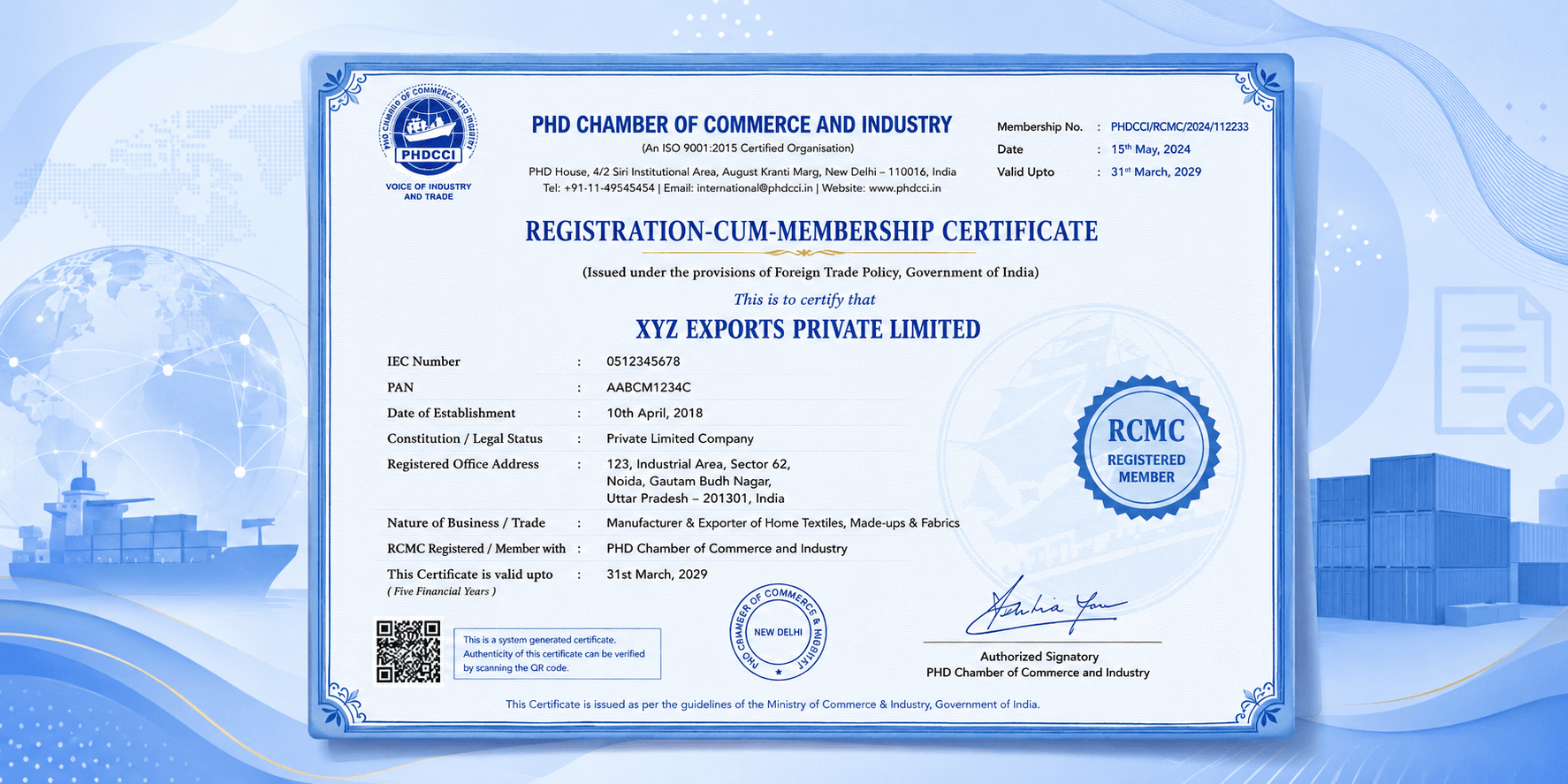

An Indian exporter has an IEC, is ready to apply for an export-related benefit, and is told that an RCMC is required. The next questions are usually straightforward: What does RCMC stand for? Who needs it? Which council issues it? And how do you apply?
RCMC stands for Registration-Cum-Membership Certificate. It is issued by recognised Export Promotion Councils, Commodity Boards, Development Authorities, or other competent registering authorities and confirms an exporter’s registration with the relevant body.
For exporters, RCMC is mainly important when applying for certain authorisations, benefits, or concessions under India’s Foreign Trade Policy.
This guide explains RCMC registration, eligibility, validity, documents required, issuing authorities, and how to apply for e-RCMC through the DGFT portal.
RCMC stands for Registration-Cum-Membership Certificate. It is issued by recognised Export Promotion Councils, Commodity Boards, Development Authorities, or other competent registering authorities and confirms an exporter’s registration with the relevant body.
For exporters, RCMC is mainly important when applying for certain authorisations, benefits, or concessions under India’s Foreign Trade Policy.
This guide explains RCMC registration, eligibility, validity, documents required, issuing authorities, and how to apply for e-RCMC through the DGFT portal.
TL;DR
- RCMC stands for Registration-Cum-Membership Certificate and is issued by recognised export councils or other authorised registering bodies.
- It is generally required when an exporter applies for certain authorisations, benefits, or concessions under the Foreign Trade Policy.
- An active IEC and updated IEC profile are key prerequisites for applying for e-RCMC through the DGFT portal.
- RCMC is generally issued for five financial years, unless the relevant authority specifies otherwise.
What is RCMC?
An RCMC, or Registration-Cum-Membership Certificate, validates an exporter’s registration with an authorised Export Promotion Council, Commodity Board, Development Authority, or other competent body.
The relevant registering authority depends largely on the exporter’s main line of business and the products or services being exported.
RCMC is not a general export licence. IEC remains the core identification requirement for most export and import activity.
Who needs RCMC registration?
RCMC is generally required when an exporter is:
- applying for an authorisation to import or export under the Foreign Trade Policy, subject to applicable exceptions
- applying for a benefit or concession under the Foreign Trade Policy
- required to register with a particular Export Promotion Council or Commodity Board for the relevant product or service
The requirement depends on the activity, scheme, product category, and benefit being claimed.
What is the validity of an RCMC?
An RCMC is generally valid for five financial years, unless the issuing authority specifies otherwise.
Its validity normally begins from 1 April of the licensing year in which it is issued and continues until 31 March of the fifth financial year.
Who issues RCMC certificates?
RCMCs are issued by recognised registering authorities such as:
- Export Promotion Councils
- Commodity Boards
- Development Authorities
- other competent authorities
| Product category | Registering authority |
|---|---|
| Engineering goods and project exports | Engineering Export Promotion Council (EEPC India) |
| Basic chemicals, cosmetics and dyes | Basic Chemicals, Cosmetics and Dyes Export Promotion Council (CHEMEXCIL) |
| Chemicals and allied products, such as minerals, ceramics and granite | Chemicals and Allied Products Export Promotion Council (CAPEXIL) |
| Pharmaceuticals | Pharmaceuticals Export Promotion Council (Pharmexcil) |
| Plastics | Plastics Export Promotion Council (PLEXCONCIL) |
| Apparel | Apparel Export Promotion Council (AEPC) |
| Cotton textiles | Cotton Textiles Export Promotion Council (TEXPROCIL) |
| Synthetic and rayon textiles | Synthetic and Rayon Textiles Export Promotion Council (SRTEPC) |
| Powerloom products | Powerloom Development and Export Promotion Council (PDEXCIL) |
| Wool and woollens | Wool and Woollens Export Promotion Council (WWEPC) |
| Silk | Indian Silk Export Promotion Council (ISEPC) |
| Handloom products | Handloom Export Promotion Council (HEPC) |
| Carpets | Carpet Export Promotion Council (CEPC) |
| Handicrafts | Export Promotion Council for Handicrafts (EPCH) |
| Gems and jewellery | Gem and Jewellery Export Promotion Council (GJEPC) |
| Leather and leather products | Council for Leather Exports (CLE) |
| Sports goods | Sports Goods Export Promotion Council (SGEPC) |
| Shellac and forest products | Shellac and Forest Products Export Promotion Council (SHEFEXIL) |
| Electronics and computer software | Electronics and Computer Software Export Promotion Council (ESC) |
| Telecom equipment and services | Telecom Equipment and Services Export Promotion Council (TEPC) |
| Services | Services Export Promotion Council (SEPC) |
| Cashew | Cashew Export Promotion Council of India (CEPCI) |
| Agricultural and processed food products | Agricultural and Processed Food Products Export Development Authority (APEDA) |
| Marine products | Marine Products Export Development Authority (MPEDA) |
| Spices | Spices Board |
| Tea | Tea Board |
| Coffee | Coffee Board |
| Rubber | Rubber Board |
| Tobacco | Tobacco Board |
| Coir and coir products | Coir Board |
| EOUs and SEZ units | Export Promotion Council for EOUs and SEZs (EPCES) |
| Multi-product exporters and products not covered by any other council | Federation of Indian Export Organisations (FIEO) |
RCMC for Service Exporters
Service exporters don’t need an RCMC (Registration-cum-Membership Certificate) just to export services or receive payments from overseas clients. It becomes necessary only when you want to claim benefits under the Foreign Trade Policy, such as support for trade fairs and buyer-seller meets, status holder recognition, or schemes like EPCG. You’ll need an IEC before applying.
Most service exporters register with the Services Export Promotion Council (SEPC), but some service categories have their own council:
| Type of service | Registering authority |
|---|---|
| Most services, including consulting, healthcare, education, tourism, logistics, media and entertainment | Services Export Promotion Council (SEPC) |
| Software, IT and IT-enabled services | Electronics and Computer Software Export Promotion Council (ESC) |
| Telecom services | Telecom Equipment and Services Export Promotion Council (TEPC) |
| Engineering and project services | Engineering Export Promotion Council (EEPC India) |
You can apply online through the DGFT portal by selecting the relevant council, uploading your IEC and business documents, and paying the council’s membership fee. An RCMC is generally valid for five years, after which it must be renewed.
What are the prerequisites for RCMC registration?
Before starting the application, an exporter should generally have:
- an active IEC
- an updated IEC profile
- a linked Digital Signature Certificate or Aadhaar e-Signature, as applicable
- business and contact details
- information about the products or services being exported
How to apply for e-RCMC on the DGFT portal
The RCMC application process is electronic.
Step 1: Log in to the DGFT portal
Sign in using the credentials linked to the exporter’s IEC.
Step 2: Open the e-RCMC service
Navigate to:
Services → e-RCMC → Apply for e-RCMC
Step 3: Select the registering authority
Choose the Export Promotion Council, Commodity Board, Development Authority, or other relevant body based on the exporter’s main business activity.
Step 4: Review the business details
Confirm the pre-filled information linked to the IEC and provide any additional details requested in the application.
Step 5: Upload supporting documents
The exact document list can vary by registering authority and business type.
Upload the documents requested for the chosen council or board.
Step 6: Pay the applicable fee
Membership and RCMC fees differ across registering authorities.
Step 7: Sign and submit
Complete the application using the available digital-signature or e-sign facility.
The registering authority then reviews the application before issuing the e-RCMC.
How to Renew or Amend Your e-RCMC
Since DGFT moved RCMC services online, both renewals and amendments are handled through the e-RCMC module on the DGFT portal. Renew your e-RCMC before its five-year validity ends, and apply for an amendment whenever key business details change, such as your firm's name, address, partners or directors, or the products you export.
- Log in to the DGFT portal at dgft.gov.in using your IEC-linked account.
- Go to the RCMC section under Services and choose Renew RCMC or Amend RCMC.
- Select your existing e-RCMC and the export promotion council or commodity board that issued it.
- Update your details and upload supporting documents, such as your updated IEC, GST registration, or proof of the change.
- Pay the applicable fee set by the council and submit the application.
- Track the status on the portal. Once the council approves it, the renewed or amended e-RCMC can be downloaded from your dashboard.
Tip: If your business details have changed, update your IEC on the DGFT portal first. The e-RCMC draws on IEC data, so an outdated IEC is a common reason amendment requests are delayed.

What documents are required for RCMC registration?
There is no single document checklist that applies identically to every Export Promotion Council.
However, exporters may be asked for information or documents such as:
- IEC details
- PAN
- business constitution documents
- partnership deed, where applicable
- Memorandum and Articles of Association, where applicable
- director, partner, or proprietor details
- GST details where relevant
- export turnover or performance details
- product or service information
- manufacturing or industrial registration details where relevant
Always check the requirements of the specific registering authority before applying.
What are the benefits of RCMC?
Access to applicable FTP benefits
RCMC can be required when applying for certain benefits, concessions, or authorisations available under the Foreign Trade Policy.
Membership of the relevant export body
Export Promotion Councils and similar organisations support exporters within specific sectors.
Membership may provide access to sector updates, export-market information, trade events, buyer-seller meets, training, and industry representation.
Easier alignment with sector-specific export requirements
Being registered with the appropriate council can help exporters stay informed about changes affecting their product or service category.
RCMC vs IEC: what is the difference?
| IEC | RCMC |
|---|---|
| Importer Exporter Code | Registration-Cum-Membership Certificate |
| Issued through DGFT | Issued by recognised registering authorities |
| Core identification for most import/export activity | Relevant for specific FTP authorisations, benefits, and membership |
| Linked to the business PAN | Linked to the relevant export sector or council |
| Must be kept updated | Has a defined validity period |
Common RCMC registration mistakes
Avoid:
- applying to the wrong Export Promotion Council
- using an inactive or outdated IEC profile
- submitting inconsistent business details
- assuming the same documents apply to every registering authority
- forgetting to renew an expiring RCMC
- treating RCMC as a substitute for other export registrations or licences
Once the documentation side is in place, exporters still need a reliable way to collect and reconcile international payments.
PayGlocal helps Indian businesses accept cross-border payments and maintain clearer transaction and settlement records, making the payment side of exporting easier to manage.
Looking for RCMC Share Registry? That’s a separate company that provides share registrar and transfer agent services, and it is unrelated to the Registration-cum-Membership Certificate issued by export promotion councils.