
Key Takeaways
- Ineligible transactions are usually caused by card security settings, inactive accounts, or regulatory restrictions such as GST Section 17(5).
- Standard error triggers include blocked international usage, outdated KYC, high-risk merchant categories, and disabled transaction types.
- Resolving the issue often involves updating card permissions, enabling specific channels (like POS or online), or contacting your bank with the exact error code.
- Preventive steps, such as reviewing bank settings quarterly, enabling international usage in advance, and keeping your contact information up to date, can significantly reduce transaction failure rates.
- Platforms like PayGlocal provide solutions that enable merchants to minimize transaction errors through intelligent routing, secure processing, and real-time fraud detection.
Imagine you’re about to process a crucial international payment for a business deal you’ve been working on for weeks. The details are all set. Amount, recipient, everything’s lined up. However, you then encounter an "ineligible transaction error”.
This error typically occurs when a payment doesn’t meet specific criteria, such as the incorrect payment method, mismatched account information, or restricted countries.
For businesses and individuals handling cross-border payments, this can be a common roadblock. Whether it’s a glitch, missing data, or just a mismatch, an ineligible transaction error can stop you in your tracks.
However, understanding the cause of this error and knowing how to fix it quickly can save you time, money, and significant stress.
What are ineligible transaction errors?
An ineligible transaction error occurs when a bank or financial institution flagsor blocks a transaction due to restrictions, limits, or regulations. These errors can stop you from completing purchases or making payments, even if your account is in good standing. Some of the most common reasons could be:
- Fraud detection triggers: Transactions that deviate from your regular spending pattern.
- Geo-restrictions: Transactions in countries where your card isn't authorized.
- Bank-imposed rules: Usage limits, outdated KYC, or inactivity can result in restrictions.
For example, attempting to make an international payment without enabling foreign transactions in your banking app can trigger this error. On the other hand, trying to make a purchase that violates a bank’s usage policy, such as purchasing from high-risk merchant categories, can block the transaction with this error.
What commonly causes ineligible transaction errors?
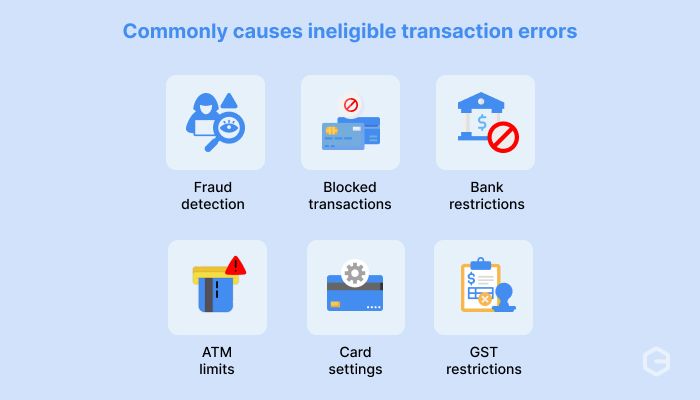
While each bank or financial institution has its own rules, some common triggers apply across most systems:
Fraud detection and security settings: Unusual activity, such as large purchases or unauthorized foreign transactions, can trigger security reviews for your card.
- Blocked international or domestic transactions: Many cards are restricted to domestic use by default. Users must manually enable global access.
- Bank-imposed restrictions: Inactive accounts, insufficient KYC details, or regulatory requirements like transaction limits and daily caps can result in auto-blocked payments.
- ATM card usage issues: Attempting high-value withdrawals, using the card in a new location, or exceeding usage limits may result in declines.
- Security settings on bank cards: Users often forget to enable online or international transactions through their banking apps. Cards also expire or get deactivated without notice to the user.
* Ineligible transactions under GST Section 17(5) For businesses, claiming ITC on non-eligible expenses like employee perks, motor vehicles for personal use, or club memberships can result in compliance-related errors.
These restrictions aren’t just about risk mitigation. They’re part of layered security protocols intended to protect users from fraud, but in doing so, they often prevent legitimate transactions as well.
Even something as basic as a new card that hasn't been appropriately activated or a temporarily frozen account can trigger these errors. You might never know until you face a failed transaction.
How to fix an ineligible transaction error?
Fixing ineligible transaction errors often starts with reviewing and updating your card settings. Banks today offer multiple advanced portals that let users customize usage, limits, and even regional access preferences.
- Accessing bank portals: Use your bank’s mobile app or net banking to view and change your card’s transaction permissions.
- Changing security or usage settings: As needed, turn on or off features like contactless payments, international usage, or online transactions.
- Enabling specific transaction types: Many cards allow fine-tuning settings for ATM use, POS transactions, or e-commerce. Make sure the required channel is active.
Banks also issue alerts or messages when a transaction fails. These often contain applicable codes or reasons that can speed up your troubleshooting. If changes in the portal don’t work, calling customer support with that code can help resolve the issue more quickly.
Effective resolution requires being proactive. This includes monitoring card settings regularly and updating them in sync with your financial habits. But wouldn’t it be better to avoid the errors altogether?
What steps can prevent ineligible transactions
Preventing ineligible transaction errors is not only possible but also advisable. Most of these issues stem from outdated settings or overlooked preferences that could be fixed in advance.
- Update preferences regularly: Adjust your transaction limits, payment settings, and card features based on your current usage patterns.
- Reviewing domestic and international settings: Always check whether your card is active for the region where you transact, especially when making travel or international purchases.
- Maintaining updated contact info: The transaction may be blocked if the bank can't reach you for verification. Ensure your phone number and email address are up to date.
Even minor oversights can cause unnecessary disruptions. Reviewing your bank settings regularly, at least quarterly, can help maintain transaction continuity. For businesses handling guest checkout or unfamiliar identifiers, exploring solutions like Alt ID can offer an added layer of reliability and prevent unexpected declines.
How do ineligible transactions impact users?
The fallout from an ineligible transaction error can cause multiple inconveniences. It can delay payments, affect cash flow, and even result in missed opportunities.
- Disruption in banking activities: Users may be locked out of essential services, from denied payments to blocked withdrawals.
- Cash flow issues: For freelancers, small businesses, or exporters, ineligibility can stop urgent payments and lead to financial stress.
- Impact on tax management: Errors related to GST and ITC can delay tax filings or result in penalties if not managed carefully.
Such problems can affect your financial transactions and, if left unresolved for a long time, may impact your relationship with the vendor.
Selecting a thoughtful payment gateway improves transaction success rates and helps prevent confusion, enabling faster resolution when issues arise during payment processing. That’s where PayGlocal comes in, offering merchant-first infrastructure built to navigate these complexities easily and precisely.
How does PayGlocal reduce ineligible transaction errors?
When payment transactions fail, the issue often lies in outdated card settings, missing compliance checks, or bank routing errors. PayGlocal is built to solve exactly these challenges. It is a cross-border payment platform designed for modern businesses that need smarter, faster, and safer transactions across geographies.
Rather than relying on fragmented payment systems or piecing together multiple providers, PayGlocal offers an integrated solution that reduces the chances of failed or ineligible transactions. It helps businesses operate more reliably, even in complex regulatory and banking environments.
- Dynamic checkout: Offers intelligent checkout flows tailored to the buyer’s location, currency, and device, improving transaction success rates.
- Card payments: Accepts all major cards with built-in fraud protection and smart routing to reduce declines.
- Global payment methods: Supports UPI, bank transfers, wallets, and more, so customers can pay using their preferred method.
- Recurring payments: Automates billing for subscriptions or repeat services with built-in authentication and compliance checks.
- Multi-currency account: Let businesses accept, hold, and settle in local currencies to avoid unnecessary conversion delays or fees.
- One platform: Centralizes reporting, settlement, and transaction history, giving merchants complete control in one place.
- Sanction screening: Applies real-time compliance checks to block ineligible or high-risk transactions before they occur.
Whether you're struggling with ineligible card declines, compliance complexities, or transaction failures, countless businesses have already turned to PayGlocal.
A single, scalable platform that streamlines payments and prevents costly disruptions. Don’t get left behind!
Conclusion
Ineligible transaction errors can disrupt financial routines and create unnecessary hurdles. Identifying, resolving, and preventing these issues is crucial for smoother banking and payment experiences.
Proactive measures, such as regularly reviewing settings, being aware of transaction policies, and maintaining open communication with your bank, can significantly lower the risk. PayGlocal works to minimize transaction failures by offering merchant-friendly payment solutions that align with bank protocols and ensure a seamless customer experience.
FAQs
1. What does "ineligible transaction" mean on a card machine?
A: An "ineligible transaction" message on a card machine means your attempted payment doesn't meet the card’s usage rules, settings, or bank-imposed restrictions. This could include region limitations, transaction type blocks, or insufficient permissions set by your financial institution.
2. Why is my international payment failing with a valid card?
A: Even if your card is valid, international payments may fail if global usage isn’t enabled in your banking app or settings. Other factors include currency restrictions, blocked merchant categories, or failure to complete authentication, such as 3DS or OTP verification.
3. How do I fix an ineligible transaction on the GST portal?
A: To resolve an ineligible transaction on the GST portal, review the expense category and check eligibility under Section 17(5) of the CGST Act. Ineligible expenses, like personal use items, can’t be claimed for Input Tax Credit (ITC) reimbursements or refunds.
4. Can repeated ineligible transactions block my card?
A: Yes, if you repeatedly attempt ineligible transactions, banks may view the activity as suspicious. As a result, your card may be temporarily blocked for security reasons. It’s essential to review permissions and settings before retrying high-risk or declined transactions.
5. Is enabling international transactions safe on my card?
A: Enabling international transactions is safe if managed responsibly. Utilize features such as two-factor authentication (2FA), strong passwords, and transaction alerts. Only activate global usage when necessary and monitor account activity to catch any unauthorized attempts or potential fraud early.