
Need a sample IBAN number to check international payment formats? With around 88 countries using IBAN (International Bank Account Number) for global transactions, knowing the right IBAN structure is essential while managing your international payment setup.
Whether you're a freelancer receiving payments from European clients or an exporter setting up international banking, exploring IBAN examples helps you learn about the right format and avoid costly payment delays.
In this guide, we provide sample IBAN numbers from major countries. Find out what the ideal structure of IBAN numbers is and you can how to validate IBANs for your business needs.
IBAN format varies by country: Lengths range from 15 to 34 characters containing country code, check digits, and bank details.
Sample numbers prevent errors: IBAN examples help you check the correct format for each country before setting up international payments.
Validation prevents failures: IBAN checking stops payment rejections and creates faster processing for international transactions.
PayGlocal offers global payment solutions: Get multi-currency accounts with one platform management and instant settlement across 180+ countries.
An IBAN (International Bank Account Number) is a standardized international numbering system for bank accounts. It was developed by the International Organization for Standardization (ISO) and European Committee for Banking Standards to reduce errors in cross-border payments.
The IBAN system helps banks identify the correct account across different countries and banking systems. For example, a UK IBAN like GB29NWBK60161331926819 tells banks exactly which British institution and account to credit, while a German IBAN like DE89370400440532013000 directs payments to the correct German bank.
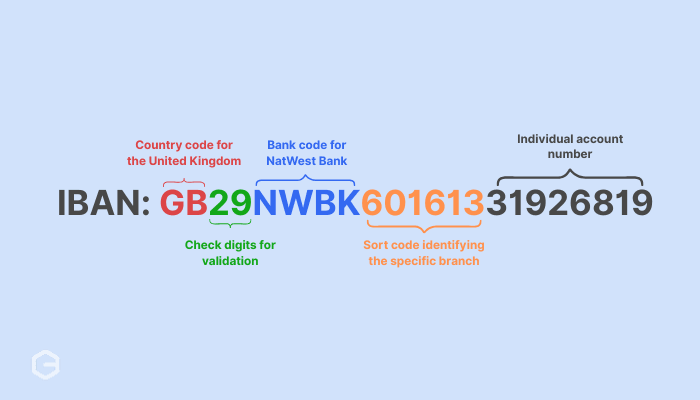
A sample IBAN follows a specific structure regardless of the country. Every IBAN contains four main components arranged in a precise order.
The format starts with a two-letter country code (like GB for the United Kingdom or DE for Germany), followed by two check digits that validate the entire number. Next comes the bank identifier code, which varies in length by country, and finally the account number portion.
For instance, in the sample IBAN GB29NWBK60161331926819:
Different countries have different IBAN lengths. UK IBANs are always 22 characters, German IBANs are 22 characters, while French IBANs are 27 characters long.
IBAN country codes follow ISO 3166-1 alpha-2 standards, using two letters to identify each participating nation. These codes are mandatory and must appear at the start of every IBAN.
While exploring IBANs, it’s also worth knowing about the Single Euro Payments Area (SEPA), a payment integration initiative that makes bank transfers across participating European countries as easy as domestic payments. SEPA countries use standardized payment processes to ensure smooth payments within the region.
Here's a complete breakdown of IBAN formats by region:
The European member countries work together on trade and banking standards. Most European countries use IBAN and participate in SEPA, making payments between these nations fast and affordable for businesses.
Western Europe includes major business hubs like the UK, Germany, and France that handle high volumes of international trade. These countries were among the first to adopt standardized IBAN formats for cross-border payments.
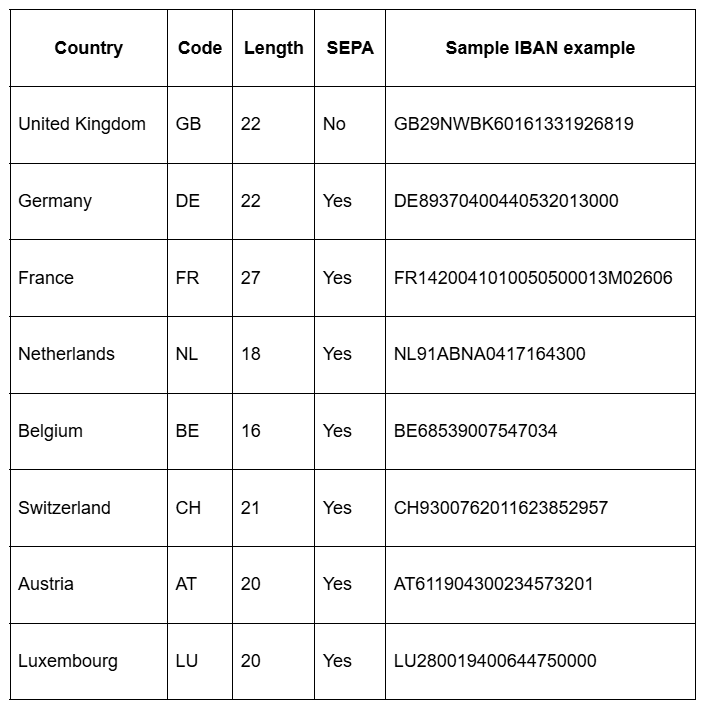
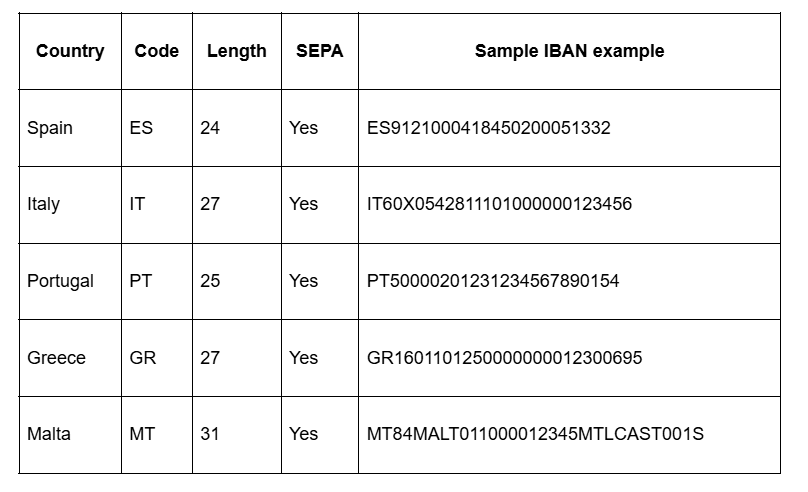
Southern Europe covers countries like Spain, Italy, and Greece that are popular destinations for tourism and trade payments. Many businesses in this region receive international payments from clients across Europe and beyond.
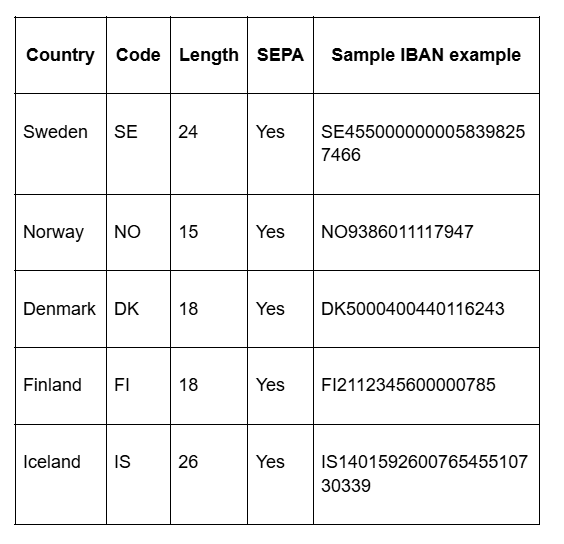
Nordic countries include Sweden, Norway, Denmark, Finland, and Iceland, known for their advanced digital banking systems. These countries often lead in payment technology and have well-organized IBAN structures.
Countries outside Europe have also adopted IBAN to connect with global markets and attract international business. These regions include major economies in the Middle East, Latin America, and other areas that want to simplify cross-border payments.
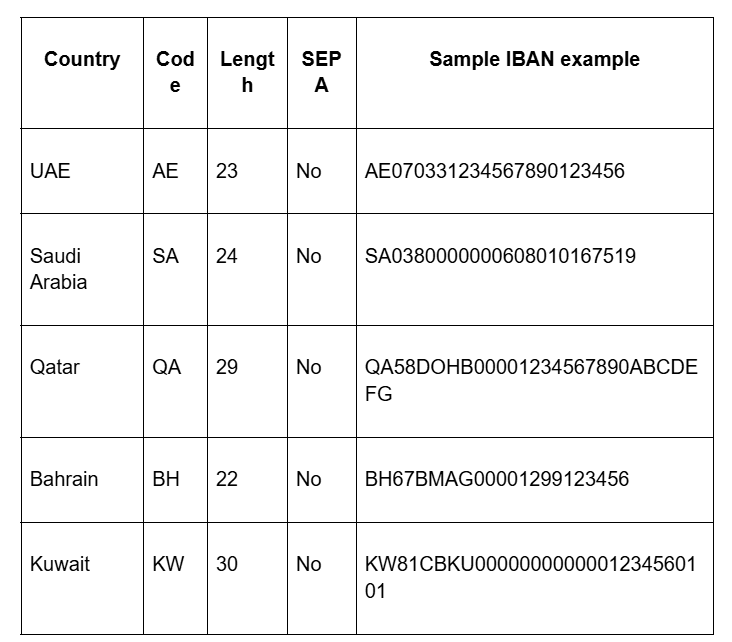
Gulf countries include the UAE, Saudi Arabia, Qatar, and other oil-rich nations that conduct significant international business. These countries adopted IBAN to facilitate trade with global partners and attract foreign investment.
These countries adopted IBAN for specific business needs or to connect with international markets. They represent diverse regions that want to participate in global banking standards.
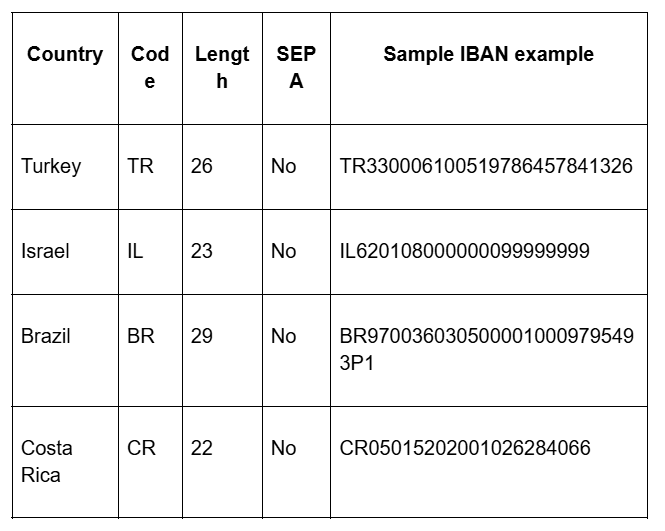
Each country determines its own IBAN length and structure while following the global format standards.
The IBAN validation process checks that the number follows the correct format and passes mathematical checks before processing payments. This prevents costly payment failures and delays.
The validation process involves several steps:
Length verification: Each country has a fixed IBAN length. UK IBANs must be exactly 22 characters, while German IBANs are also 22 characters. Any deviation indicates an error.
Character check: IBANs contain only letters and numbers with no spaces or special characters. The first two characters must be valid country codes (like GB, DE, FR).
Check digit calculation: The two-digit number after the country code acts as a checksum. Banks use modulo-97 arithmetic to verify these digits match the rest of the IBAN.
Bank code validation: The bank identifier portion must correspond to a financial institution in that country. Invalid bank codes cause immediate payment rejections.
IBAN formatting errors cause thousands of payment failures daily. Knowing common mistakes helps businesses avoid delays and additional fees.
Incorrect spacing: IBANs should have no spaces when entering them into payment systems. While humans often write IBANs with spaces for readability (like GB29 NWBK 6016 1331 9268 19), computer systems require continuous strings.
Wrong country codes: Using outdated or incorrect country codes leads to immediate rejections. Always verify the current ISO country code for your destination.
Invalid check digits: Manual IBAN creation often results in wrong check digits. These two numbers after the country code must be calculated precisely using modulo-97 arithmetic.
Mixing up bank codes: Each country has specific bank identifier formats. Using a sort code format in a country that requires a different bank code structure causes failures.
Length errors: Adding or omitting characters breaks the IBAN format. German IBANs must be exactly 22 characters - no more, no less.
Character substitutions: Confusing similar-looking characters (like 0 and O, or 1 and I) creates invalid IBANs that fail validation checks.
Managing international payments across multiple countries and currencies can slow down your business growth. While IBAN knowledge helps you send payments correctly, collecting money from global customers requires a different approach that focuses on speed, convenience, and reliability.
PayGlocal provides a complete all-in-one payment platform that handles international collections without the complexity of managing different banking relationships or currency accounts. Here’s how PayGlocal can help you:
PayGlocal handles currency conversions and payment routing automatically so you can focus on growing your business instead of managing payment infrastructure across different countries.
Sample IBAN numbers provide essential templates for checking international payment formats across different countries. From 16-character Belgian IBANs to 31-character Maltese ones, each format serves specific banking requirements that create accurate cross-border transactions.
While knowing IBAN structure helps businesses work with international payments, managing multiple formats and validation requirements can become complex as you scale globally. The key is having a reliable system like PayGlocal that handles these technicalities automatically while maintaining speed.
Ready to collect international payments faster and scale globally? Get started with PayGlocal today.
Whether you're a freelancer receiving payments from European clients or an exporter setting up international banking, exploring IBAN examples helps you learn about the right format and avoid costly payment delays.
In this guide, we provide sample IBAN numbers from major countries. Find out what the ideal structure of IBAN numbers is and you can how to validate IBANs for your business needs.
Key Takeaways:
IBAN format varies by country: Lengths range from 15 to 34 characters containing country code, check digits, and bank details.
Sample numbers prevent errors: IBAN examples help you check the correct format for each country before setting up international payments.
Validation prevents failures: IBAN checking stops payment rejections and creates faster processing for international transactions.
PayGlocal offers global payment solutions: Get multi-currency accounts with one platform management and instant settlement across 180+ countries.
What is an IBAN number?
An IBAN (International Bank Account Number) is a standardized international numbering system for bank accounts. It was developed by the International Organization for Standardization (ISO) and European Committee for Banking Standards to reduce errors in cross-border payments.
The IBAN system helps banks identify the correct account across different countries and banking systems. For example, a UK IBAN like GB29NWBK60161331926819 tells banks exactly which British institution and account to credit, while a German IBAN like DE89370400440532013000 directs payments to the correct German bank.
What does a sample IBAN number look like?
A sample IBAN follows a specific structure regardless of the country. Every IBAN contains four main components arranged in a precise order.
The format starts with a two-letter country code (like GB for the United Kingdom or DE for Germany), followed by two check digits that validate the entire number. Next comes the bank identifier code, which varies in length by country, and finally the account number portion.
For instance, in the sample IBAN GB29NWBK60161331926819:
- GB: Country code for the United Kingdom.
- 29: Check digits for validation.
- NWBK: Bank code for NatWest Bank.
- 601613: Sort code identifying the specific branch.
- 31926819: Individual account number.
Different countries have different IBAN lengths. UK IBANs are always 22 characters, German IBANs are 22 characters, while French IBANs are 27 characters long.
What are IBAN country codes and formats with examples?
IBAN country codes follow ISO 3166-1 alpha-2 standards, using two letters to identify each participating nation. These codes are mandatory and must appear at the start of every IBAN.
While exploring IBANs, it’s also worth knowing about the Single Euro Payments Area (SEPA), a payment integration initiative that makes bank transfers across participating European countries as easy as domestic payments. SEPA countries use standardized payment processes to ensure smooth payments within the region.
Here's a complete breakdown of IBAN formats by region:
European Countries
The European member countries work together on trade and banking standards. Most European countries use IBAN and participate in SEPA, making payments between these nations fast and affordable for businesses.
Western Europe
Western Europe includes major business hubs like the UK, Germany, and France that handle high volumes of international trade. These countries were among the first to adopt standardized IBAN formats for cross-border payments.
Southern Europe
Southern Europe covers countries like Spain, Italy, and Greece that are popular destinations for tourism and trade payments. Many businesses in this region receive international payments from clients across Europe and beyond.
Nordic Countries
Nordic countries include Sweden, Norway, Denmark, Finland, and Iceland, known for their advanced digital banking systems. These countries often lead in payment technology and have well-organized IBAN structures.
Middle East and Other Regions
Countries outside Europe have also adopted IBAN to connect with global markets and attract international business. These regions include major economies in the Middle East, Latin America, and other areas that want to simplify cross-border payments.
Gulf Countries
Gulf countries include the UAE, Saudi Arabia, Qatar, and other oil-rich nations that conduct significant international business. These countries adopted IBAN to facilitate trade with global partners and attract foreign investment.
Other Notable Countries
These countries adopted IBAN for specific business needs or to connect with international markets. They represent diverse regions that want to participate in global banking standards.
Each country determines its own IBAN length and structure while following the global format standards.
How to validate sample IBAN numbers?
The IBAN validation process checks that the number follows the correct format and passes mathematical checks before processing payments. This prevents costly payment failures and delays.
The validation process involves several steps:
Length verification: Each country has a fixed IBAN length. UK IBANs must be exactly 22 characters, while German IBANs are also 22 characters. Any deviation indicates an error.
Character check: IBANs contain only letters and numbers with no spaces or special characters. The first two characters must be valid country codes (like GB, DE, FR).
Check digit calculation: The two-digit number after the country code acts as a checksum. Banks use modulo-97 arithmetic to verify these digits match the rest of the IBAN.
Bank code validation: The bank identifier portion must correspond to a financial institution in that country. Invalid bank codes cause immediate payment rejections.
What are common IBAN format mistakes to avoid?
IBAN formatting errors cause thousands of payment failures daily. Knowing common mistakes helps businesses avoid delays and additional fees.
Incorrect spacing: IBANs should have no spaces when entering them into payment systems. While humans often write IBANs with spaces for readability (like GB29 NWBK 6016 1331 9268 19), computer systems require continuous strings.
Wrong country codes: Using outdated or incorrect country codes leads to immediate rejections. Always verify the current ISO country code for your destination.
Invalid check digits: Manual IBAN creation often results in wrong check digits. These two numbers after the country code must be calculated precisely using modulo-97 arithmetic.
Mixing up bank codes: Each country has specific bank identifier formats. Using a sort code format in a country that requires a different bank code structure causes failures.
Length errors: Adding or omitting characters breaks the IBAN format. German IBANs must be exactly 22 characters - no more, no less.
Character substitutions: Confusing similar-looking characters (like 0 and O, or 1 and I) creates invalid IBANs that fail validation checks.
Manage all global payments from one platform with PayGlocal
Managing international payments across multiple countries and currencies can slow down your business growth. While IBAN knowledge helps you send payments correctly, collecting money from global customers requires a different approach that focuses on speed, convenience, and reliability.
PayGlocal provides a complete all-in-one payment platform that handles international collections without the complexity of managing different banking relationships or currency accounts. Here’s how PayGlocal can help you:
- Multi-currency accounts: Collect in 33+ currencies from 180+ countries without setting up multiple bank relationships or managing different account types.
- Dynamic checkout options: Give customers multiple payment methods including cards, local payment options, and bank transfers through one platform that adapts to their location.
- Recurring payment management: Set up automatic billing for subscriptions and repeat customers with high success rate and global card support.
- One platform control: Manage all international payments, track settlements, and download compliance documents from a single dashboard without switching between systems.
- Zero setup fees: Start collecting internationally without upfront costs, monthly maintenance charges, or minimum volume requirements.
PayGlocal handles currency conversions and payment routing automatically so you can focus on growing your business instead of managing payment infrastructure across different countries.
Final thoughts
Sample IBAN numbers provide essential templates for checking international payment formats across different countries. From 16-character Belgian IBANs to 31-character Maltese ones, each format serves specific banking requirements that create accurate cross-border transactions.
While knowing IBAN structure helps businesses work with international payments, managing multiple formats and validation requirements can become complex as you scale globally. The key is having a reliable system like PayGlocal that handles these technicalities automatically while maintaining speed.
Ready to collect international payments faster and scale globally? Get started with PayGlocal today.