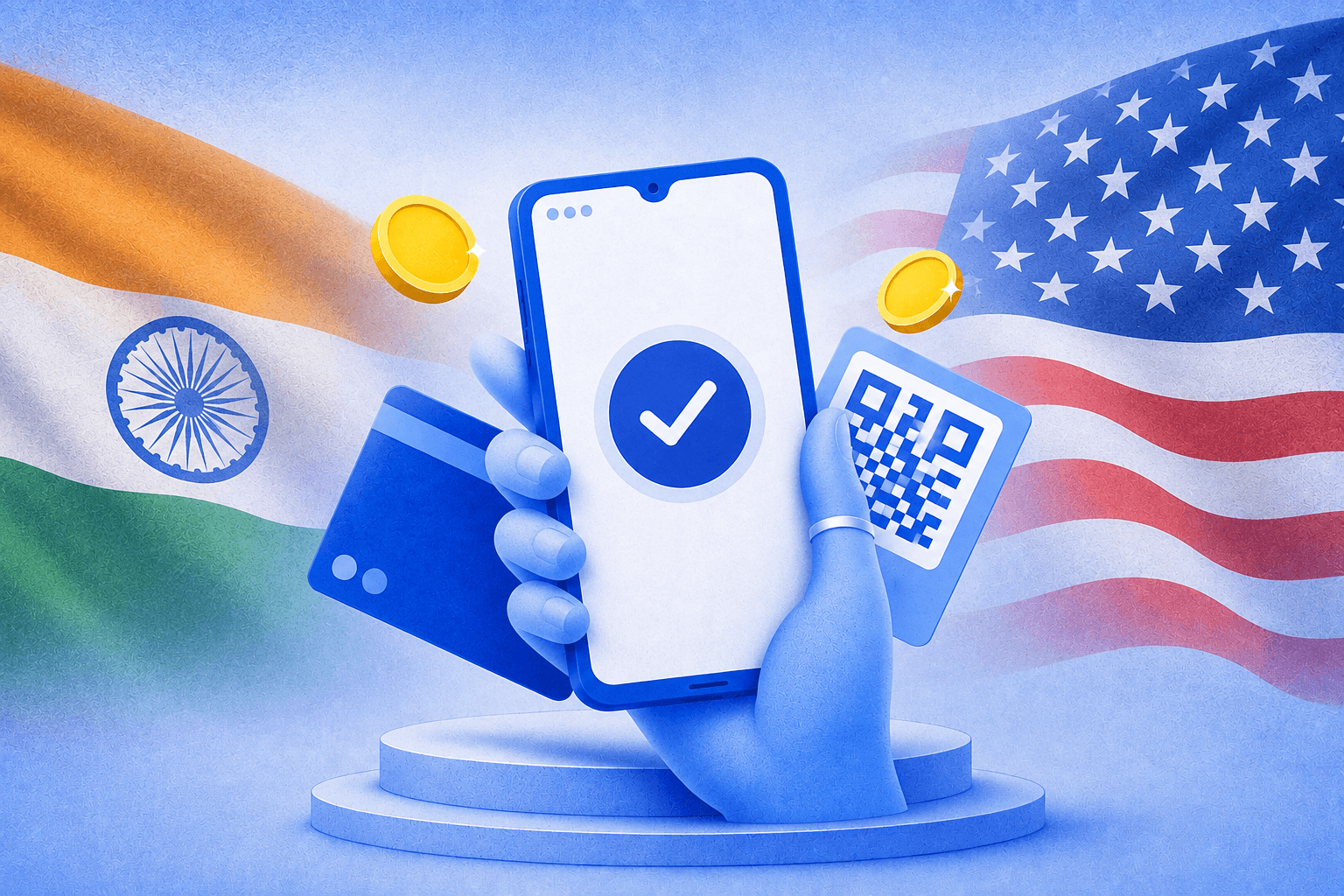

When you compare UPI vs US payment systems, the gap is not about speed or technology, it is about how the pieces fit together. India's Unified Payments Interface (UPI) lets any bank and any app settle a payment through one shared network, so money moves in seconds no matter which bank or app each person uses. The US, by contrast, runs several strong but separate rails, FedNow, RTP, Zelle, Venmo, Cash App, and cards, and the friction lives in the seams between them. This piece looks at how UPI's real-time, interoperable model actually works, where US payment systems are built differently, and which of UPI's design choices America could realistically borrow.
TL;DR
- UPI works because any bank and any app talk to each other through one identifier, so a payment "just goes through" without the sender knowing or caring which bank the receiver uses.
- The US runs several strong but separate rails (FedNow, RTP, Zelle, Venmo, Cash App, cards), and the gaps between them are where friction, fees, and delays live.
- The US will not copy UPI wholesale, but three of its design choices, open access for apps, one shared address layer, and built-in two-factor security, point at what better instant payments could look like.
What is UPI?
UPI (Unified Payments Interface) is a real-time payment system built by the National Payments Corporation of India (NPCI) that moves money directly between bank accounts using a phone number or a virtual payment address (VPA) instead of card or account details. It runs 24/7, links multiple bank accounts to a single ID, and lets different banks and apps settle payments through one shared network. That single design decision, one network everyone plugs into, is why a payment from a State Bank account to an HDFC account through two different apps still lands in seconds.
Why does UPI work so well in India?
UPI's strength is not any single feature. It is that the whole system is interoperable by default, so the parts add up instead of fragmenting.
- Instant, round-the-clock transfers: money moves in real time, including nights, weekends, and holidays, with no batch-settlement lag.
- One ID, many banks: a user links several bank accounts to a single UPI identity and picks which one pays.
- Apps and banks are decoupled: the app you tap and the bank that holds your money do not have to be the same company, or even partners.
Put together, these turn payments into something closer to plumbing than a product. The user thinks about the coffee, not the rail underneath it. That invisibility is the benchmark other countries are measured against.
How are US payment systems built differently?
The US does not lack instant-payment technology. It lacks a single layer that ties the pieces together. Most consumers juggle several apps that each work well inside their own walls.
- App-to-bank lock-in: Zelle and Venmo work smoothly, but reach and features depend on which banks and users are already inside each network.
- Card fees sit on merchants: card processing costs remain a real line item for US businesses, unlike a direct account-to-account transfer.
- Uneven settlement speed: some transfers clear instantly, others still take time, so "sent" and "settled" are not always the same moment.
None of these is a flaw in isolation. The friction shows up in the seams between systems, which is exactly the seam UPI removed.
UPI vs US payment systems: a side-by-side
| What matters | UPI (India) | US payment systems |
|---|---|---|
| Core design | One shared network any bank or app plugs into | Several separate rails (FedNow, RTP, Zelle, Venmo, Cash App, cards) |
| Interoperability | Works across all banks and apps through one identifier | Depends on which network each side is already inside |
| Who can build on it | Open to third-party apps like Google Pay and PhonePe | FedNow and RTP are primarily bank-led |
| Identifier used | Phone number or virtual payment address (VPA) | Account details, card, email, or phone tied to a specific app |
| Speed | Real time, 24/7, including nights and weekends | Instant on some rails, still delayed on others |
| Everyday cost to user | Free for most person-to-person and merchant payments | Card processing fees typically sit with the merchant |
| Security model | Two-factor on every transaction, built into the rail | Varies app to app, layered on top rather than shared |
| Primary focus | Everyday consumer payments | Mixed; FedNow's early weight is bank and institutional flows |
UPI vs FedNow: what is the core contrast?
FedNow, the Federal Reserve's real-time payment service, is the closest US parallel to UPI's ambition, but the two are built on different philosophies. FedNow modernizes bank-to-bank settlement; UPI reorganizes the entire consumer experience on top of it.
The differences that matter most:
- Open to apps vs bank-led: UPI lets third-party apps like Google Pay and PhonePe build directly on the network. FedNow operates primarily through banks.
- Everyday vs institutional focus: UPI was designed around the person buying vegetables. FedNow's early center of gravity is bank and institutional payment flows.
- Adoption curve: UPI already carries mass everyday volume, while FedNow is earlier in its rollout and competing for attention alongside RTP and card networks.
FedNow is a genuine step toward faster US payments. The gap is less about speed and more about who is allowed to build on top and how unified the front end feels.
Where could UPI's design actually help the US?
The US will not adopt UPI, and it does not need to. What travels well is not the software but three design choices underneath it.
- A shared address layer: one identifier that resolves across banks and apps would cut the "which app do you use?" negotiation before every transfer.
- Open access for third-party apps: letting non-bank apps build on a common rail widened India's reach fast, without waiting for every bank to ship its own polished app.
- Security baked into the rail, not bolted on: two-factor authentication on every transaction and network-level fraud monitoring set a floor that individual apps do not have to reinvent.
The honest catch: India built UPI with heavy central coordination through NPCI, and the US payments market is more fragmented and more privately run. The lesson is directional, not a template to copy field by field.
How does UPI handle fraud and security?
Security is the part of UPI most worth studying, because a fast rail with weak controls just moves fraud faster. UPI's answer is to make strong authentication the default rather than an add-on.
- Two-factor on every transaction: each payment is authenticated, so a stolen phone number alone is not enough to move money.
- Layered technical controls: device binding, encrypted transactions, and dynamic QR codes reduce phishing and unauthorized access.
- Privacy by masking: the VPA hides the underlying bank and account details from the person you are paying.
For the US, the transferable idea is the floor, not the exact mechanism: if strong authentication and real-time monitoring live in the rail itself, every app on top inherits them.
Where do cross-border payments fit in?
Domestic instant rails like UPI and FedNow solve payments *inside* a country. The moment money crosses a border, a different set of problems appears: currency conversion, card declines on foreign transactions, and reconciliation across banking systems.
That is the gap PayGlocal works in. As an RBI-authorised cross-border payments provider, it helps Indian businesses collect international payments at a high Payment Success Rate (PSR), the share of attempted payments that actually go through, with multi-currency acceptance and automated FIRA documentation for export compliance. A strong domestic rail and a strong cross-border setup solve different halves of the same journey.
If your business collects from customers abroad, the rail that matters is the one that keeps foreign card payments from failing at checkout.