

A 2024 study revealed that 73% of firms reported improved cash flow due to AP automation, highlighting its significant impact on financial efficiency.
Accounts Payable (AP) is pivotal in managing short-term financial obligations and fostering strong vendor relationships. Efficient AP processes ensure timely and accurate payments, enhance compliance with global tax regulations, and reduce the risk of errors in cross-border payments.
In this blog, we’ll explore how AP automation transforms business operations and why it's essential for staying competitive in the global market.
Accounts Payable (AP) refers to the outstanding amounts a business owes to suppliers or vendors for goods and services received on credit. It is a key component of a company's financial management, impacting cash flow and overall financial health.
Common examples of accounts payable include:
Your accounts payable will appear on your cash flow statement under "operating activities." Every business owner must closely monitor these expenses to maintain liquidity and smooth operations.
The Accounts Payable (AP) process is how businesses manage and pay their bills. It involves receiving invoices from suppliers, checking them against purchase orders, and making payments.
AP mainly focuses on effective invoice management as part of the procure-to-pay business process. Proper management ensures timely payments, maintains good vendor relationships, avoids penalties, and keeps financial records accurate. Efficient AP management also helps businesses track cash flow and save resources.
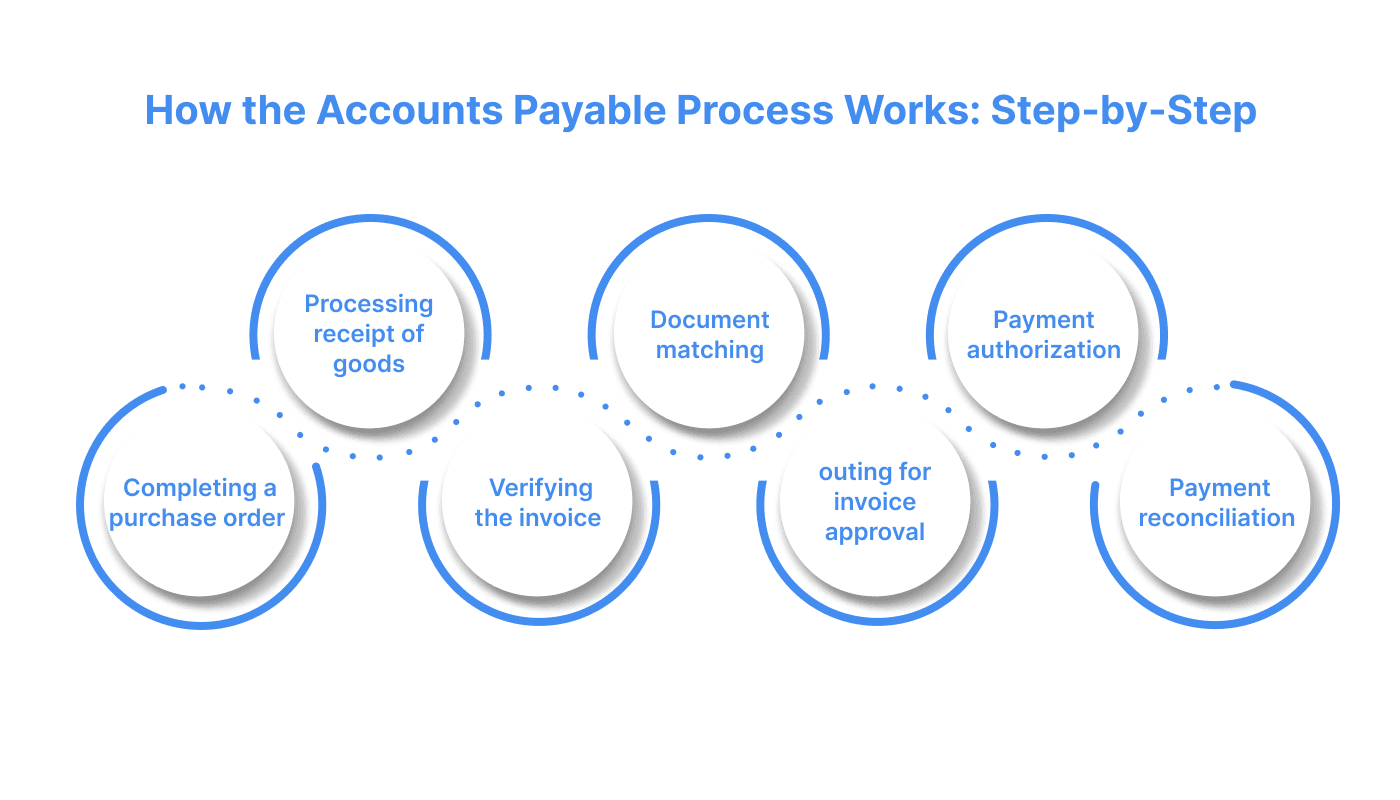
Each step in the accounts payable (AP) process, from invoice verification to payment recording, contributes to accurate reporting, timely payments, and strong vendor relationships.
A purchase order is a legally enforceable agreement within an organization. The document outlines all necessary details, like the purchased items, quantities, prices, and delivery timelines.
Companies rely on purchase orders to ensure their vendors provide the products/services they need in the agreed-upon quantities and prices. The purchase order is the initial step in requesting and receiving goods or services through accounts payable.
Suppliers provide receiving reports to document the delivered goods and services. Companies must carefully review these reports before making payments.
A thorough check verifies that the goods/services match the purchase order (PO) and supplier invoice. This step is vital in efficient purchasing, confirming that all items are received as ordered before payment.
Once the goods or services are delivered, the vendor sends an invoice, which the AP team verifies against the purchase order and the receipt of goods. This prevents overpayments or errors.
Staff should carefully check the invoice for discrepancies in vendor information, invoice number, dates, item descriptions, quantities, prices, and applicable taxes, further forwarding the invoice for approval.
The accounts payable team matches documents using a two-way match, where only the purchase order and invoice are compared, and a three-way match involves comparing the purchase order, delivery receipt, and invoice to ensure all documents align.
Once the invoice is verified, it is sent to the appropriate internal department for approval, adding an extra layer of accountability. This ensures that the correct team reviews and approves the invoice before payment.
Once the invoice is approved, the AP team processes the payment using ACH payments, a check, or a credit card. A streamlined and efficient payment process ensures payments are made promptly, helping avoid late fees and instilling strong relationships with vendors.
The last step is recording the payment in the general ledger for proper documentation and reconciliation of the transaction. This completes the accounts payable process and ensures that financial records remain current.
Imagine an export company based in India that imports materials from a supplier in the UK to manufacture products for international markets. The process starts when the company receives an invoice from the supplier for the raw materials. The accounts payable team verifies the invoice against the original purchase order and the delivery receipt.
Once everything matches, the invoice is routed for approval within the company. After approval, the payment is processed through an online payment system, and the transaction is recorded in the company’s financial records.
By closely monitoring the accounts payable process, you can gain better control over your cash flow, prepare accurate financial statements, optimize payment schedules, and negotiate better terms with vendors to reduce overhead costs.
The AP automation market is growing rapidly, expected to increase from $2.4 billion in 2024 to $2.61 billion in 2025, with an 8.6% CAGR. Automation in AP brings efficiency, reduces errors, and enhances cash flow management.

Source: AP/AR Automation Market Report 2025
Let’s explore the key benefits of automating your AP process
1. Save Time: AP automation eliminates repetitive, manual tasks in the source-to-pay process, speeding up invoice approval and payment cycles. Employees can collaborate in real-time, thus reducing delays. Automation provides instant access to business spending insights, freeing staff to focus on more strategic tasks.
2. Reduce Errors: Manual data entry is prone to mistakes. With automation, you reduce the risk of errors like duplicate payments or incorrect account entries. By pre-populating vendor data and minimizing manual intervention, automation helps with accuracy and reduces accounting risks.
3. Prevent Fraud: Fraud is a significant concern in AP processes, with over 79% of organizations being victims of payment fraud attacks in 2024. Automated systems enable quicker detection of fraudulent activities like inflated charges, phishing scams, or duplicate payments.
4. Cash Flow Reporting and Analysis: AP automation goes beyond improving efficiency by providing detailed analytics and reporting features. You can track crucial metrics like payment cycle times, vendor performance, and cash outflow trends.
AP management has been a significant bottleneck in optimizing working capital. Once manual and prone to errors, it has become increasingly automated. However, with the rise of automation, businesses are transforming their AP functions, leading to more streamlined cash flow management.
Managing accounts payable (AP) effectively is crucial for any business, but several challenges arise, particularly when the process is manual.
To overcome these challenges, businesses can benefit from Payglocal’s accounts payable (AP) process with its global payment processing platform and automate payments with standing instructions for flexibility.
Effectively managing AP enables a business to maintain a strong financial position, foster better vendor relationships, and optimize cash flow. Here are some steps to efficiently handle your accounts payable:
1. Centralize Accounts Payable: Implement a shared service environment for real-time processing and reporting. This ensures consistency in practices and allows employees to follow common standards. Measuring performance against established metrics helps accomplish tasks faster and with fewer resources, ultimately reducing enterprise costs.
2. Adopt Strong Governance Practices: Strengthen internal controls to minimize errors throughout the accounts payable process, including during contract reviews. Implementing governance practices ensures better accuracy and consistency.
3. Creating a Paperless Environment: Consider using electronic data interchange (EDI) to automate the AP process. Although unsuitable for every business, automating vendor communication streamlines approval processes, ensures timely payments, automatically generates purchase orders, approves requisitions, and helps secure discounts and rebates.
4. Utilize Cloud Storage for Records and Compliance: Storing accounts payable records on cloud platforms provides easy access, better organization, and disaster recovery. Cloud storage also helps track invoices and payments, simplifies compliance with legal and regulatory requirements, ensures data security with encryption, and provides businesses with a centralized and easily accessible repository for audit trails.
Automation tools can greatly enhance the accounts payable process, helping streamline tasks like invoice approval, payment processing, and data analysis. Even better, a one-stop solution like Payglocal that integrates all these functionalities, making the entire process seamless for timely payments and accurate financial records.
Efficient accounts payable management offers numerous benefits, including timely payments, improved cash flow, stronger vendor relationships, and more accurate financial records. The shift towards automation in the AP process has revolutionized how businesses handle payments, reducing errors, speeding up approval cycles, and providing real-time insights into financial data. With automation, you can optimize their AP workflows, save time, and reduce operational costs.
For businesses involved in cross-border payments, Payglocal offers a seamless platform for managing international transactions. Payglocal simplifies the entire payment process, ensuring smooth, secure, and timely payments across borders, helping you easily manage global operations.
Get started today and streamline your AP process for better financial management.
Accounts Payable (AP) is pivotal in managing short-term financial obligations and fostering strong vendor relationships. Efficient AP processes ensure timely and accurate payments, enhance compliance with global tax regulations, and reduce the risk of errors in cross-border payments.
In this blog, we’ll explore how AP automation transforms business operations and why it's essential for staying competitive in the global market.
What are Accounts Payable?
Accounts Payable (AP) refers to the outstanding amounts a business owes to suppliers or vendors for goods and services received on credit. It is a key component of a company's financial management, impacting cash flow and overall financial health.
Common examples of accounts payable include:
- Purchases made from suppliers on credit
- Business-related purchases
- Subscription or installment payments that are due after receiving goods or services.
Your accounts payable will appear on your cash flow statement under "operating activities." Every business owner must closely monitor these expenses to maintain liquidity and smooth operations.
What is the Accounts Payable Process?
The Accounts Payable (AP) process is how businesses manage and pay their bills. It involves receiving invoices from suppliers, checking them against purchase orders, and making payments.
AP mainly focuses on effective invoice management as part of the procure-to-pay business process. Proper management ensures timely payments, maintains good vendor relationships, avoids penalties, and keeps financial records accurate. Efficient AP management also helps businesses track cash flow and save resources.
How the Accounts Payable Process Works: Step-by-Step
Each step in the accounts payable (AP) process, from invoice verification to payment recording, contributes to accurate reporting, timely payments, and strong vendor relationships.
Step 1: Completing a purchase order (PO)
A purchase order is a legally enforceable agreement within an organization. The document outlines all necessary details, like the purchased items, quantities, prices, and delivery timelines.
Companies rely on purchase orders to ensure their vendors provide the products/services they need in the agreed-upon quantities and prices. The purchase order is the initial step in requesting and receiving goods or services through accounts payable.
Step 2: Processing receipt of goods
Suppliers provide receiving reports to document the delivered goods and services. Companies must carefully review these reports before making payments.
A thorough check verifies that the goods/services match the purchase order (PO) and supplier invoice. This step is vital in efficient purchasing, confirming that all items are received as ordered before payment.
Step 3: Verifying the invoice
Once the goods or services are delivered, the vendor sends an invoice, which the AP team verifies against the purchase order and the receipt of goods. This prevents overpayments or errors.
Staff should carefully check the invoice for discrepancies in vendor information, invoice number, dates, item descriptions, quantities, prices, and applicable taxes, further forwarding the invoice for approval.
Step 4: Document matching
The accounts payable team matches documents using a two-way match, where only the purchase order and invoice are compared, and a three-way match involves comparing the purchase order, delivery receipt, and invoice to ensure all documents align.
Step 5: Routing for invoice approval
Once the invoice is verified, it is sent to the appropriate internal department for approval, adding an extra layer of accountability. This ensures that the correct team reviews and approves the invoice before payment.
Step 6: Payment authorization
Once the invoice is approved, the AP team processes the payment using ACH payments, a check, or a credit card. A streamlined and efficient payment process ensures payments are made promptly, helping avoid late fees and instilling strong relationships with vendors.
Step 7: Payment reconciliation
The last step is recording the payment in the general ledger for proper documentation and reconciliation of the transaction. This completes the accounts payable process and ensures that financial records remain current.
Example of Account Payable Process
Imagine an export company based in India that imports materials from a supplier in the UK to manufacture products for international markets. The process starts when the company receives an invoice from the supplier for the raw materials. The accounts payable team verifies the invoice against the original purchase order and the delivery receipt.
Once everything matches, the invoice is routed for approval within the company. After approval, the payment is processed through an online payment system, and the transaction is recorded in the company’s financial records.
By closely monitoring the accounts payable process, you can gain better control over your cash flow, prepare accurate financial statements, optimize payment schedules, and negotiate better terms with vendors to reduce overhead costs.
Benefits of Automation in Accounts Payable Process
The AP automation market is growing rapidly, expected to increase from $2.4 billion in 2024 to $2.61 billion in 2025, with an 8.6% CAGR. Automation in AP brings efficiency, reduces errors, and enhances cash flow management.
Source: AP/AR Automation Market Report 2025
Let’s explore the key benefits of automating your AP process
1. Save Time: AP automation eliminates repetitive, manual tasks in the source-to-pay process, speeding up invoice approval and payment cycles. Employees can collaborate in real-time, thus reducing delays. Automation provides instant access to business spending insights, freeing staff to focus on more strategic tasks.
2. Reduce Errors: Manual data entry is prone to mistakes. With automation, you reduce the risk of errors like duplicate payments or incorrect account entries. By pre-populating vendor data and minimizing manual intervention, automation helps with accuracy and reduces accounting risks.
3. Prevent Fraud: Fraud is a significant concern in AP processes, with over 79% of organizations being victims of payment fraud attacks in 2024. Automated systems enable quicker detection of fraudulent activities like inflated charges, phishing scams, or duplicate payments.
4. Cash Flow Reporting and Analysis: AP automation goes beyond improving efficiency by providing detailed analytics and reporting features. You can track crucial metrics like payment cycle times, vendor performance, and cash outflow trends.
AP management has been a significant bottleneck in optimizing working capital. Once manual and prone to errors, it has become increasingly automated. However, with the rise of automation, businesses are transforming their AP functions, leading to more streamlined cash flow management.
What are the Challenges in the Manual Account Payable Process?
Managing accounts payable (AP) effectively is crucial for any business, but several challenges arise, particularly when the process is manual.
- Manual AP processes often require approvals from multiple departments, significantly increasing cycle time.
- Manual data entry into different systems increases mistakes, such as incorrect invoices or misplaced documents.
- Paper-based systems make getting real-time insights into AP difficult, leading to decisions based on outdated data.
- Without automation, tracking payments and understanding cash flow becomes challenging, thus causing financial mismanagement.
- Sorting and organizing paper invoices takes up valuable time that could be spent on more strategic tasks. According to the Institute of Finance & Management, 84% of AP staff’s time is spent on manual tasks.
To overcome these challenges, businesses can benefit from Payglocal’s accounts payable (AP) process with its global payment processing platform and automate payments with standing instructions for flexibility.
Best Practices for Efficient Accounts Payable Management
Effectively managing AP enables a business to maintain a strong financial position, foster better vendor relationships, and optimize cash flow. Here are some steps to efficiently handle your accounts payable:
1. Centralize Accounts Payable: Implement a shared service environment for real-time processing and reporting. This ensures consistency in practices and allows employees to follow common standards. Measuring performance against established metrics helps accomplish tasks faster and with fewer resources, ultimately reducing enterprise costs.
2. Adopt Strong Governance Practices: Strengthen internal controls to minimize errors throughout the accounts payable process, including during contract reviews. Implementing governance practices ensures better accuracy and consistency.
3. Creating a Paperless Environment: Consider using electronic data interchange (EDI) to automate the AP process. Although unsuitable for every business, automating vendor communication streamlines approval processes, ensures timely payments, automatically generates purchase orders, approves requisitions, and helps secure discounts and rebates.
4. Utilize Cloud Storage for Records and Compliance: Storing accounts payable records on cloud platforms provides easy access, better organization, and disaster recovery. Cloud storage also helps track invoices and payments, simplifies compliance with legal and regulatory requirements, ensures data security with encryption, and provides businesses with a centralized and easily accessible repository for audit trails.
Automation tools can greatly enhance the accounts payable process, helping streamline tasks like invoice approval, payment processing, and data analysis. Even better, a one-stop solution like Payglocal that integrates all these functionalities, making the entire process seamless for timely payments and accurate financial records.
Conclusion
Efficient accounts payable management offers numerous benefits, including timely payments, improved cash flow, stronger vendor relationships, and more accurate financial records. The shift towards automation in the AP process has revolutionized how businesses handle payments, reducing errors, speeding up approval cycles, and providing real-time insights into financial data. With automation, you can optimize their AP workflows, save time, and reduce operational costs.
For businesses involved in cross-border payments, Payglocal offers a seamless platform for managing international transactions. Payglocal simplifies the entire payment process, ensuring smooth, secure, and timely payments across borders, helping you easily manage global operations.
Get started today and streamline your AP process for better financial management.