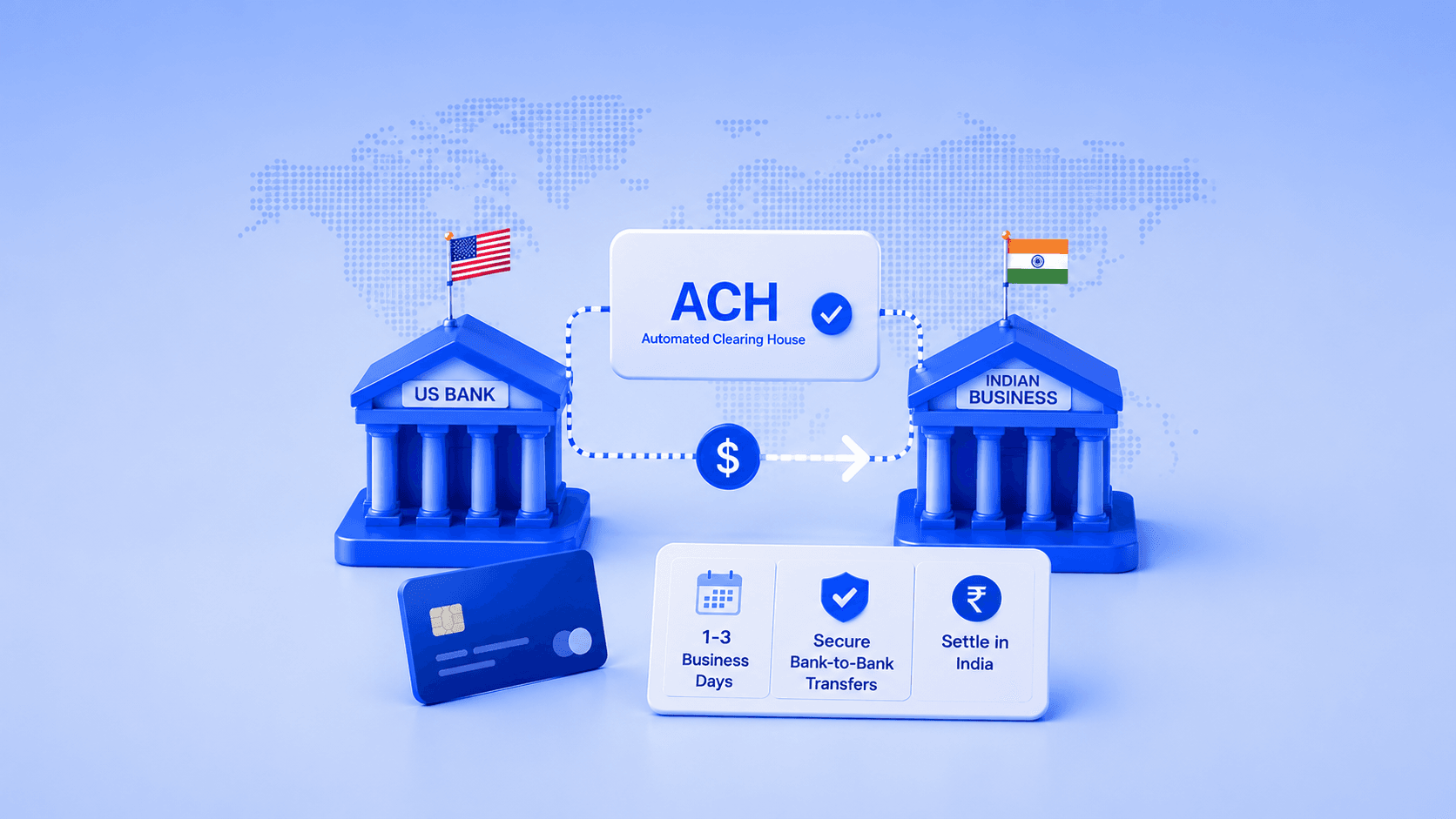

You have a US client ready to pay. They ask how you want the money: ACH or wire? Both move funds bank to bank, but for a business sitting in India, the two are not interchangeable, and neither is designed with you in mind.
This guide explains how ACH and wire transfers actually work, what changes the moment the payer is in the US and the recipient is in India, and how to receive payments from US customers in India without losing days to settlement or a slice to hidden forex charges.
This guide explains how ACH and wire transfers actually work, what changes the moment the payer is in the US and the recipient is in India, and how to receive payments from US customers in India without losing days to settlement or a slice to hidden forex charges.
TL;DR
- If a US customer pays you by ACH, it is cheap but slow (usually one to three business days) and settles into a US bank account, so an Indian business without US banking rails often cannot receive it directly.
- A US wire is fast (often same day) and works internationally, but it carries higher fees, an intermediary-bank cut, and a forex markup on conversion to INR, and it gives you no automatic proof of remittance.
- For an Indian freelancer, SaaS exporter, or D2C seller, the practical question is not ACH versus wire in the abstract, but how to collect from US clients into India at a high success rate, with clean INR settlement and an automatic FIRA. That is where a cross-border collection setup like PayGlocal changes the maths.
What is an ACH transfer, and can an Indian business receive one?
An ACH transfer is an electronic bank-to-bank payment processed through the US Automated Clearing House network, governed by NACHA (the body that runs the US ACH system). Payments move in scheduled batches rather than one by one, which is what makes ACH cheap and well suited to recurring, high-volume payments.
In the US, ACH is the default for payroll, vendor payments, subscription billing, and B2B transfers. Standard ACH settles in one to three business days; Same-Day ACH exists for eligible payments.
Here is the catch for you. ACH is a domestic US rail. It moves money between US bank accounts. An Indian business without a US bank account or a US-collection setup usually cannot receive an ACH payment directly, which is exactly the gap most "ACH vs wire" explainers ignore. To collect ACH-style payments from US clients, you typically need a local US account or a cross-border provider that gives you one.
What is a wire transfer, and what does it cost you in India?
A wire transfer moves funds directly from one bank account to another, processed individually rather than in batches. That individual processing is why wires are fast: a domestic US wire can settle within hours, and international wires reach India within a few days depending on the banks in the chain.
Wires do cross borders, so a US client can wire you in India today. The trade-off is cost and friction:
- Higher fees on both ends. The sending bank charges the payer, and your receiving bank in India often deducts a fee too.
- An intermediary-bank cut. International wires usually route through one or more correspondent banks, each of which can take a slice, so the amount that lands can be less than what was sent.
- A forex markup. Converting USD to INR at your bank frequently carries a spread well above the mid-market rate.
- No automatic proof of remittance. You will often have to chase your bank for a FIRA/FIRC (Foreign Inward Remittance Advice/Certificate, the document that proves you received a foreign payment), which you need for GST and FEMA compliance.
So a wire works, but it is the expensive, manual way to get paid from the US.
ACH vs wire transfer: the difference that matters when you are in India
Both are secure forms of electronic funds transfer (EFT). The real differences, seen from India, are these:
| Feature | ACH transfer | Wire transfer |
|---|---|---|
| Processing method | Batch | Individual |
| Speed | 1 to 3 business days (Same-Day ACH for eligible payments) | Same day to a few days internationally |
| Cost | Low | High (bank fees plus intermediary cuts) |
| Reaches India directly? | No, US-domestic rail | Yes, but with fees and forex markup |
| Forex markup to INR | Not applicable directly | Yes, often above mid-market |
| Proof of remittance (FIRA) | Not provided | Not automatic, you must request it |
| Best for | Recurring US-to-US payments | One-off, high-value cross-border payments |
The honest takeaway: for a US payer moving money inside the US, ACH usually wins on cost and wire wins on speed. For you in India, the choice is narrower than it looks, because ACH often is not available to you at all, and a raw wire quietly costs you more than the headline fee.
The better question: how should an Indian business collect from US clients?
If your customers are in the US and your bank account is in India, optimising "ACH vs wire" is optimising the wrong thing. The outcome you actually want is simple: get paid reliably, in INR, without losing money to spreads or losing hours to paperwork.
A cross-border collection setup solves this by giving you US-friendly ways to be paid, then settling cleanly into your Indian account:
- Local collection that your US clients recognise. Let clients pay the way they expect, so more payments go through. Payment Success Rate (PSR, the share of attempted payments that succeed) is the metric that decides how much of your invoiced money actually arrives.
- Multi-currency accounts. Collect USD (and GBP, EUR, and more) and convert on your terms, not at whatever spread your bank applies to an inbound wire.
- Transparent, success-based pricing. With PayGlocal you pay only when you transact, with no setup, platform, or documentation fees, so the cost of getting paid is predictable.
- Automatic FIRA. PayGlocal auto-issues the FIRA after settlement, so your GST and FEMA proof is handled instead of chased.
PayGlocal is RBI-authorised as a Payment Aggregator, Cross Border, Inward and Outward (PA-CB-I&O) and as an Online Payment Aggregator (PA-O), and is part of the ICICI Bank Group. For money moving across a border into India, those authorisations are the trust floor you should expect from any provider you use.
Which option should you choose?
Choose a raw wire if a US client needs to send you a single large payment once and you are willing to absorb the fees, the forex markup, and the FIRA follow-up for the sake of getting it done today.
Choose a cross-border collection setup if you are billing US clients regularly (freelancers, SaaS and IT exporters, D2C sellers, agencies), want more payments to succeed, want a fair USD-to-INR rate, and want your remittance proof issued automatically.
Most Indian businesses getting paid from the US do not need to master ACH batch windows or wire cut-off times. They need one reliable way to collect that is built for the India corridor.