
Digital payments are growing rapidly in India. According to recent data, over the past six financial years from 2019-20 to 2024-25, there have been more than 65,000 crore digital transactions worth over Rs. 12,000 lakh crore.
Whether you're paying locally or receiving payments from international clients, bank codes work as the unique identifiers that ensure your money reaches the right destination every time.
In this guide, we cover everything you need to know about bank codes, their formats, types, how to find them, and why they matter for your business payments.
* Bank identification: Bank codes like IFSC and SWIFT act as unique identifiers for financial institutions during payment processing.
* IFSC format consistency: IFSC codes follow an 11-character format combining bank and branch information for domestic Indian transfers.
* Country-specific variations: Different countries use specific bank code formats like ABA (US), BSB (Australia), and IBAN (Europe) for local transfers.
* Easy access methods: You can find your bank codes on statements, cheques, or by contacting your bank directly.
* Global payments: PayGlocal handles complex banking codes and routing for you automatically across international transactions.
Bank codes are unique alphanumeric identifiers assigned to financial institutions and their branches to facilitate accurate payment routing. These codes help banks, payment processors, and financial networks identify the exact institution and location where funds should be transferred.
Every bank and branch combination gets a specific code that distinguishes it from thousands of other financial institutions. For example, when you transfer money using NEFT (National Electronic Funds Transfer) or RTGS (Real Time Gross Settlement), the IFSC code tells the payment system exactly which bank branch should receive the funds.
Bank codes remove the confusion in payment processing and ensure your money reaches the intended recipient without delays or errors.
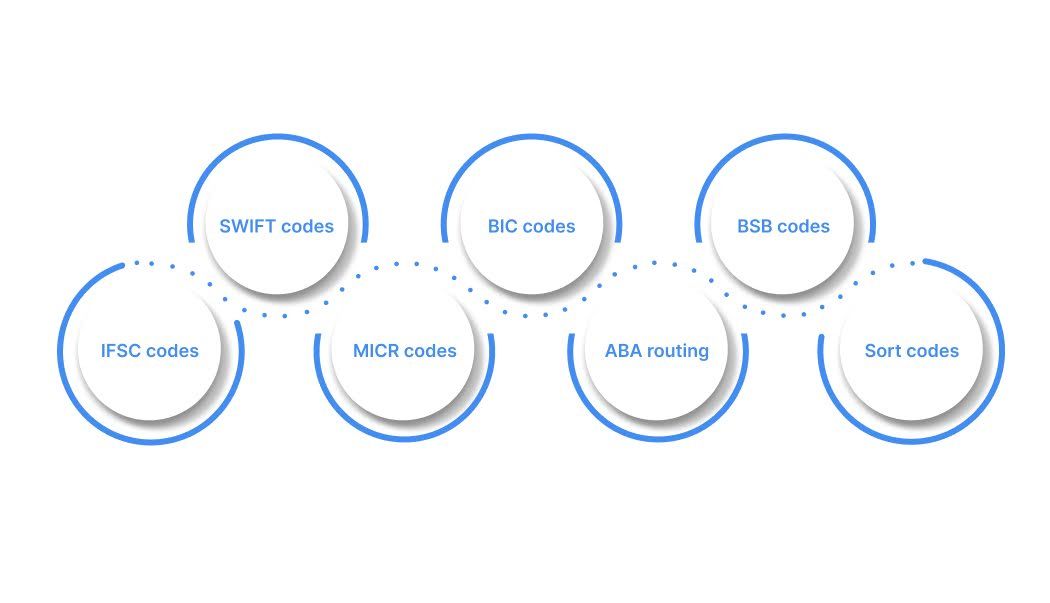
Financial institutions use various bank code formats depending on the payment type and geographic location. Each code serves a specific purpose in the global banking network. Here's how they compare:
Let's look at each code type in detail with specific examples:
IFSC (Indian Financial System Code) codes contain 11 characters that identify specific bank branches in India. The first four letters represent the bank name, the fifth character is always zero, and the last six characters identify the branch location.
Format example: HDFC0000123
HDFC identifies the bank
0 is the mandatory control character
000123 pinpoints the specific branch
SWIFT (Society for Worldwide Interbank Financial Telecommunication) codes enable international money transfers between banks globally. These codes contain 8 to 11 characters that identify the bank, country, location, and sometimes the specific branch.
Format example: AXISINBB123
AXIS identifies the bank
IN represents India
BB indicates the location code
123 represents the branch code
MICR (Magnetic Ink Character Recognition) codes are 9-digit numbers printed on cheques using magnetic ink. The first three digits represent the city, the next three identify the bank, and the last three specify the branch.
Format example: 400240001
400 represents the city code
240 identifies the bank
001 specifies the branch
BIC (Bank Identifier Code) works similarly to SWIFT codes and often refers to the same identifier. European banks primarily use BIC codes for SEPA (Single Euro Payments Area) transactions.
Format example: DEUTDEFF
DEUT identifies Deutsche Bank
DE represents Germany
FF indicates Frankfurt
ABA (American Bankers Association) routing numbers are 9-digit codes used for domestic transfers within the United States. These codes identify specific banks and help route payments through the Federal Reserve system.
Format example: 021000021
021 represents the Federal Reserve routing symbol
000021 identifies the specific bank
BSB (Bank State Branch) codes contain 6 digits that identify Australian banks and their branches for domestic transfers. These codes help route payments through the Australian banking system.
Format example: 062001
062 identifies the bank
001 specifies the branch
Sort codes are 6-digit numbers used in the United Kingdom to identify banks and branches for domestic payments. They appear in a hyphenated format on UK banking documents.
Format example: 20-00-00
20 identifies the bank
00-00 specifies the branch location
When you initiate a payment, the banking system reads the bank code to determine the routing path. The code tells payment processors which financial institution should receive the funds and exactly which branch location to credit. Here's how the process works:
* Payment initiation: You provide the recipient's bank code along with account details.
* Code verification: The payment system validates the bank code format and checks if it exists.
* Routing determination: Based on the code, the system determines the best path to reach the destination bank.
* Transfer execution: Funds move through the appropriate banking networks to the identified institution.
* Final settlement: The destination bank receives and credits the payment using the branch information in the code.
Locating your bank codes is simple once you know where to look. Most banks provide this information through multiple channels.
* Check your bank statements: IFSC codes usually appear on monthly statements near your account details. Look for an 11-character code starting with your bank's abbreviation.
* Review your cheque book: MICR codes are printed at the bottom of cheques in magnetic ink. IFSC codes often appear on the top portion of cheque leaves.
* Use online bank code finders: Several websites maintain updated databases of IFSC and SWIFT codes. Simply search using your bank name and branch location.
* Contact your bank directly: Call customer service or visit your branch to get accurate bank codes. This method ensures you receive the most current information.
* Check your bank's website: Most banks publish branch-wise IFSC codes in their website's branch locator sections.
IFSC codes follow a standardized 11-character format established by the Reserve Bank of India for all Indian banks and financial institutions.
The structure breaks down as follows:
* Characters 1-4: Bank identifier using four alphabetic characters.
* Character 5: Always zero (0) as a control character.
* Characters 6-11: Six-character branch code combining letters and numbers.
For example, in HDFC0001234:
HDFC represents HDFC Bank
0 is the mandatory control character
001234 identifies the specific branch
This consistent format helps payment systems quickly validate and process IFSC codes across all Indian banking networks.
Yes, all customers banking at the same branch share the same IFSC code regardless of their account type or customer status. The IFSC code identifies the branch location, not individual accounts.
Whether you have a savings account, current account, or fixed deposit at a particular branch, you'll use the same IFSC code for all incoming transfers. Your unique account number differentiates your transactions from other customers at the same branch.
For example, if you and your business partner both bank at the same HDFC branch, you'll both use the same IFSC code but different account numbers for receiving payments.
Managing different bank codes across countries can get complex when you're collecting payments globally. Each region has unique requirements, formats, and routing rules that can slow down your international transactions.
PayGlocal provides a unified payment platform that handles all banking codes and international routing automatically. Here's how PayGlocal can help you:
* Multi-currency accounts: Collect payments in USD, GBP, EUR, and CAD without worrying about complex international bank codes.
* Dynamic checkout options: Offer flexible payment flows suitable to your customers' preferred methods and increase your sales.
* Local payment methods: Accept 40+ global payment methods without managing different bank code requirements for each.
* Recurring payment solutions: Set up subscription billing that handles international bank routing seamlessly.
* One-platform management: Track all international payments from a single dashboard regardless of the origin country's banking codes.
Whether you're a freelancer receiving payments from multiple countries or an exporter managing large international transactions, PayGlocal handles the complexity so you can focus on growing your business.
Bank codes serve as essential identifiers that ensure your payments reach the right destination quickly and securely. From IFSC codes for domestic transfers to SWIFT codes for international transactions, these bank codes help you manage business payments more effectively.
While domestic bank codes are relatively straightforward to manage, international payments often involve multiple banking networks and complex routing requirements. Modern payment platforms like PayGlocal can simplify this process by handling the technical details automatically.
Ready to accept international payments and manage all payment processes from one platform? Get started with PayGlocal today.
Whether you're paying locally or receiving payments from international clients, bank codes work as the unique identifiers that ensure your money reaches the right destination every time.
In this guide, we cover everything you need to know about bank codes, their formats, types, how to find them, and why they matter for your business payments.
Key Takeaways:
* Bank identification: Bank codes like IFSC and SWIFT act as unique identifiers for financial institutions during payment processing.
* IFSC format consistency: IFSC codes follow an 11-character format combining bank and branch information for domestic Indian transfers.
* Country-specific variations: Different countries use specific bank code formats like ABA (US), BSB (Australia), and IBAN (Europe) for local transfers.
* Easy access methods: You can find your bank codes on statements, cheques, or by contacting your bank directly.
* Global payments: PayGlocal handles complex banking codes and routing for you automatically across international transactions.
What are bank codes?
Bank codes are unique alphanumeric identifiers assigned to financial institutions and their branches to facilitate accurate payment routing. These codes help banks, payment processors, and financial networks identify the exact institution and location where funds should be transferred.
Every bank and branch combination gets a specific code that distinguishes it from thousands of other financial institutions. For example, when you transfer money using NEFT (National Electronic Funds Transfer) or RTGS (Real Time Gross Settlement), the IFSC code tells the payment system exactly which bank branch should receive the funds.
Bank codes remove the confusion in payment processing and ensure your money reaches the intended recipient without delays or errors.
What are the different types of bank codes?
Financial institutions use various bank code formats depending on the payment type and geographic location. Each code serves a specific purpose in the global banking network. Here's how they compare:
Let's look at each code type in detail with specific examples:
IFSC codes for Indian domestic transfers
IFSC (Indian Financial System Code) codes contain 11 characters that identify specific bank branches in India. The first four letters represent the bank name, the fifth character is always zero, and the last six characters identify the branch location.
Format example: HDFC0000123
HDFC identifies the bank
0 is the mandatory control character
000123 pinpoints the specific branch
SWIFT codes for international transfers
SWIFT (Society for Worldwide Interbank Financial Telecommunication) codes enable international money transfers between banks globally. These codes contain 8 to 11 characters that identify the bank, country, location, and sometimes the specific branch.
Format example: AXISINBB123
AXIS identifies the bank
IN represents India
BB indicates the location code
123 represents the branch code
MICR codes for cheque processing
MICR (Magnetic Ink Character Recognition) codes are 9-digit numbers printed on cheques using magnetic ink. The first three digits represent the city, the next three identify the bank, and the last three specify the branch.
Format example: 400240001
400 represents the city code
240 identifies the bank
001 specifies the branch
BIC codes for European transactions
BIC (Bank Identifier Code) works similarly to SWIFT codes and often refers to the same identifier. European banks primarily use BIC codes for SEPA (Single Euro Payments Area) transactions.
Format example: DEUTDEFF
DEUT identifies Deutsche Bank
DE represents Germany
FF indicates Frankfurt
ABA routing numbers (USA)
ABA (American Bankers Association) routing numbers are 9-digit codes used for domestic transfers within the United States. These codes identify specific banks and help route payments through the Federal Reserve system.
Format example: 021000021
021 represents the Federal Reserve routing symbol
000021 identifies the specific bank
BSB codes (Australia)
BSB (Bank State Branch) codes contain 6 digits that identify Australian banks and their branches for domestic transfers. These codes help route payments through the Australian banking system.
Format example: 062001
062 identifies the bank
001 specifies the branch
Sort codes (UK)
Sort codes are 6-digit numbers used in the United Kingdom to identify banks and branches for domestic payments. They appear in a hyphenated format on UK banking documents.
Format example: 20-00-00
20 identifies the bank
00-00 specifies the branch location
How do bank codes work for payments?
When you initiate a payment, the banking system reads the bank code to determine the routing path. The code tells payment processors which financial institution should receive the funds and exactly which branch location to credit. Here's how the process works:
* Payment initiation: You provide the recipient's bank code along with account details.
* Code verification: The payment system validates the bank code format and checks if it exists.
* Routing determination: Based on the code, the system determines the best path to reach the destination bank.
* Transfer execution: Funds move through the appropriate banking networks to the identified institution.
* Final settlement: The destination bank receives and credits the payment using the branch information in the code.
How to find your bank code?
Locating your bank codes is simple once you know where to look. Most banks provide this information through multiple channels.
* Check your bank statements: IFSC codes usually appear on monthly statements near your account details. Look for an 11-character code starting with your bank's abbreviation.
* Review your cheque book: MICR codes are printed at the bottom of cheques in magnetic ink. IFSC codes often appear on the top portion of cheque leaves.
* Use online bank code finders: Several websites maintain updated databases of IFSC and SWIFT codes. Simply search using your bank name and branch location.
* Contact your bank directly: Call customer service or visit your branch to get accurate bank codes. This method ensures you receive the most current information.
* Check your bank's website: Most banks publish branch-wise IFSC codes in their website's branch locator sections.
What is the IFSC code format and length?
IFSC codes follow a standardized 11-character format established by the Reserve Bank of India for all Indian banks and financial institutions.
The structure breaks down as follows:
* Characters 1-4: Bank identifier using four alphabetic characters.
* Character 5: Always zero (0) as a control character.
* Characters 6-11: Six-character branch code combining letters and numbers.
For example, in HDFC0001234:
HDFC represents HDFC Bank
0 is the mandatory control character
001234 identifies the specific branch
This consistent format helps payment systems quickly validate and process IFSC codes across all Indian banking networks.
Are IFSC codes the same for all customers at one branch?
Yes, all customers banking at the same branch share the same IFSC code regardless of their account type or customer status. The IFSC code identifies the branch location, not individual accounts.
Whether you have a savings account, current account, or fixed deposit at a particular branch, you'll use the same IFSC code for all incoming transfers. Your unique account number differentiates your transactions from other customers at the same branch.
For example, if you and your business partner both bank at the same HDFC branch, you'll both use the same IFSC code but different account numbers for receiving payments.
Collect payments globally and settle locally with PayGlocal
Managing different bank codes across countries can get complex when you're collecting payments globally. Each region has unique requirements, formats, and routing rules that can slow down your international transactions.
PayGlocal provides a unified payment platform that handles all banking codes and international routing automatically. Here's how PayGlocal can help you:
* Multi-currency accounts: Collect payments in USD, GBP, EUR, and CAD without worrying about complex international bank codes.
* Dynamic checkout options: Offer flexible payment flows suitable to your customers' preferred methods and increase your sales.
* Local payment methods: Accept 40+ global payment methods without managing different bank code requirements for each.
* Recurring payment solutions: Set up subscription billing that handles international bank routing seamlessly.
* One-platform management: Track all international payments from a single dashboard regardless of the origin country's banking codes.
Whether you're a freelancer receiving payments from multiple countries or an exporter managing large international transactions, PayGlocal handles the complexity so you can focus on growing your business.
Final Thoughts
Bank codes serve as essential identifiers that ensure your payments reach the right destination quickly and securely. From IFSC codes for domestic transfers to SWIFT codes for international transactions, these bank codes help you manage business payments more effectively.
While domestic bank codes are relatively straightforward to manage, international payments often involve multiple banking networks and complex routing requirements. Modern payment platforms like PayGlocal can simplify this process by handling the technical details automatically.
Ready to accept international payments and manage all payment processes from one platform? Get started with PayGlocal today.