
GFF 2026 made one thing very clear: the payments industry is entering a phase where individual technologies matter less than how well they work together.
Agentic AI was everywhere. Faster payments continued to reshape expectations around speed. Treasury infrastructure was becoming more intelligent. Commerce was moving into conversations, platforms and increasingly autonomous interfaces.
But the most interesting development was not any one of these trends.
It was their convergence.
The next generation of financial infrastructure will not be built around a payment gateway, an AI assistant or a treasury platform operating independently. It will be built around experiences in which discovery, decision-making, payments and financial operations begin to function as one connected system.
That was the larger theme we saw emerging at GFF 2026, and it is also the direction in which we believe global commerce is heading.
Agentic AI was everywhere. Faster payments continued to reshape expectations around speed. Treasury infrastructure was becoming more intelligent. Commerce was moving into conversations, platforms and increasingly autonomous interfaces.
But the most interesting development was not any one of these trends.
It was their convergence.
The next generation of financial infrastructure will not be built around a payment gateway, an AI assistant or a treasury platform operating independently. It will be built around experiences in which discovery, decision-making, payments and financial operations begin to function as one connected system.
That was the larger theme we saw emerging at GFF 2026, and it is also the direction in which we believe global commerce is heading.
TL;DR
- Payments are increasingly becoming part of the commerce experience rather than a separate step at the end of it.
- Agentic AI will move beyond answering questions to completing commercial and financial actions on behalf of users.
- Faster payments, intelligent treasury and AI will increasingly converge rather than evolve independently.
- The companies that win will be those that make sophisticated financial infrastructure feel almost invisible to the customer.
- At GFF 2026, PayGlocal launched Flash, its Agentic Commerce Suite and Echo—three products built around different parts of this shift.
The payment journey is starting much earlier than checkout
For years, payments infrastructure was largely designed around a predictable sequence.
A customer discovered a product.
They visited a website.
They added something to a cart.
They reached checkout.
Then the payment infrastructure took over.
That boundary is becoming harder to define.
Commerce is moving into messaging platforms, AI interfaces, embedded experiences and increasingly conversational journeys. A customer may discover a product, compare options, ask questions, make a decision and initiate a purchase without moving through a traditional storefront at all.
As interfaces change, payments have to change with them.
The challenge is no longer simply, *Can the customer pay?* It is increasingly: Can the payment experience adapt to wherever the commercial decision is being made? That requires us to rethink the role of payments infrastructure.
The future of commerce may not have a conventional checkout: Cue-in Agentic Commerce
One of the most discussed ideas at GFF this year was agentic commerce.
And understandably so.
Generative AI has already changed how people search for information. The next step is for AI systems to move from helping customers understand their options to helping them act on those decisions.
A customer could tell an AI assistant:
*"Find me a three-day holiday within this budget."*
The system could potentially discover suitable options, compare them, answer questions, personalise the itinerary and eventually help complete the transaction.
In that world, the traditional sequence of search → website → product page → checkout begins to collapse.
Commerce becomes a conversation.
But building that experience requires much more than placing an AI model in front of an existing website.
The agent needs access to inventory, product information, pricing, identity, payments and other commercial systems. It needs to understand what actions it is authorised to perform. And the payment journey still needs to remain secure, reliable and compliant.
That distinction matters.

At GFF, there was no shortage of discussion around *agentic* experiences. Our focus at PayGlocal has been on moving the idea from demonstration to transaction.
That is why we built our Agentic Commerce Suite around the complete journey—helping a customer discover, explore, choose and pay within one conversation.
We launched the experience with Culture Holidays through its consumer platform, Take Your Break.
It was an important experiment for us because it demonstrated something we believe will become increasingly important: AI commerce becomes meaningful when the agent can complete the journey, not merely recommend the next step.
AI assistants will move from answering to doing: Try Echo!
A similar shift is taking place inside businesses.
Most of today's AI assistants are still primarily information interfaces.
You ask a question. They retrieve information. They give you an answer.
The more consequential opportunity is for AI to become an action interface.
Consider the everyday operational questions a merchant may have:
- Where is my settlement?
- What happened to this transaction?
- Can I create a payment link?
- What is the status of this dispute?
Today, answering each question may require logging into dashboards, navigating menus or coordinating with support teams.
Tomorrow, merchants will increasingly expect to simply ask—and have the appropriate action completed.
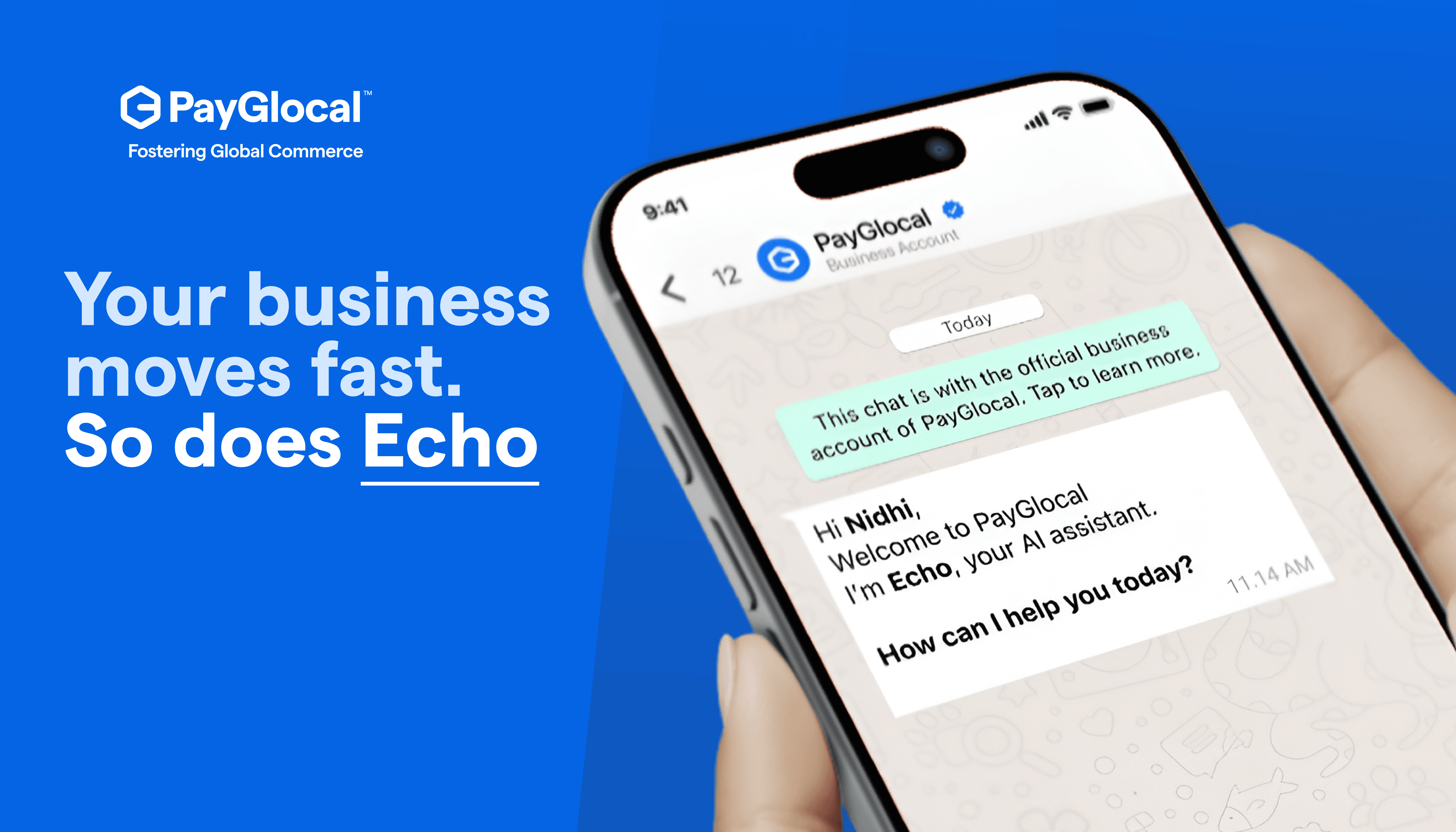
That thinking shaped Echo, which we launched at GFF with Sarvam.

Echo brings AI-powered payment operations to WhatsApp and PayGlocal Go, allowing merchants to interact through text or voice across areas such as transactions, settlements, disputes and payment links.
The broader principle is more important than the individual product.
Software interfaces are moving from navigation to intent.
Instead of users learning where every function sits inside an application, software will increasingly need to understand what a user is trying to accomplish and orchestrate the systems required to make it happen.
For fintech, that can fundamentally change how businesses interact with financial infrastructure.
Simplicity on the surface requires intelligence underneath: Introducing Flash
There is another tension shaping payments.
Customers expect payments to become simpler. The infrastructure underneath them is becoming more sophisticated.
That is not a contradiction. In many ways, it is the objective. The best infrastructure absorbs complexity so that the end user does not have to.
Our third launch at GFF, Flash, reflects that philosophy.
Launched with MakeMyTrip, the proposition is deliberately simple:
Create once. Pay faster. Shop across India.

But simplicity at the customer layer rarely means simplicity underneath.
Identity, authentication, merchant integrations, payment processing and user experience all need to work together before the experience can feel effortless.
This principle extends far beyond one product.
Cross-border payments themselves are becoming progressively more complex behind the scenes—combining routing, fraud detection, authentication, local acquiring, multiple currencies and payment methods.
Customers should not have to understand that complexity.
They should simply experience a payment that works.
That is where infrastructure creates real value.
Payments, AI and treasury are becoming one conversation
One observation from our team after GFF captured the shift particularly well.
Prasanna Suryawanshi, Head of Banking Alliances & Strategic Partnerships, put it perfectly: “The next frontier isn’t one technology, but the convergence of Agentic AI, faster payments and treasury innovation—and the partnerships that bring them together.”
That convergence is significant.
Historically, many parts of the financial stack evolved independently.
- Payments teams optimised acceptance.
- Treasury teams optimised liquidity.
- Banks built faster rails.
- Technology teams improved interfaces.
AI introduces the possibility of connecting these systems through a new decision-making layer.
Imagine financial infrastructure that does not merely execute instructions but continuously helps determine the best action.
- Which payment route should be used?
- Which currency should a business settle in?
- When should funds be converted?
- How should a merchant respond to a payment exception?
- What should happen when a transaction fails?
As systems become more intelligent, the line between payments infrastructure and financial decision infrastructure may gradually disappear.
That will require strong technology. It will also require strong partnerships.
No single company will own every part of this ecosystem.
Banks, payment companies, AI providers, networks, merchants and platforms will increasingly need to operate as interconnected components of the same experience.
Cross-border payments are ultimately an infrastructure problem
Winning Best Cross-Border Solution at GFF 2026 was an important moment for PayGlocal.
But awards are most useful when they reinforce the problem a company set out to solve.
For us, that problem remains straightforward.
Global commerce continues to grow easier at the front end.
A business in India can reach a customer thousands of kilometres away in seconds. Discovery is global. Advertising is global. E-commerce platforms are global.
Yet the infrastructure required to complete the transaction can still carry the friction of borders: payment failures, authentication differences, currency complexity, fraud risk, reconciliation and settlement.
That gap will matter even more as commerce becomes increasingly AI-driven.
An AI agent may be capable of identifying the perfect product for a customer. It may be able to negotiate preferences, answer questions and personalise the experience, but none of that creates commerce until money can move reliably.
The future of global commerce therefore depends not only on better interfaces. It depends on better infrastructure beneath them.
The best technology eventually becomes invisible
Walking through GFF, it was tempting to focus on the visible technology. AI agents, voice interfaces, real-time payments, embedded financial experiences. But the more important question is what happens after these technologies mature.
Most successful infrastructure eventually disappears from the customer's attention. People do not want to think about payment routing. They do not want to understand acquiring infrastructure. They do not want to navigate five dashboards to understand where their money is.
And increasingly, they may not even want to navigate a conventional checkout. They want to accomplish something.
- Buy the trip.
- Place the order.
- Collect the payment.
- Understand the settlement.
- Resolve the problem.
The role of financial technology is increasingly to understand that intent and make the complexity underneath it disappear.
That, more than any single technology showcased at GFF 2026, is the direction we believe the industry is moving in.
For PayGlocal, the three products we launched—Flash, Agentic Commerce Suite and Echo—approach that future from different directions.
- One simplifies how consumers pay.
- One explores how AI can participate directly in commerce.
- One changes how merchants interact with payment operations.
Together, they represent a broader belief:
The future of payments will not be defined by another button, dashboard or checkout page.
It will be defined by how intelligently financial infrastructure can participate in the experience around it.
GFF 2026 gave us a glimpse of that future, and the opportunity to showcase it.