
Managing international payments can be challenging for freelancers, SMEs, and exporters in India, but the right tools can make it much easier and more efficient. With rising transaction costs and delays, staying on top of cross-border payments is important for freelancers and SMEs to balance the cash flow and induce business growth.
According to a recent survey from the World Bank, India received a staggering 14.3% of the global remittances, amounting to $129.1 billion in 2024, its highest ever. This data underscores the critical need for businesses like yours to grasp the intricacies of international money transfers.
This blog explains how to receive payments from international clients and send funds to suppliers abroad, helping you minimize fees and speed up processing while ensuring compliance.
International money transfers refer to the process of moving funds between countries, enabling businesses to pay for goods, services, and salaries across borders.
For Indian businesses with cross-border payments, these transfers are a lifeline for engaging with global clients, suppliers, and partners. Efficient international transfers are key to making sure your payments and receipts happen on time, which keeps everything running smoothly and helps your business stay competitive.
Platforms like PayGlocal make this process easier by speeding up cross-border transactions and reducing costs. With multi-currency accounts and lower fees, it simplifies global payments, giving businesses the freedom to grow without the usual payment hurdles.
When it comes to receiving international payments or making overseas transfers, choosing the correct method can save you time and money. Here are India's most common payment options, each suited to different business needs and transaction types.
Banks like SBI, HDFC, and ICICI provide traditional and widely trusted international wire transfer services. These transfers are well-suited for large-value transactions and offer strong security. However, they often come with higher fees (both sending and receiving fees) and longer processing times than newer digital alternatives.
Gateways such as PayGlocal, Razorpay, PayPal, etc., simplify international payments. They support multiple payment methods, have easy integrations, enhance global acceptability, and offer faster settlements. These platforms are best suited for freelancers, SMEs, and e-commerce businesses.
Services like PayGlocal, Wise, etc., provide bank accounts in multiple countries, enabling fast, low-cost, multi-currency payments. They offer real-time exchange rate updates and are compliant with regulations. These are perfect for exporters and freelancers having clients across multiple countries.
Forex cards and wallets, such as Google Pay and Apple Pay, offer instant, secure access to funds. However, due to fees and transaction limits, they are mainly for personal use and have limited functionality for business payments.
Platforms like Western Union and Wise P2P serve primarily for personal transfers and smaller sums, with limited support for business transaction needs due to compliance and documentation limits.
Here’s a quick evaluation of their benefits and relevant charges:
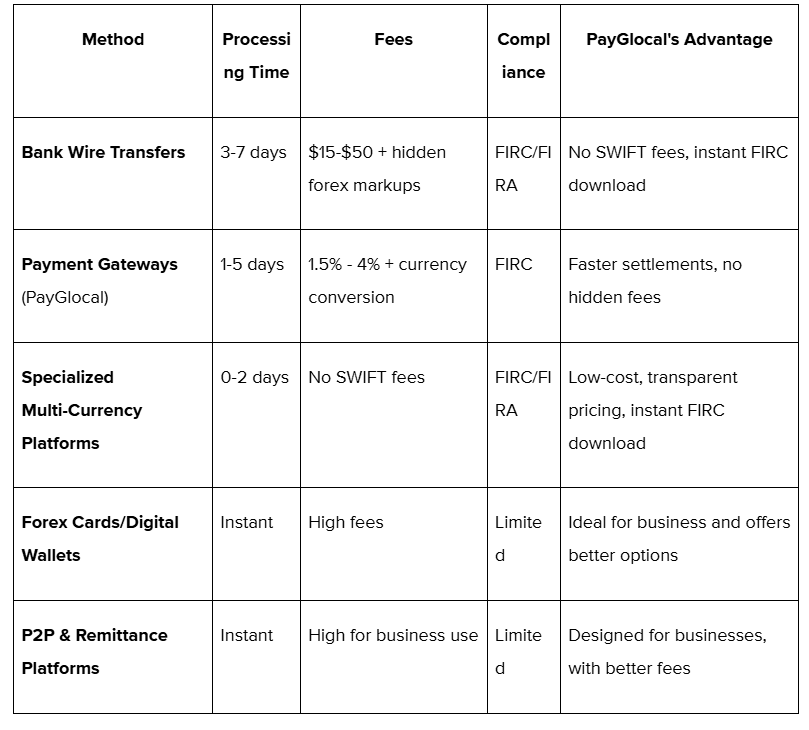
Evaluating each option based on key factors like processing time, fees, and convenience is essential to choosing the best payment method for your business. Let's take a closer look at these critical parameters.
When selecting the right international payment method, it's important to consider factors that directly impact both your costs and operational efficiency. Here are the key aspects to keep in mind when choosing a payment solution.
High transaction fees can significantly reduce your profits, especially if you make frequent international payments. It's also important to ensure there are no hidden fees that could impact your budget.
Always ask about upfront fees and check if there are additional charges like currency conversion markups. PayGlocal offers clear and transparent pricing without any hidden fees, which can help manage costs more effectively.
Choose platforms that provide real-time, competitive currency conversion rates. A poor exchange rate can result in significant losses when transferring large sums, as small differences in the rates can add up over time.
For example, banks often mark down rates (e.g., the market rate of 1 USD = ₹84 may be offered at ₹82), while many payment platforms provide the actual market rate.
Services that offer competitive rates can make a significant difference, especially when your business needs to make large and recurring transfers.
A user-friendly platform reduces the time spent managing payments, allowing businesses to focus on growth rather than the technicalities of transactions.
Choose platforms that offer consolidated dashboards, where you can handle payments, compliance, and reporting in one place, are generally more efficient for businesses with ongoing international payment needs.
For instance, PayGlocal has a unified dashboard for all payment-related activities.
Compliance with global regulations ensures your payments are secure and you avoid legal complications, particularly when dealing with international laws around money transfers.
Make sure your payment provider adheres to local and international compliance standards, such as RBI regulations and KYC/AML rules, and provides necessary certifications like FIRC. This will ensure a smooth process and help protect your business from compliance-related issues.
Responsive customer support is essential, especially when dealing with international transactions where the potential for issues can be higher.
Ensure your payment platform offers reliable customer service that's available when you need it, particularly if you are handling payments in different time zones. A good support system can save time and prevent costly delays.
Unlike instant domestic UPI payments, international transfers vary in speed. Banks may take up to 7 business days, and these delays in settlement can disrupt your cash flow, which is critical for maintaining smooth business operations, especially in global trade.
If your business requires fast payments, look for platforms like PayGlocal that provide quick settlements. Having funds available sooner can help businesses manage their cash flow better.
Security is essential to safeguard your business and customer data, as well as prevent fraud during transactions.
Look for platforms that use encryption methods and follow industry best practices for fraud prevention. Secure payment platforms offer multi-factor authentication and other protective measures to keep transactions safe.
With a clear understanding of what matters most in international transfers, let's explore practical tips for saving time and reducing costs on your global payments.
To make your international money transfers more efficient and cost-effective, follow proven strategies that streamline the process and protect your bottom line. Here are some of them.
Implementing these smart tips can significantly improve your money transfer experience, but choosing the right partner can take your international payments to the next level.
Managing international payments can be a challenge for businesses, but solutions like PayGlocal can simplify the process while ensuring security, compliance, and cost-effectiveness.
Here's why PayGlocal is the wise choice for managing your cross-border payments:
Choosing PayGlocal means partnering with a trusted, RBI-authorized payment aggregator focused on empowering your business to scale confidently and efficiently in the global marketplace.
International money transfers are important for running a global business. They ensure that payments are made smoothly across borders and help businesses tap into new markets. Understanding the common methods, from traditional bank transfers to digital payment platforms, helps you choose the best option for international money transfers in India.
By prioritizing essential factors such as fees, exchange rates, compliance, and transfer speed, you can simplify international payments, save valuable time, and reduce costs. With PayGlocal, you can seamlessly manage cross-border transactions, benefit from multi-currency support, eliminate hidden charges, enjoy faster settlements, and stay compliant with global regulations. Visit PayGlocal today and experience a hassle-free payment process tailored for your business growth.
According to a recent survey from the World Bank, India received a staggering 14.3% of the global remittances, amounting to $129.1 billion in 2024, its highest ever. This data underscores the critical need for businesses like yours to grasp the intricacies of international money transfers.
This blog explains how to receive payments from international clients and send funds to suppliers abroad, helping you minimize fees and speed up processing while ensuring compliance.
What are international money transfers?
International money transfers refer to the process of moving funds between countries, enabling businesses to pay for goods, services, and salaries across borders.
For Indian businesses with cross-border payments, these transfers are a lifeline for engaging with global clients, suppliers, and partners. Efficient international transfers are key to making sure your payments and receipts happen on time, which keeps everything running smoothly and helps your business stay competitive.
Platforms like PayGlocal make this process easier by speeding up cross-border transactions and reducing costs. With multi-currency accounts and lower fees, it simplifies global payments, giving businesses the freedom to grow without the usual payment hurdles.
Common methods for international money transfer in India
When it comes to receiving international payments or making overseas transfers, choosing the correct method can save you time and money. Here are India's most common payment options, each suited to different business needs and transaction types.
Bank wire transfers
Banks like SBI, HDFC, and ICICI provide traditional and widely trusted international wire transfer services. These transfers are well-suited for large-value transactions and offer strong security. However, they often come with higher fees (both sending and receiving fees) and longer processing times than newer digital alternatives.
- Processing timeframes: International wire transfers can take up to 7 business days or more due to factors like multiple intermediary banks, holidays, or incorrect details, which can impact your cash flow.
- Compliance requirements: A foreign inward remittance certificate (FIRC) or advice (FIRA) isn't automatically provided and often comes with fees. For example, banks charge around ₹250 per FIRA and additional costs for duplicates, requiring you to follow up with your bank.
- Charges: International bank transfer fees, or SWIFT fees (usually $15–$50), are often passed on to you by your clients. Currency conversion rates include hidden forex markups. For example, if the market rate is ₹84/USD, banks may offer ₹82/USD, leading to significant losses on large transfers. Additional service fees for the MT103 document for tracking and confirmation can further increase costs.
Payment gateways
Gateways such as PayGlocal, Razorpay, PayPal, etc., simplify international payments. They support multiple payment methods, have easy integrations, enhance global acceptability, and offer faster settlements. These platforms are best suited for freelancers, SMEs, and e-commerce businesses.
- Processing timeframes: It takes 1 to 5 business days for the funds to appear in your bank account.
- Compliance requirements: Payment gateways, often part of a payment processor platform, provide businesses and freelancers with FIRCs.
- Charges: They usually charge a fixed platform fee per transaction, ranging between 2.5% and 7%, plus additional currency conversion fees and GST.
Specialized multi-currency payment platforms
Services like PayGlocal, Wise, etc., provide bank accounts in multiple countries, enabling fast, low-cost, multi-currency payments. They offer real-time exchange rate updates and are compliant with regulations. These are perfect for exporters and freelancers having clients across multiple countries.
- Processing timeframes: Once the payment reaches your virtual account, it's quickly transferred to your bank account, usually within 0-2 business days.
- Compliance requirements: Most platforms offering multi-currency virtual accounts in India provide FIRA/FIRC to their users. While Wise charges a fee, PayGlocal offers a downloadable FIRC from the dashboard instantly and for free, making the process quicker and more convenient.
- Charges: No SWIFT fees apply since virtual bank accounts skip SWIFT transfers. However, each platform has its charges. Refer to PayGlocal's transparent pricing.
Forex cards and digital wallets
Forex cards and wallets, such as Google Pay and Apple Pay, offer instant, secure access to funds. However, due to fees and transaction limits, they are mainly for personal use and have limited functionality for business payments.
Peer-to-Peer (P2P) and remittance platforms
Platforms like Western Union and Wise P2P serve primarily for personal transfers and smaller sums, with limited support for business transaction needs due to compliance and documentation limits.
Here’s a quick evaluation of their benefits and relevant charges:
Evaluating each option based on key factors like processing time, fees, and convenience is essential to choosing the best payment method for your business. Let's take a closer look at these critical parameters.
International money transfers: How to prioritize?
When selecting the right international payment method, it's important to consider factors that directly impact both your costs and operational efficiency. Here are the key aspects to keep in mind when choosing a payment solution.
Transaction fees
High transaction fees can significantly reduce your profits, especially if you make frequent international payments. It's also important to ensure there are no hidden fees that could impact your budget.
Always ask about upfront fees and check if there are additional charges like currency conversion markups. PayGlocal offers clear and transparent pricing without any hidden fees, which can help manage costs more effectively.
Exchange rates
Choose platforms that provide real-time, competitive currency conversion rates. A poor exchange rate can result in significant losses when transferring large sums, as small differences in the rates can add up over time.
For example, banks often mark down rates (e.g., the market rate of 1 USD = ₹84 may be offered at ₹82), while many payment platforms provide the actual market rate.
Services that offer competitive rates can make a significant difference, especially when your business needs to make large and recurring transfers.
Ease of use
A user-friendly platform reduces the time spent managing payments, allowing businesses to focus on growth rather than the technicalities of transactions.
Choose platforms that offer consolidated dashboards, where you can handle payments, compliance, and reporting in one place, are generally more efficient for businesses with ongoing international payment needs.
For instance, PayGlocal has a unified dashboard for all payment-related activities.
Regulatory compliance
Compliance with global regulations ensures your payments are secure and you avoid legal complications, particularly when dealing with international laws around money transfers.
Make sure your payment provider adheres to local and international compliance standards, such as RBI regulations and KYC/AML rules, and provides necessary certifications like FIRC. This will ensure a smooth process and help protect your business from compliance-related issues.
Customer support
Responsive customer support is essential, especially when dealing with international transactions where the potential for issues can be higher.
Ensure your payment platform offers reliable customer service that's available when you need it, particularly if you are handling payments in different time zones. A good support system can save time and prevent costly delays.
Settlement timelines
Unlike instant domestic UPI payments, international transfers vary in speed. Banks may take up to 7 business days, and these delays in settlement can disrupt your cash flow, which is critical for maintaining smooth business operations, especially in global trade.
If your business requires fast payments, look for platforms like PayGlocal that provide quick settlements. Having funds available sooner can help businesses manage their cash flow better.
Security
Security is essential to safeguard your business and customer data, as well as prevent fraud during transactions.
Look for platforms that use encryption methods and follow industry best practices for fraud prevention. Secure payment platforms offer multi-factor authentication and other protective measures to keep transactions safe.
With a clear understanding of what matters most in international transfers, let's explore practical tips for saving time and reducing costs on your global payments.
Tips for transferring money internationally
To make your international money transfers more efficient and cost-effective, follow proven strategies that streamline the process and protect your bottom line. Here are some of them.
- Double-check payment details: Always verify bank account numbers, SWIFT codes, and other info multiple times before confirming a transfer to avoid costly errors or delays.
- Compare providers: Use comparison tools to find services like PayGlocal that offer competitive fees and exchange rates tailored to Indian businesses.
- Negotiate fees with clients: For large payments, ask clients to cover transfer fees or include these costs in your pricing to protect your margins.
- Set up recurring transfers: Automate regular payments to save time and ensure consistent cash flow with minimal manual effort.
- Use loyalty programs: Leverage reward programs from banks or payment services that offer fee discounts or cashback on frequent transactions or transactions beyond a certain threshold.
- Stay updated on regulations: Monitor compliance requirements regularly to avoid disruptions or penalties.
- Monitor exchange rates and fees: Track currency fluctuations and service charges to schedule transfers at optimal times and reduce unexpected costs.
Implementing these smart tips can significantly improve your money transfer experience, but choosing the right partner can take your international payments to the next level.
Why choose PayGlocal for international transfers?
Managing international payments can be a challenge for businesses, but solutions like PayGlocal can simplify the process while ensuring security, compliance, and cost-effectiveness.
Here's why PayGlocal is the wise choice for managing your cross-border payments:
- Global payment reach: Accept payments in over 33 currencies across 180+ countries, including cards and local payment methods, such as Klarna, GrabPay, Giropay, etc. These are trusted by customers worldwide, thus enhancing convenience and conversion rates. This wide acceptance helps increase conversion rates and customer satisfaction by offering localized payment options.
- Transparent and cost-effective pricing: Enjoy a clear fee structure with no hidden markups, monthly fees, or surprise costs. It is ideal for exporters and SMEs aiming to optimize cash flow.
- Unified platform management: PayGlocal offers a single, secure dashboard to manage all your payments, refunds, and reports in one place. With features like end-to-end encryption and multi-factor authentication, your data is safeguarded at all times.
- Security and compliance: Benefit from advanced fraud detection, PCI DSS compliance, and SamruddhiX sanctions screening—a privacy-first, zero-knowledge-proof solution ensuring adherence to global AML regulations without exposing sensitive data.
- High transaction success rates: PayGlocal's intelligent routing and orchestration engine maximizes approval rates, which is significant for international card payments. It also minimizes declined transactions and revenue loss.
- Faster settlements and real-time notifications: Track your transactions in real time and enjoy quicker settlements, helping you maintain healthy cash flow and respond promptly to your business needs.
- Seamless integration & customization: Customize your payment flows with dynamic checkout and recurring payment APIs, providing customers with a smooth, branded experience on web or mobile platforms.
Choosing PayGlocal means partnering with a trusted, RBI-authorized payment aggregator focused on empowering your business to scale confidently and efficiently in the global marketplace.
Conclusion
International money transfers are important for running a global business. They ensure that payments are made smoothly across borders and help businesses tap into new markets. Understanding the common methods, from traditional bank transfers to digital payment platforms, helps you choose the best option for international money transfers in India.
By prioritizing essential factors such as fees, exchange rates, compliance, and transfer speed, you can simplify international payments, save valuable time, and reduce costs. With PayGlocal, you can seamlessly manage cross-border transactions, benefit from multi-currency support, eliminate hidden charges, enjoy faster settlements, and stay compliant with global regulations. Visit PayGlocal today and experience a hassle-free payment process tailored for your business growth.