

Planning to grow your business in international markets? Recent data shows Indian exports are increasing at 7.1%, while the global rate is 2.5%. This indicates a strong international demand for Indian products and services.
The global growth potential exists, but smart business expansion needs careful planning. Which markets make sense for your business? What regulations apply? How do you collect payments globally? Getting these factors right early saves you from costly mistakes later.
In this guide, we break down the top factors to consider when expanding a business internationally. You’ll get insights on market research, financial planning, compliance requirements, payment solutions, and more. By the end, you'll know exactly what to evaluate before scaling globally.
Global expansion means taking your products or services to customers outside your home country. It involves entering new markets, serving international customers, and building operations across borders.
For Indian businesses, this often starts with exports to the US, UK, Europe, or Southeast Asia. It can mean selling software subscriptions to global clients, shipping products internationally, or providing professional services remotely.
But expansion requires more than accepting international orders. It requires planning, infrastructure, and a proper strategy.
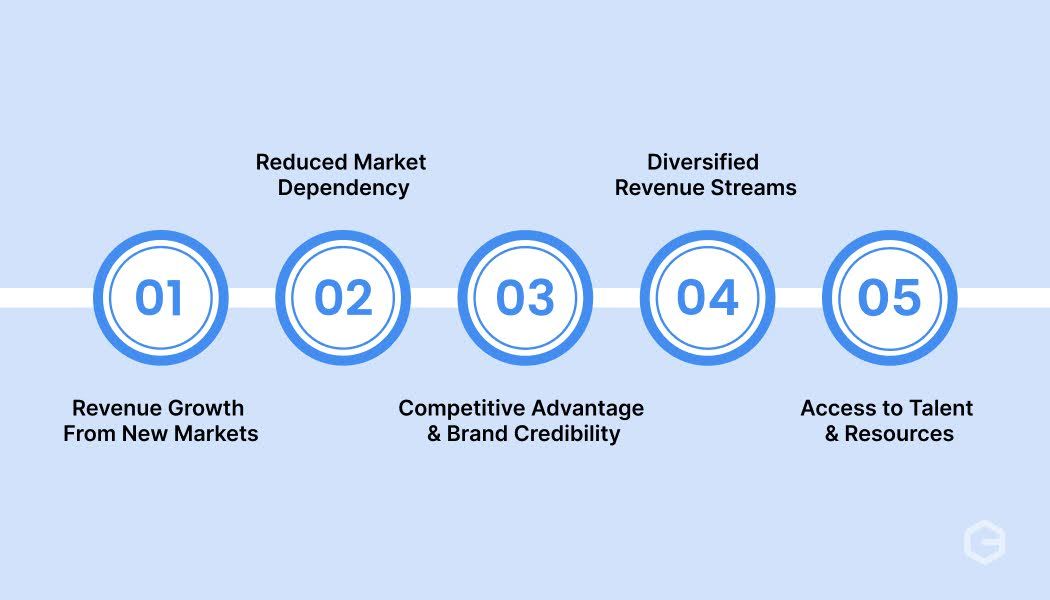
Global expansion offers clear advantages that go beyond just adding new customers. When done right, it creates multiple growth levers for your business. Here's what you gain:
It is exciting when you start getting early interest from customers worldwide. It shows your product or service has the potential. But now the question is whether your business has the right systems, processes, and planning in place to support that growth.
Here are some of the top factors to consider when expanding your business into international markets:
Research whether there's real demand for what you offer. Look at market size, growth trends, and customer needs. A market that's growing fast with underserved demand creates the best opportunity.
Start by looking at these elements:
Market size and growth rate: Calculate the total addressable market and annual growth projections. Larger, faster-growing markets offer more revenue potential.
Customer needs and pain points: Validate that your product solves a problem that customers in that market actually have. What works in India might not resonate in the US or Europe.
Competitive landscape: Identify local and international players. Strong competition means you need a clear differentiator. Underserved markets give you an opening to capture share quickly.
Use data to validate assumptions. Look at search trends, industry reports, and customer feedback. Talk to potential customers in the target market before committing resources.
Expansion costs add up quickly. You'll pay for market research, legal setup, marketing, hiring, logistics, and payment processing. Make sure your business has the cash flow to sustain operations while revenue builds in the new market.
Focus on these financial elements:
Initial investment requirements: Calculate costs for market entry, including legal fees, marketing spend, technology setup, and hiring.
Break-even timeline: Estimate how long it takes to become profitable in the new market. Can your business afford that runway without hurting existing operations?
Hidden costs: Currency conversion fees, cross-border transaction charges, tax compliance, and local partnerships drain budgets fast. International payment processing fees can range from 3% to 5% per transaction.
Cash flow management: Settlement delays of 5 to 10 business days can create working capital challenges. Plan for this gap between sales and receiving funds.
For instance, if you're launching in the UK, budget for VAT registration, pound sterling conversion costs, and potentially hire a local accountant to manage compliance.
Plan for contingencies. Markets take longer to mature than expected. Having a financial cushion protects you from slow adoption or regulatory delays.
Every country has its own rules. You'll need to comply with business registration, tax laws, employment regulations, and data privacy standards. Ignoring these leads to fines, legal trouble, or being blocked from operating.
Here are the main compliance areas you need to address:
Business registration: Register your entity according to local requirements. Some countries require a local subsidiary, others allow foreign companies to operate directly.
Tax structures: Countries have different VAT, GST, corporate tax, and withholding tax rules. The US requires businesses to handle TDS (Tax Deducted at Source) when paying Indian service providers.
Data privacy laws: GDPR in Europe, CCPA in California, and India's DPDP Act impose strict rules on handling customer data. Non-compliance results in heavy penalties.
Employment regulations: Hiring international employees or contractors means following local labor laws, benefits requirements, and payroll regulations. Misclassifying workers creates legal and financial risks.
Work with local legal and tax experts. They help you set up correctly, stay compliant, and avoid costly mistakes.
Payment infrastructure determines whether customers can pay easily and whether you get paid quickly. Poor payment systems reduce conversions and hurt cash flow.
These payment factors directly impact your success:
Transaction fees and settlement speed: Traditional banks charge 3% to 5% in fees, and settlements take 5 to 10 business days. This delays access to working capital.
Payment success rates: Low approval rates mean lost revenue. Factors like incorrect messaging to international issuers or a lack of local payment methods reduce success.
Currency support: Customers prefer paying in their local currency. Offering USD, EUR, GBP, and other currencies increases conversion rates.
Payment method variety: US customers expect credit cards. European customers prefer SEPA transfers. Southeast Asian customers use digital wallets. Support multiple options.
Compliance documentation: Indian businesses need an FIRC (Foreign Inward Remittance Certificate) for every international transaction. Manual processes delay this and create paperwork headaches.
Choosing the right payment partner solves these problems. You need multi-currency support, local payment methods, high success rates, and automated compliance.
Your product, messaging, and customer experience must align with local culture. What works in one market can confuse or offend customers in another.
Focus your localization efforts on these priorities:
Language translation: Translate your website, product interface, support docs, and marketing content. But translation alone isn't enough. Adapt tone, examples, and messaging to fit cultural norms.
Customer expectations: US customers expect fast, self-service support. Indian customers prefer direct communication via WhatsApp or phone. European customers value data privacy and transparency.
Marketing adaptation: Social media platforms, ad formats, and campaign messages that work in India might not resonate in Germany or the UK. Test and adapt based on local feedback.
Product modifications: Pricing models, features, and user flows may need adjustment. Some markets prefer monthly subscriptions, others annual plans with discounts.
For instance, a food delivery app successful in India would need to adjust menu options, delivery expectations, and payment methods when entering Southeast Asian markets where food preferences and logistics differ significantly.
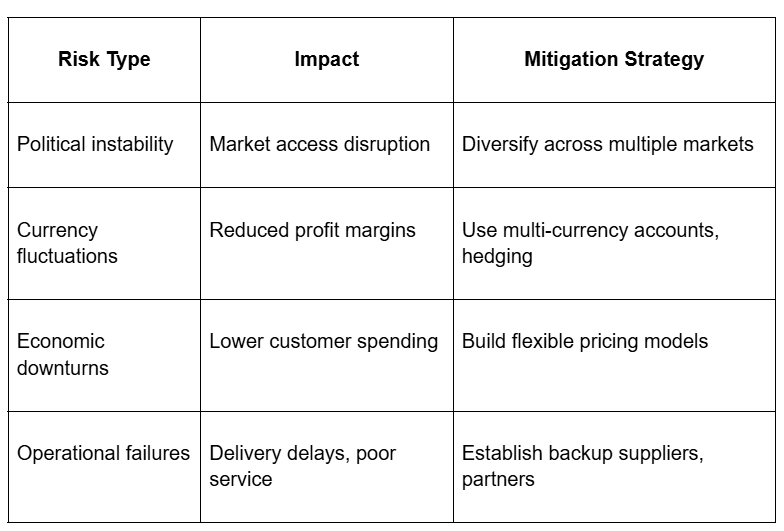
Risk comes in many forms when expanding globally. Political instability, economic downturns, currency fluctuations, and operational challenges can all impact success.
You need to assess these risk categories:
Political and economic stability: Some markets are business-friendly with stable policies. Others face regulatory uncertainty, corruption, or sudden changes. Research the business environment before committing.
Currency fluctuation risk: Exchange rates change constantly. A sudden drop in your home currency can eat into profits. Multi-currency accounts or hedging strategies help manage this.
Operational challenges: Supply chain delays, logistics issues, and unreliable partners can hurt customer satisfaction. Build backup plans for critical operations.
Exit strategy: Know when and how to pull back if the market doesn't perform as expected. Some businesses test markets with minimal investment before scaling fully.
How you enter a market determines your speed, cost, and control. Your strategy depends on your goals, resources, and the market's characteristics.
Here are the most common entry approaches:
Exporting: Sell and ship products from your home country. This is the simplest approach, requiring less investment. But shipping costs, customs, and delivery times can create challenges.
Partnerships and distribution: Leverage local players who handle sales, marketing, and customer service. This reduces risk but means sharing revenue and control.
Direct sales: Sell directly to customers via your website or sales team. Works well for digital products and services. Gives you full control and higher margins but requires building brand awareness from scratch.
Physical presence: Open an office, warehouse, or retail location. Most expensive option, but gives you the strongest local footprint. Makes sense when you need local teams or face-to-face customer interaction.
For example, a SaaS company can start with direct online sales to test demand, then establish a local sales team once revenue justifies the investment.
Start small and scale. Many successful businesses begin with exports or partnerships, validate demand, and then expand their presence as revenue grows.
Getting products or services to international customers reliably requires planning. Logistics breakdowns create delays, unhappy customers, and lost sales.
Plan for these logistics elements:
Shipping and delivery: Choose reliable carriers, calculate delivery times, and set clear customer expectations. Factor in customs clearance and potential delays.
Warehousing strategy: Decide whether to ship from India or establish local warehouses in target markets. Local warehousing speeds delivery but increases costs.
Customs and duties: Understand import regulations, tariffs, and documentation requirements for each market. Incorrect paperwork causes delays and additional fees.
Returns and customer service: Create a clear returns process for international customers. Partner with local service providers if needed to handle returns efficiently.
For instance, an Indian apparel brand selling to US customers can reduce delivery times from 15 days to 3 days by using a fulfillment center in the US, but must weigh this against higher warehousing costs.
Test your logistics before scaling. Send sample shipments to yourself or partners in the target market to identify potential issues.
Your systems must handle multiple markets, currencies, languages, and regulations without breaking. Technology gaps create operational nightmares as you scale.
Your technology needs to cover these requirements:
Multi-currency and payment systems: Your platform must process transactions in different currencies, handle tax calculations correctly, and integrate with local payment methods.
Website and platform localization: Support multiple languages, regional pricing, and local compliance requirements without requiring separate systems for each market.
Customer support tools: Provide support across time zones using tools that handle different languages and channels (email, chat, phone, WhatsApp).
Data and analytics: Track performance by market, currency, and customer segment. Make decisions based on accurate data rather than assumptions.
Invest in scalable infrastructure early. Quick fixes might work for one market but break when you add a second or third.
Serving international markets requires people who know those markets. Building the right team determines execution quality.
Consider these talent factors:
Local market expertise: Hire people who know the culture, regulations, and customer behavior in your target markets. Local hires bring insights you can't get from desk research.
Remote team management: Build systems to manage teams across time zones. Clear communication, project management tools, and regular check-ins keep everyone aligned.
Skills and capabilities: Ensure your team has the skills needed for international operations like cross-border finance, international marketing, and global customer support.
Training and onboarding: Prepare your existing team to work with international customers. This includes cultural awareness, time zone management, and understanding different business practices.
Start with a small team and add people as revenue justifies the investment. Many businesses hire contractors initially before committing to full-time international employees.
Payment challenges slow down even the best expansion plans. High fees, low success rates, compliance delays, and a lack of local payment options cost you customers and cash flow.
PayGlocal offers the payment infrastructure you need to collect internationally and settle locally without the usual payment processing issues. Here's how it helps:
Multi-currency accounts: Accept payments in USD, GBP, EUR, CAD, and 33+ other currencies from 180+ countries with transparent pricing and no hidden fees.
Dynamic checkout: Fast, secure, and customizable checkout flows that increase payment success rates, reducing lost sales from failed transactions.
Sanction screening: Built-in compliance checks with zero-knowledge-proof technology to verify transactions while protecting sensitive customer data and staying compliant with global regulations.
Instant compliance documentation: Auto-generated FIRC after every settlement, so you stay compliant without manual follow-ups or paperwork delays.
One platform: Manage all payments, view transaction details, download reports, and track fund status from a single dashboard.
PayGlocal helps you focus on growing your business while it handles the complexity of cross-border payments. Faster settlements, lower costs, and higher success rates in one platform.
When expanding a business globally, the decisions you make early shape your success. Market research, financial planning, compliance, and payment infrastructure all matter. Skip any of these, and you risk delays, lost revenue, or costly mistakes.
The good news is that global expansion is more accessible than ever before. By using proper strategies and tools, you can serve international customers, grow revenue, and build a truly global brand.
The right payment infrastructure helps you collect payments faster, settle locally, and scale easily. Get started with PayGlocal today and start accepting international payments faster, with better security.
The global growth potential exists, but smart business expansion needs careful planning. Which markets make sense for your business? What regulations apply? How do you collect payments globally? Getting these factors right early saves you from costly mistakes later.
In this guide, we break down the top factors to consider when expanding a business internationally. You’ll get insights on market research, financial planning, compliance requirements, payment solutions, and more. By the end, you'll know exactly what to evaluate before scaling globally.
Key takeaways
- Market research comes first: Analyze demand, competition, customer behavior, and growth potential before entering any market.
- Financial readiness matters: Calculate expansion costs, revenue projections, and ensure your business can sustain operations during the growth phase.
- Regulatory compliance is essential: Each country has unique tax, employment, data privacy, and business registration requirements you must meet.
- Logistics and supply chain planning prevent delays: Shipping, customs, warehousing, and distribution need clear processes to serve international customers reliably.
- PayGlocal simplifies global payments: With PayGlocal, you can collect payments in 33+ currencies, settle in INR, and get instant compliance documentation.
What does global expansion mean for your business?
Global expansion means taking your products or services to customers outside your home country. It involves entering new markets, serving international customers, and building operations across borders.
For Indian businesses, this often starts with exports to the US, UK, Europe, or Southeast Asia. It can mean selling software subscriptions to global clients, shipping products internationally, or providing professional services remotely.
But expansion requires more than accepting international orders. It requires planning, infrastructure, and a proper strategy.
What are the benefits of expanding a business globally?
Global expansion offers clear advantages that go beyond just adding new customers. When done right, it creates multiple growth levers for your business. Here's what you gain:
- Revenue growth from new markets: Access new customer bases who are willing to pay for your product or service. International markets often have higher purchasing power and less competition than your home market.
- Reduced market dependency: Relying on one country makes your business vulnerable to local economic downturns, policy changes, or competitive pressures. Serving multiple markets spreads risk and creates stability.
- Competitive advantage and brand credibility: International customers, partnerships, and success stories position your business as a serious player. This helps with funding, talent acquisition, and long-term growth.
- Diversified revenue streams: Economic cycles vary by region. When one market slows down, another can pick up the slack. This creates more predictable revenue and reduces overall business risk.
- Access to talent and resources: Global expansion opens doors to hiring international talent, partnering with foreign companies, and accessing resources that might be expensive or unavailable domestically.
What factors to consider when expanding a business internationally?
It is exciting when you start getting early interest from customers worldwide. It shows your product or service has the potential. But now the question is whether your business has the right systems, processes, and planning in place to support that growth.
Here are some of the top factors to consider when expanding your business into international markets:
Market demand and opportunity
Research whether there's real demand for what you offer. Look at market size, growth trends, and customer needs. A market that's growing fast with underserved demand creates the best opportunity.
Start by looking at these elements:
Market size and growth rate: Calculate the total addressable market and annual growth projections. Larger, faster-growing markets offer more revenue potential.
Customer needs and pain points: Validate that your product solves a problem that customers in that market actually have. What works in India might not resonate in the US or Europe.
Competitive landscape: Identify local and international players. Strong competition means you need a clear differentiator. Underserved markets give you an opening to capture share quickly.
Use data to validate assumptions. Look at search trends, industry reports, and customer feedback. Talk to potential customers in the target market before committing resources.
Financial readiness and cost planning
Expansion costs add up quickly. You'll pay for market research, legal setup, marketing, hiring, logistics, and payment processing. Make sure your business has the cash flow to sustain operations while revenue builds in the new market.
Focus on these financial elements:
Initial investment requirements: Calculate costs for market entry, including legal fees, marketing spend, technology setup, and hiring.
Break-even timeline: Estimate how long it takes to become profitable in the new market. Can your business afford that runway without hurting existing operations?
Hidden costs: Currency conversion fees, cross-border transaction charges, tax compliance, and local partnerships drain budgets fast. International payment processing fees can range from 3% to 5% per transaction.
Cash flow management: Settlement delays of 5 to 10 business days can create working capital challenges. Plan for this gap between sales and receiving funds.
For instance, if you're launching in the UK, budget for VAT registration, pound sterling conversion costs, and potentially hire a local accountant to manage compliance.
Plan for contingencies. Markets take longer to mature than expected. Having a financial cushion protects you from slow adoption or regulatory delays.
Regulations and compliance
Every country has its own rules. You'll need to comply with business registration, tax laws, employment regulations, and data privacy standards. Ignoring these leads to fines, legal trouble, or being blocked from operating.
Here are the main compliance areas you need to address:
Business registration: Register your entity according to local requirements. Some countries require a local subsidiary, others allow foreign companies to operate directly.
Tax structures: Countries have different VAT, GST, corporate tax, and withholding tax rules. The US requires businesses to handle TDS (Tax Deducted at Source) when paying Indian service providers.
Data privacy laws: GDPR in Europe, CCPA in California, and India's DPDP Act impose strict rules on handling customer data. Non-compliance results in heavy penalties.
Employment regulations: Hiring international employees or contractors means following local labor laws, benefits requirements, and payroll regulations. Misclassifying workers creates legal and financial risks.
Work with local legal and tax experts. They help you set up correctly, stay compliant, and avoid costly mistakes.
Payment infrastructure and collections
Payment infrastructure determines whether customers can pay easily and whether you get paid quickly. Poor payment systems reduce conversions and hurt cash flow.
These payment factors directly impact your success:
Transaction fees and settlement speed: Traditional banks charge 3% to 5% in fees, and settlements take 5 to 10 business days. This delays access to working capital.
Payment success rates: Low approval rates mean lost revenue. Factors like incorrect messaging to international issuers or a lack of local payment methods reduce success.
Currency support: Customers prefer paying in their local currency. Offering USD, EUR, GBP, and other currencies increases conversion rates.
Payment method variety: US customers expect credit cards. European customers prefer SEPA transfers. Southeast Asian customers use digital wallets. Support multiple options.
Compliance documentation: Indian businesses need an FIRC (Foreign Inward Remittance Certificate) for every international transaction. Manual processes delay this and create paperwork headaches.
Choosing the right payment partner solves these problems. You need multi-currency support, local payment methods, high success rates, and automated compliance.
Cultural fit and localization
Your product, messaging, and customer experience must align with local culture. What works in one market can confuse or offend customers in another.
Focus your localization efforts on these priorities:
Language translation: Translate your website, product interface, support docs, and marketing content. But translation alone isn't enough. Adapt tone, examples, and messaging to fit cultural norms.
Customer expectations: US customers expect fast, self-service support. Indian customers prefer direct communication via WhatsApp or phone. European customers value data privacy and transparency.
Marketing adaptation: Social media platforms, ad formats, and campaign messages that work in India might not resonate in Germany or the UK. Test and adapt based on local feedback.
Product modifications: Pricing models, features, and user flows may need adjustment. Some markets prefer monthly subscriptions, others annual plans with discounts.
For instance, a food delivery app successful in India would need to adjust menu options, delivery expectations, and payment methods when entering Southeast Asian markets where food preferences and logistics differ significantly.
Risk assessment and contingency planning
Risk comes in many forms when expanding globally. Political instability, economic downturns, currency fluctuations, and operational challenges can all impact success.
You need to assess these risk categories:
Political and economic stability: Some markets are business-friendly with stable policies. Others face regulatory uncertainty, corruption, or sudden changes. Research the business environment before committing.
Currency fluctuation risk: Exchange rates change constantly. A sudden drop in your home currency can eat into profits. Multi-currency accounts or hedging strategies help manage this.
Operational challenges: Supply chain delays, logistics issues, and unreliable partners can hurt customer satisfaction. Build backup plans for critical operations.
Exit strategy: Know when and how to pull back if the market doesn't perform as expected. Some businesses test markets with minimal investment before scaling fully.
Market entry strategy
How you enter a market determines your speed, cost, and control. Your strategy depends on your goals, resources, and the market's characteristics.
Here are the most common entry approaches:
Exporting: Sell and ship products from your home country. This is the simplest approach, requiring less investment. But shipping costs, customs, and delivery times can create challenges.
Partnerships and distribution: Leverage local players who handle sales, marketing, and customer service. This reduces risk but means sharing revenue and control.
Direct sales: Sell directly to customers via your website or sales team. Works well for digital products and services. Gives you full control and higher margins but requires building brand awareness from scratch.
Physical presence: Open an office, warehouse, or retail location. Most expensive option, but gives you the strongest local footprint. Makes sense when you need local teams or face-to-face customer interaction.
For example, a SaaS company can start with direct online sales to test demand, then establish a local sales team once revenue justifies the investment.
Start small and scale. Many successful businesses begin with exports or partnerships, validate demand, and then expand their presence as revenue grows.
Logistics and supply chain planning
Getting products or services to international customers reliably requires planning. Logistics breakdowns create delays, unhappy customers, and lost sales.
Plan for these logistics elements:
Shipping and delivery: Choose reliable carriers, calculate delivery times, and set clear customer expectations. Factor in customs clearance and potential delays.
Warehousing strategy: Decide whether to ship from India or establish local warehouses in target markets. Local warehousing speeds delivery but increases costs.
Customs and duties: Understand import regulations, tariffs, and documentation requirements for each market. Incorrect paperwork causes delays and additional fees.
Returns and customer service: Create a clear returns process for international customers. Partner with local service providers if needed to handle returns efficiently.
For instance, an Indian apparel brand selling to US customers can reduce delivery times from 15 days to 3 days by using a fulfillment center in the US, but must weigh this against higher warehousing costs.
Test your logistics before scaling. Send sample shipments to yourself or partners in the target market to identify potential issues.
Technology and infrastructure readiness
Your systems must handle multiple markets, currencies, languages, and regulations without breaking. Technology gaps create operational nightmares as you scale.
Your technology needs to cover these requirements:
Multi-currency and payment systems: Your platform must process transactions in different currencies, handle tax calculations correctly, and integrate with local payment methods.
Website and platform localization: Support multiple languages, regional pricing, and local compliance requirements without requiring separate systems for each market.
Customer support tools: Provide support across time zones using tools that handle different languages and channels (email, chat, phone, WhatsApp).
Data and analytics: Track performance by market, currency, and customer segment. Make decisions based on accurate data rather than assumptions.
Invest in scalable infrastructure early. Quick fixes might work for one market but break when you add a second or third.
Team and talent acquisition
Serving international markets requires people who know those markets. Building the right team determines execution quality.
Consider these talent factors:
Local market expertise: Hire people who know the culture, regulations, and customer behavior in your target markets. Local hires bring insights you can't get from desk research.
Remote team management: Build systems to manage teams across time zones. Clear communication, project management tools, and regular check-ins keep everyone aligned.
Skills and capabilities: Ensure your team has the skills needed for international operations like cross-border finance, international marketing, and global customer support.
Training and onboarding: Prepare your existing team to work with international customers. This includes cultural awareness, time zone management, and understanding different business practices.
Start with a small team and add people as revenue justifies the investment. Many businesses hire contractors initially before committing to full-time international employees.
Get paid globally and scale your business with PayGlocal
Payment challenges slow down even the best expansion plans. High fees, low success rates, compliance delays, and a lack of local payment options cost you customers and cash flow.
PayGlocal offers the payment infrastructure you need to collect internationally and settle locally without the usual payment processing issues. Here's how it helps:
Multi-currency accounts: Accept payments in USD, GBP, EUR, CAD, and 33+ other currencies from 180+ countries with transparent pricing and no hidden fees.
Dynamic checkout: Fast, secure, and customizable checkout flows that increase payment success rates, reducing lost sales from failed transactions.
Sanction screening: Built-in compliance checks with zero-knowledge-proof technology to verify transactions while protecting sensitive customer data and staying compliant with global regulations.
Instant compliance documentation: Auto-generated FIRC after every settlement, so you stay compliant without manual follow-ups or paperwork delays.
One platform: Manage all payments, view transaction details, download reports, and track fund status from a single dashboard.
PayGlocal helps you focus on growing your business while it handles the complexity of cross-border payments. Faster settlements, lower costs, and higher success rates in one platform.
Final thoughts
When expanding a business globally, the decisions you make early shape your success. Market research, financial planning, compliance, and payment infrastructure all matter. Skip any of these, and you risk delays, lost revenue, or costly mistakes.
The good news is that global expansion is more accessible than ever before. By using proper strategies and tools, you can serve international customers, grow revenue, and build a truly global brand.
The right payment infrastructure helps you collect payments faster, settle locally, and scale easily. Get started with PayGlocal today and start accepting international payments faster, with better security.