
India's export sector is growing rapidly. According to recent data, merchandise exports reached $35.10 billion in August 2025, up from $32.89 billion in August 2024.
But if you're shipping goods internationally, you've probably come across the term CFS in freight quotes, shipping documents, or customs paperwork. But what does CFS actually mean, and why does it matter for your business?
In this guide, we break down in detail what CFS means, how these facilities work, including their key functions and benefits. So, let’s get started.
-CFS stands for Container Freight Station: A warehouse where cargo is consolidated or deconsolidated for international shipping.
-Essential for LCL shipments: If you're not filling an entire container, your goods go through a CFS for grouping with other shipments.
-Handles customs clearance: CFS facilities inspect cargo, complete documentation, and ensure compliance before release.
-Reduces port congestion: By moving cargo processing off-site, CFS facilities help ports operate more efficiently.
-Involves specific charges: CFS operations come with handling, storage, and service fees you need to factor into your costs.
CFS (Container Freight Station) is a designated warehouse located near seaports, airports, or inland container depots where cargo belonging to different importers or exporters gets consolidated into full containers for export, or deconsolidated from full containers after import.
For businesses that don't have enough cargo to fill an entire container, CFS facilities are important. Instead of paying for a full container you don't need, you share container space with other shippers. The CFS handles the loading, unloading, documentation, and customs procedures for these mixed shipments.
The facility acts as an intermediate point between your supplier or warehouse and the final destination. Your cargo arrives at the CFS, gets inspected and documented, clears customs if required, and then moves forward in the supply chain.
For example, if you're importing electronic components from Germany, your goods arrive in a shared container, get deconsolidated at a CFS near the port, clear customs there, and then get delivered to your warehouse.
CFS facilities also provide storage space while paperwork gets processed or while you arrange for final delivery. This keeps ports less crowded and gives you flexibility in managing your shipments.
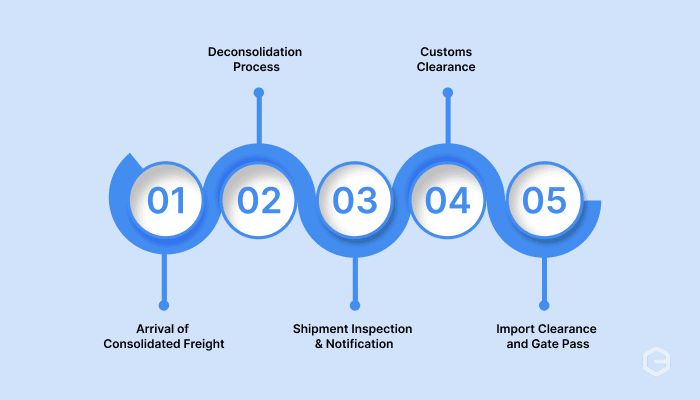
The CFS process involves several clear steps that move your cargo from arrival to final delivery. Here's how it works.
When your imported goods arrive at the port, they're part of a consolidated container shared with cargo from other importers. The shipping line or freight forwarder transfers this container from the port to the CFS facility.
At the CFS, workers unload the container and separate cargo based on individual bills of lading or shipping documents. Your shipment gets identified, counted, and moved to a designated area within the warehouse. This step ensures each importer's goods are correctly tracked.
CFS staff inspect cargo for damages, verify quantities against shipping documents, and check for any discrepancies. Once inspection is complete, you receive a notification that your goods have arrived and are ready for customs clearance. The CFS provides detailed reports on the condition and quantity of your shipment.
Customs officials visit the CFS to examine cargo, verify documents, and assess duties and taxes. You or your customs broker submit required paperwork like commercial invoices, packing lists, and import licenses. The CFS provides space and support for this clearance process. Once customs approves the shipment, they issue clearance documents.
After customs clearance, the CFS issues a gate pass or delivery order. You present this document to collect your cargo or arrange for transportation to your warehouse. The CFS tracks the entire process and provides status updates so you know exactly when your goods are ready for pickup.
For export shipments, the process works in reverse. You deliver cargo to the CFS, where it gets inspected, documented, and consolidated with other shipments into full containers before moving to the port for loading onto vessels.
CFS facilities handle multiple important tasks that keep international shipping running smoothly. Here's what they do.
Cargo consolidation and deconsolidation: CFS facilities combine smaller shipments from multiple exporters into full containers for export, and separate mixed cargo from full containers for individual importers. This makes LCL shipping practical and cost-effective.
Storage and warehousing: Goods can be stored at the CFS while awaiting customs clearance, documentation completion, or final delivery arrangements. Storage periods vary based on regulations and your needs, but extended storage usually involves additional charges.
Customs examination and clearance: CFS provides the physical space and facilities for customs officials to inspect cargo, verify documents, and complete clearance procedures. They coordinate with customs authorities to speed up the process.
Documentation and record keeping: All shipping documents, bills of lading, packing lists, and customs paperwork get processed and maintained at the CFS. This creates a clear audit trail for compliance and tracking purposes.
Cargo inspection and quality checks: CFS staff verify cargo condition, check for damages, and ensure quantities match shipping documents. This protects both importers and exporters from disputes.
Loading and unloading services: The facility provides equipment and labor to load cargo into containers or unload it safely, reducing the risk of damage during handling.
Using CFS facilities offers several practical advantages for businesses handling international shipments.
What are CFS charges, and what do they include?
CFS operations involve several types of charges that you need to factor into your total shipping costs. Here's what you typically pay for.
CFS and CY are two common terms in shipping that serve different purposes. Here's how they compare.
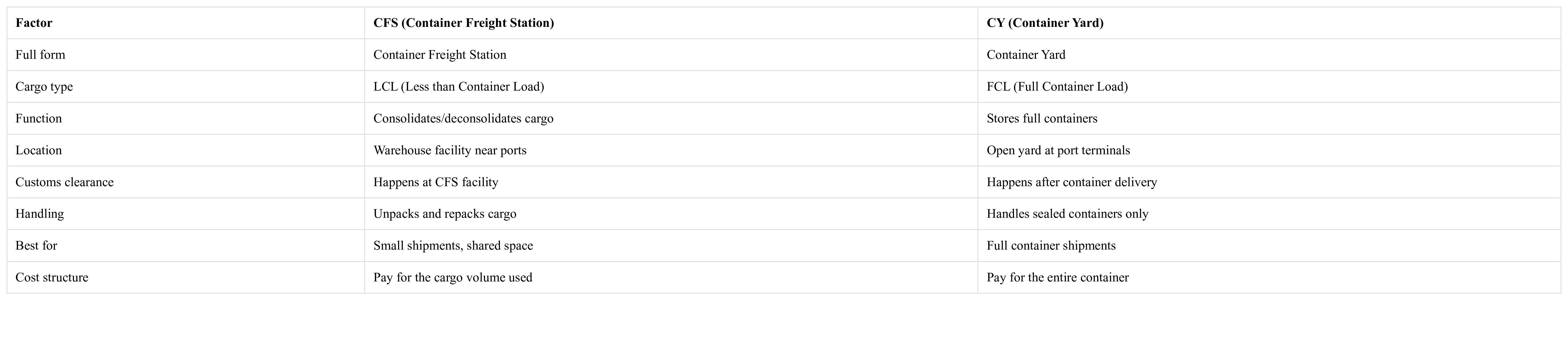
CY is simpler if you're shipping enough goods to fill a complete container. The container moves from the supplier to the port to the destination without opening or mixing with other cargo. CFS becomes necessary when you're dealing with smaller quantities that need to be grouped with other shipments to make container shipping economical.
For example, if you're exporting 5 cubic meters of handicrafts, you use CFS because renting an entire 20-foot container wastes space and money. But if you're exporting 20 pallets of machinery that fill a container, CY makes more sense.
CFS facilities have become an important part of international trade infrastructure for several reasons.
Managing freight and customs is one part of international trade. The other critical part is getting paid smoothly from your global clients and paying suppliers without delays or hidden costs.
When you're importing raw materials or exporting finished goods, you need a payment system that works as reliably as your logistics. Payment delays, currency conversion issues, or compliance gaps can hold up your entire supply chain just as much as a stuck shipment at CFS.
PayGlocal helps businesses handle international payments efficiently with transparent pricing, multi-currency, and better security. Here's what you get with PayGlocal:
Multi-currency accounts: Accept payments in 33+ currencies from 180+ countries, making it easy for international clients to pay you.
Instant compliance documentation: Receive FIRC (Foreign Inward Remittance Certificate) directly in your inbox after settlement, keeping your records clear for audits and tax filings.
Zero fixed costs: Pay only when you transact, with transparent pricing and no hidden charges.
Sanction screening: Verify transactions against global sanction lists with privacy-first technology to stay compliant and avoid regulatory risks.
One platform: Manage all your international payment operations from a single dashboard with customizable user access and detailed reporting.
Whether you're an exporter waiting for payments from overseas buyers or an importer paying suppliers in different currencies, PayGlocal simplifies the money movement so you can focus on growing your business.
CFS facilities play a practical role in international shipping by making LCL shipments possible, handling customs procedures, and keeping cargo secure during the clearance process. For businesses that don't ship full containers regularly, CFS provides an affordable way to participate in global trade.
But just as efficient cargo handling matters, smooth payment operations are equally important. Late payments or currency conversion issues can delay your entire supply chain, just like cargo stuck at customs.
Ready to handle international payments easily with better speed and security? Get started with PayGlocal today and collect payments from global clients while managing everything in one platform.
But if you're shipping goods internationally, you've probably come across the term CFS in freight quotes, shipping documents, or customs paperwork. But what does CFS actually mean, and why does it matter for your business?
In this guide, we break down in detail what CFS means, how these facilities work, including their key functions and benefits. So, let’s get started.
Key takeaways
-CFS stands for Container Freight Station: A warehouse where cargo is consolidated or deconsolidated for international shipping.
-Essential for LCL shipments: If you're not filling an entire container, your goods go through a CFS for grouping with other shipments.
-Handles customs clearance: CFS facilities inspect cargo, complete documentation, and ensure compliance before release.
-Reduces port congestion: By moving cargo processing off-site, CFS facilities help ports operate more efficiently.
-Involves specific charges: CFS operations come with handling, storage, and service fees you need to factor into your costs.
- Smooth international payments matter: PayGlocal helps you collect payments from global clients in multiple currencies while managing compliance and tracking.
What is CFS in shipping?
CFS (Container Freight Station) is a designated warehouse located near seaports, airports, or inland container depots where cargo belonging to different importers or exporters gets consolidated into full containers for export, or deconsolidated from full containers after import.
For businesses that don't have enough cargo to fill an entire container, CFS facilities are important. Instead of paying for a full container you don't need, you share container space with other shippers. The CFS handles the loading, unloading, documentation, and customs procedures for these mixed shipments.
The facility acts as an intermediate point between your supplier or warehouse and the final destination. Your cargo arrives at the CFS, gets inspected and documented, clears customs if required, and then moves forward in the supply chain.
For example, if you're importing electronic components from Germany, your goods arrive in a shared container, get deconsolidated at a CFS near the port, clear customs there, and then get delivered to your warehouse.
CFS facilities also provide storage space while paperwork gets processed or while you arrange for final delivery. This keeps ports less crowded and gives you flexibility in managing your shipments.
How does a CFS work?
The CFS process involves several clear steps that move your cargo from arrival to final delivery. Here's how it works.
Step 1: Arrival of consolidated freight
When your imported goods arrive at the port, they're part of a consolidated container shared with cargo from other importers. The shipping line or freight forwarder transfers this container from the port to the CFS facility.
Step 2: Deconsolidation process
At the CFS, workers unload the container and separate cargo based on individual bills of lading or shipping documents. Your shipment gets identified, counted, and moved to a designated area within the warehouse. This step ensures each importer's goods are correctly tracked.
Step 3: Shipment inspection and notification
CFS staff inspect cargo for damages, verify quantities against shipping documents, and check for any discrepancies. Once inspection is complete, you receive a notification that your goods have arrived and are ready for customs clearance. The CFS provides detailed reports on the condition and quantity of your shipment.
Step 4: Customs clearance
Customs officials visit the CFS to examine cargo, verify documents, and assess duties and taxes. You or your customs broker submit required paperwork like commercial invoices, packing lists, and import licenses. The CFS provides space and support for this clearance process. Once customs approves the shipment, they issue clearance documents.
Step 5: Import clearance and gate pass
After customs clearance, the CFS issues a gate pass or delivery order. You present this document to collect your cargo or arrange for transportation to your warehouse. The CFS tracks the entire process and provides status updates so you know exactly when your goods are ready for pickup.
For export shipments, the process works in reverse. You deliver cargo to the CFS, where it gets inspected, documented, and consolidated with other shipments into full containers before moving to the port for loading onto vessels.
What are the main functions of CFS in shipping?
CFS facilities handle multiple important tasks that keep international shipping running smoothly. Here's what they do.
Cargo consolidation and deconsolidation: CFS facilities combine smaller shipments from multiple exporters into full containers for export, and separate mixed cargo from full containers for individual importers. This makes LCL shipping practical and cost-effective.
Storage and warehousing: Goods can be stored at the CFS while awaiting customs clearance, documentation completion, or final delivery arrangements. Storage periods vary based on regulations and your needs, but extended storage usually involves additional charges.
Customs examination and clearance: CFS provides the physical space and facilities for customs officials to inspect cargo, verify documents, and complete clearance procedures. They coordinate with customs authorities to speed up the process.
Documentation and record keeping: All shipping documents, bills of lading, packing lists, and customs paperwork get processed and maintained at the CFS. This creates a clear audit trail for compliance and tracking purposes.
Cargo inspection and quality checks: CFS staff verify cargo condition, check for damages, and ensure quantities match shipping documents. This protects both importers and exporters from disputes.
Loading and unloading services: The facility provides equipment and labor to load cargo into containers or unload it safely, reducing the risk of damage during handling.
What are the benefits of using CFS facilities?
Using CFS facilities offers several practical advantages for businesses handling international shipments.
- Cost savings for smaller shipments: Instead of paying for an entire container when you only need partial space, CFS lets you share container costs with other shippers. This makes international shipping affordable even for smaller businesses or lower-volume orders.
- Reduces port congestion: By handling cargo processing, storage, and customs clearance away from busy port terminals, CFS facilities help ports operate more efficiently. This can reduce delays in getting your goods through the system.
- Facilitates smooth customs processing: CFS provides dedicated space and resources for customs examination, making the clearance process more organized and often faster than handling it directly at crowded ports.
- Improves shipment tracking: Modern CFS facilities offer tracking systems that let you monitor your cargo status, receive notifications at each stage, and plan your logistics accordingly. You know exactly when goods arrive, when they clear customs, and when they're ready for collection.
- Provides secure storage: Your cargo stays in a controlled, secure environment while awaiting clearance or delivery. This reduces the risk of theft, damage, or loss compared to leaving goods in less secure locations.
- Supports compliance requirements: CFS facilities help you meet regulatory requirements by maintaining proper documentation, providing inspection facilities, and ensuring all procedures follow customs regulations.
What are CFS charges, and what do they include?
CFS operations involve several types of charges that you need to factor into your total shipping costs. Here's what you typically pay for.
- Handling charges: Fees for unloading cargo from containers, moving it within the facility, and preparing it for delivery. These charges usually apply per unit or per weight.
- Storage charges: If your goods stay at the CFS beyond a free period (usually 3-5 days), you pay storage fees. These charges increase the longer the cargo remains at the facility.
- Documentation charges: Fees for processing paperwork, maintaining records, and issuing delivery orders or gate passes. Some CFS facilities include this in their base charges, while others bill separately.
- Container destuffing charges: The cost of unloading and deconsolidating cargo from containers. This usually applies per container or per cubic meter of cargo.
- Customs examination charges: Fees for providing space and support during customs inspection. These may be separate from customs duties and taxes.
- Miscellaneous service charges: Additional fees for special services like cargo photography, repacking, labeling, or weekend operations.
- CFS charges vary based on location, facility, cargo type, and service requirements. Always get a detailed breakdown of fees before choosing a CFS facility to avoid surprises.
What is the difference between CFS and CY?
CFS and CY are two common terms in shipping that serve different purposes. Here's how they compare.
CY is simpler if you're shipping enough goods to fill a complete container. The container moves from the supplier to the port to the destination without opening or mixing with other cargo. CFS becomes necessary when you're dealing with smaller quantities that need to be grouped with other shipments to make container shipping economical.
For example, if you're exporting 5 cubic meters of handicrafts, you use CFS because renting an entire 20-foot container wastes space and money. But if you're exporting 20 pallets of machinery that fill a container, CY makes more sense.
Why is CFS necessary for importers and exporters?
CFS facilities have become an important part of international trade infrastructure for several reasons.
- Makes LCL shipping practical: Without CFS facilities, small and medium businesses couldn't afford international shipping. CFS enables cost-effective exports and imports even when you don't have full container loads.
- Ensures regulatory compliance: Customs regulations require proper inspection and documentation before cargo enters or leaves a country. CFS provides the infrastructure and processes to meet these requirements efficiently.
- Improves supply chain efficiency: By handling time-consuming tasks like deconsolidation, inspection, and documentation off-site, CFS facilities keep ports moving and reduce delays in the overall supply chain.
- Provides flexibility in logistics: You can store cargo at CFS while arranging final transportation, waiting for documents, or coordinating with buyers. This flexibility helps manage cash flow and operations.
- Reduces risks: Professional handling, secure storage, and proper documentation at CFS facilities reduce the risk of cargo damage, loss, or compliance issues that could result in penalties.
- Supports smaller businesses: CFS democratizes international trade by making it accessible to businesses that can't fill entire containers. This levels the playing field and enables growth.
Manage global payments easily in one platfrom with PayGlocal
Managing freight and customs is one part of international trade. The other critical part is getting paid smoothly from your global clients and paying suppliers without delays or hidden costs.
When you're importing raw materials or exporting finished goods, you need a payment system that works as reliably as your logistics. Payment delays, currency conversion issues, or compliance gaps can hold up your entire supply chain just as much as a stuck shipment at CFS.
PayGlocal helps businesses handle international payments efficiently with transparent pricing, multi-currency, and better security. Here's what you get with PayGlocal:
Multi-currency accounts: Accept payments in 33+ currencies from 180+ countries, making it easy for international clients to pay you.
Instant compliance documentation: Receive FIRC (Foreign Inward Remittance Certificate) directly in your inbox after settlement, keeping your records clear for audits and tax filings.
Zero fixed costs: Pay only when you transact, with transparent pricing and no hidden charges.
Sanction screening: Verify transactions against global sanction lists with privacy-first technology to stay compliant and avoid regulatory risks.
One platform: Manage all your international payment operations from a single dashboard with customizable user access and detailed reporting.
Whether you're an exporter waiting for payments from overseas buyers or an importer paying suppliers in different currencies, PayGlocal simplifies the money movement so you can focus on growing your business.
Final thoughts
CFS facilities play a practical role in international shipping by making LCL shipments possible, handling customs procedures, and keeping cargo secure during the clearance process. For businesses that don't ship full containers regularly, CFS provides an affordable way to participate in global trade.
But just as efficient cargo handling matters, smooth payment operations are equally important. Late payments or currency conversion issues can delay your entire supply chain, just like cargo stuck at customs.
Ready to handle international payments easily with better speed and security? Get started with PayGlocal today and collect payments from global clients while managing everything in one platform.