
If you work with international clients, run a business that sells overseas, or receive money from family abroad, you may already be familiar with foreign inward remittance.
Put simply, it is money received in India from a sender located outside the country. The payment may be for exported goods or services, freelance work, family support, an investment or another permitted purpose.
The money can arrive through an authorised bank, a regulated money-transfer service or, for eligible business collections, a cross-border payments platform such as PayGlocal.
While receiving money from abroad can be straightforward, the purpose of the payment matters. A personal remittance from a family member does not have the same tax, documentation or compliance requirements as payment from an overseas customer.
This guide explains how foreign inward remittance works in India, the steps involved, the tax implications and the documents you may need.
Put simply, it is money received in India from a sender located outside the country. The payment may be for exported goods or services, freelance work, family support, an investment or another permitted purpose.
The money can arrive through an authorised bank, a regulated money-transfer service or, for eligible business collections, a cross-border payments platform such as PayGlocal.
While receiving money from abroad can be straightforward, the purpose of the payment matters. A personal remittance from a family member does not have the same tax, documentation or compliance requirements as payment from an overseas customer.
This guide explains how foreign inward remittance works in India, the steps involved, the tax implications and the documents you may need.
TL;DR
- Foreign inward remittance is money received in India from a sender outside the country for a permitted personal, business, investment or other purpose.
- The remittance itself is not automatically taxable simply because it came from abroad. Tax treatment depends on why you received the money.
- Businesses and exporters may need documents such as FIRA, e-BRC and EDPMS records, depending on the transaction and compliance requirement.
- Always use an RBI-authorised bank or regulated payments provider and give the correct purpose code, beneficiary details and supporting documents to avoid delays.
What is foreign inward remittance?
Foreign inward remittance refers to money transferred from outside India to a recipient in India.
The sender could be:
- an overseas customer paying an Indian exporter;
- a foreign company paying an Indian freelancer or consultant;
- a family member sending money home;
- an international marketplace paying an Indian seller; or
- another permitted overseas payer.
The recipient may receive the money in Indian rupees after currency conversion, or through an eligible foreign-currency or multi-currency collection arrangement depending on the product being used.
Under FEMA, foreign exchange transactions in India must generally be carried out through persons authorised by the Reserve Bank of India. The RBI defines an authorised person as an entity permitted to deal in foreign exchange under the Foreign Exchange Management Act. You can read the RBI's foreign exchange FAQs here.
Examples of foreign inward remittance
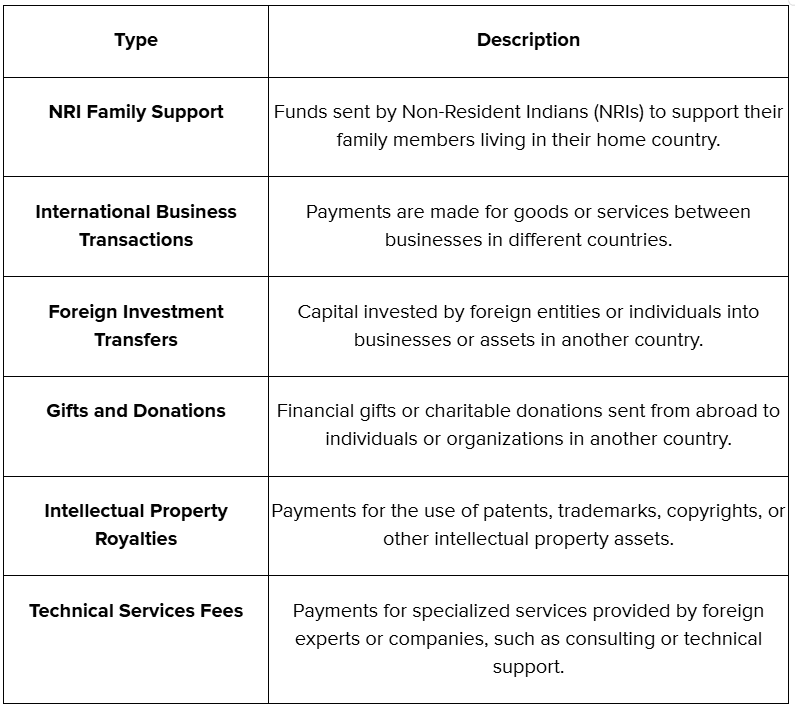
Common examples include:
| Type of remittance | Example |
|---|---|
| Export payment | An overseas buyer pays an Indian business for goods |
| Service payment | A US client pays an Indian consultant or SaaS company |
| Freelance income | A freelancer receives payment from an international platform or client |
| Family maintenance | A family member living abroad sends money to relatives in India |
| Investment-related receipt | Funds are received for a permitted investment or capital transaction |
| Marketplace payout | An Indian seller receives proceeds from an overseas marketplace |
The compliance requirements can differ significantly across these categories, so identifying the purpose correctly is important.
Why foreign inward remittances matter
Foreign inward remittances play several roles in the Indian economy.
Foreign exchange inflows
Remittances bring foreign currency into India through permitted channels and form part of the country's broader external-sector flows.
Support for households
Personal remittances from Indians living abroad can help families meet expenses such as education, healthcare, housing and day-to-day needs.
Revenue for Indian businesses
For exporters, freelancers, SaaS companies and other businesses serving international customers, inward remittances are how overseas sales turn into realised revenue.
Investment and entrepreneurship
Foreign receipts can also support eligible investments, business expansion and entrepreneurial activity, subject to the regulations applicable to that type of transaction.
The important distinction is that not every inward remittance is the same. A family transfer, export receipt and investment can all involve money entering India from abroad, but they may be governed by different tax and regulatory requirements.
How does foreign inward remittance work?
The exact journey depends on the payment method, but a typical foreign inward remittance follows these steps.
1. The sender initiates the payment
The overseas sender provides the beneficiary details and instructs their bank, money-transfer provider or payment platform to send the funds.
For a bank transfer, the sender may need information such as:
- beneficiary name;
- Indian bank account number;
- bank name and branch;
- IFSC;
- SWIFT/BIC code, where applicable;
- recipient address or business details; and
- reason or purpose of payment.
For business payments, an invoice or other supporting information may also be required.
2. The payment is routed to India
The money moves through the relevant banking or payments network.
A traditional international bank transfer may use the SWIFT network and, in some cases, correspondent or intermediary banks.
Other regulated payment products may use local collection rails in the payer's country before settling the money to the Indian beneficiary.
3. Currency conversion takes place
If the money is received in a foreign currency but is being settled into a rupee account, the amount is converted to INR.
The final amount you receive can depend on:
- the exchange rate;
- FX markup or spread;
- transfer fees;
- correspondent-bank deductions; and
- the payment provider's pricing model.
This is why businesses should compare the final amount received, not only the headline transaction fee.
4. Compliance checks are completed
Banks and regulated payment providers carry out checks required under FEMA, KYC, AML and other applicable rules.
Depending on the payment, they may ask for:
- the purpose of the remittance;
- a purpose code;
- invoice details;
- sender and beneficiary information;
- export documentation; or
- clarification on the source of funds.
Providing the correct purpose at the beginning can reduce unnecessary delays.
5. The beneficiary receives the funds
Once the payment passes the required checks, the amount is credited or settled to the recipient.
For business collections, the provider or Authorised Dealer bank may also generate remittance and export-compliance records associated with the payment.
What is a UTR number in foreign inward remittance?
A UTR, or Unique Transaction Reference, is a reference used to identify and trace a financial transaction.
Depending on the route used for an international transfer, your bank or payment provider may show a UTR or another transaction reference associated with the remittance.
If a payment has not reached your account, the reference number can help the sender, receiving bank and payment provider trace its status.
For SWIFT payments, you may also encounter other references associated with the underlying international message or transfer. The exact reference shown depends on the payment rail and institutions involved.
How long does foreign inward remittance take?
There is no single timeline for every foreign inward remittance.
A traditional international bank transfer may take a few business days depending on:
- the sender's bank;
- intermediary banks;
- currency and country;
- cut-off times;
- weekends and public holidays;
- compliance reviews; and
- whether additional information is required.
Local collection and cross-border payment platforms can sometimes settle eligible business receipts faster because the payment may not need to follow a conventional correspondent-banking route.
For example, PayGlocal's Multi-Currency Account currently states that eligible collections can be settled to the merchant's Indian bank account within 24 hours.
Always check the actual settlement commitment for the payment method you are using rather than assuming every international transfer follows the same timeline.
Key players in a foreign inward remittance
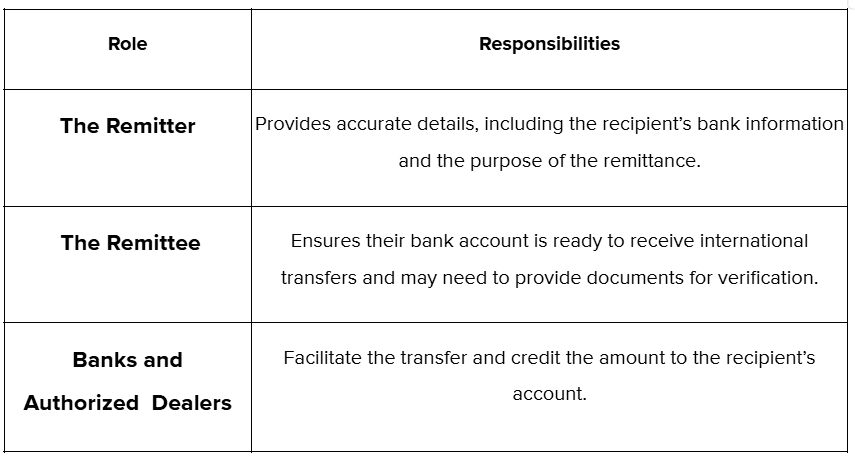
A foreign inward remittance can involve several participants:
Sender or remitter
The individual or business outside India that initiates the payment.
Sending bank or payment provider
The institution used by the sender to initiate the transfer.
Correspondent or intermediary bank
Traditional international transfers can pass through one or more intermediary banks before reaching India.
Authorised Dealer bank or regulated cross-border provider
The institution handling the foreign exchange transaction and applicable regulatory requirements in India.
Beneficiary
The person or business in India receiving the money.
For business payments, additional systems and authorities may become relevant depending on the transaction, such as EDPMS for goods exports or DGFT's e-BRC system.
Also read: Why alternate payment methods matter
Is foreign inward remittance taxable in India?
Receiving money from abroad does not automatically make the remittance taxable.
The tax treatment depends primarily on the nature of the receipt, not the fact that it came from another country.
Business and professional income
If you receive payment for goods sold, consulting, freelance work, SaaS subscriptions or other business or professional services, the amount generally forms part of your business or professional income and is taxed according to the applicable provisions.
Export transactions can also involve GST and export-compliance requirements separate from income tax.
Money received as a gift
Money received without consideration can fall under Section 56(2)(x) of the Income-tax Act.
According to the Income Tax Department, where the aggregate amount of money received without consideration from applicable persons during the year exceeds ₹50,000, the entire amount can generally become taxable as income from other sources unless an exemption applies.
One important exemption is money received from a relative as defined under the Income-tax Act. Other exemptions include certain receipts on marriage, under a will or inheritance and specified circumstances.
You can review the Income Tax Department's explanation of deemed income and gifts under Section 56(2)(x).
So, if your parent or another qualifying relative living abroad sends you money, the tax treatment can be very different from receiving the same amount from an unrelated person.
Double taxation and foreign tax credit
If the same income has been taxed outside India and is also taxable in India, relief may be available under a Double Taxation Avoidance Agreement or through other foreign-tax-credit provisions.
The Income Tax Department explains that eligible resident taxpayers may claim foreign tax credit for taxes paid outside India, subject to the applicable rules and documentation. Read more about Form 67 and foreign tax credit.
Because tax treatment depends on your residential status, purpose of payment and nature of income, seek professional tax advice for material or unusual remittances.
FIRA, FIRC and e-BRC: what is the difference?
One of the most common sources of confusion around inward remittances is the documentation.
FIRA, FIRC and e-BRC are related to foreign receipts, but they are not the same document.
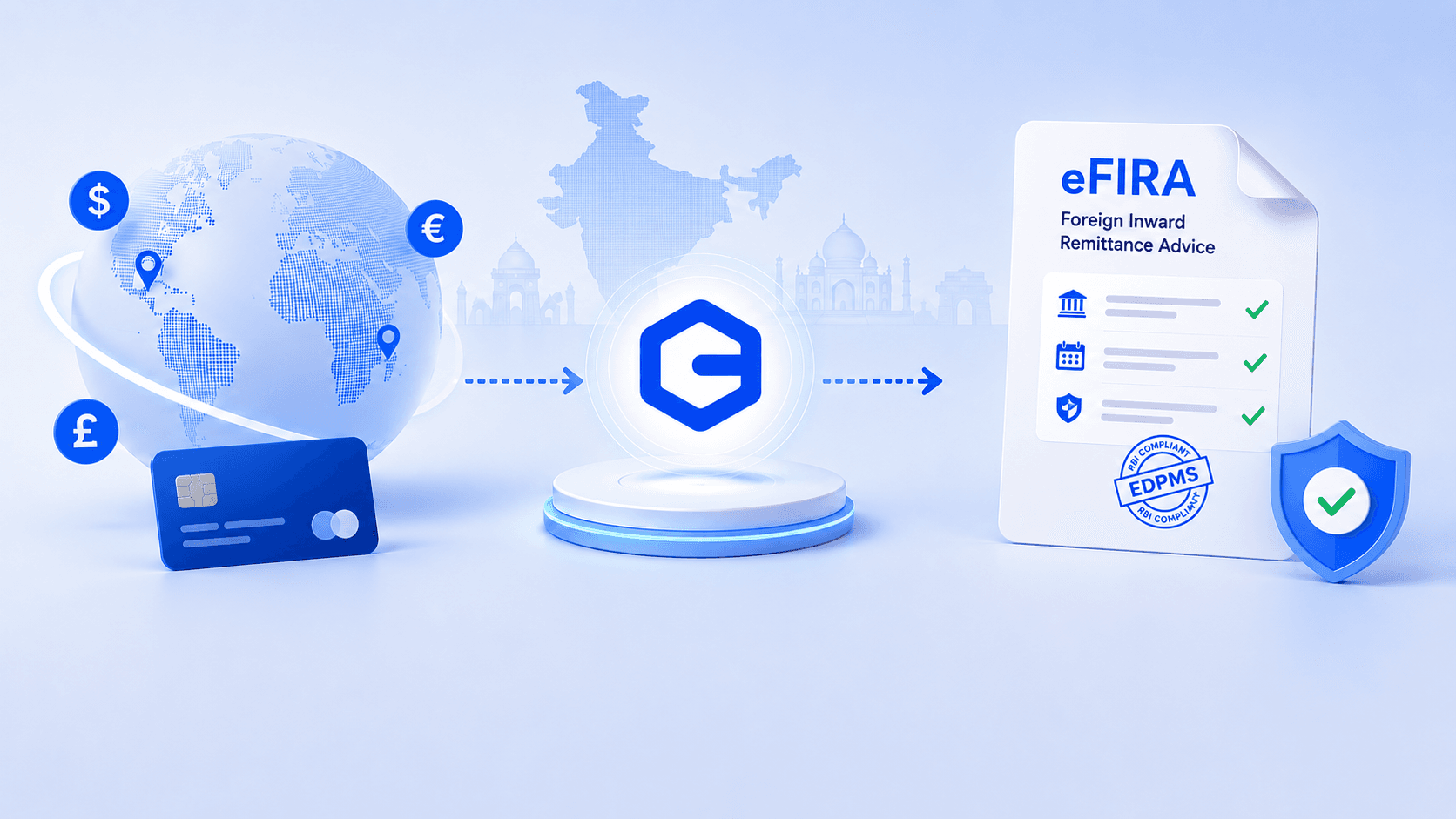
FIRA: Foreign Inward Remittance Advice
FIRA is commonly used as evidence that a foreign inward remittance has been received.
Depending on the bank or payment provider, it may contain information such as:
- remitter details;
- beneficiary details;
- amount and currency;
- date of receipt;
- exchange rate;
- purpose code; and
- transaction reference.
For exporters and businesses, having the remittance advice available automatically can simplify reconciliation and compliance workflows.
FIRC: Foreign Inward Remittance Certificate
FIRC is a certificate associated with particular types of inward foreign remittances.
It should not be assumed that every international business payment requires a traditional FIRC. The document required depends on the transaction, banking route and regulatory purpose.
For a detailed comparison, read FIRC: Everything you need to know and FIRA vs FIRC for Indian exporters and freelancers.
e-BRC: electronic Bank Realisation Certificate
An e-BRC is an electronic record used to establish realisation of export proceeds for relevant DGFT and Foreign Trade Policy purposes.
It is different from the initial remittance advice generated when funds arrive.
Goods exporters may also need their receipt correctly reflected and reconciled in EDPMS, the Export Data Processing and Monitoring System.
The right document therefore depends on what you received the money for and what compliance process you are completing.
Methods of receiving foreign inward remittances
There are several ways money can be received from abroad.
International bank transfers
A sender transfers money from their overseas bank to the recipient's Indian bank account, commonly using international banking networks such as SWIFT.
This route is widely supported but can involve intermediary banks, FX spreads and variable transfer times.
Money-transfer services
Regulated providers can facilitate eligible personal remittances from abroad.
The RBI's Money Transfer Service Scheme, for example, is designed for permitted personal inward remittances, including family-maintenance transfers. It is not a route for ordinary commercial or business payments.
International payment platforms
Freelancers and businesses may receive eligible payments through online platforms or payment providers.
The fee structure, FX rate, documentation and settlement process can differ considerably by provider.
Local and multi-currency collection accounts
Businesses can also collect payments using local account details in overseas markets and settle the proceeds into India.
This can reduce reliance on traditional SWIFT transfers for every individual payment and make reconciliation easier.
PayGlocal's Multi-Currency Account, for example, supports global collections across 33+ currencies, with local collection options in major currencies, automatic FIRA generation and export-compliance workflows.
Foreign currency demand drafts
Foreign currency demand drafts are a more traditional method in which a bank issues a draft denominated in foreign currency for deposit or collection.
They are less convenient than electronic transfer methods for many modern use cases but may still be available through banks for specific purposes.
How businesses can make foreign inward collections easier
For a business, receiving the money is only one part of the process.
You also need to know:
- which customer paid;
- which invoice the payment belongs to;
- what exchange rate was applied;
- how much was deducted in fees;
- when the amount settled;
- whether FIRA is available;
- whether the receipt has been reconciled for export compliance; and
- whether the finance team can retrieve the records later.
This is where business-focused cross-border payment infrastructure can be useful.
PayGlocal is an RBI-authorised cross-border payments platform built for Indian businesses receiving money from overseas customers.
With PayGlocal Multi-Currency Accounts, eligible businesses can:
- collect payments across 33+ currencies;
- receive through local collection rails in supported markets;
- settle funds into an Indian bank account;
- access automatic FIRA on supported payments;
- manage invoice and payment reconciliation;
- support EDPMS and e-BRC workflows; and
- see the applicable FX and transaction pricing before settlement.
This is designed for business and export collections, rather than personal family remittances.
Explore PayGlocal's international collection solutions or talk to the PayGlocal team.
Common mistakes to avoid when receiving money from abroad
A few simple mistakes can cause unnecessary delays.
Using the wrong purpose code
The purpose tells the bank or payment provider why the money is being received.
Selecting an incorrect code can lead to follow-up questions or compliance issues, especially for business receipts.
Sharing incomplete bank details
Double-check the beneficiary name, account number, IFSC and any SWIFT/BIC details required for the transfer.
Comparing only transfer fees
A low transfer fee can be offset by an unfavourable FX rate or intermediary-bank deduction.
For business payments, compare the final amount settled and the documentation included.
Treating FIRA, FIRC and e-BRC as interchangeable
They serve different purposes. Ask your bank, payment provider or CA which record you actually need.
Mixing personal and business receipts
Where possible, keep business collections within the appropriate business banking and payment setup. This makes accounting, reconciliation and compliance considerably clearer.
Conclusion
Foreign inward remittance is simply money coming into India from abroad, but the reason for the payment determines almost everything that follows.
A family member sending money home, a freelancer getting paid by an overseas client and an exporter collecting against an invoice may all receive foreign funds, but the tax, documentation and compliance requirements can be very different.
Before receiving a payment, make sure you:
- use an authorised or regulated channel;
- share the correct beneficiary information;
- choose the right purpose of remittance;
- understand the FX rate and fees;
- keep the relevant remittance records; and
- know whether your transaction requires additional export or tax documentation.
For Indian businesses collecting international revenue, PayGlocal brings the payment, reconciliation and export-documentation workflow together in one place.
Explore PayGlocal Multi-Currency Accounts or get in touch with PayGlocal to simplify how your business gets paid from around the world.