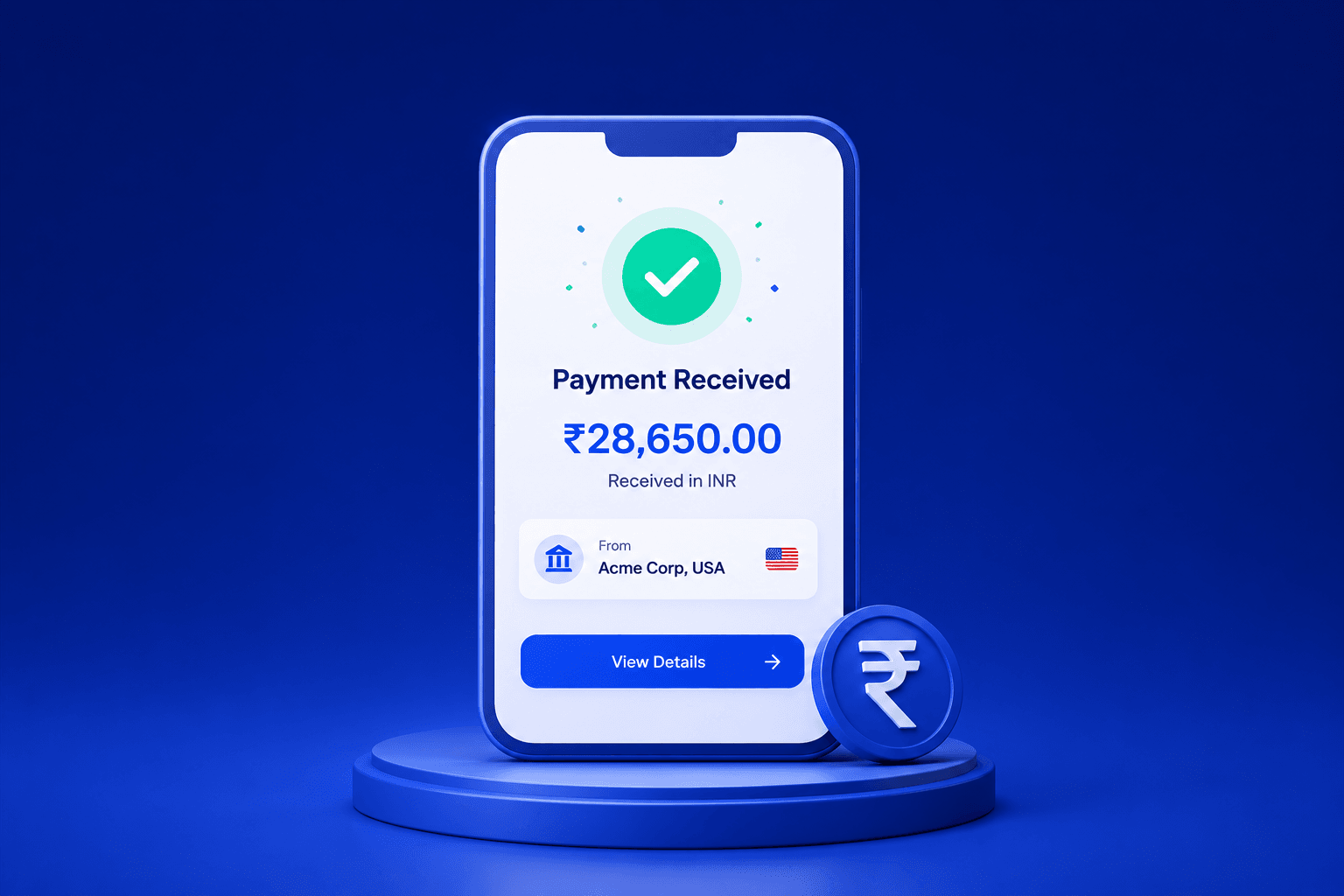

Rahul writes code for two clients in the US and one in Berlin. The work is steady. Getting paid is the messy part: a wire lands short after intermediary bank cuts, a platform holds his balance for a week, and at year-end he is chasing paperwork to prove the money came from abroad.
This guide breaks down the payment methods for freelancers in India, so you get paid faster, keep more of each invoice, and get clean forex proof without the year-end scramble.
This guide breaks down the payment methods for freelancers in India, so you get paid faster, keep more of each invoice, and get clean forex proof without the year-end scramble.
TL;DR
- India has over 15 million freelancers, most of them billing clients abroad, so the payment method matters as much as the work itself.
- The right method gets you paid faster, keeps forex markup and fees low, and gives you FIRA proof (Foreign Inward Remittance Advice, the document that proves a foreign payment reached you) for clean books.
- Platforms and bank wires work, but a cross-border payment setup built for Indian collections usually lands more of your money in INR, quicker.
Freelancing from India is booming. The country is home to over 15 million freelancers, and with 10M+ developers and a young, tech-savvy workforce, more people are choosing solo careers every year. Growth has been driven by cheap internet access, the remote-work shift that accelerated during COVID-19, and rising global acceptance of Indian freelancers by businesses and corporates worldwide.
But once the clients are foreign, how you collect the payment quietly decides how much you keep.
Most freelancing advice stops at "find clients." The harder problem starts after the invoice. When your client is in New York or London and you bank in India, every payment crosses currencies, borders, and a few banks that each take a cut.
Three things go wrong most often:
Pick the method that solves all three and you keep more, faster, with less paperwork.
There is no single best option for everyone. The right one depends on your clients, your volumes, and how much you care about fees and proof. Here are the main routes.
Global platforms help Indian freelancers reach international clients and handle payment and documentation for you. For someone starting out, they are a useful springboard to test and refine an offering with a global audience.
The trade-off: platforms take a commission on your earnings, apply their own conversion rate on withdrawal to an Indian account, and can hold funds before release. Great for finding work, less great for keeping the full value of it once you have a steady client base.
A direct SWIFT transfer from your client's bank to yours is familiar and works everywhere. The catch is cost and speed: intermediary banks along the route each deduct a fee, the forex markup is often opaque, and settlement can take several days. Fine for the occasional large invoice, heavy going for regular monthly billing.
A cross-border payments setup lets your foreign clients pay by card or local method, then settles the amount into your Indian account in INR, with FIRA issued automatically on settlement. This is where a specialist matters: routing each payment down the path most likely to be approved lifts your Payment Success Rate (PSR, the share of attempted payments that actually go through), so fewer client payments silently fail at checkout.
For a freelancer, the practical wins are a transparent rate, faster settlement, and the forex proof handled for you instead of chased at year-end.
Match the method to how you actually work, not to a feature list.
A quick test: for a sample $1,000 invoice, ask what actually lands in your account in INR, how many days it takes, and whether you get FIRA. The method with the best answer across all three wins.
The same payment math applies across the fields where Indian freelancing is strongest:
Whatever the craft, the client is often abroad, so the collection method is the common problem.
The payment method is one piece. These habits protect the rest:
But once the clients are foreign, how you collect the payment quietly decides how much you keep.
Why payment method is a freelancer's real bottleneck
Most freelancing advice stops at "find clients." The harder problem starts after the invoice. When your client is in New York or London and you bank in India, every payment crosses currencies, borders, and a few banks that each take a cut.
Three things go wrong most often:
- Fees and forex markup eat the invoice. Wires and some platforms layer on a currency conversion spread plus flat charges, so a $1,000 invoice can arrive noticeably lighter.
- Money moves slowly. International transfers can sit for days in intermediary banks with no clear status.
- Proof is missing. For an Indian freelancer exporting services, you need FIRA (Foreign Inward Remittance Advice) to show the money came from abroad. Without it, reconciliation and tax filing get painful.
Pick the method that solves all three and you keep more, faster, with less paperwork.
What payment methods can Indian freelancers use?
There is no single best option for everyone. The right one depends on your clients, your volumes, and how much you care about fees and proof. Here are the main routes.
Freelance platforms (Upwork, Toptal, Freelancer, Deel)
Global platforms help Indian freelancers reach international clients and handle payment and documentation for you. For someone starting out, they are a useful springboard to test and refine an offering with a global audience.
The trade-off: platforms take a commission on your earnings, apply their own conversion rate on withdrawal to an Indian account, and can hold funds before release. Great for finding work, less great for keeping the full value of it once you have a steady client base.
Bank wires (SWIFT)
A direct SWIFT transfer from your client's bank to yours is familiar and works everywhere. The catch is cost and speed: intermediary banks along the route each deduct a fee, the forex markup is often opaque, and settlement can take several days. Fine for the occasional large invoice, heavy going for regular monthly billing.
Cross-border payment collection built for India
A cross-border payments setup lets your foreign clients pay by card or local method, then settles the amount into your Indian account in INR, with FIRA issued automatically on settlement. This is where a specialist matters: routing each payment down the path most likely to be approved lifts your Payment Success Rate (PSR, the share of attempted payments that actually go through), so fewer client payments silently fail at checkout.
For a freelancer, the practical wins are a transparent rate, faster settlement, and the forex proof handled for you instead of chased at year-end.
How do you choose the right method?
Match the method to how you actually work, not to a feature list.
- Just starting, few clients: a freelance platform is a reasonable springboard while you build a portfolio and testimonials.
- Steady clients, regular invoices: move to a direct collection setup so commissions and conversion spreads stop shaving every payment.
- Larger one-off invoices: compare a wire against a card or local-method collection on total cost, not just the headline fee.
- You need clean books and tax proof: prioritise a method that issues FIRA automatically, so export-of-services documentation is not a scramble.
A quick test: for a sample $1,000 invoice, ask what actually lands in your account in INR, how many days it takes, and whether you get FIRA. The method with the best answer across all three wins.
Which freelancing sectors does this apply to?
The same payment math applies across the fields where Indian freelancing is strongest:
- IT and software services: web and app development, software engineering, cybersecurity. High-value invoices, so fees and forex markup add up fast.
- Content writing and localisation: blogs, marketing copy, translation, and localisation, a niche that keeps growing even as generative AI reshapes plain content work.
- Graphic design and creative services: logos, branding, illustration, animation, and video editing for clients worldwide.
- Digital marketing and SEO: SEO, social, email, and PPC work delivered to overseas businesses.
Whatever the craft, the client is often abroad, so the collection method is the common problem.
How to set yourself up to get paid well
The payment method is one piece. These habits protect the rest:
- Specialise and show proof. A clear niche plus a portfolio and testimonials wins better-paying clients, which makes an efficient payment method worth more.
- Keep a professional presence. An updated profile across platforms, social, and a personal site builds the credibility clients check before they pay.
- Network and collaborate. Referrals from other freelancers and communities are among the most reliable sources of steady, payable work.
- Deliver quality on time. Reliable delivery and clear communication are what turn a one-off client into recurring, predictable income.
- Stay current. Track how tools, demand, and payment options change, and switch methods when a better one appears.