
You have just sent the final file. Your first international client loves the work. Then comes the awkward part: they ask how to pay you, and you do not have a clean answer. Bank transfer? A wallet? Something else?
Getting paid from abroad should not be the hardest part of the job. Yet for most Indian freelancers, cross border payments for freelancers in India is exactly where the confusion starts, and where a chunk of hard-earned income quietly leaks away in fees.
Getting paid from abroad should not be the hardest part of the job. Yet for most Indian freelancers, cross border payments for freelancers in India is exactly where the confusion starts, and where a chunk of hard-earned income quietly leaks away in fees.
TL;DR
- Your payment method decides your take-home. The wrong one can quietly cost a freelancer earning $5,000 a month around $300 to $400 in fees, while the right one gets you paid faster and keeps more of it.
- Match the method to your work, not the other way round. Small one-off projects suit payment links and wallets; regular USD, GBP, or EUR clients suit multi-currency accounts; retainers suit recurring billing.
- Get paid in your client's currency, with the paperwork sorted. Collecting locally and converting to INR on your terms cuts costs, and picking a method that auto-generates your FIRC/FIRA saves a scramble at GST and tax time.
India's gig workforce is set to reach 2.35 crore workers by 2029-30, up from 1 crore in 2024-25. More of them are billing clients overseas every year. The payment method you choose decides how fast you get paid, how much you keep, and how easy you are to work with.
This guide breaks it down: the common ways to receive foreign payments in India, how they compare on fees and speed, and how to pick the one that fits your setup.
Cross border payments for freelancers are the ways you collect money from clients in other countries for your work. They range from traditional bank transfers and card payments to newer options like multi-currency accounts and digital wallets. Each carries its own fee structure, transfer speed, and level of convenience.
Here is a simple example. A freelance developer in Pune invoices a client in Canada. The client can pay by wire transfer, by card, through a digital wallet, or into a multi-currency account. The developer receives the funds in INR after conversion. The method decides how much goes to fees and how long the wait is.
One document you will meet along the way is the FIRC (Foreign Inward Remittance Certificate), or its digital form, the FIRA (Foreign Inward Remittance Advice). It is proof that money came into India from abroad. You need it for GST records, and it matters at tax time, so pick a method that gives you one without a chase.
The method matters because it changes your take-home pay, your cash flow, and how likely a client is to pay on time.
A freelancer earning $5,000 a month from international clients could lose $300 to $400 every month to fees alone with the wrong method. Over a year, that is $3,600 to $4,800 gone, with no extra work on your part.
Here is what your choice actually moves:
The right method fixes all three at once. The wrong one costs you money and time, every single month.
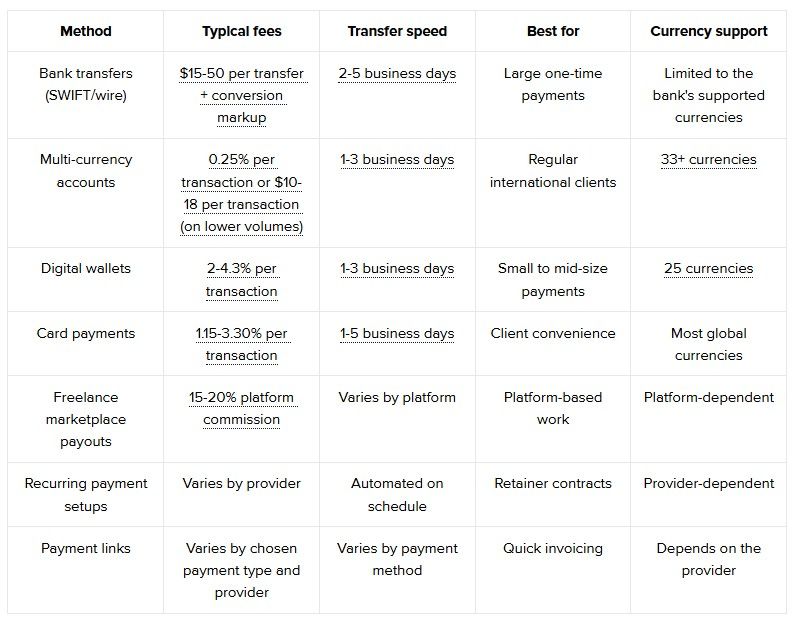
There are seven methods most Indian freelancers actually use to receive international payments in India: bank transfers, multi-currency accounts, digital wallets, card payments, marketplace payouts, recurring setups, and payment links. Each has a real trade-off, so the right pick depends on your clients and your volume.
What works for someone billing $500 a month will not work for someone collecting $10,000 from clients in five countries. Here is each one in plain terms.
Bank transfers are the oldest way to receive international payments. Your client sends money from their bank to yours using your account number, SWIFT code, and bank address.
The upside is that they handle large amounts well. If a client owes you $10,000 or more, a wire is straightforward, with no platform taking a cut.
The catch is cost and speed. Each transfer can run $15 to $50 in SWIFT charges, and intermediary banks may skim more along the way. Transfers take 2 to 5 business days, and bank conversion rates usually carry a markup over the mid-market rate.
A multi-currency account gives you local bank details in countries like the US, UK, and across the EU. Your client pays into a local account in their own currency and skips international transfer fees on their end.
You hold the funds in the foreign currency and convert to INR when the rate suits you. That control over timing is the point, and it lowers the total cost per payment.
For freelancers billing regularly in USD, GBP, or EUR, this is one of the most cost-effective options. Fees tend to sit below wire charges, and settlement is faster.
With a digital wallet, your client does not need your bank details. They send money to your wallet, and you withdraw it to your Indian bank account.
Setup is quick, and most clients already have an account. For smaller payments under $500, the convenience often beats the fees.
The catch: fees can run 2% to 4.3% per transaction once conversion is included, withdrawal times vary, and some wallets charge again to move money to your bank. For high-value international payments, that gets expensive fast.
Card payments are the most familiar option for clients worldwide. You set up a payment page or send an invoice, and the client pays by credit or debit card.
For freelancers, cards remove friction. The client enters card details, confirms, and it is done, with none of the delay that complicated transfers invite. This is also where a high payment success rate matters: cross-border card payments fail more often than domestic ones, and a failed payment is a delayed payment.
Fees typically range from 1.15% to 3.30% per transaction, with settlement in 1 to 5 business days depending on the provider.
If you find clients through freelance platforms, the platform collects the payment and pays you out. No invoicing, no chasing.
The trade-off is cost. Most platforms charge 15% to 20% of your earnings as commission, well above anything else on this list. You also lose control over how and when you get paid, since the platform sets the schedule. As you build a direct client base, these payouts matter less and lower-fee methods take over.
If you work on a monthly retainer or an ongoing contract, a recurring setup automates the billing. You set it up once, and the agreed amount is charged to your client's card or account on schedule.
No monthly invoice, no reminder, no chase. It also gives you predictable cash flow, which helps freelancers in India managing steady monthly expenses. Not every provider supports recurring billing on international cards, so check for it if retainers are a big part of your income.
A payment link is a simple URL you send by email or chat. The client clicks, enters their details, and pays. No account needed on their end.
This is one of the easiest methods to set up. You generate a link, attach it to your invoice, and send. It works well for one-off projects and new clients. Fees and settlement speed depend on the underlying payment type and provider.
Match the method to your clients, your ticket size, and how often you invoice. There is rarely one winner; most freelancers run one method for regular clients and a backup for one-offs.
Run through these five checks:
A single missing detail can hold up a payment for days. International clients often need more information than domestic ones, and an incomplete invoice gives their finance team a reason to sit on it.
At a minimum, include:
Most platforms let you generate invoices with these fields pre-filled. Use that instead of building invoices by hand; it saves time and cuts errors.
Most late or lost payments trace back to a handful of avoidable habits, not to difficult clients. The common ones:
Verify new clients, use a written contract, take a deposit, and choose a platform with built-in fraud screening. Disputes across borders are hard to resolve, so a little caution up front protects weeks of earnings.
The steps that matter most:
Getting paid from international clients should not take days of waiting and guessing. Slow payments, hidden fees, and failed transactions cost more than money; they cost the focus you would rather spend on the work.
PayGlocal is an RBI-authorised cross-border payments platform built for Indian businesses and freelancers collecting from clients worldwide. What that means for you:
Pricing is transparent, with no monthly or setup fees; you pay only when you transact. If you are a freelancer collecting from clients across countries, it is one place to handle it all.
Your payment method is a business decision that touches your income every month. The right setup saves on fees, gets you paid faster, and makes you easier to work with. Do not leave it to chance.
Start by checking what you currently pay in fees and how long payments take to land. Compare that against the methods here. Even moving from a high-fee method to a multi-currency account can save a meaningful amount over a year.
This guide breaks it down: the common ways to receive foreign payments in India, how they compare on fees and speed, and how to pick the one that fits your setup.
Key takeaways
- Speed varies widely. Some methods settle in hours, others take 3 to 5 business days or longer for international transfers.
- Fees are often hidden. Currency conversion markups, intermediary bank charges, and platform commissions add up quietly.
- Multi-currency accounts cut costs. Collecting in your client's currency and converting on your own terms saves money.
- Recurring setups suit retainer clients. Ongoing contracts run on autopilot instead of a fresh invoice every cycle.
- PayGlocal is built for this. Freelancers can collect from 180+ countries with 40+ payment methods on one platform, with FIRA generated automatically.
What are cross border payments for freelancers?
Cross border payments for freelancers are the ways you collect money from clients in other countries for your work. They range from traditional bank transfers and card payments to newer options like multi-currency accounts and digital wallets. Each carries its own fee structure, transfer speed, and level of convenience.
Here is a simple example. A freelance developer in Pune invoices a client in Canada. The client can pay by wire transfer, by card, through a digital wallet, or into a multi-currency account. The developer receives the funds in INR after conversion. The method decides how much goes to fees and how long the wait is.
One document you will meet along the way is the FIRC (Foreign Inward Remittance Certificate), or its digital form, the FIRA (Foreign Inward Remittance Advice). It is proof that money came into India from abroad. You need it for GST records, and it matters at tax time, so pick a method that gives you one without a chase.
Tip: Decide on your payment method before you sign the first contract. Putting the payment details in your proposal looks professional and gets you paid faster.
Why does your payment method matter?
The method matters because it changes your take-home pay, your cash flow, and how likely a client is to pay on time.
A freelancer earning $5,000 a month from international clients could lose $300 to $400 every month to fees alone with the wrong method. Over a year, that is $3,600 to $4,800 gone, with no extra work on your part.
Here is what your choice actually moves:
- Net income. A 3% total cost on a $2,000 payment is $60 gone. Over 10 payments a month, that is $600 you earned but never received.
- Payment speed. A method that takes five business days to settle delays every expense you planned to cover with it.
- Client experience. Clients who find it easy to pay you pay on time and come back. A clunky process creates friction before the project even starts.
The right method fixes all three at once. The wrong one costs you money and time, every single month.
What are the common ways to receive international payments in India?
There are seven methods most Indian freelancers actually use to receive international payments in India: bank transfers, multi-currency accounts, digital wallets, card payments, marketplace payouts, recurring setups, and payment links. Each has a real trade-off, so the right pick depends on your clients and your volume.
What works for someone billing $500 a month will not work for someone collecting $10,000 from clients in five countries. Here is each one in plain terms.
Bank transfers (SWIFT and wire)
Bank transfers are the oldest way to receive international payments. Your client sends money from their bank to yours using your account number, SWIFT code, and bank address.
The upside is that they handle large amounts well. If a client owes you $10,000 or more, a wire is straightforward, with no platform taking a cut.
The catch is cost and speed. Each transfer can run $15 to $50 in SWIFT charges, and intermediary banks may skim more along the way. Transfers take 2 to 5 business days, and bank conversion rates usually carry a markup over the mid-market rate.
Multi-currency accounts
A multi-currency account gives you local bank details in countries like the US, UK, and across the EU. Your client pays into a local account in their own currency and skips international transfer fees on their end.
You hold the funds in the foreign currency and convert to INR when the rate suits you. That control over timing is the point, and it lowers the total cost per payment.
For freelancers billing regularly in USD, GBP, or EUR, this is one of the most cost-effective options. Fees tend to sit below wire charges, and settlement is faster.
Digital wallets
With a digital wallet, your client does not need your bank details. They send money to your wallet, and you withdraw it to your Indian bank account.
Setup is quick, and most clients already have an account. For smaller payments under $500, the convenience often beats the fees.
The catch: fees can run 2% to 4.3% per transaction once conversion is included, withdrawal times vary, and some wallets charge again to move money to your bank. For high-value international payments, that gets expensive fast.
Card payments
Card payments are the most familiar option for clients worldwide. You set up a payment page or send an invoice, and the client pays by credit or debit card.
For freelancers, cards remove friction. The client enters card details, confirms, and it is done, with none of the delay that complicated transfers invite. This is also where a high payment success rate matters: cross-border card payments fail more often than domestic ones, and a failed payment is a delayed payment.
Fees typically range from 1.15% to 3.30% per transaction, with settlement in 1 to 5 business days depending on the provider.
Freelance marketplace payouts
If you find clients through freelance platforms, the platform collects the payment and pays you out. No invoicing, no chasing.
The trade-off is cost. Most platforms charge 15% to 20% of your earnings as commission, well above anything else on this list. You also lose control over how and when you get paid, since the platform sets the schedule. As you build a direct client base, these payouts matter less and lower-fee methods take over.
Recurring payment setups
If you work on a monthly retainer or an ongoing contract, a recurring setup automates the billing. You set it up once, and the agreed amount is charged to your client's card or account on schedule.
No monthly invoice, no reminder, no chase. It also gives you predictable cash flow, which helps freelancers in India managing steady monthly expenses. Not every provider supports recurring billing on international cards, so check for it if retainers are a big part of your income.
Payment links
A payment link is a simple URL you send by email or chat. The client clicks, enters their details, and pays. No account needed on their end.
This is one of the easiest methods to set up. You generate a link, attach it to your invoice, and send. It works well for one-off projects and new clients. Fees and settlement speed depend on the underlying payment type and provider.
Tip: If you send proposals or quotes, drop a payment link straight into the document. Clients pay quicker when it is one click away.
How do you choose the right method?
Match the method to your clients, your ticket size, and how often you invoice. There is rarely one winner; most freelancers run one method for regular clients and a backup for one-offs.
Run through these five checks:
- Client location. Mostly US clients? Favour a method that accepts USD or ACH. Europe? Look for EUR support. Ask clients what is easiest for them before you decide.
- Transaction size. Under $500, digital wallets and payment links are fine. Above $2,000, multi-currency accounts and bank transfers save more on fees.
- Payment frequency. One-off projects need flexibility. Monthly retainers want automated recurring billing.
- Fee transparency. Some providers show a low transaction fee, then add a conversion markup separately. Add the transaction fee, conversion charge, and withdrawal fee together to see the real cost.
- Currency range. If you work with clients outside the US and UK, confirm your method supports their currency. Forcing a client to convert before paying often causes delays.
Note: Test any new method with a small payment before a big project. You will spot issues with timing or conversion rates before real money is on the line.
What should a freelance invoice for international clients include?
A single missing detail can hold up a payment for days. International clients often need more information than domestic ones, and an incomplete invoice gives their finance team a reason to sit on it.
At a minimum, include:
- Your full name and business details: name, address, and your account or platform details.
- Client's full name and company: match the name on their business registration to avoid processing delays.
- Invoice number and date: use a consistent numbering system so you and the client can track invoices over time.
- Project description and deliverables: a short line on the work done. Vague terms like "consulting services" trigger questions from accounts teams.
- Amount and currency: state the total in the agreed currency. If you agreed on USD, do not invoice in INR and expect the client to convert.
- Payment method and instructions: include your payment link, multi-currency account details, or bank details directly, so the client does not have to ask.
- Due date and payment terms: be specific. "Net 15" is clear; "pay when convenient" is not.
Most platforms let you generate invoices with these fields pre-filled. Use that instead of building invoices by hand; it saves time and cuts errors.
Tip: Send the invoice the same day you deliver the work. Every day you wait is a day added to your payment timeline.
What payment mistakes do freelancers make?
Most late or lost payments trace back to a handful of avoidable habits, not to difficult clients. The common ones:
- Delaying the invoice. Wait a week to send it and you have added a week to the timeline. Send it the day you deliver.
- Accepting the default conversion rate. Most providers add a markup over the mid-market rate. Compare rates, or you will not know whether you are paying 0.5% or 3% extra on every conversion.
- Ignoring failed or delayed payments. Follow up the same day. Waiting a week signals that late payment is fine.
- Mixing personal and freelance money. Use a separate account for freelance income. It makes tracking earnings, calculating tax, and spotting missing payments far easier.
- Not keeping records. Log every payment with gross amount, fees, exchange rate, and net INR received. Without it, year-end reconciliation eats hours.
- Sticking with the first method forever. Your clients, volumes, and provider pricing all change. Review your setup at least every six months.
Tip: Keep a simple spreadsheet: date, client, gross amount, fees, net payout. Five minutes per payment saves hours at tax time.
How do you keep your freelance payments secure?
Verify new clients, use a written contract, take a deposit, and choose a platform with built-in fraud screening. Disputes across borders are hard to resolve, so a little caution up front protects weeks of earnings.
The steps that matter most:
- Verify new clients before you start. Check their website, LinkedIn, and online presence. Unusually high pay with no interview is a warning sign.
- Use a written contract every time. Scope, amount, currency, method, and due date. A signed agreement is your proof if a dispute arises.
- Collect a deposit. For new clients, ask for 25% to 50% upfront. It protects you from non-payment and shows whether the client is serious.
- Choose a platform with fraud protection. Built-in screening flags suspicious transactions before they reach you, which matters most for card payments where chargebacks are possible.
- Keep records of every transaction. Invoices, delivery confirmations, receipts. If a client disputes a payment, these are your evidence.
Note: If a client asks you to accept payment through an unusual channel or wants your login credentials for any reason, treat it as a red flag. Stick to established platforms.
How PayGlocal helps freelancers get paid globally
Getting paid from international clients should not take days of waiting and guessing. Slow payments, hidden fees, and failed transactions cost more than money; they cost the focus you would rather spend on the work.
PayGlocal is an RBI-authorised cross-border payments platform built for Indian businesses and freelancers collecting from clients worldwide. What that means for you:
- Multi-currency accounts: collect locally in USD, GBP, EUR, CAD, and more, so clients pay in their own currency without extra transfer fees on their end.
- Card payments with a high success rate: fewer international card payments get declined, so more clients finish paying on the first try.
- Global payment methods: 40+ methods across 180+ countries, so clients have a convenient way to pay wherever they are.
- Recurring payments: automate billing for retainer clients, with payments arriving on schedule and no reminder from you.
- One platform: track every payment, download your FIRA, and manage all your clients from a single dashboard instead of three tools.
Pricing is transparent, with no monthly or setup fees; you pay only when you transact. If you are a freelancer collecting from clients across countries, it is one place to handle it all.
Final thoughts
Your payment method is a business decision that touches your income every month. The right setup saves on fees, gets you paid faster, and makes you easier to work with. Do not leave it to chance.
Start by checking what you currently pay in fees and how long payments take to land. Compare that against the methods here. Even moving from a high-fee method to a multi-currency account can save a meaningful amount over a year.