
As India climbs to 22nd place in global shipping activity, the ability to manage international freight invoices has moved from a back-office task to a strategic necessity. Every shipment represents more than just cargo; it’s a complex trail of multi-currency invoices, varying payment terms, and cross-border regulatory hurdles.!
Unlike domestic billing, international freight payments are high-stakes. A single error in currency conversion or a delay in payment verification costs you money and can lead to stalled shipments, port storage fees, and strained carrier relationships.
In this guide, we break down in detail how international freight invoice payments work, the main payment models, and the best practices to manage them better.
International freight invoice payment is about paying carriers or logistics providers for transporting goods across borders. Unlike domestic freight payments, international payments involve multiple currencies, cross-border banking, and different regulatory requirements.
For example, if you're an Indian exporter shipping machinery to Germany, your freight forwarder will bill you in EUR. You need to convert INR to EUR, pay through a bank transfer or payment platform, and ensure the carrier receives the funds on time to avoid delays.
The payment timing depends on the agreement. Some shipments are prepaid, meaning the shipper pays before the goods move. Others are collect, where the receiver pays when the shipment arrives. This affects who manages the invoice and when cash leaves your account.
In international trade, the payment model you select determines your level of control over the shipment and the timing of your cash outflows. Choosing the right structure is a balance between maintaining liquidity and ensuring a smooth delivery experience for your customer.
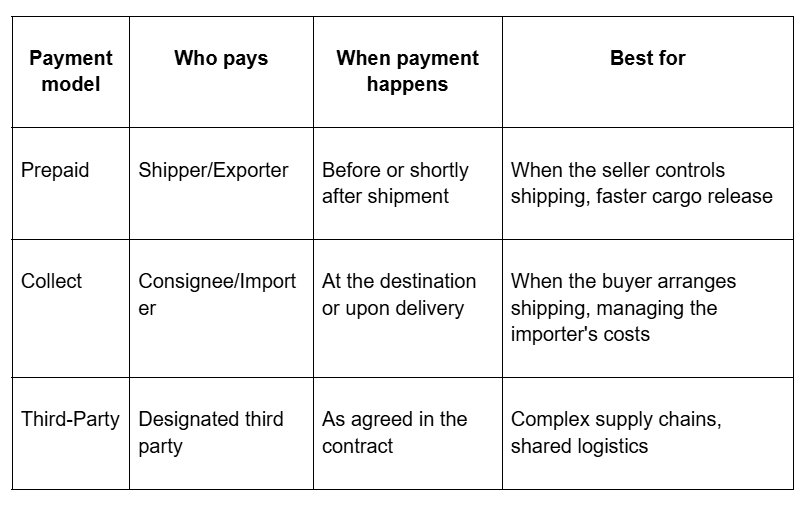
With prepaid freight, the shipper pays the carrier before or within a few days of the cargo departing. The exporter handles the invoice and payment, and the shipment moves without the receiver needing to pay anything at the destination. This model works well when you want control over shipping costs and faster cargo release at the destination.
For instance, if you're shipping textiles to the US and want the buyer to receive goods quickly without payment delays, you can pay the freight upfront.
The challenge is cash flow. You pay the carrier before receiving payment from your buyer, which ties up working capital.
Collect freight means the receiver pays the transportation charges when the shipment arrives or is collected. The importer receives the invoice and settles it with the carrier before taking possession of the goods.
This model shifts the payment responsibility to the buyer. For example, if you're importing electronics from China and the supplier ships on collect terms, you pay the shipping company when the goods reach India.
The risk here is delayed cargo release if the receiver doesn't pay promptly, which can create storage fees and operational bottlenecks.
Sometimes neither the shipper nor the consignee pays directly. Instead, a designated third party handles the freight invoice payment. This often happens in complex supply chains where a logistics partner or parent company manages all freight costs centrally.
For instance, a multinational company might use a central payment office to handle all freight invoices globally, giving them better visibility and control over transportation spending.
Incoterms are international trade terms that define who pays for shipping at different stages of delivery. These terms directly affect whether you pay freight charges or your buyer does.
When you agree on an Incoterm with your buyer, you're also deciding the freight payment model. Some Incoterms require the seller to pay all shipping costs, while others put that responsibility on the buyer.
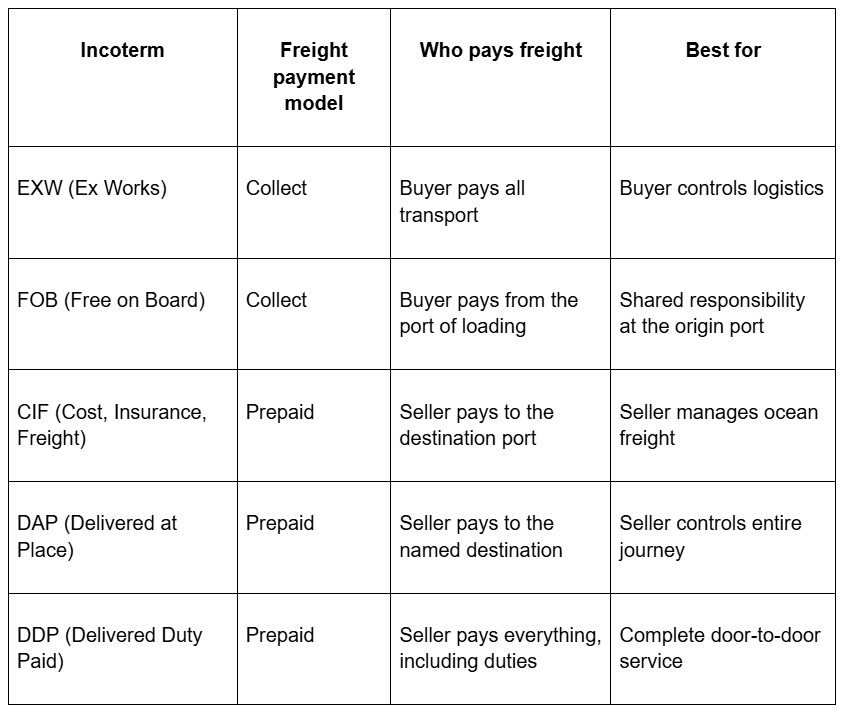
For example, if you agree to FOB terms for a shipment from Mumbai to Los Angeles, you pay to get the goods to Mumbai port, but your buyer handles and pays for ocean freight and delivery in the US. If you agree to CIF terms instead, you pay the ocean freight and insurance, and your buyer only pays from the LA port to their warehouse.
Knowing this connection helps you plan cash flow and avoid surprises. When you negotiate Incoterms, you're also negotiating when freight payments hit your account.
The payment process involves several steps from invoice receipt to final settlement. Knowing this workflow helps you spot where delays or errors typically happen:
The entire process can take days or weeks with manual handling, but automation can reduce this to hours.
Freight audit is the process of verifying every charge on a freight invoice before you pay it. Carriers can make mistakes. They might apply the wrong rate, add duplicate charges, or include accessorial fees you didn't agree to. Without auditing, these errors go straight through to payment.
For example, you could have a contracted rate of $800 per container, but the invoice shows $1,050 because the carrier applied a peak season surcharge you never authorized.
Here's what a proper freight audit checks:
While these checks are vital, the way you perform them, whether through manual line-by-line review or automated software matching, will determine if your audit process is a bottleneck or a competitive advantage. This choice leads directly to which payment model fits your business.
Most businesses handle freight payments through manual in-house processing, outsourced audit and payment services, or automated platform tools. Your volume, budget, and need for direct carrier relationships determine which model works best.
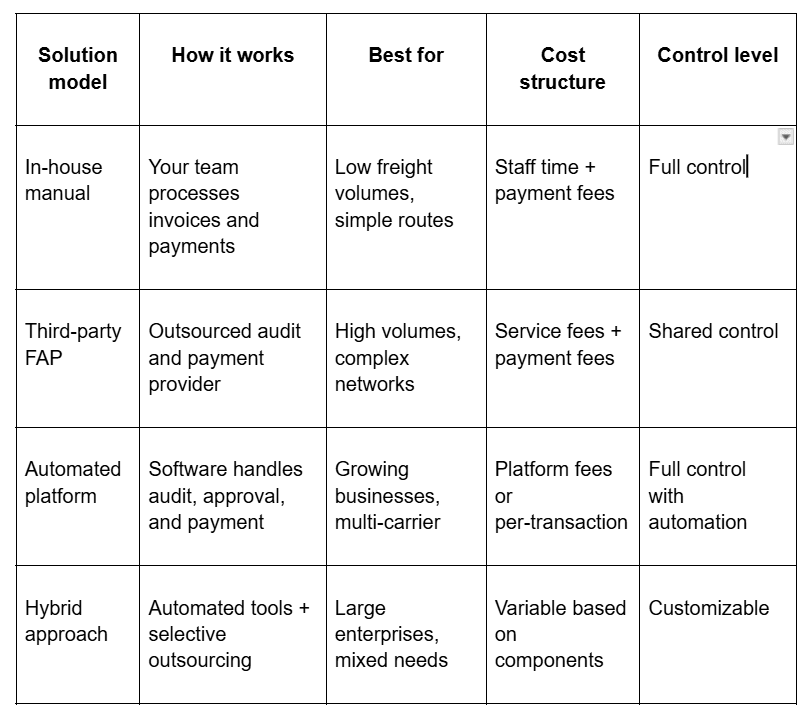
Your finance team receives freight invoices, verifies them against contracts, processes currency conversions, and sends payments through your bank. This gives you complete control over every step.
This model works when you have 10-20 freight invoices per month and straightforward routing with a few carriers. For instance, if you ship regularly to three countries using the same freight forwarder each time, manual processing is manageable.
The challenge is scalability. As volumes grow, manual processing becomes slow and error-prone. Staff spend hours matching invoices to shipments, and mistakes slip through because people get tired of reviewing hundreds of line items.
Specialized FAP providers take over the entire process. You give them your carrier contracts and shipping data, and they receive invoices directly from carriers, audit them, and pay on your behalf. You fund their account, and they provide detailed reporting on all freight spending.
This model suits businesses with high freight volumes across many carriers and countries. The provider's audit systems catch errors you'd miss manually, and they handle all the payment logistics.
The downside is cost and control. FAP providers charge service fees on top of payment processing costs, and you lose direct relationships with carriers. You also depend on their systems and timelines rather than controlling the process yourself.
Modern platforms give you software tools to automate invoice processing, auditing, and payment while keeping everything in-house. You maintain control and carrier relationships but eliminate manual work.
For example, with multi-currency accounts, you can receive freight invoices, verify charges, and pay carriers globally without the delays or high fees of traditional banking.
This approach works well for growing businesses that need automation but want to keep control. You get the efficiency of outsourcing without the service fees or loss of carrier relationships.
Large enterprises often combine models. They might use automated platforms for standard freight payments, but outsource complex audits or specific regions to FAP providers.
For instance, you could handle North American and European freight payments through your automated platform while using a local FAP provider in Asia, where you have less shipping expertise.
Tip: The best approach is to choose the model that matches your volume, complexity, and internal capabilities. Starting with in-house processing is fine, but plan to automate or outsource as volumes grow.
Even with clear processes, freight invoice payments come with specific challenges that create delays and extra costs. Here are the main issues you'll face:
In short, these problems do more than just cause a headache for your accounts team. They can lead to your goods being held at the port, extra storage fees, and unhappy shipping partners. If you don't stay on top of these small errors, they quickly turn into big, expensive delays.
Managing your freight payments better isn't about working harder; it's about being smarter with how you handle your money and your data. Here are the simple steps you can take to make the whole process smoother and cheaper:
Following these steps works well at first, but as your business grows, doing all of this manually becomes a full-time job. That’s where automation comes in.
Moving from manual to automated freight payment processing delivers measurable improvements in cost, speed, and accuracy. Instead of your team chasing invoices, an automated system works in the background to handle the heavy lifting.
Here is how it changes your daily operations:
While these benefits help save money, they only happen if you pick a platform that actually matches your workflow.
When you're ready to move beyond manual processing or switch from your current solution, certain criteria separate good options from great ones. Here's what to evaluate while choosing the best freight payment solution:
For instance, if you're shipping to 15 countries now but planning to expand to 30 within two years, choose a solution that already supports those markets rather than one you'll outgrow.
The right solution saves you money on every transaction while reducing the time your team spends on freight payments. It should feel like it's working for you, not creating new problems to solve.
International freight invoice payments don't have to be complicated or expensive. The challenge is finding a payment solution that handles multiple currencies, provides transparency, and processes payments quickly without excessive fees.
PayGlocal is built for businesses that need to collect payments internationally without the friction of traditional banking. Here's what you get:
PayGlocal makes international freight invoice payments faster, cheaper, and more transparent. You get the control you need without the complexity of traditional banking or the high costs of intermediaries.
International freight invoice payments involve more complexity than domestic transactions, but with the right approach, you can handle them efficiently. The key is verifying charges before payment, using payment methods that reduce costs, and tracking everything in real time.
Whether you're paying prepaid or managing collect shipments, having multi-currency capabilities and transparent pricing makes the process smoother. You avoid surprise fees, reduce conversion costs, and keep your operations moving without payment delays.
If you're ready to move beyond traditional banking for freight payments, PayGlocal offers the infrastructure you need. With multi-currency accounts, real-time tracking, and zero hidden fees, you can manage international freight invoices with confidence.
Get started with PayGlocal today and take control of your cross-border freight payments.
Unlike domestic billing, international freight payments are high-stakes. A single error in currency conversion or a delay in payment verification costs you money and can lead to stalled shipments, port storage fees, and strained carrier relationships.
In this guide, we break down in detail how international freight invoice payments work, the main payment models, and the best practices to manage them better.
Key Takeaways
- Payment timing matters: Freight can be prepaid (shipper pays) or collect (receiver pays), and this affects your cash flow and who handles the invoice.
- Incoterms determine payment responsibility: Your trade terms directly decide who pays freight charges and when those payments happen.
- Freight audit is critical: Verifying invoice accuracy before payment catches overcharges, duplicate bills, and unauthorized fees that can cost thousands annually.
- Multiple solution models exist: You can handle freight payments in-house, use third-party providers, or leverage automated platforms depending on your volume and needs.
- PayGlocal helps you get paid globally: Accept payments in 33+ currencies from international customers with transparent pricing, giving you better control over multi-currency cash flow.
What is an International Freight Invoice Payment?
International freight invoice payment is about paying carriers or logistics providers for transporting goods across borders. Unlike domestic freight payments, international payments involve multiple currencies, cross-border banking, and different regulatory requirements.
For example, if you're an Indian exporter shipping machinery to Germany, your freight forwarder will bill you in EUR. You need to convert INR to EUR, pay through a bank transfer or payment platform, and ensure the carrier receives the funds on time to avoid delays.
The payment timing depends on the agreement. Some shipments are prepaid, meaning the shipper pays before the goods move. Others are collect, where the receiver pays when the shipment arrives. This affects who manages the invoice and when cash leaves your account.
What are the main freight payment models?
In international trade, the payment model you select determines your level of control over the shipment and the timing of your cash outflows. Choosing the right structure is a balance between maintaining liquidity and ensuring a smooth delivery experience for your customer.
Prepaid Freight
With prepaid freight, the shipper pays the carrier before or within a few days of the cargo departing. The exporter handles the invoice and payment, and the shipment moves without the receiver needing to pay anything at the destination. This model works well when you want control over shipping costs and faster cargo release at the destination.
For instance, if you're shipping textiles to the US and want the buyer to receive goods quickly without payment delays, you can pay the freight upfront.
The challenge is cash flow. You pay the carrier before receiving payment from your buyer, which ties up working capital.
Collect Freight
Collect freight means the receiver pays the transportation charges when the shipment arrives or is collected. The importer receives the invoice and settles it with the carrier before taking possession of the goods.
This model shifts the payment responsibility to the buyer. For example, if you're importing electronics from China and the supplier ships on collect terms, you pay the shipping company when the goods reach India.
The risk here is delayed cargo release if the receiver doesn't pay promptly, which can create storage fees and operational bottlenecks.
Third-Party Freight
Sometimes neither the shipper nor the consignee pays directly. Instead, a designated third party handles the freight invoice payment. This often happens in complex supply chains where a logistics partner or parent company manages all freight costs centrally.
For instance, a multinational company might use a central payment office to handle all freight invoices globally, giving them better visibility and control over transportation spending.
How Incoterms Affect Freight Payment Responsibility
Incoterms are international trade terms that define who pays for shipping at different stages of delivery. These terms directly affect whether you pay freight charges or your buyer does.
When you agree on an Incoterm with your buyer, you're also deciding the freight payment model. Some Incoterms require the seller to pay all shipping costs, while others put that responsibility on the buyer.
For example, if you agree to FOB terms for a shipment from Mumbai to Los Angeles, you pay to get the goods to Mumbai port, but your buyer handles and pays for ocean freight and delivery in the US. If you agree to CIF terms instead, you pay the ocean freight and insurance, and your buyer only pays from the LA port to their warehouse.
Knowing this connection helps you plan cash flow and avoid surprises. When you negotiate Incoterms, you're also negotiating when freight payments hit your account.
How International Freight Payments Work
The payment process involves several steps from invoice receipt to final settlement. Knowing this workflow helps you spot where delays or errors typically happen:
- Invoice generation: The carrier or freight forwarder creates an invoice after the shipment is booked or delivered, including freight charges, fuel surcharges, customs fees, and accessorial charges like storage or special handling.
- Invoice receipt: You receive the invoice via email or through the carrier's online portal, often in a different currency or language depending on where the carrier operates.
- Charge verification: You verify the charges against your shipping contract or rate agreement to catch incorrect rates, duplicate invoices, or unauthorized fees before payment.
- Currency conversion: If the invoice is in USD or EUR and you're paying from an INR account, you convert the currency through your bank or payment platform.
- Payment processing: You send the payment via wire transfer, online banking, or through a payment platform to the carrier's designated account.
- Payment confirmation: The carrier confirms receipt of payment and updates their records, providing you with a payment reference number for tracking.
The entire process can take days or weeks with manual handling, but automation can reduce this to hours.
What is a Freight Audit and Why Does it Matter?
Freight audit is the process of verifying every charge on a freight invoice before you pay it. Carriers can make mistakes. They might apply the wrong rate, add duplicate charges, or include accessorial fees you didn't agree to. Without auditing, these errors go straight through to payment.
For example, you could have a contracted rate of $800 per container, but the invoice shows $1,050 because the carrier applied a peak season surcharge you never authorized.
Here's what a proper freight audit checks:
- Rate accuracy: Confirms the invoice matches your contracted rates or spot quotes.
- Accessorial charges: Verifies that extra fees like fuel surcharges, storage, or special handling were actually incurred and authorized.
- Duplicate invoices: Catches when carriers bill the same shipment twice, which happens more often than you'd think with multiple invoice systems.
- Service verification: Ensures you're charged for services you actually received, not services that were quoted but never provided.
- Currency and calculations: Checks that currency conversions use agreed rates and that all math on the invoice is correct.
While these checks are vital, the way you perform them, whether through manual line-by-line review or automated software matching, will determine if your audit process is a bottleneck or a competitive advantage. This choice leads directly to which payment model fits your business.
Freight Payment Solution Models
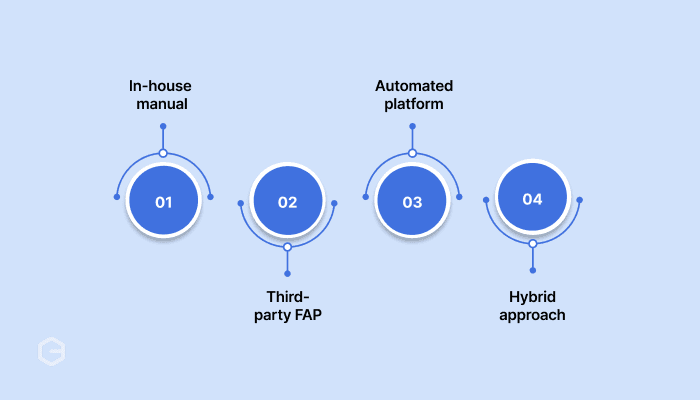
Most businesses handle freight payments through manual in-house processing, outsourced audit and payment services, or automated platform tools. Your volume, budget, and need for direct carrier relationships determine which model works best.
In-House Manual Processing
Your finance team receives freight invoices, verifies them against contracts, processes currency conversions, and sends payments through your bank. This gives you complete control over every step.
This model works when you have 10-20 freight invoices per month and straightforward routing with a few carriers. For instance, if you ship regularly to three countries using the same freight forwarder each time, manual processing is manageable.
The challenge is scalability. As volumes grow, manual processing becomes slow and error-prone. Staff spend hours matching invoices to shipments, and mistakes slip through because people get tired of reviewing hundreds of line items.
Third-Party Freight Audit and Payment Providers
Specialized FAP providers take over the entire process. You give them your carrier contracts and shipping data, and they receive invoices directly from carriers, audit them, and pay on your behalf. You fund their account, and they provide detailed reporting on all freight spending.
This model suits businesses with high freight volumes across many carriers and countries. The provider's audit systems catch errors you'd miss manually, and they handle all the payment logistics.
The downside is cost and control. FAP providers charge service fees on top of payment processing costs, and you lose direct relationships with carriers. You also depend on their systems and timelines rather than controlling the process yourself.
Automated Payment Platforms
Modern platforms give you software tools to automate invoice processing, auditing, and payment while keeping everything in-house. You maintain control and carrier relationships but eliminate manual work.
For example, with multi-currency accounts, you can receive freight invoices, verify charges, and pay carriers globally without the delays or high fees of traditional banking.
This approach works well for growing businesses that need automation but want to keep control. You get the efficiency of outsourcing without the service fees or loss of carrier relationships.
Hybrid Approaches
Large enterprises often combine models. They might use automated platforms for standard freight payments, but outsource complex audits or specific regions to FAP providers.
For instance, you could handle North American and European freight payments through your automated platform while using a local FAP provider in Asia, where you have less shipping expertise.
Tip: The best approach is to choose the model that matches your volume, complexity, and internal capabilities. Starting with in-house processing is fine, but plan to automate or outsource as volumes grow.
Common Challenges in International Freight Invoice Payments
Even with clear processes, freight invoice payments come with specific challenges that create delays and extra costs. Here are the main issues you'll face:
- Currency conversion complexity: If your freight invoice is in USD but you pay from an INR account, you face conversion fees and exchange rate fluctuations that can change the total cost daily.
- Invoice errors and overcharges: Carriers can bill incorrect rates, include duplicate charges, or add accessorial fees you didn't authorize, leading to overpayments if you don't verify carefully.
- Payment delays and operational impact: Slow payments can trigger carriers to hold your next shipment or charge late fees, while delayed collect payments create storage charges at ports.
- Limited payment visibility: Without real-time tracking, you can't confirm if the carrier received funds, leading to unnecessary follow-ups and operational uncertainty.
- Varying compliance requirements: Different countries require specific documentation for freight payments, and using the wrong payment method can create regulatory issues.
In short, these problems do more than just cause a headache for your accounts team. They can lead to your goods being held at the port, extra storage fees, and unhappy shipping partners. If you don't stay on top of these small errors, they quickly turn into big, expensive delays.
How to Manage International Freight Invoice Payments Better
Managing your freight payments better isn't about working harder; it's about being smarter with how you handle your money and your data. Here are the simple steps you can take to make the whole process smoother and cheaper:
- Verify invoices before payment: Check rates against your contract, confirm shipment details match your records, and look for duplicate charges or unexpected fees before processing any payment.
- Centralize your payment process: Route all freight invoices through one system or team instead of having different departments handle payments, giving you better control and error detection.
- Use multi-currency accounts: Hold funds in the currencies you frequently pay in to avoid repeated conversion fees and take advantage of favorable exchange rates when they occur.
- Automate invoice processing: Use automated systems to match invoices to shipments, flag discrepancies, and route approved invoices for payment without manual intervention.
- Track payment status in real time: Monitor exactly where your payment is at any moment to manage cash flow effectively and respond quickly if issues arise.
Following these steps works well at first, but as your business grows, doing all of this manually becomes a full-time job. That’s where automation comes in.
Benefits of Automated Freight Payment Systems
Moving from manual to automated freight payment processing delivers measurable improvements in cost, speed, and accuracy. Instead of your team chasing invoices, an automated system works in the background to handle the heavy lifting.
Here is how it changes your daily operations:
- Faster payment processing: Automated systems can review, verify, and approve freight invoices in minutes instead of days, significantly reducing processing time compared to manual handling.
- Significant error reduction: Software catches rate discrepancies, duplicate invoices, and unauthorized charges that humans miss, reducing payment errors in typical implementations.
- Lower processing costs: Automation eliminates the staff hours required to manually review invoices, reducing the cost per invoice when labor savings are factored in.
- Better cash flow management: Real-time visibility into pending payments helps you plan cash flow more accurately and take advantage of early payment discounts when they make sense.
- Improved carrier relationships: Paying accurately and on time every time builds trust with carriers, which can lead to better rates and priority service when capacity is tight.
- Working capital optimization: Automated approval workflows ensure you're not paying too early or too late, keeping your cash working for you until the optimal payment moment.
- Scalability without headcount: You can handle higher invoice volume without adding finance staff, letting your team focus on strategic work instead of data entry and verification.
While these benefits help save money, they only happen if you pick a platform that actually matches your workflow.
Choosing the Right Freight Payment Solution
When you're ready to move beyond manual processing or switch from your current solution, certain criteria separate good options from great ones. Here's what to evaluate while choosing the best freight payment solution:
- Global coverage and currency support: The solution should handle payments in all the currencies and countries where you ship, with local payment options that reduce transfer fees and delays.
- Security and compliance capabilities: Look for end-to-end encryption, secure data storage, automated compliance documentation like Foreign Inward Remittance Certificate (FIRC) generation, and adherence to international payment standards.
- Real-time reporting and visibility: You need dashboards that show payment status, spending patterns, and audit results instantly, not reports that arrive days or weeks later.
- Integration capabilities: The solution should connect with your existing ERP, accounting software, and carrier systems without requiring custom development or manual data transfers.
- Transparent pricing structure: Avoid solutions with hidden fees, monthly minimums, or complex pricing formulas that make it hard to predict costs as your volumes grow.
- Quality of customer support: When payment issues arise, you need responsive support that knows about international payments and can resolve problems quickly, not generic help desk responses.
- Audit and verification tools: Built-in audit capabilities that automatically catch errors and flag discrepancies before payment, saving you the cost of separate audit systems.
- Scalability for growth: The solution should handle your current volume easily but also scale smoothly as your shipping activity grows without requiring a platform change.
For instance, if you're shipping to 15 countries now but planning to expand to 30 within two years, choose a solution that already supports those markets rather than one you'll outgrow.
The right solution saves you money on every transaction while reducing the time your team spends on freight payments. It should feel like it's working for you, not creating new problems to solve.
Get Paid Globally in Multiple Currencies with PayGlocal
International freight invoice payments don't have to be complicated or expensive. The challenge is finding a payment solution that handles multiple currencies, provides transparency, and processes payments quickly without excessive fees.
PayGlocal is built for businesses that need to collect payments internationally without the friction of traditional banking. Here's what you get:
- Multi-currency accounts: Accept payments in 33+ currencies, including USD, EUR, GBP, and CAD from customers worldwide.
- Instant compliance documentation: Receive FIRC automatically after settlement, keeping you compliant without paperwork delays.
- Real-time payment tracking: See every incoming payment status with notifications at each step.
- Advanced fraud and risk management: Built-in fraud screening protects your business while allowing legitimate payments to proceed.
- One platform for all payments: Manage customer collections and track incoming payments from a single dashboard.
PayGlocal makes international freight invoice payments faster, cheaper, and more transparent. You get the control you need without the complexity of traditional banking or the high costs of intermediaries.
Final Thoughts
International freight invoice payments involve more complexity than domestic transactions, but with the right approach, you can handle them efficiently. The key is verifying charges before payment, using payment methods that reduce costs, and tracking everything in real time.
Whether you're paying prepaid or managing collect shipments, having multi-currency capabilities and transparent pricing makes the process smoother. You avoid surprise fees, reduce conversion costs, and keep your operations moving without payment delays.
If you're ready to move beyond traditional banking for freight payments, PayGlocal offers the infrastructure you need. With multi-currency accounts, real-time tracking, and zero hidden fees, you can manage international freight invoices with confidence.
Get started with PayGlocal today and take control of your cross-border freight payments.