
eBRC for exporters explained: what it unlocks, what skipping it can cost you, and how to self-generate your eBRC without hiring a CA or auditor for routine certification.
India's total exports of goods and services reached an all-time high of USD 863.1 billion in FY 2025-26, including USD 441.8 billion in merchandise and USD 421.3 billion in services, according to the Ministry of Commerce and Industry.
Behind those shipments and invoices sits a second job: proving that the export proceeds were realised. One of the key documents in that trail is the eBRC.
For many exporters, the eBRC is still treated as somebody else's job. It gets outsourced to a chartered accountant or auditor for a fee, quarter after quarter. Others do not generate it until a scheme application, refund or reconciliation exercise forces them to.
Both situations usually come from the same gap in information: routine eBRC generation no longer requires a CA, auditor or a request to your bank.
In this blog, we look at what an eBRC is, what it unlocks for your business, what can go wrong when realisation records are incomplete, the myths that keep exporters paying for routine certification, what changed in the eBRC format in January 2026, and how you can generate one yourself.
India's total exports of goods and services reached an all-time high of USD 863.1 billion in FY 2025-26, including USD 441.8 billion in merchandise and USD 421.3 billion in services, according to the Ministry of Commerce and Industry.
Behind those shipments and invoices sits a second job: proving that the export proceeds were realised. One of the key documents in that trail is the eBRC.
For many exporters, the eBRC is still treated as somebody else's job. It gets outsourced to a chartered accountant or auditor for a fee, quarter after quarter. Others do not generate it until a scheme application, refund or reconciliation exercise forces them to.
Both situations usually come from the same gap in information: routine eBRC generation no longer requires a CA, auditor or a request to your bank.
In this blog, we look at what an eBRC is, what it unlocks for your business, what can go wrong when realisation records are incomplete, the myths that keep exporters paying for routine certification, what changed in the eBRC format in January 2026, and how you can generate one yourself.
TL;DR
- eBRC is proof of export realisation: It links the foreign payment you received with the relevant shipping bill, SOFTEX record or invoice and supports export-benefit, tax and compliance workflows.
- You do not need a CA or auditor for routine eBRC generation: Since DGFT's 2023 revamp, banks transmit IRMs electronically and exporters can self-certify eBRCs through the DGFT system.
- The eBRC format changed in January 2026: GSTIN, GST Invoice Number and GST Invoice Date are now part of the revised format, making accurate invoice-level reconciliation more important.
- eBRC and EDPMS closure are related but different: Generating an eBRC proves realisation for applicable purposes, while export proceeds must separately be realised, reported and matched within the applicable FEMA timeline.
What is an eBRC, and who needs one?
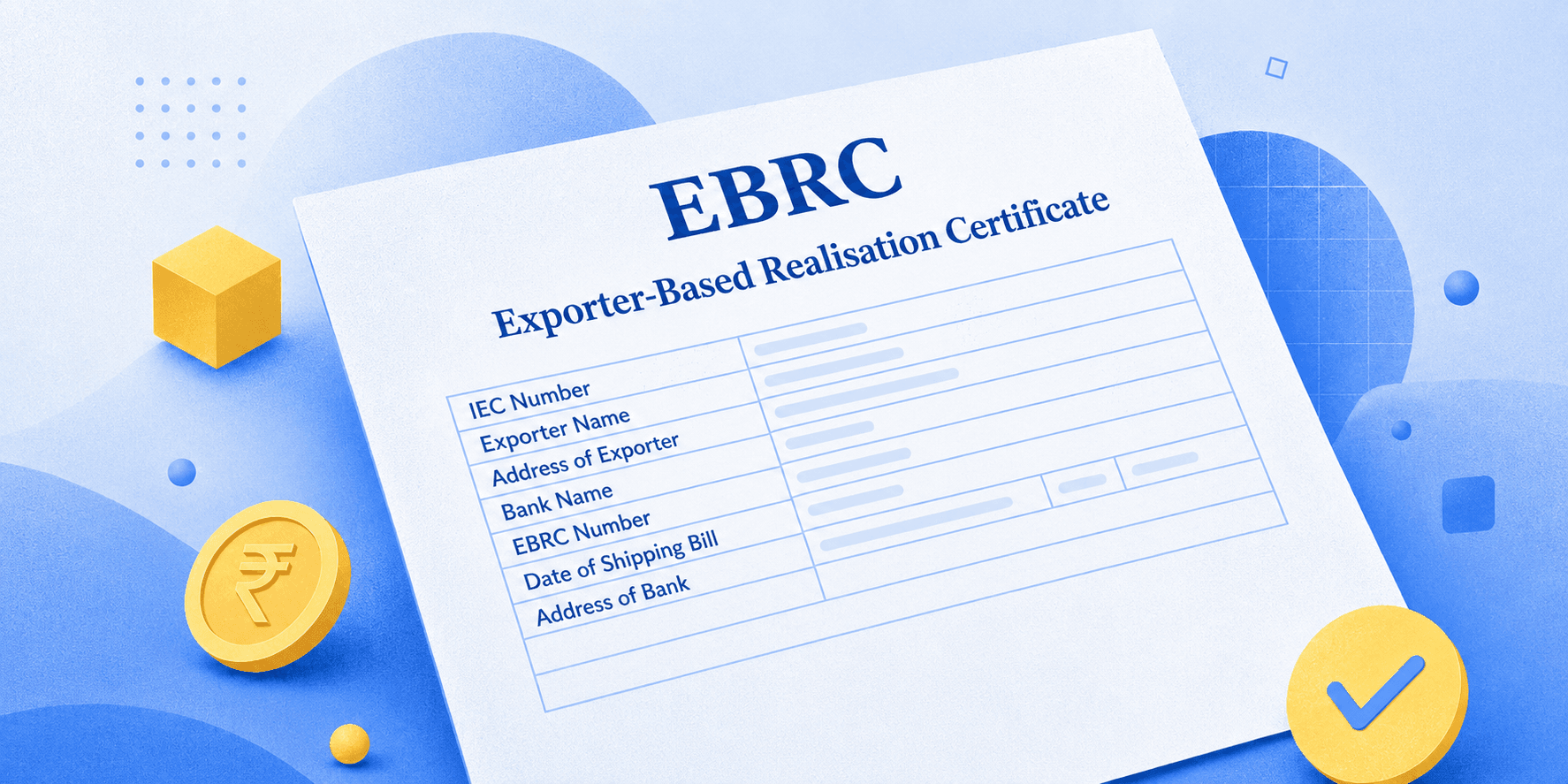
An eBRC, or electronic Bank Realisation Certificate, is generated through the Directorate General of Foreign Trade (DGFT) system and records the realisation of export proceeds against the relevant export transaction. It helps connect the foreign remittance received with the corresponding shipping bill, SOFTEX form or invoice.
The way it is produced changed fundamentally in November 2023.
Under DGFT Trade Notice 33/2023-24, banks transmit Inward Remittance Messages (IRMs) directly to DGFT electronically. Based on those IRMs, exporters can self-certify their eBRCs by matching the remittance with the relevant export document.
The bank therefore no longer has to manually issue the eBRC for the exporter.
The system supports:
- Goods exports, where the eBRC is linked to the relevant shipping bill and invoice data.
- Services exports, including IT, software and professional services, where the eBRC may be linked to an invoice or SOFTEX record, depending on the export.
- Deemed exports, using the applicable purpose-code and transaction details.
That does not mean every exporter must generate an eBRC for every inward remittance simply to receive the money. Its practical importance arises when you need formal proof of export realisation for Foreign Trade Policy benefits, specified GST refund processes, scheme closure, audit or other compliance purposes.
What your eBRC actually unlocks
The eBRC is more than a downloadable certificate. It is recognised proof that export proceeds have been realised and can support several export-compliance and benefit workflows.
It can be relevant for:
- Advance Authorisation and EPCG closure, including applications for Export Obligation Discharge Certificates where proof of realisation is required.
- GST refunds for export of services, where the refund rules require relevant BRC/FIRC-type evidence of receipt of export proceeds.
- Foreign Trade Policy benefits and verification, where proof of realisation is required.
- Export-incentive retention, because schemes such as RoDTEP and Duty Drawback are subject to export proceeds being realised within the FEMA-prescribed period.
- Audit and reconciliation, by providing a DGFT record that connects the remittance with the underlying export documents.
- Other state or sectoral schemes, where the relevant scheme specifically asks for proof of export realisation.
There is an important distinction here.
An eBRC is not automatically a precondition for the initial grant of every export benefit. For example, RoDTEP is not dependent on realisation at the time the rebate is issued. However, the rebate remains subject to the export proceeds being realised within the permitted FEMA period, failing which recovery provisions can apply.
Similarly, Duty Drawback can be recovered where export proceeds are not realised within the permitted period.
The eBRC therefore matters because it evidences realisation, even where the initial scheme claim is processed through another system.
What happens if you never generate your eBRC
There are two separate risks that are often incorrectly treated as one.
The first is documentation risk. If you need proof of realisation for an EODC application, GST refund for exported services, an audit or another benefit, not having the eBRC ready creates avoidable delays.
The second is FEMA and EDPMS risk. This is related to realisation of the export proceeds, but it is not caused simply by failing to click "Generate eBRC".
For goods and other transactions tracked through EDPMS, your Authorised Dealer bank is responsible for matching the export proceeds and updating or closing the relevant entry. eBRC generation and EDPMS closure are connected parts of the wider export-realisation trail, but they are not the same process.
As of September 2026, the current FEMA rules require export proceeds, in the ordinary case, to be realised and repatriated within nine months from the date of export, subject to applicable exceptions and extensions.
That position changed twice within the last year. RBI extended the general period to 15 months in November 2025, then reduced it back to nine months from 5 June 2026.
A further change is already scheduled. The new Foreign Exchange Management (Export and Import of Goods and Services) Regulations, 2026 come into force on 1 October 2026. Under that framework, the standard period becomes 15 months from shipment for goods and from invoice for services, with an 18-month period for exports invoiced or settled in INR, subject to the regulation's conditions.
So the rule to follow depends on the transaction date and the regulations in force at the relevant time.
The practical point remains the same: money reaching your bank account is not the end of export compliance. The receipt still needs to be correctly reported and matched to the underlying export transaction.
What changed in 2026: your eBRC is now a GST-linked document
If your understanding of eBRC is a few years old, it is out of date.
Through Public Notice 42/2025-26 dated 9 January 2026, DGFT revised Appendix 2U of the Handbook of Procedures, 2023 and added three fields to the eBRC format:
- GSTIN
- GST Invoice Number
- GST Invoice Date
The revised format became operational from 13 January 2026. Appendix 2U also supports online validation of the system-generated certificate, including through the QR code shown on the certificate.
The change creates a much clearer invoice-level link between export realisation and GST records.
That matters in practice because whoever generates the eBRC now needs the relevant invoice information available at the point of certification. The invoice number, invoice date and GSTIN should be checked carefully against your own books and GST records before the eBRC is generated.
| Aspect | Before 13 January 2026 | From 13 January 2026 |
|---|---|---|
| Primary export reference | Shipping bill / invoice / SOFTEX as applicable | Same export reference plus GST invoice fields |
| GST fields | Earlier format did not contain the three new invoice-level fields | GSTIN, GST Invoice No. and GST Invoice Date added |
| Tracking approach | Export-realisation focused | Stronger invoice-level linkage |
| Validation | DGFT system record | System-generated certificate with online/QR validation |
| Risk if mismatched | Reconciliation issue | Greater chance of invoice and realisation records not reconciling cleanly |
The amendment does not, by itself, mean every mismatch automatically triggers action from GST authorities. It does mean exporters should treat invoice-level consistency as part of routine eBRC reconciliation.
Five myths about eBRC that cost exporters money
Most avoidable eBRC cost comes from treating an old process as though it still applies.
- Myth: only my bank can issue it.
Reality: Under the revamped system, the bank transmits the IRM and the exporter self-certifies the eBRC through DGFT.
- Myth: a chartered accountant or auditor has to certify it.
Reality: Routine self-certification does not require CA or auditor certification.
- Myth: it costs money to generate.
Reality: DGFT's revamped process is paperless and designed to reduce transaction cost. If you pay a professional to do the work, you are paying for their service, not a DGFT eBRC-generation fee.
- Myth: service exporters and freelancers are exempt.
Reality: The eBRC system supports service exports as well as goods exports. Whether you actually need the certificate depends on the benefit, refund or compliance purpose for which proof of realisation is required.
- Myth: it happens automatically once the payment lands.
Reality: The bank sends the IRM, but the exporter still needs to map the remittance to the relevant export documents and self-certify the eBRC.
Why do exporters still go to a CA or auditor for eBRC?
Because it is habit, not a legal requirement for routine self-certification.
Exporters outsource it for three understandable reasons.
First, memory. Before the 2023 revamp, the process genuinely depended much more heavily on banks and manual follow-up. That reflex has outlived the process that created it.
Second, volume and portal fatigue. An exporter with hundreds of remittances a year is not intimidated by any one certificate. The problem is repeating the matching exercise hundreds of times.
Third, fear of mismatches. Export documentation is interconnected, and a wrong invoice, purpose code or remittance mapping can create downstream reconciliation work.
None of that makes using a professional wrong.
A good CA, accountant or compliance professional earns their fee on judgment: handling partial realisations, write-offs, scheme eligibility, GST treatment, unusual remittance structures or transactions that genuinely do not reconcile.
The point is narrower: you do not need to pay professional rates merely because you believe the law requires a CA to generate every routine eBRC. It does not.
How to generate an eBRC yourself, step by step
The self-certification flow is relatively short once your bank has transmitted the IRM correctly.
DGFT also introduced bulk upload and API integration with effect from 20 August 2024 under Trade Notice 12/2024-25, allowing exporters to generate multiple eBRCs concurrently or connect ERP/accounting systems to the DGFT eBRC workflow.
For an individual certificate:
- Confirm that the remittance is visible in DGFT. Banks transmit IRMs electronically to the DGFT eBRC system.
- Log in to the DGFT portal using your IEC-linked account and open the relevant eBRC/IRM repository.
- Locate the remittance and verify the amount, currency, bank and remittance date against your records.
- Match the IRM to the correct export document, such as the shipping bill, SOFTEX record or invoice, as applicable.
- Enter the required invoice and GST information, including the GSTIN, GST Invoice Number and GST Invoice Date under the 2026 format.
- Check the purpose code and export category against the underlying transaction.
- Review and self-certify the eBRC.
- Download the generated certificate and retain it with the invoice, remittance and export records.
The revamped system also supports permitted splitting and clubbing of remittances subject to DGFT's eBRC generation rules.
Generated eBRCs are available to banks for post-issuance verification and risk review.
Generating your eBRC from the PayGlocal dashboard
A task being simple does not always make it convenient.
The friction is usually that the payment lives in one system, invoices live in another, EDPMS sits with the banking/compliance workflow, and the eBRC is generated through DGFT.
PayGlocal brings more of that chain into one exporter workflow.
For eligible goods-export collection flows, PayGlocal currently provides FIRA, EDPMS closure support and eBRC for DGFT from the dashboard alongside the underlying international payment and invoice data.
That changes the operating model:
- You can see the payment and export-compliance status in one place.
- The realisation record sits next to the payment and invoice data needed for reconciliation.
- Routine compliance work can stay with your finance/operations team instead of depending on an external party's calendar.
- Past payment and documentation records remain easier to retrieve during audits or scheme applications.
The exact workflow depends on your transaction type and the export records available, but the practical objective is the same: reduce the number of separate systems your finance team has to reconcile manually.
Beyond eBRC: your compliance stack in one place
PayGlocal is a payments company, but getting paid is only part of the export workflow.
For exporters using its Multi-Currency Account stack, PayGlocal currently brings together international collections with FIRA, EDPMS-related workflows, eBRC for DGFT, invoice-linked reconciliation and client/payment records.
For routine export receipts, FIRA/eFIRA is generally the more relevant inward-remittance document than describing every export receipt as a FIRC. Traditional FIRC may still be relevant in specific investment or bank-led regulatory contexts.
The regulated foundation also matters.
PayGlocal currently holds RBI authorisation as:
- Payment Aggregator – Online (PA-O)
- Payment Aggregator – Cross Border – Inward & Outward (PA-CB-I&O)
under Certificate No. 250/2025.
Its current Multi-Currency Account product supports collections in 130+ global currencies from 180+ countries, INR settlement within 24 hours for eligible collections, automated FIRA and export-compliance workflows including EDPMS closure and eBRC.
If you export from India, your eBRC is not a document to be feared or outsourced by default. Routine generation is now a self-certification and reconciliation exercise. The harder cases are the ones where professional judgment still earns its fee. If you would like to see how eBRC, FIRA, EDPMS workflows and cross-border collections work together, explore PayGlocal Multi-Currency Accounts. This blog is general guidance and not individual tax, legal or regulatory advice.