
India's exports are growing rapidly at 7.1%, much faster than the global export growth rate of 2.5%. This highlights that Indian businesses are making great progress in international markets, with businesses of all sizes buying from and selling to international markets every day.
When it comes to foreign trade, there are just three main types, including import trade, export trade, and entrepot trade. Each type has its own flow of goods, payment structures, and paperwork requirements. Knowing these models properly helps you make smarter decisions about suppliers, buyers, and payment methods.
In this guide, we break down each type of foreign trade with detailed insights. You'll also learn how modern payment infrastructure can make your international transactions better. So, let’s get into it.
Key Takeaways
Foreign trade refers to the exchange of goods and services between countries. It connects economies, fills supply gaps, and opens new markets for businesses looking to grow beyond domestic borders.
There are three primary types of foreign trade:
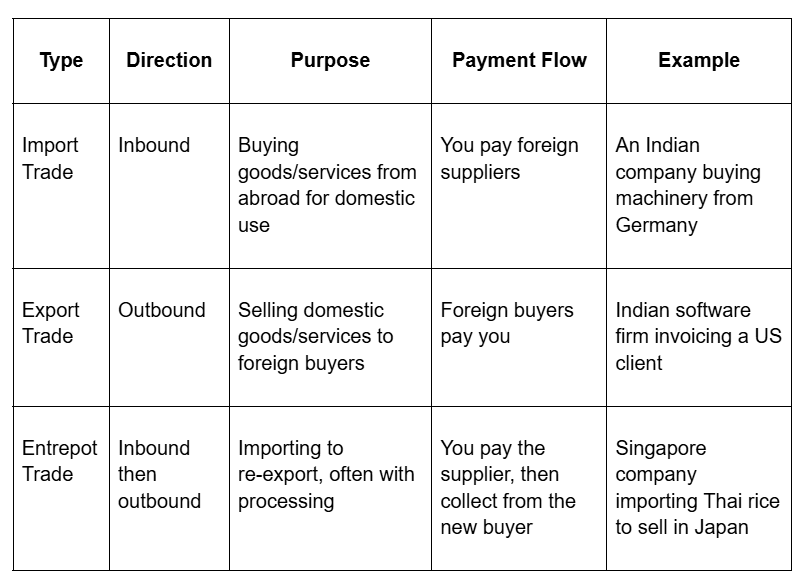
1. Import trade: The import trade occurs when your business buys products or services from another country for use or resale domestically.
2. Export trade: The export trade happens when you sell goods or services produced in your country to buyers abroad.
3. Entrepot trade: The entrepot trade, also called re-export, occurs when you import goods from one country and then export them to another, sometimes after adding value through processing or repackaging.
Each type involves different flows of goods, payment structures, and regulatory requirements. For example, an Indian textile manufacturer buying cotton from Egypt is engaged in import trade.
When that same manufacturer sells finished garments to buyers in the UK, that's export trade. Whereas, if a Dubai-based trading company imports electronics from China and sells them to retailers in Africa, that's an entrepot trade.
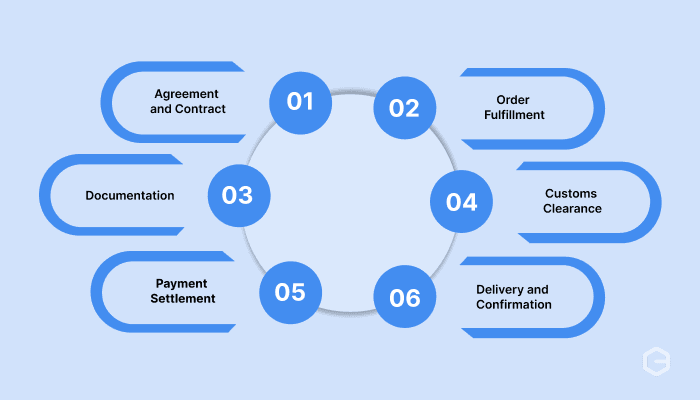
Foreign trade operates through a network of buyers, sellers, intermediaries, logistics providers, and financial institutions. Each transaction involves multiple steps, from order placement to customs clearance to final payment settlement.
Here's how a typical foreign trade transaction flows:
Agreement and contract: The buyer and seller agree on product specifications, pricing, delivery terms, and payment methods. Terms like FOB (Free on Board) or CIF (Cost, Insurance, and Freight) define who pays for shipping and insurance.
Order fulfillment: The seller prepares the goods for export, packages them according to international standards, and arranges transport via sea, air, or land.
Documentation: Both parties prepare required documents such as commercial invoices, bills of lading, packing lists, and certificates of origin. These documents are critical for customs clearance and payment release.
Customs clearance: Goods pass through customs in both the exporting and importing countries. Duties, taxes, and inspections are completed based on product classification and trade agreements.
Payment settlement: The buyer pays the seller through wire transfers, letters of credit, or international payment platforms. Payment timing depends on agreed terms: advance payment, payment on delivery, or credit terms.
Delivery and confirmation: The buyer receives the goods, inspects them for quality and quantity, and confirms receipt. Any disputes are resolved based on the contract terms.
For businesses engaged in regular foreign trade, managing payments efficiently is critical. Delayed payments, high transaction fees, and unclear fund tracking can eat into margins and slow growth. Modern payment platforms help businesses collect from international buyers faster and with full transparency.
Each type of foreign trade serves different business needs and involves unique payment and compliance considerations. Here's how the three types compare:
Beyond the three main types of foreign trade, transactions can also be classified based on the number of countries involved. Bilateral trade happens between two countries, while multilateral trade involves multiple countries through trade agreements or supply chains.
Bilateral trade is straightforward: one country exports to another and payments flow directly between buyers and sellers. For example, India exporting basmati rice to Saudi Arabia is bilateral trade. Many bilateral trade relationships are governed by Free Trade Agreements (FTAs) that reduce tariffs and simplify customs procedures.
Multilateral trade involves multiple countries and is often facilitated by regional trade agreements like ASEAN, the European Union, or trade blocs like BRICS. For instance, an Indian software company providing services to a German client, who then resells those services to customers across Europe, is part of a multilateral trade flow.
Businesses engaged in multilateral trade often deal with multiple currencies, varying compliance requirements, and complex payment routing. Having a payment partner that supports collection in major currencies and provides clear fund tracking makes managing these relationships easier.
Trade in services is a major component of foreign trade but often gets less attention than goods trade. Services trade includes IT consulting, software development, financial services, education, healthcare, and professional services like legal and accounting.
India is one of the world's largest exporters of services, particularly in IT and business process outsourcing. Indian freelancers, agencies, and enterprises provide services to clients globally, from software development for US startups to customer support for European e-commerce companies.
For example, a Pune-based design agency creating branding assets for a Canadian client is engaged in services export. The agency invoices the client in CAD, receives payment in their local currency account, and generates the required compliance documentation for tax and regulatory purposes.
Foreign trade opens significant opportunities for businesses looking to grow beyond domestic markets. Whether you're importing, exporting, or engaged in entrepot trade, international commerce brings clear advantages.
Some of the main benefits include:
Foreign trade creates opportunities but also introduces operational complexities. Businesses new to international commerce often struggle with payment collection, compliance management, and currency fluctuations.
Common challenges include:
These challenges are especially painful for small and mid-sized businesses without dedicated finance teams or enterprise banking relationships. The solution is a payment infrastructure designed specifically for global trade, with transparent pricing, multi-currency support, and automated compliance.
Foreign trade is how your business grows globally. But outdated payment infrastructure holds you back. Slow settlements, high fees, and unclear compliance tracking create unnecessary friction in every international transaction.
Whether you're exporting services to the US, importing materials from Europe, or running entrepot operations across Asia, you need payment infrastructure that works as fast as your business moves.
PayGlocal is built for businesses doing global trade. Here's how we remove payment friction:
With PayGlocal, you can collect payments faster than traditional payment channels, with full visibility into every transaction from initiation to settlement.
Foreign trade is the gateway to global growth. Import trade fills domestic gaps, export trade opens new revenue streams, and entrepot trade creates value through strategic intermediation. Each type of foreign trade has its own operational requirements, but all share one common challenge: efficient payment collection.
The businesses winning in international markets aren't necessarily the ones with the best products. They're the ones that make it easy for customers to pay them, track every transaction transparently, and stay compliant without manual overhead.
If you're serious about scaling your foreign trade operations, modern payment infrastructure isn't optional anymore. It's the difference between chasing payments for weeks and having funds settled in days. Between losing margin to hidden fees and knowing exactly what you'll receive.
Speed up and secure your international payment processes. Get started with PayGlocal today and start accepting payments from global buyers.
When it comes to foreign trade, there are just three main types, including import trade, export trade, and entrepot trade. Each type has its own flow of goods, payment structures, and paperwork requirements. Knowing these models properly helps you make smarter decisions about suppliers, buyers, and payment methods.
In this guide, we break down each type of foreign trade with detailed insights. You'll also learn how modern payment infrastructure can make your international transactions better. So, let’s get into it.
Key Takeaways
- Three core types: Foreign trade includes import trade (buying from abroad), export trade (selling abroad), and entrepot trade (buying and reselling internationally).
- Import trade fills gaps: Businesses import goods or services they can't produce domestically, from raw materials to finished products.
- Export trade drives growth: Selling to international markets increases revenue and helps businesses scale beyond domestic limitations.
- Entrepot trade adds value: This re-export model involves importing goods for processing or resale to third countries, common in hub economies.
- PayGlocal simplifies global payments: With local accounts in USD, GBP, EUR, and CAD, plus instant compliance docs and transparent tracking, PayGlocal helps businesses collect payments from international buyers without friction.
What are the types of foreign trade?
Foreign trade refers to the exchange of goods and services between countries. It connects economies, fills supply gaps, and opens new markets for businesses looking to grow beyond domestic borders.
There are three primary types of foreign trade:
1. Import trade: The import trade occurs when your business buys products or services from another country for use or resale domestically.
2. Export trade: The export trade happens when you sell goods or services produced in your country to buyers abroad.
3. Entrepot trade: The entrepot trade, also called re-export, occurs when you import goods from one country and then export them to another, sometimes after adding value through processing or repackaging.
Each type involves different flows of goods, payment structures, and regulatory requirements. For example, an Indian textile manufacturer buying cotton from Egypt is engaged in import trade.
When that same manufacturer sells finished garments to buyers in the UK, that's export trade. Whereas, if a Dubai-based trading company imports electronics from China and sells them to retailers in Africa, that's an entrepot trade.
How does foreign trade work?
Foreign trade operates through a network of buyers, sellers, intermediaries, logistics providers, and financial institutions. Each transaction involves multiple steps, from order placement to customs clearance to final payment settlement.
Here's how a typical foreign trade transaction flows:
Agreement and contract: The buyer and seller agree on product specifications, pricing, delivery terms, and payment methods. Terms like FOB (Free on Board) or CIF (Cost, Insurance, and Freight) define who pays for shipping and insurance.
Order fulfillment: The seller prepares the goods for export, packages them according to international standards, and arranges transport via sea, air, or land.
Documentation: Both parties prepare required documents such as commercial invoices, bills of lading, packing lists, and certificates of origin. These documents are critical for customs clearance and payment release.
Customs clearance: Goods pass through customs in both the exporting and importing countries. Duties, taxes, and inspections are completed based on product classification and trade agreements.
Payment settlement: The buyer pays the seller through wire transfers, letters of credit, or international payment platforms. Payment timing depends on agreed terms: advance payment, payment on delivery, or credit terms.
Delivery and confirmation: The buyer receives the goods, inspects them for quality and quantity, and confirms receipt. Any disputes are resolved based on the contract terms.
For businesses engaged in regular foreign trade, managing payments efficiently is critical. Delayed payments, high transaction fees, and unclear fund tracking can eat into margins and slow growth. Modern payment platforms help businesses collect from international buyers faster and with full transparency.
How do different types of foreign trade compare?
Each type of foreign trade serves different business needs and involves unique payment and compliance considerations. Here's how the three types compare:
What is bilateral and multilateral trade?
Beyond the three main types of foreign trade, transactions can also be classified based on the number of countries involved. Bilateral trade happens between two countries, while multilateral trade involves multiple countries through trade agreements or supply chains.
Bilateral trade is straightforward: one country exports to another and payments flow directly between buyers and sellers. For example, India exporting basmati rice to Saudi Arabia is bilateral trade. Many bilateral trade relationships are governed by Free Trade Agreements (FTAs) that reduce tariffs and simplify customs procedures.
Multilateral trade involves multiple countries and is often facilitated by regional trade agreements like ASEAN, the European Union, or trade blocs like BRICS. For instance, an Indian software company providing services to a German client, who then resells those services to customers across Europe, is part of a multilateral trade flow.
Businesses engaged in multilateral trade often deal with multiple currencies, varying compliance requirements, and complex payment routing. Having a payment partner that supports collection in major currencies and provides clear fund tracking makes managing these relationships easier.
What is trade in services?
Trade in services is a major component of foreign trade but often gets less attention than goods trade. Services trade includes IT consulting, software development, financial services, education, healthcare, and professional services like legal and accounting.
India is one of the world's largest exporters of services, particularly in IT and business process outsourcing. Indian freelancers, agencies, and enterprises provide services to clients globally, from software development for US startups to customer support for European e-commerce companies.
For example, a Pune-based design agency creating branding assets for a Canadian client is engaged in services export. The agency invoices the client in CAD, receives payment in their local currency account, and generates the required compliance documentation for tax and regulatory purposes.
What are the benefits of foreign trade?
Foreign trade opens significant opportunities for businesses looking to grow beyond domestic markets. Whether you're importing, exporting, or engaged in entrepot trade, international commerce brings clear advantages.
Some of the main benefits include:
- Revenue growth: Access to international markets means more customers and higher sales potential compared to relying only on domestic buyers.
- Product and service variety: Importing allows you to source products, materials, or services not available locally, giving a competitive advantage in quality or pricing.
- Economies of scale: Exporting increases production volumes, which lowers per-unit costs and improves profit margins.
- Foreign exchange opportunities: Favorable exchange rates can increase your margins when selling in stronger currencies or sourcing from countries with weaker currencies.
- Diversification: Selling to multiple countries reduces dependence on any single market, protecting your business from local economic downturns.
- Access to innovation: Foreign trade exposes businesses to new technologies, business practices, and customer preferences that drive innovation.
- Competitive advantage: Businesses that can efficiently manage international payments, compliance, and logistics gain market share over competitors who struggle with these challenges.
What challenges do businesses face in foreign trade?
Foreign trade creates opportunities but also introduces operational complexities. Businesses new to international commerce often struggle with payment collection, compliance management, and currency fluctuations.
Common challenges include:
- Payment delays: International wire transfers can take days or weeks, creating cash flow gaps that strain operations.
- High transaction fees: Traditional banks and payment processors charge significant fees for cross-border transactions, eating into margins.
- Currency conversion costs: Unfavorable exchange rates and hidden markups reduce the actual amount you receive from international payments.
- Compliance complexity: Managing documentation like FIRA, invoices, and tax filings across multiple jurisdictions is time-consuming and error-prone.
- Payment failures: Rejected transactions due to incorrect banking details, sanctions screening, or intermediary bank issues delay or block payments entirely.
- Lack of transparency: Not knowing where your payment is in the settlement process creates uncertainty and makes it hard to plan cash flow.
- Customer payment friction: If paying you is difficult for international buyers, they may choose competitors with easier payment options.
These challenges are especially painful for small and mid-sized businesses without dedicated finance teams or enterprise banking relationships. The solution is a payment infrastructure designed specifically for global trade, with transparent pricing, multi-currency support, and automated compliance.
Scale globally with PayGlocal’s secure payment solutions
Foreign trade is how your business grows globally. But outdated payment infrastructure holds you back. Slow settlements, high fees, and unclear compliance tracking create unnecessary friction in every international transaction.
Whether you're exporting services to the US, importing materials from Europe, or running entrepot operations across Asia, you need payment infrastructure that works as fast as your business moves.
PayGlocal is built for businesses doing global trade. Here's how we remove payment friction:
- Multi-currency accounts: Collect payments in USD, GBP, EUR, and CAD with local account details that make it easy for international buyers to pay you.
- Global payment methods: Accept payments through 40+ local payment methods across 180+ countries, giving your buyers options they trust.
- Recurring payments: Automate subscription billing and repeat charges for service exports, making it easy to collect ongoing payments from international clients.
- Sanction screening: Stay compliant with global AML regulations through privacy-first sanctions screening that protects your business from risk.
- One platform management: Track all payments, manage compliance documents, and view transaction reports from a single dashboard with custom user roles.
With PayGlocal, you can collect payments faster than traditional payment channels, with full visibility into every transaction from initiation to settlement.
Final thoughts
Foreign trade is the gateway to global growth. Import trade fills domestic gaps, export trade opens new revenue streams, and entrepot trade creates value through strategic intermediation. Each type of foreign trade has its own operational requirements, but all share one common challenge: efficient payment collection.
The businesses winning in international markets aren't necessarily the ones with the best products. They're the ones that make it easy for customers to pay them, track every transaction transparently, and stay compliant without manual overhead.
If you're serious about scaling your foreign trade operations, modern payment infrastructure isn't optional anymore. It's the difference between chasing payments for weeks and having funds settled in days. Between losing margin to hidden fees and knowing exactly what you'll receive.
Speed up and secure your international payment processes. Get started with PayGlocal today and start accepting payments from global buyers.