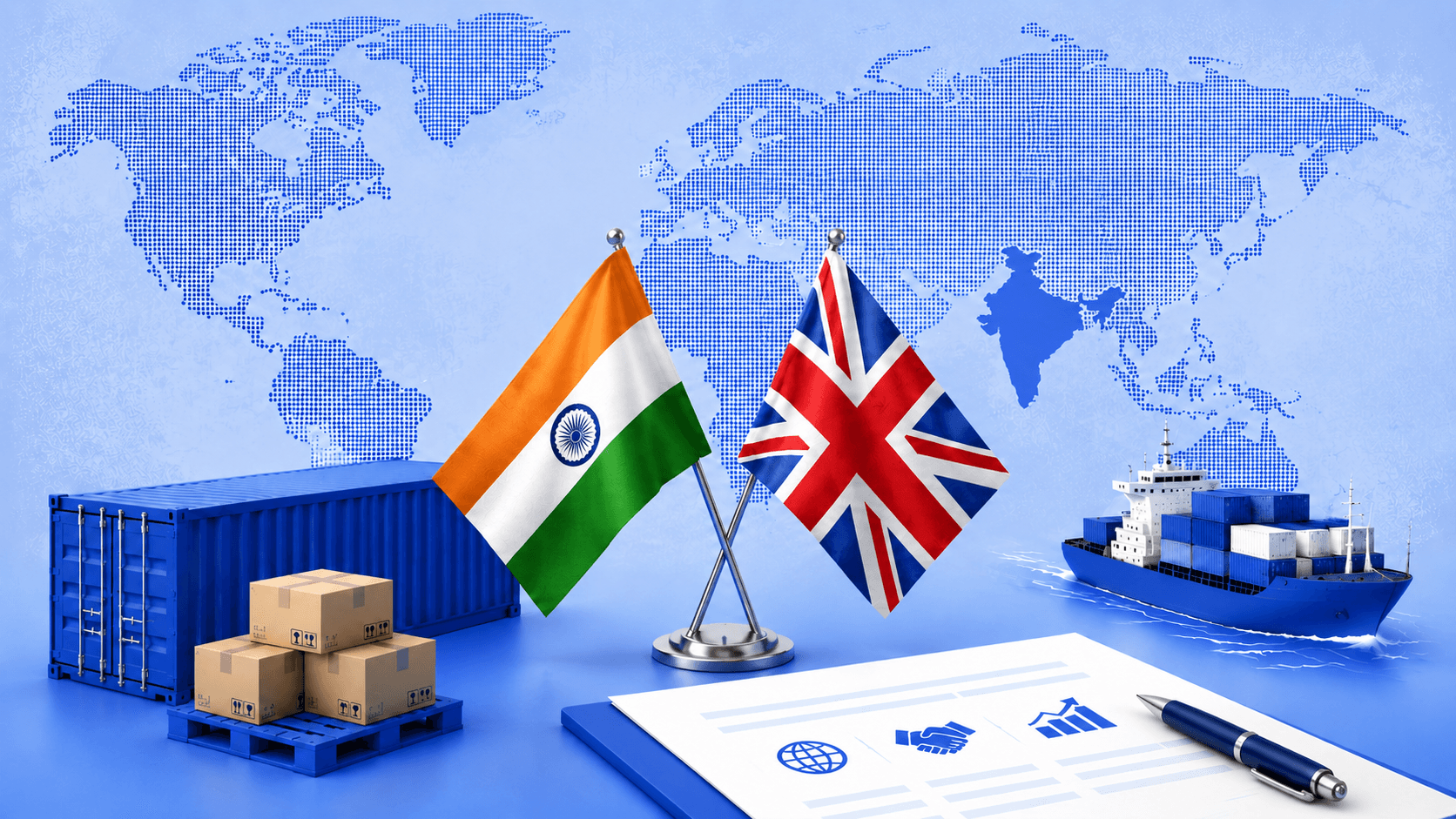

The India–UK trade deal, formally the Comprehensive Economic and Trade Agreement (CETA), came into effect on 15 July 2026, and it changes the economics of exporting to the United Kingdom overnight.
Nearly 99% of Indian exports to the UK now enjoy zero-duty access, covering almost 100% of trade value. For labour-intensive sectors like textiles, leather, gems and jewellery, and marine products, where Indian exporters previously competed against duty-free rivals like Vietnam and Bangladesh, the playing field has finally been levelled.
But the tariff cut is only half of the story. To capture the full benefit of the UK India trade deal, Indian exporters need to get three things right: rules of origin compliance, faster customs documentation, and efficient cross-border payment collection. This guide covers all three.
This is also the most significant India FTA in years, and for Indian exporters it is the trade deal delivering benefits right now.
The Comprehensive Economic and Trade Agreement (CETA), commonly called the India–UK FTA, is a bilateral free trade agreement (FTA) covering goods, services, digital trade, customs facilitation, intellectual property, government procurement, and professional mobility.
The headline numbers:
The UK has eliminated duties on 96.8% of tariff lines, covering 97.7% of trade value from India, effectively zero-duty access for ~99% of Indian exports
India will remove or reduce tariffs on 90% of tariff lines, covering 92% of existing UK imports, with sensitive sectors (dairy, poultry, eggs, sugar) excluded
Bilateral merchandise trade stood at $25.12 billion in FY 2025–26, with India exporting $13.44 billion, a surplus that CETA is expected to widen
Services trade adds another $35+ billion, with India running a healthy services surplus
The agreement was signed in July 2025 and entered into force on 15 July 2026, after ratification by both parliaments. Tariff benefits apply to eligible shipments from that date, meaning goods clearing UK customs now can already claim preferential treatment, provided origin requirements are met.
Previously facing UK tariffs of 8–12%, Indian textiles and garments now enter duty-free, directly closing the gap with Bangladesh and Vietnam, which already enjoyed preferential access. Expect the biggest gains in ready-made garments, home textiles, and carpets. This is the sector the government expects to drive the largest employment impact.
Duties on gems and jewellery have been removed, strengthening India's position in one of its highest-value export categories to the UK.
Full duty elimination makes Indian leather goods and footwear immediately more price-competitive on the UK high street, a significant win for clusters in Agra, Kanpur, and Chennai.
Duties on marine exports are gone, opening the UK's premium seafood market to Indian shrimp and fish exporters who previously absorbed tariffs of up to 20%.
Spices, vegetables, fruits, and processed foods gain duty-free access. Note the exclusions on the import side: India has kept dairy, poultry, eggs, and sugar out of its own concessions, protecting domestic producers.
Auto components and engineering goods gain tariff-free access, positioning Indian manufacturers deeper into UK supply chains.
CETA isn't just a goods deal. India's government expects over 75,000 professionals and 900+ companies to benefit on the services side:
If you're an Indian IT services firm, SaaS company, or consultancy invoicing UK clients, your addressable market just got easier to serve, and your UK receivables volume is likely to grow.
Zero duty isn't automatic. To claim preferential treatment, your goods must qualify under CETA's rules of origin (Chapter 3 of the agreement). Key operational points:
Practical takeaway: exporters with disciplined documentation will clear faster and win repeat UK buyers. Sloppy paperwork forfeits the entire tariff advantage.
Here's the part most CETA coverage skips: more UK orders mean more GBP receivables, and how you collect them determines how much of the tariff benefit you actually keep.
For Indian exporters scaling UK business, three payment realities matter:
1. FX margins can quietly eat your tariff gains. A duty saving of 8–10% means little if you lose 2–4% on hidden FX markups and intermediary bank charges on every GBP remittance. Choose a payments partner with transparent, competitive FX on GBP–INR.
2. Compliance documentation is non-negotiable. Every export receipt needs an FIRC/FIRA (Foreign Inward Remittance Certificate/Advice) for RBI compliance, GST refunds, and export incentive claims. Manual follow-ups with banks for FIRCs slow down your working capital cycle, so automated digital FIRA issuance solves this.
3. Speed of settlement = working capital. As UK order volumes grow under CETA, faster settlement of GBP receivables into INR directly funds your next production cycle.
PayGlocal, an RBI-licensed cross-border payments platform (PA-CB), helps Indian exporters, from MSME merchants to IT/SaaS firms, collect payments from UK buyers with competitive FX rates, automated FIRA generation, and full RBI compliance built in. Whether you're invoicing a UK retailer for a container of garments or billing a London client for software services, PayGlocal makes the payment leg as frictionless as CETA has made the customs leg.
Nearly 99% of Indian exports to the UK now enjoy zero-duty access, covering almost 100% of trade value. For labour-intensive sectors like textiles, leather, gems and jewellery, and marine products, where Indian exporters previously competed against duty-free rivals like Vietnam and Bangladesh, the playing field has finally been levelled.
But the tariff cut is only half of the story. To capture the full benefit of the UK India trade deal, Indian exporters need to get three things right: rules of origin compliance, faster customs documentation, and efficient cross-border payment collection. This guide covers all three.
This is also the most significant India FTA in years, and for Indian exporters it is the trade deal delivering benefits right now.
What Is the India–UK CETA?
The Comprehensive Economic and Trade Agreement (CETA), commonly called the India–UK FTA, is a bilateral free trade agreement (FTA) covering goods, services, digital trade, customs facilitation, intellectual property, government procurement, and professional mobility.
The headline numbers:
The UK has eliminated duties on 96.8% of tariff lines, covering 97.7% of trade value from India, effectively zero-duty access for ~99% of Indian exports
India will remove or reduce tariffs on 90% of tariff lines, covering 92% of existing UK imports, with sensitive sectors (dairy, poultry, eggs, sugar) excluded
Bilateral merchandise trade stood at $25.12 billion in FY 2025–26, with India exporting $13.44 billion, a surplus that CETA is expected to widen
Services trade adds another $35+ billion, with India running a healthy services surplus
When Did the India–UK FTA Come Into Effect?
The agreement was signed in July 2025 and entered into force on 15 July 2026, after ratification by both parliaments. Tariff benefits apply to eligible shipments from that date, meaning goods clearing UK customs now can already claim preferential treatment, provided origin requirements are met.
India UK FTA impact on Indian Exporters: A Sector-by-Sector Look
Textiles and Apparel
Previously facing UK tariffs of 8–12%, Indian textiles and garments now enter duty-free, directly closing the gap with Bangladesh and Vietnam, which already enjoyed preferential access. Expect the biggest gains in ready-made garments, home textiles, and carpets. This is the sector the government expects to drive the largest employment impact.
Gems and Jewellery
Duties on gems and jewellery have been removed, strengthening India's position in one of its highest-value export categories to the UK.
Leather and Footwear
Full duty elimination makes Indian leather goods and footwear immediately more price-competitive on the UK high street, a significant win for clusters in Agra, Kanpur, and Chennai.
Marine Products
Duties on marine exports are gone, opening the UK's premium seafood market to Indian shrimp and fish exporters who previously absorbed tariffs of up to 20%.
Agri and Processed Food
Spices, vegetables, fruits, and processed foods gain duty-free access. Note the exclusions on the import side: India has kept dairy, poultry, eggs, and sugar out of its own concessions, protecting domestic producers.
Engineering Goods and Auto Components
Auto components and engineering goods gain tariff-free access, positioning Indian manufacturers deeper into UK supply chains.
What About Services Exporters? IT, SaaS, and Professionals
CETA isn't just a goods deal. India's government expects over 75,000 professionals and 900+ companies to benefit on the services side:
- Expanded market access for IT/ITeS, financial services, professional services, healthcare, education, engineering, telecom, and consultancy
- Social security relief: under the Double Contribution Convention, Indian employees temporarily posted to the UK contribute only to their home-country social security system for up to three years, a direct cost saving for IT and consulting firms deputing talent
- Greater legal certainty for Indian SaaS and services companies billing UK clients
If you're an Indian IT services firm, SaaS company, or consultancy invoicing UK clients, your addressable market just got easier to serve, and your UK receivables volume is likely to grow.
Rules of Origin: How to Actually Claim CETA Benefits
Zero duty isn't automatic. To claim preferential treatment, your goods must qualify under CETA's rules of origin (Chapter 3 of the agreement). Key operational points:
- Self-certification: CETA allows exporters to self-certify origin through an origin declaration, with no third-party certificate needed for standard claims
- One declaration per shipment, valid for goods that meet origin criteria; keep non-originating goods off the declaration
- Record-keeping: retain all origin-related records, including invoices, supplier declarations, and production and costing records, for at least five years
- Verification risk: customs authorities on both sides can verify claims; incorrect claims mean the importer pays back duties, plus possible penalties. Learn more about FIRC/FIRA
- 48-hour release commitment: CETA commits both customs administrations to releasing compliant goods within 48 hours, but only if your documentation is clean
Practical takeaway: exporters with disciplined documentation will clear faster and win repeat UK buyers. Sloppy paperwork forfeits the entire tariff advantage.
You Won the Tariff Cut. Now Get Paid Right.
Here's the part most CETA coverage skips: more UK orders mean more GBP receivables, and how you collect them determines how much of the tariff benefit you actually keep.
For Indian exporters scaling UK business, three payment realities matter:
1. FX margins can quietly eat your tariff gains. A duty saving of 8–10% means little if you lose 2–4% on hidden FX markups and intermediary bank charges on every GBP remittance. Choose a payments partner with transparent, competitive FX on GBP–INR.
2. Compliance documentation is non-negotiable. Every export receipt needs an FIRC/FIRA (Foreign Inward Remittance Certificate/Advice) for RBI compliance, GST refunds, and export incentive claims. Manual follow-ups with banks for FIRCs slow down your working capital cycle, so automated digital FIRA issuance solves this.
3. Speed of settlement = working capital. As UK order volumes grow under CETA, faster settlement of GBP receivables into INR directly funds your next production cycle.
PayGlocal, an RBI-licensed cross-border payments platform (PA-CB), helps Indian exporters, from MSME merchants to IT/SaaS firms, collect payments from UK buyers with competitive FX rates, automated FIRA generation, and full RBI compliance built in. Whether you're invoicing a UK retailer for a container of garments or billing a London client for software services, PayGlocal makes the payment leg as frictionless as CETA has made the customs leg.