
According to recent data, digital transactions exceeded 18,000 crore in 2024-25, indicating steady growth in payment volumes. Yet most businesses still handle each transaction manually, moving data between payment systems, accounting software, and customer databases.
Smart companies are connecting these systems instead of handling them separately. The integrated payment solutions make transaction data flow automatically across all your business tools. This means less manual work, fewer mistakes, and better visibility into your payment processes.
In this guide, we break down what integrated payment solutions are, how they work, and how you can implement them to process payments faster, reduce costs, and improve customer experience. Let’s get started.
Integrated payment solutions connect your payment processing system directly to other business software you use every day. Instead of manually moving transaction data between systems, everything syncs automatically.
When a customer pays you, the transaction details flow immediately into your accounting software, CRM, inventory system, and any other connected platforms. The payment amount, customer information, order details, and timestamps all transfer without human intervention.
For example, when your e-commerce store processes an international card payment, an integrated system updates your inventory count, creates an accounting entry, logs the customer interaction in your CRM, and generates compliance documentation. All within seconds, without manual work.
This connection removes the need to manually transfer payment data between different business tools. You get real-time visibility into cash flow, accurate records for tax compliance, and fewer errors from manual entry.
Integrated payment systems follow a clear sequence when processing transactions. The process ensures data flows smoothly between your payment processor and business systems without manual intervention. Here's how the workflow operates:
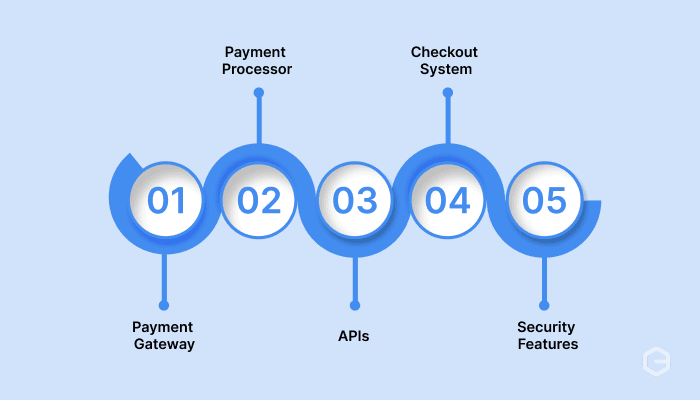
An integrated payment system has several components working together to process transactions and share data across your business tools. Each piece plays a specific role in creating seamless payment operations.
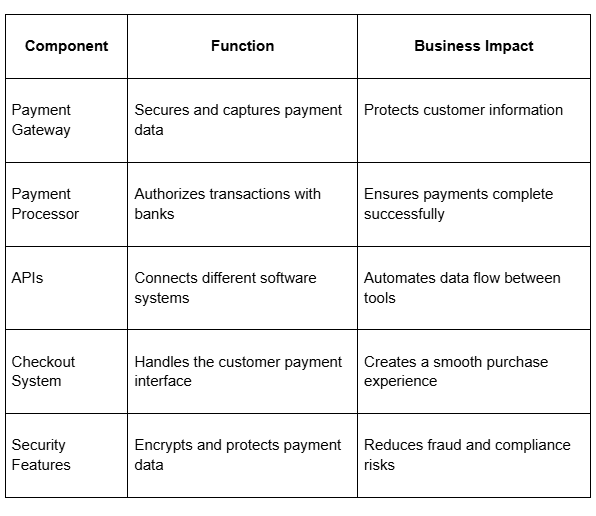
Here's a quick comparison of the key components:
Connecting your payment systems to business tools creates measurable improvements across operations and customer experience. Here's what businesses typically gain.
Your team stops spending hours on data entry and reconciliation. Transaction details flow automatically into accounting software, CRM systems, and reporting tools. For instance, an exporter collecting payments in multiple currencies can see all transactions consolidated in one dashboard without manual updates.
You see exactly where your money is at any moment. Cash flow tracking becomes instant instead of waiting for end-of-day reconciliation. Finance teams can make decisions based on current data rather than yesterday's reports. For example, you can immediately identify which products or services generate the most revenue and adjust strategy accordingly.
Integrated checkout flows are faster and offer more payment options. Customers can pay using their preferred method, whether that's an international card, digital wallet, or local payment option. The system remembers customer information for faster future purchases.
When payment data moves automatically between systems with encryption, you reduce security vulnerabilities from manual handling. Built-in fraud detection analyzes transactions in real-time and flags suspicious activity before processing completes.
Integrated systems track the complete transaction history across all platforms. When customers request refunds or dispute charges, you have immediate access to all relevant data. Processing refunds becomes a few clicks instead of searching through multiple systems.
As transaction volumes increase, integrated systems handle the load without adding manual work. You can process 100 or 10,000 transactions with the same level of effort. The system also makes it easier to expand into new markets or add new payment methods.
The difference between integrated and non-integrated systems shows up clearly in daily operations and business outcomes. Here's how they compare:
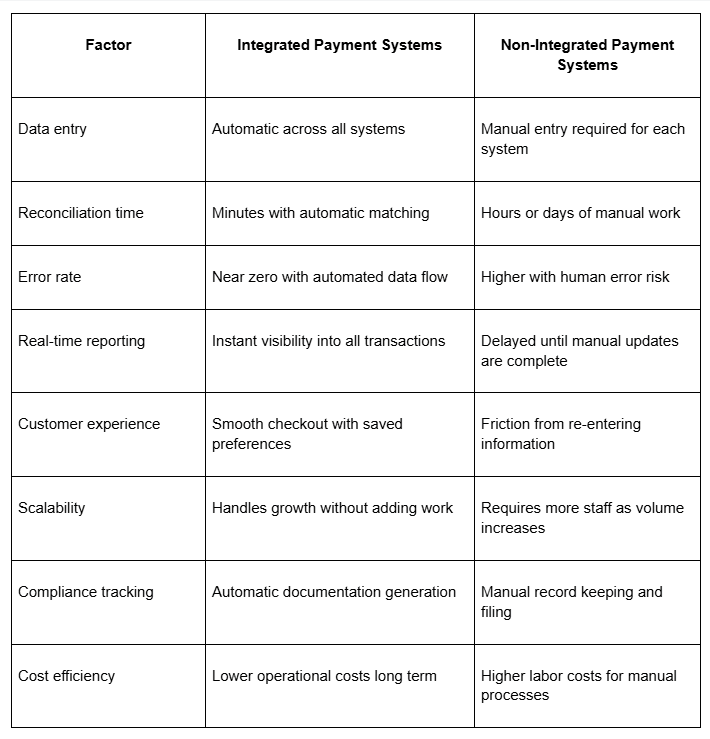
The non-integrated systems force your team to act as the connection between payment processing and business tools. Every transaction requires someone to manually move data between systems. This creates bottlenecks when transaction volumes grow and introduces errors that cost time and money to fix.
The integrated systems remove this manual layer. Data flows automatically, reports update in real-time, and your team focuses on strategic work instead of data entry. The upfront investment in integration pays back through reduced operational costs and faster business decisions.
Integration follows a simple process regardless of your business size or technical capabilities. Here's how to do it step by step:
List all the business software you use, such as e-commerce platforms, accounting software, CRM, inventory management, and billing systems. Identify which systems need payment data to function effectively. This mapping shows you exactly what needs to connect.
You have many options. API integration gives you maximum flexibility and customization, but requires developer resources. Pre-built plugins work with popular platforms like Shopify, WooCommerce, or QuickBooks and can be set up in hours. No-code integration tools let you connect systems using visual interfaces without writing code.
Look for providers that support your required payment methods, currencies, and geographic markets. Check that they offer integrations with your existing business tools. Evaluate their pricing structure, settlement times, and support availability. For businesses processing international payments, choose a provider with strong cross-border capabilities.
Run test payments through your integrated system before going live. Verify that data flows correctly into all connected systems. Check that refunds, partial payments, and failed transactions are all handled properly. Test with different payment methods to ensure everything works.
Show your finance, customer service, and operations teams how to use the integrated system. Document common processes like issuing refunds, looking up transaction histories, and running reports. Make sure everyone knows where to find the information they need.
After going live, watch key metrics like transaction success rates, reconciliation time, and error frequency. Use these insights to fine-tune your integration. Most businesses see the biggest efficiency gains within the first few months as teams adapt to automated workflows.
Payment integration continues to evolve with new technologies that make transactions faster, smarter, and more secure.
These advances make integrated payment solutions more powerful while remaining easy to use. The businesses that adopt modern integrated systems gain competitive advantages through better customer experiences and operational efficiency.
Building for global scale? Manual payment processing won't get you there. PayGlocal helps businesses collect globally and settle locally with integrated payment acceptance across 180+ countries.
Manual payment processes and disconnected systems slow down businesses trying to grow internationally. You need a solution that handles complexity while keeping operations simple.
PayGlocal provides a complete integrated payment platform designed for businesses processing international transactions. Whether you're a freelancer collecting from international clients or an enterprise managing thousands of transactions monthly, you get the tools to accept, track, and settle payments efficiently.
Here's what you get with PayGlocal:
PayGlocal integrates with your existing business systems through APIs and plugins. Transaction data flows automatically to your accounting software, order management systems, and business intelligence tools. You get real-time visibility into payment status, automatic reconciliation, and instant access to compliance documentation.
Integrated payment solutions connect your payment processing to business systems for automatic data flow and real-time visibility. This removes manual work, reduces errors, and creates better experiences for customers and your team.
If you're processing international payments or planning to expand globally, choosing the right integrated solution determines how smoothly you can scale. Look for providers that support your required currencies, payment methods, and geographic markets while offering easy integration with your existing tools.
Ready to accept payments from customers worldwide and scale your business? Get started with PayGlocal today and see how an integrated payment solution can enhance your business processes.
Smart companies are connecting these systems instead of handling them separately. The integrated payment solutions make transaction data flow automatically across all your business tools. This means less manual work, fewer mistakes, and better visibility into your payment processes.
In this guide, we break down what integrated payment solutions are, how they work, and how you can implement them to process payments faster, reduce costs, and improve customer experience. Let’s get started.
Key takeaways
- Integrated payment solutions: These payment solutions connect payment processing with your existing business systems, like accounting software, CRM, and inventory management, for automatic data flow.
- Key components: Payment gateways, processors, APIs, and security features work together to handle transactions and sync data across platforms.
- Efficiency gains: Businesses reduce manual data entry and cut reconciliation time from hours to minutes with proper integration.
- Implementation approach: Most businesses can integrate payment systems using APIs, plugins, or no-code solutions, depending on technical resources and needs.
- Global payment capability: PayGlocal offers integrated payment acceptance across 180+ countries with automatic compliance documentation and multi-currency support for growing businesses.
What are integrated payment solutions?
Integrated payment solutions connect your payment processing system directly to other business software you use every day. Instead of manually moving transaction data between systems, everything syncs automatically.
When a customer pays you, the transaction details flow immediately into your accounting software, CRM, inventory system, and any other connected platforms. The payment amount, customer information, order details, and timestamps all transfer without human intervention.
For example, when your e-commerce store processes an international card payment, an integrated system updates your inventory count, creates an accounting entry, logs the customer interaction in your CRM, and generates compliance documentation. All within seconds, without manual work.
This connection removes the need to manually transfer payment data between different business tools. You get real-time visibility into cash flow, accurate records for tax compliance, and fewer errors from manual entry.
How do integrated payment solutions work?
Integrated payment systems follow a clear sequence when processing transactions. The process ensures data flows smoothly between your payment processor and business systems without manual intervention. Here's how the workflow operates:
- Payment initiation: Customer enters payment details on your checkout page or point-of-sale terminal.
- Authorization request: The payment gateway securely sends transaction data to the processor for bank approval.
- Real-time verification: Processor checks with banks and card networks to approve or decline the transaction.
- Data distribution: Approved transaction details automatically sync to connected business systems via APIs.
- System updates: Accounting software, inventory management, and CRM platforms receive transaction data instantly.
- Confirmation delivery: Customer receives payment confirmation while your systems update financial records automatically.
What makes a payment system integrated?
An integrated payment system has several components working together to process transactions and share data across your business tools. Each piece plays a specific role in creating seamless payment operations.
Here's a quick comparison of the key components:
What are the benefits of integrated payment solutions?
Connecting your payment systems to business tools creates measurable improvements across operations and customer experience. Here's what businesses typically gain.
Less manual work and fewer errors
Your team stops spending hours on data entry and reconciliation. Transaction details flow automatically into accounting software, CRM systems, and reporting tools. For instance, an exporter collecting payments in multiple currencies can see all transactions consolidated in one dashboard without manual updates.
Real-time financial visibility
You see exactly where your money is at any moment. Cash flow tracking becomes instant instead of waiting for end-of-day reconciliation. Finance teams can make decisions based on current data rather than yesterday's reports. For example, you can immediately identify which products or services generate the most revenue and adjust strategy accordingly.
Better customer experience
Integrated checkout flows are faster and offer more payment options. Customers can pay using their preferred method, whether that's an international card, digital wallet, or local payment option. The system remembers customer information for faster future purchases.
Stronger security and fraud prevention
When payment data moves automatically between systems with encryption, you reduce security vulnerabilities from manual handling. Built-in fraud detection analyzes transactions in real-time and flags suspicious activity before processing completes.
Easier refund and dispute management
Integrated systems track the complete transaction history across all platforms. When customers request refunds or dispute charges, you have immediate access to all relevant data. Processing refunds becomes a few clicks instead of searching through multiple systems.
Scalability for growth
As transaction volumes increase, integrated systems handle the load without adding manual work. You can process 100 or 10,000 transactions with the same level of effort. The system also makes it easier to expand into new markets or add new payment methods.
How do integrated and non-integrated payment systems compare?
The difference between integrated and non-integrated systems shows up clearly in daily operations and business outcomes. Here's how they compare:
Non-integrated systems
The non-integrated systems force your team to act as the connection between payment processing and business tools. Every transaction requires someone to manually move data between systems. This creates bottlenecks when transaction volumes grow and introduces errors that cost time and money to fix.
Integrated systems
The integrated systems remove this manual layer. Data flows automatically, reports update in real-time, and your team focuses on strategic work instead of data entry. The upfront investment in integration pays back through reduced operational costs and faster business decisions.
How do you implement integrated payment solutions into your business?
Integration follows a simple process regardless of your business size or technical capabilities. Here's how to do it step by step:
Evaluate your current systems
List all the business software you use, such as e-commerce platforms, accounting software, CRM, inventory management, and billing systems. Identify which systems need payment data to function effectively. This mapping shows you exactly what needs to connect.
Choose your integration method
You have many options. API integration gives you maximum flexibility and customization, but requires developer resources. Pre-built plugins work with popular platforms like Shopify, WooCommerce, or QuickBooks and can be set up in hours. No-code integration tools let you connect systems using visual interfaces without writing code.
Select a payment provider
Look for providers that support your required payment methods, currencies, and geographic markets. Check that they offer integrations with your existing business tools. Evaluate their pricing structure, settlement times, and support availability. For businesses processing international payments, choose a provider with strong cross-border capabilities.
Set up test transactions
Run test payments through your integrated system before going live. Verify that data flows correctly into all connected systems. Check that refunds, partial payments, and failed transactions are all handled properly. Test with different payment methods to ensure everything works.
Train your team
Show your finance, customer service, and operations teams how to use the integrated system. Document common processes like issuing refunds, looking up transaction histories, and running reports. Make sure everyone knows where to find the information they need.
Monitor and optimize
After going live, watch key metrics like transaction success rates, reconciliation time, and error frequency. Use these insights to fine-tune your integration. Most businesses see the biggest efficiency gains within the first few months as teams adapt to automated workflows.
What does the future hold for integrated payments?
Payment integration continues to evolve with new technologies that make transactions faster, smarter, and more secure.
- Intelligent routing and optimization: Advanced systems analyze each transaction and automatically route it through the best processing path for maximum approval rates.
- AI-powered fraud detection: Machine learning models analyze transaction patterns in real-time and flag suspicious activity with high accuracy while reducing false declines.
- Blockchain for settlement: Some payment providers use blockchain technology to speed up cross-border settlements and reduce costs with full transparency.
- Personalized payment experiences: Systems use customer data to personalize checkout by remembering preferences and suggesting relevant payment methods based on location.
- Voice and biometric payments: Integration with voice assistants and biometric authentication creates new ways for customers to complete purchases securely.
These advances make integrated payment solutions more powerful while remaining easy to use. The businesses that adopt modern integrated systems gain competitive advantages through better customer experiences and operational efficiency.
Building for global scale? Manual payment processing won't get you there. PayGlocal helps businesses collect globally and settle locally with integrated payment acceptance across 180+ countries.
Get paid faster and scale your business globally with PayGlocal
Manual payment processes and disconnected systems slow down businesses trying to grow internationally. You need a solution that handles complexity while keeping operations simple.
PayGlocal provides a complete integrated payment platform designed for businesses processing international transactions. Whether you're a freelancer collecting from international clients or an enterprise managing thousands of transactions monthly, you get the tools to accept, track, and settle payments efficiently.
Here's what you get with PayGlocal:
- Global Payment Methods: Add 40+ local payment options to reach customers in markets with low card adoption, including digital wallets and region-specific methods.
- Multi-Currency Accounts: Collect payments locally in USD, GBP, EUR, and CAD while accepting payments in 33+ currencies from 180+ countries with automatic FIRC generation.
- Recurring Payments: Manage subscriptions and recurring billing for international customers with standing instructions and auto-debit functionality.
- One Platform: View and manage all your payments from a single dashboard with transaction tracking, reporting, and compliance documents.
- Sanction Screening: Built-in compliance screening checks transactions against global sanction lists using zero-knowledge-proof technology for privacy and regulatory compliance.
PayGlocal integrates with your existing business systems through APIs and plugins. Transaction data flows automatically to your accounting software, order management systems, and business intelligence tools. You get real-time visibility into payment status, automatic reconciliation, and instant access to compliance documentation.
Final thoughts
Integrated payment solutions connect your payment processing to business systems for automatic data flow and real-time visibility. This removes manual work, reduces errors, and creates better experiences for customers and your team.
If you're processing international payments or planning to expand globally, choosing the right integrated solution determines how smoothly you can scale. Look for providers that support your required currencies, payment methods, and geographic markets while offering easy integration with your existing tools.
Ready to accept payments from customers worldwide and scale your business? Get started with PayGlocal today and see how an integrated payment solution can enhance your business processes.