
India's Gross Domestic GST revenue reached ₹1,45,052 crore in October 2025, up from ₹1,42,251 crore the previous year. The system is working well domestically, but what happens when you start selling globally?
Every country has its own version of a consumption tax. International GST can feel overwhelming when you're trying to scale globally. But the good news is that once you know how these taxes work across different countries, you can price correctly, stay compliant, and focus on growth.
In this guide, we break down what international GST is, how it works in major economies, and what you need to know as an Indian business doing international commerce. Let’s get started.
International GST refers to the goods and services tax or value-added tax (VAT) applied to international transactions. When you sell products or services to customers in other countries, you need to account for the indirect tax system in their jurisdiction.
Over 175 countries worldwide use some form of GST or VAT. While the names differ, the principle remains the same. It is a consumption tax collected at multiple stages of the supply chain, with the final cost passed to the end consumer.
For instance, if you're an Indian software company selling to a client in Germany, you need to know Germany's VAT rules, which currently sit at a 19% standard rate.
The key principle is destination-based taxation. This means tax is collected where goods or services are consumed, not where your business is located. If you export from India to Australia, Australian GST applies at the point of consumption, whereas your export from India is typically zero-rated.
Running a business across countries means dealing with multiple tax systems. Each country has its own rates, registration thresholds, and compliance requirements.
Getting international GST wrong can lead to penalties, delayed payments, or damaged client relationships. For example, if you don't properly document your exports, you might face issues when claiming input tax credits in India, which can directly affect your cash flow.
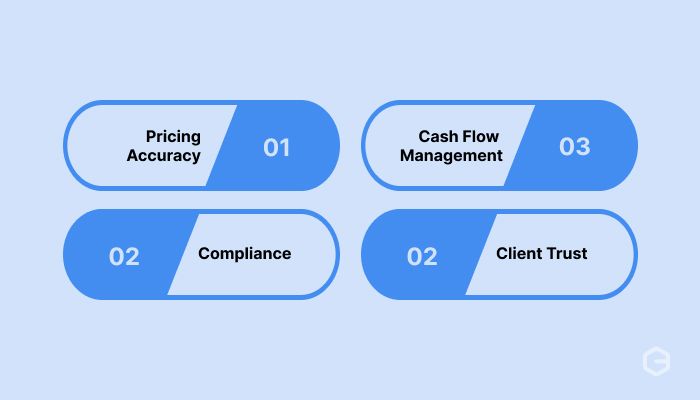
Here's why international GST matters:
International GST operates differently depending on where you're doing business. Here's how the system works in India and the different countries.
India implemented its Goods and Services Tax (GST) system on July 1, 2017, replacing multiple indirect taxes with a unified structure. The system uses a dual tax model with CGST (Central GST) and SGST (State GST) for intra-state transactions, or IGST (Integrated GST) for inter-state and international transactions.
Current rate slabs are 5%, 18%, and 40% after the major reform in September 2025 simplified the previous four-slab structure. Essential items like milk, vegetables, and grains remain at 0%, while health insurance is exempt. Registration is mandatory for businesses with an annual turnover above ₹40 lakhs (₹20 lakhs for special category states).
Exports are zero-rated, meaning you don't charge GST on international sales but can claim Input Tax Credit (ITC) on your business expenses. This makes Indian products competitive globally. Unlike single-rate systems in Australia or Singapore, India uses multiple slabs to accommodate different product categories and socio-economic considerations.
Australia has a 10% GST on most goods and services sold or consumed within the country. The rate has remained unchanged since the system was implemented in 2000.
Registration threshold is AU$75,000 in annual turnover. If your sales to Australian customers exceed this amount, you need to register for GST with the Australian Taxation Office (ATO). Fresh food, healthcare, and education are GST-free. The system is straightforward with a single rate, making compliance simpler compared to multi-rate systems.
The UK uses a Value Added Tax (VAT) system with a standard rate of 20%. There are also reduced rates of 5% and 0% for specific categories.
Exports from the UK are zero-rated, meaning you don't charge VAT but can still reclaim input VAT. Essential items like most food, children's clothing, and books are zero-rated. Financial services and property transactions are exempt. After Brexit, the UK maintained a similar VAT structure but operates independently from EU VAT rules.
The US is unique among major economies. It has no federal GST or VAT. Instead, individual states levy sales taxes ranging from 0% to 7.25%.
Five states have zero sales tax: Alaska, Delaware, Montana, New Hampshire, and Oregon. This creates complexity for businesses selling across multiple US states, as you need to track sales tax requirements for over 13,000 different tax jurisdictions. For instance, if you sell software to clients in California, you need to apply California's 7.25% base sales tax, while sales to Oregon clients have no state sales tax.
Canada operates a dual system with a 5% federal Goods and Services Tax (GST) plus provincial taxes. Five provinces use Harmonized Sales Tax (HST), which combines federal and provincial components.
HST rates range from 13% to 15% depending on the province. For example, Ontario has 13% HST (5% federal + 8% provincial), while Nova Scotia reduced its rate to 14% in April 2025. Registration threshold is CAD 30,000 in annual turnover. Basic groceries, prescription medications, and exports are zero-rated.
Singapore has a 9% GST rate as of January 2024, increased from 8%. The system uses a single consistent rate, making it relatively simple.
The registration threshold is SGD 1 million in annual turnover, which is significantly higher than in most countries. Financial services, residential property, and investment in precious metals are exempt. International services and exports are zero-rated. The rate started at 3% in 1994 and has gradually increased over the years.
The UAE implemented a 5% VAT in January 2018 as part of a GCC-wide agreement. It's one of the lowest standard rates globally.
Registration is mandatory for businesses with AED 375,000 or more in annual turnover (approximately $102,000). Exports, education, healthcare, and crude oil are zero-rated. E-invoicing becomes mandatory from July 1, 2026. The low rate and straightforward system make the UAE attractive for businesses.
EU countries follow VAT rules with a minimum standard rate of 15%, though individual countries set their own exact rates.
France has a 20% standard rate with reduced rates of 10%, 5.5%, and 2.1% for specific items. Germany applies a 19% standard rate. Hungary has the highest rate globally at 27%. Sweden charges 25%. All EU countries zero-rate exports to non-EU countries and apply complex rules for intra-EU trade.
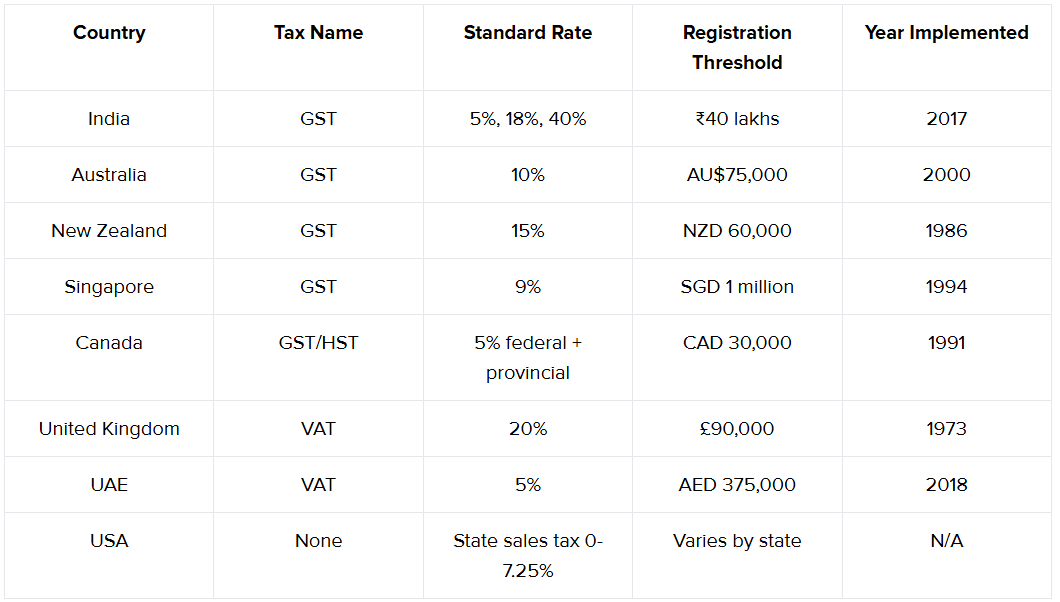
Here's how rates compare across countries Indian businesses commonly work with:
If you're exporting services or goods, you need a reliable payment system that can automatically handle global payments while meeting compliance requirements. From freelance projects to enterprise contracts, the right platform gives you confidence that documentation is correct and accessible when you need it.
[PayGlocal](link) helps you collect internationally while staying compliant. Here’s how PayGlocal can help your business scale globally:
PayGlocal handles the complexity of international payments so you can focus on delivering value to your global clients. Your transactions stay compliant, your documentation stays organized, and your payments arrive faster.
International GST varies significantly across countries, but the core principle stays consistent. It's a consumption tax applied where goods and services are used. Rates range from 5% to 27%, and each jurisdiction has unique registration thresholds and compliance requirements.
The businesses that scale globally are the ones that simplify compliance early. When you have systems that generate proper documentation automatically, handle multi-currency transactions smoothly, and keep you audit-ready, you free up time to focus on growth instead of paperwork.
Ready to collect payments globally with built-in compliance? Get started with PayGlocal today and scale your business globally.
Every country has its own version of a consumption tax. International GST can feel overwhelming when you're trying to scale globally. But the good news is that once you know how these taxes work across different countries, you can price correctly, stay compliant, and focus on growth.
In this guide, we break down what international GST is, how it works in major economies, and what you need to know as an Indian business doing international commerce. Let’s get started.
Key takeaways
- What international GST means: International GST refers to consumption taxes (GST or VAT) applied on cross-border transactions, with over 175 countries using some form of indirect tax system.
- Registration thresholds matter: You may need to register for GST/VAT in another country if your sales exceed specific thresholds, which vary by region.
- Destination-based taxation: Tax is typically charged where goods or services are consumed, not where your business is located.
- Zero-rated exports: Most countries zero-rate exports, meaning you don't charge GST/VAT on international sales, but you can claim input credits.
- Simplified payment collection helps: Using payment platforms like PayGlocal that handle multi-currency transactions and generate compliance documents automatically can save significant time and reduce errors.
What is international GST?
International GST refers to the goods and services tax or value-added tax (VAT) applied to international transactions. When you sell products or services to customers in other countries, you need to account for the indirect tax system in their jurisdiction.
Over 175 countries worldwide use some form of GST or VAT. While the names differ, the principle remains the same. It is a consumption tax collected at multiple stages of the supply chain, with the final cost passed to the end consumer.
For instance, if you're an Indian software company selling to a client in Germany, you need to know Germany's VAT rules, which currently sit at a 19% standard rate.
The key principle is destination-based taxation. This means tax is collected where goods or services are consumed, not where your business is located. If you export from India to Australia, Australian GST applies at the point of consumption, whereas your export from India is typically zero-rated.
Why does international GST matter for your business?
Running a business across countries means dealing with multiple tax systems. Each country has its own rates, registration thresholds, and compliance requirements.
Getting international GST wrong can lead to penalties, delayed payments, or damaged client relationships. For example, if you don't properly document your exports, you might face issues when claiming input tax credits in India, which can directly affect your cash flow.
Here's why international GST matters:
- Pricing accuracy: You need to know whether to include GST/VAT in your pricing or whether exports are zero-rated in your target markets.
- Compliance: Failing to register when required or not charging the correct rate can result in fines and legal issues.
- Cash flow management: Input tax credits and refunds depend on proper documentation and compliance with both Indian and foreign tax authorities.
- Client trust: Professional invoicing with correct tax treatment builds confidence with international clients and speeds up payment processing.
How does international GST work across major countries?
International GST operates differently depending on where you're doing business. Here's how the system works in India and the different countries.
India
India implemented its Goods and Services Tax (GST) system on July 1, 2017, replacing multiple indirect taxes with a unified structure. The system uses a dual tax model with CGST (Central GST) and SGST (State GST) for intra-state transactions, or IGST (Integrated GST) for inter-state and international transactions.
Current rate slabs are 5%, 18%, and 40% after the major reform in September 2025 simplified the previous four-slab structure. Essential items like milk, vegetables, and grains remain at 0%, while health insurance is exempt. Registration is mandatory for businesses with an annual turnover above ₹40 lakhs (₹20 lakhs for special category states).
Exports are zero-rated, meaning you don't charge GST on international sales but can claim Input Tax Credit (ITC) on your business expenses. This makes Indian products competitive globally. Unlike single-rate systems in Australia or Singapore, India uses multiple slabs to accommodate different product categories and socio-economic considerations.
Australia
Australia has a 10% GST on most goods and services sold or consumed within the country. The rate has remained unchanged since the system was implemented in 2000.
Registration threshold is AU$75,000 in annual turnover. If your sales to Australian customers exceed this amount, you need to register for GST with the Australian Taxation Office (ATO). Fresh food, healthcare, and education are GST-free. The system is straightforward with a single rate, making compliance simpler compared to multi-rate systems.
United Kingdom
The UK uses a Value Added Tax (VAT) system with a standard rate of 20%. There are also reduced rates of 5% and 0% for specific categories.
Exports from the UK are zero-rated, meaning you don't charge VAT but can still reclaim input VAT. Essential items like most food, children's clothing, and books are zero-rated. Financial services and property transactions are exempt. After Brexit, the UK maintained a similar VAT structure but operates independently from EU VAT rules.
United States
The US is unique among major economies. It has no federal GST or VAT. Instead, individual states levy sales taxes ranging from 0% to 7.25%.
Five states have zero sales tax: Alaska, Delaware, Montana, New Hampshire, and Oregon. This creates complexity for businesses selling across multiple US states, as you need to track sales tax requirements for over 13,000 different tax jurisdictions. For instance, if you sell software to clients in California, you need to apply California's 7.25% base sales tax, while sales to Oregon clients have no state sales tax.
Canada
Canada operates a dual system with a 5% federal Goods and Services Tax (GST) plus provincial taxes. Five provinces use Harmonized Sales Tax (HST), which combines federal and provincial components.
HST rates range from 13% to 15% depending on the province. For example, Ontario has 13% HST (5% federal + 8% provincial), while Nova Scotia reduced its rate to 14% in April 2025. Registration threshold is CAD 30,000 in annual turnover. Basic groceries, prescription medications, and exports are zero-rated.
Singapore
Singapore has a 9% GST rate as of January 2024, increased from 8%. The system uses a single consistent rate, making it relatively simple.
The registration threshold is SGD 1 million in annual turnover, which is significantly higher than in most countries. Financial services, residential property, and investment in precious metals are exempt. International services and exports are zero-rated. The rate started at 3% in 1994 and has gradually increased over the years.
United Arab Emirates
The UAE implemented a 5% VAT in January 2018 as part of a GCC-wide agreement. It's one of the lowest standard rates globally.
Registration is mandatory for businesses with AED 375,000 or more in annual turnover (approximately $102,000). Exports, education, healthcare, and crude oil are zero-rated. E-invoicing becomes mandatory from July 1, 2026. The low rate and straightforward system make the UAE attractive for businesses.
European Union countries
EU countries follow VAT rules with a minimum standard rate of 15%, though individual countries set their own exact rates.
France has a 20% standard rate with reduced rates of 10%, 5.5%, and 2.1% for specific items. Germany applies a 19% standard rate. Hungary has the highest rate globally at 27%. Sweden charges 25%. All EU countries zero-rate exports to non-EU countries and apply complex rules for intra-EU trade.
How does International GST compare across different countries?
Here's how rates compare across countries Indian businesses commonly work with:
Accept global payments faster and securely with PayGlocal
If you're exporting services or goods, you need a reliable payment system that can automatically handle global payments while meeting compliance requirements. From freelance projects to enterprise contracts, the right platform gives you confidence that documentation is correct and accessible when you need it.
[PayGlocal](link) helps you collect internationally while staying compliant. Here’s how PayGlocal can help your business scale globally:
- Multi-currency accounts: Collect payments locally in USD, GBP, EUR, and CAD, with global collection in 130+ global currencies from 180+ countries.
- Instant compliance documents: Receive FIRC (Foreign Inward Remittance Certificate) automatically in your inbox after settlement, no manual follow-up with banks needed.
- Sanction screening: Screen transactions against 300+ global sanctions lists with privacy-first zero-knowledge-proof technology to protect your business from risks.
- Global payment methods: Accept 40+ local payment methods, including cards, bank transfers, and regional options your clients prefer.
- One platform for everything: Manage all international payments, view transaction reports, and download compliance documents from a single dashboard.
PayGlocal handles the complexity of international payments so you can focus on delivering value to your global clients. Your transactions stay compliant, your documentation stays organized, and your payments arrive faster.
Final thoughts
International GST varies significantly across countries, but the core principle stays consistent. It's a consumption tax applied where goods and services are used. Rates range from 5% to 27%, and each jurisdiction has unique registration thresholds and compliance requirements.
The businesses that scale globally are the ones that simplify compliance early. When you have systems that generate proper documentation automatically, handle multi-currency transactions smoothly, and keep you audit-ready, you free up time to focus on growth instead of paperwork.
Ready to collect payments globally with built-in compliance? Get started with PayGlocal today and scale your business globally.