
Indian businesses receive money from overseas customers through five main methods: card payments, bank transfers, local collection accounts, digital wallets, and marketplace payouts. There is no single best one. The right choice depends almost entirely on your average invoice size, because the cost of each method behaves differently as the amount goes up. Below roughly one thousand dollars, cards usually win despite costing more, because the buyer does not have to do anything unusual. Above ten thousand dollars, bank-based methods win on cost by a wide margin.
- The five methods, what each costs, and how fast each settles
- The variable most guides ignore: how much work your buyer has to do
- Why cards are the easiest option for small businesses, with the numbers
- Where cards stop being the right answer
- Which method fits a freelancer, a SaaS company and a goods exporter
TL;DR
- Indian businesses can receive international payments through cards, bank transfers, local collection accounts, digital wallets, or marketplace payouts.
- The best method depends largely on invoice size and buyer effort: cards work well for smaller payments, while bank-based options become more cost-effective as invoices grow.
- Most growing businesses benefit from using more than one method—cards for small, new, or recurring payments and bank-based collection for larger invoices.
The five methods
01. Card payments
Your customer pays with a Visa, Mastercard or Amex card, through a checkout page or a payment link you send them.
- Speed: Instant confirmation, settlement in a few days
- Buyer effort: Almost none. They already have the card
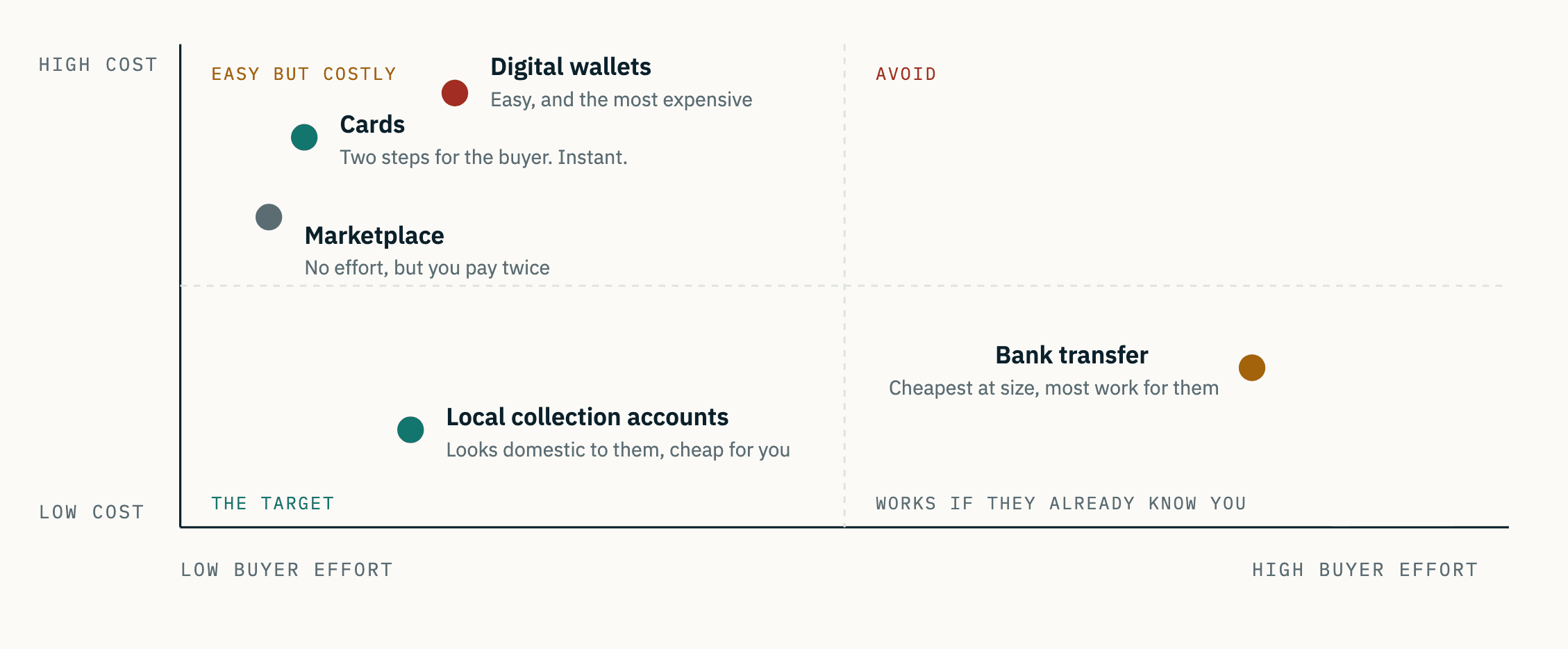
- Cost: Highest headline rate of the five, commonly around three to four percent all-in for international cards
- Best for: Small and medium invoices, recurring billing, self-serve products
02. Bank transfer
The traditional international wire. Your customer instructs their bank to send money using your bank details.
- Speed: Commonly two to five days
- Buyer effort: High. A form, your details, and usually a fee they pay
- Cost: Sender fee, possible intermediary deductions, and a conversion margin rarely quoted to you
- Best for: Large invoices to established clients
03. Local collection accounts
You get bank details in your customer's own country. They pay what looks to them like a domestic account.
- Speed: Commonly one to two days
- Buyer effort: Low. It looks like a normal domestic payment
- Cost: Varies. Flat-fee models are common, so very cheap on large invoices and relatively expensive on small ones
- Best for: Regular direct invoicing to business customers
04. Digital wallets
Consumer payment platforms your customer may already use.
- Speed: Fast to the wallet, slower to your bank
- Buyer effort: Low if they already have an account
- Cost: Typically the most expensive once conversion is counted. Published rates commonly combine a fee above four percent with a separate three to four percent conversion margin
- Best for: Occasional payments where the customer insists
05. Marketplace payouts
If your work comes through a platform, the platform pays you.
- Speed: Platform hold period, then the withdrawal
- Buyer effort: None, they already paid the platform
- Cost: You pay twice. Platform commission, then again to move money home
- Best for: Work you sourced through that platform, and nothing else
The variable most guides ignore
Almost everything written about this topic is written from your side of the transaction. What does it cost me, how fast does it reach me.
That misses the decision that actually determines whether you get paid, and when. Your customer chooses. If paying you is more work than paying somebody else, three things happen, and all three cost you money.
They delay. An invoice that requires someone to log into their bank, find the international transfer page, enter a SWIFT code and pay a fee is an invoice that waits for a moment when they have twenty free minutes. That moment is often next week.
They ask questions. Every question is an email, and every email is days.
Sometimes they simply do not. For a small purchase from a new supplier, the effort can exceed the value of the thing being bought.
Why cards are easy for small businesses
This is the part that matters most if you are a freelancer, a sole proprietor, or a small SaaS company, and it is worth being precise about, because cards are not the cheapest option. They are the easiest, and for small amounts easy beats cheap.
Your customer does not have to set anything up. They have the card in their pocket. No account to create, no form, no code to look up. Roughly two steps between wanting to pay you and having paid you.
It works at any size. Asking someone to initiate an international wire for a one hundred and fifty dollar invoice is asking for more effort than the invoice is worth. Cards have no such floor.
You know immediately. A card authorises or it does not, in seconds. Ship the product, grant the login, start the work. A bank transfer leaves you refreshing your account for three days.
No back and forth about bank details. This also removes a fraud vector. Invoice interception, where someone substitutes their own bank details into an emailed invoice, is among the most common frauds against small businesses. A card payment has no bank details to substitute.
It works while you are asleep. A payment link collects from a customer in another time zone with nobody involved on your side.
It repeats. Subscriptions, retainers and renewals work on cards. Wires need a human to initiate them every time, and one month that human forgets.
The honest counterweight
Cards cost more, and the gap grows with the invoice.
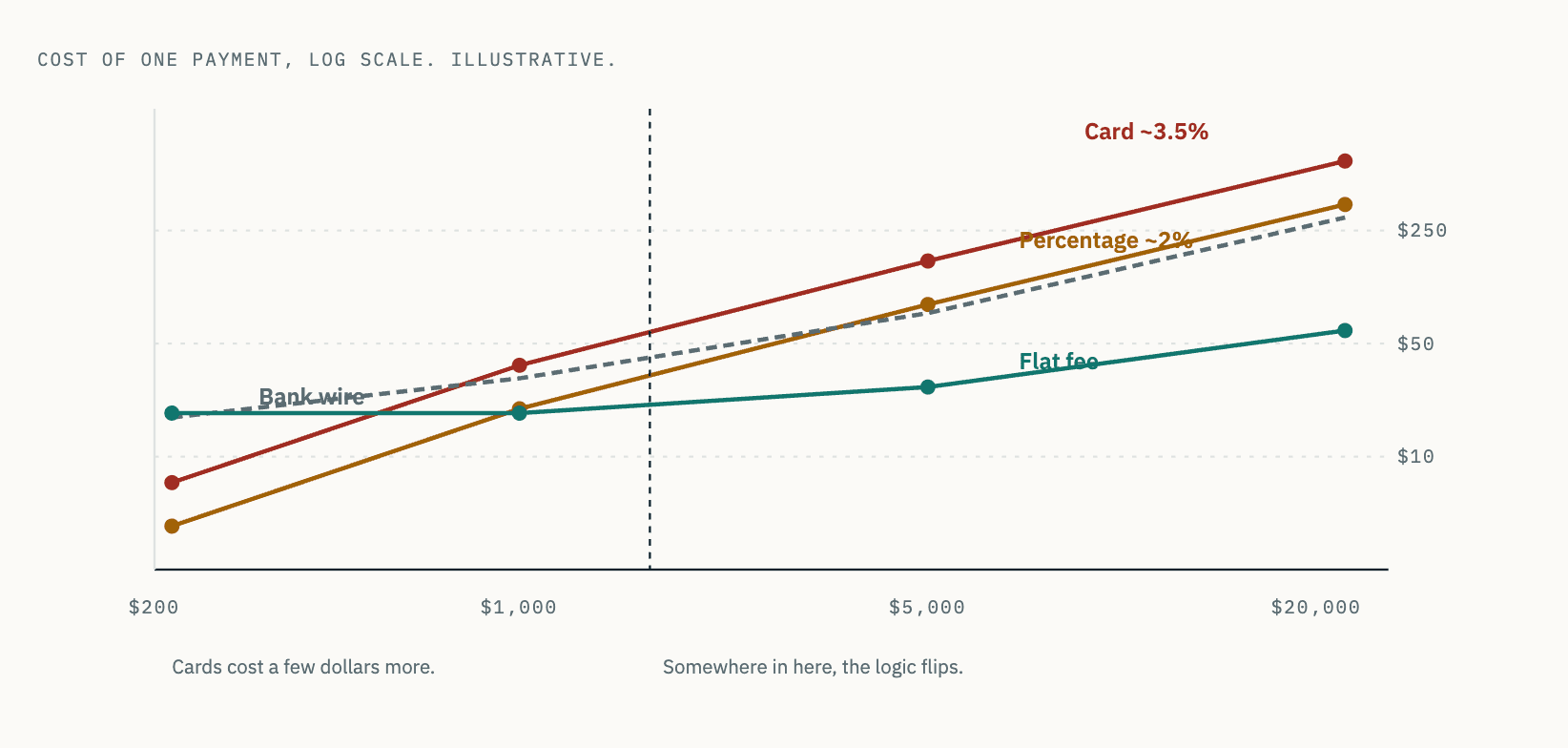
| Invoice | Card ~3.5% | Percentage ~2% | Flat fee | Bank wire |
|---|---|---|---|---|
| $200 | ~$7 | ~$4 | ~$19 | ~$18 |
| $1,000 | ~$35 | ~$20 | ~$19 | ~$30 |
| $5,000 | ~$175 | ~$100 | ~$29 | ~$90 |
| $20,000 | ~$700 | ~$400 | ~$60 | ~$315 |
*Indicative figures to show the shape of the curve, not a rate card. Use your own provider's actual rates.*
Percentage costs scale with the invoice and flat costs do not. This is the whole story. A percentage that feels small at two hundred dollars is a large number at twenty thousand.
At small tickets, a flat fee is the worst option. Nineteen dollars on a two hundred dollar invoice is nearly ten percent. The same nineteen dollars on a five thousand dollar invoice is negligible.
Cards are never the cheapest, and are frequently still the right answer below about a thousand dollars, because the difference is a few dollars and a few dollars is a small price for getting paid today instead of next week.
Match the method to your business
Freelancer or sole proprietor
Mostly small to medium invoices, often to clients who are new to you. Cards or a payment link should be your default, because the conversion advantage outweighs the fee at your ticket sizes and because you cannot afford three days chasing a two hundred dollar invoice.
If you have three or four regular clients paying larger monthly amounts, move those specific clients onto a bank-based method and keep cards for everyone else. Using two methods is normal and usually the cheapest overall answer.
SaaS company
Cards, and it is not close. Self-serve signup with no human involved. Instant provisioning on payment. Recurring billing that renews without anyone doing anything. Customers in dozens of countries who will never fill in a bank form.
The thing to get right is not the method, it is the failure rate. Card-based recurring revenue leaks through expired cards, reissued cards and declined renewals, and that leak is invisible unless you look for it. We have written separately about why international payments fail.
For enterprise deals above a certain size, add a bank option. Large customers often prefer it and their procurement teams sometimes require it.
Exporter of services
Usually larger, regular, invoice-based payments to business customers. Local collection accounts generally give the best total cost here, especially with flat-fee pricing, because your invoice sizes are large enough that a flat fee rounds to nothing.
Keep a card option available anyway. It costs nothing to offer and it collects the deposits, the small add-ons, and the new customer who wants to start small before committing.
Exporter of goods
Same logic, with one addition: your buyer often wants to pay a deposit before shipping and the balance after. That split favours having both live. Card for the deposit, because it is small, fast and confirms instantly so you can begin production. Bank-based for the balance, because it is large and the relationship is now established.
The one number worth tracking
Whatever you choose, measure it the same way. Take the rupees that actually landed in your bank. Divide by the dollars you invoiced. That is your realised rate. Compare it against the mid-market exchange rate on the day.
The gap is your true, all-in cost, including everything that was never presented to you as a fee. Advertised rates will not tell you this. Four payments in a spreadsheet will.
One practical note
Whichever method you use, you will need a record of what each payment was for. Some methods produce this automatically for every transaction, some require you to request it, and some charge for it. If you receive payments regularly, treat automatic documentation as a selection criterion rather than something to sort out later. We covered this separately in our post on proof of inward remittance.
Where PayGlocal fits
We build cross-border collection infrastructure for Indian businesses selling to customers abroad, covering both card acceptance and account-based collection. If your income comes through a marketplace, the honest answer is that the marketplace's own payout is usually the least friction and the thing worth optimising is the second leg.