
Recent data show exports increased by 4.84% in April-October 2025 compared to the same months in 2024. This growth indicates that more businesses are finding the right ways to reach international customers and deliver value.
But growth depends on choosing an entry mode that fits your resources and goals. Some businesses start with simple exports, while others establish joint ventures or wholly owned subsidiaries abroad. Each approach involves different levels of investment, risk, and control.
In this guide, we break down the main modes of international business, what each one involves, and how to select the best fit for your situation. Let’s get started.
Modes of international business are the different strategies companies use to enter and operate in foreign markets. They're your options for doing business beyond your home country's borders.
Each mode represents a different level of involvement, from simply shipping products abroad to setting up fully owned operations in another country. The mode you pick determines how much money you invest, what risks you face, and how much control you keep over your brand and operations.
The right mode depends on your business type, budget, target market, and growth goals. Some businesses need tight control over quality and branding, while others prefer to share risks and leverage local partners' market knowledge.
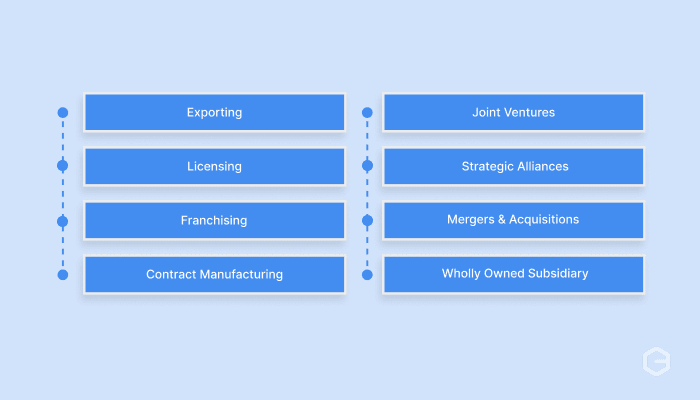
When you're planning to enter international markets, you have several strategic options. Each mode sits on a spectrum of risk, investment, and control. Here's a quick comparison of the main entry modes:
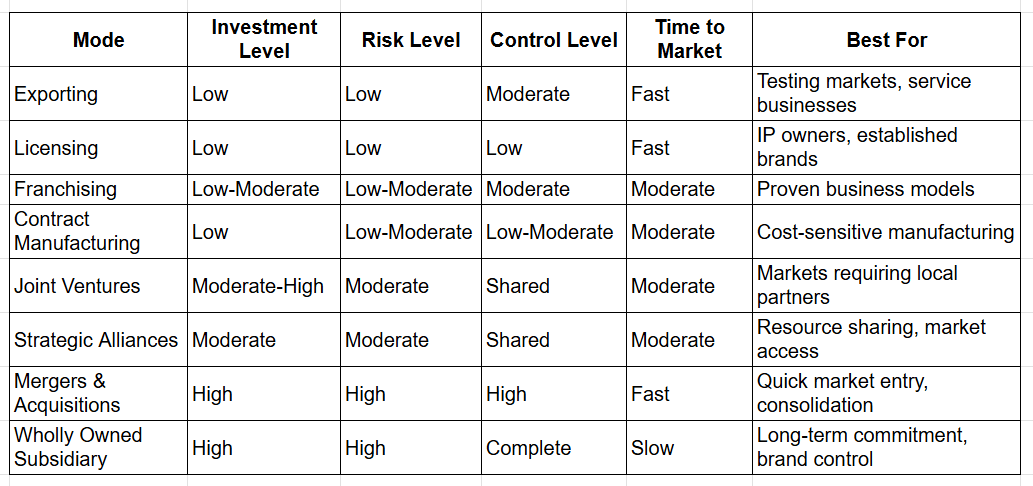
Let's break down what each mode actually involves:
Exporting is the simplest way to start selling internationally. You produce goods or deliver services in your home country and sell them to customers abroad. This can be direct (selling straight to foreign customers) or indirect (working through distributors or agents).
For instance, an Indian textile manufacturer can export fabrics to buyers in the UK through an export agent who handles logistics and customs. Or a software company can sell directly to clients in Singapore through online channels.
The main advantage is low financial risk since you don't need to set up physical operations abroad. You can test markets without major commitments. But you have limited control over how products are marketed and sold in foreign markets, and you depend on intermediaries or your own limited presence.
Licensing means you grant a foreign company the right to use your intellectual property (IP), technology, or brand in exchange for royalty payments. The licensee produces and sells using your IP while you collect fees.
For example, an Indian pharmaceutical company can license its drug formulation to a European manufacturer who produces and distributes it locally. You earn revenue without setting up manufacturing facilities abroad.
This mode works well when you have valuable IP but lack resources to operate internationally. Risks include less quality control and potential IP theft if contracts aren't solid. But you earn passive income with minimal investment.
Franchising is similar to licensing but involves transferring an entire business model, not just IP. The franchisee pays fees and royalties to operate under your brand using your systems, processes, and support.
For instance, an Indian restaurant chain can franchise locations in Dubai, where franchisees run outlets following the brand's recipes, service standards, and operational procedures. You expand your brand internationally while franchisees invest their capital and take operational risks.
This works best when you have a proven, replicable business model. You maintain more control than licensing through strict operational guidelines, but success depends on finding committed franchisees who execute well.
Contract manufacturing involves hiring a foreign manufacturer to produce your products according to your specifications. You own the design and brand, but outsource production to reduce costs or access specialized capabilities.
For example, an Indian electronics brand can contract with a manufacturer in Vietnam to produce components or finished products at lower costs. You focus on design, marketing, and distribution while the contractor handles production.
This mode reduces capital requirements for manufacturing infrastructure. But you need strong quality control systems and face risks around intellectual property protection and dependency on the contractor.
Joint ventures involve partnering with a foreign company to create a new, shared business entity. Both parties contribute capital, resources, and expertise, and share profits, losses, and control.
For instance, an Indian automotive parts manufacturer can form a 50-50 joint venture with a German company to manufacture and sell products in Europe. Both bring different strengths: local market knowledge versus technical expertise.
Joint ventures work well in markets with foreign ownership restrictions or where local partners provide critical market access. You share risks and costs, but decision-making requires alignment between partners, and conflicts can arise over strategy or profit distribution.
Strategic alliances are partnerships where companies collaborate without creating a new joint entity. Partners share resources, technology, or market access while remaining independent businesses.
For example, an Indian cloud services company can form an alliance with a Japanese IT consulting firm to jointly bid on enterprise projects, combining technical capabilities with local client relationships. Both companies benefit without merging or forming a separate venture.
This mode offers flexibility since it's less formal than joint ventures. You can access complementary resources and markets quickly. But success depends on trust and clear agreements, since there's no unified ownership structure to enforce decisions.
Mergers and acquisitions involve buying or merging with an existing foreign company to instantly gain market presence, customers, assets, and local expertise.
For instance, an Indian e-commerce company can acquire a smaller competitor in Southeast Asia to immediately access their customer base, logistics network, and local market knowledge. You skip the slow process of building from scratch.
Mergers and acquisitions deliver speed and established operations, but require significant capital and come with integration challenges. You inherit the acquired company's culture, systems, and potential problems, and deals can fail if integration isn't managed well.
Wholly owned subsidiaries mean establishing a 100% owned operation in a foreign country. You can do this through greenfield investment (building new facilities from scratch) or through acquisition (buying an existing company).
For example, an Indian software services firm can open a wholly owned office in the US to serve American clients directly. You have complete control over operations, branding, hiring, and strategy.
This mode offers maximum control and profit retention, but requires the highest investment and carries the most risk. You're fully responsible for compliance, hiring, operations, and success in an unfamiliar market. It works best when you need tight control and have resources for long-term commitment.
Different entry modes offer distinct advantages depending on your business situation and goals. Here are the key benefits across various modes:
Choosing your entry mode requires evaluating several factors specific to your situation. Your decision affects everything from upfront investment to ongoing operational control, so pick carefully based on your actual capabilities and goals.
Here's what to consider:
For instance, many Indian software companies start by exporting services to US clients, then open sales offices abroad, and eventually establish full subsidiaries with local teams. They scale their commitment as they gain confidence and market share.
Whichever mode you choose, you need a payment infrastructure to collect from international customers. Without reliable ways to accept payments in multiple currencies and jurisdictions, even the best entry strategy fails at the most critical step.
You've picked your international business model. Now you need a payment infrastructure that actually works across borders.
Whether you're exporting services, licensing IP, running franchises abroad, or operating subsidiaries, you face the same fundamental challenge: collecting payments from international customers and getting that money back to India smoothly. Manual processes, high fees, and payment failures slow you down and cost you revenue.
PayGlocal provides the complete payment stack for businesses operating internationally:
PayGlocal handles the payment complexity so you can focus on executing your international business strategy. Whether you're starting with simple exports or scaling to wholly owned operations, you have the infrastructure to collect reliably from day one.
Choosing the right mode of international business sets the foundation for your global expansion. Each entry strategy offers different balances of risk, investment, and control, from low-commitment exporting to fully owned subsidiaries.
Your ideal mode depends on your resources, industry, target markets, and how much control you need over operations. Most businesses start with simpler modes and scale to higher-commitment strategies as they learn markets and grow revenue. The important thing is starting with a clear understanding of what each mode involves.
Ready to expand globally with a reliable payment infrastructure? Get started with PayGlocal today and scale your business internationally.
But growth depends on choosing an entry mode that fits your resources and goals. Some businesses start with simple exports, while others establish joint ventures or wholly owned subsidiaries abroad. Each approach involves different levels of investment, risk, and control.
In this guide, we break down the main modes of international business, what each one involves, and how to select the best fit for your situation. Let’s get started.
Key takeaways
- Entry modes are your market strategy: They range from low-commitment exporting to full ownership through subsidiaries.
- Risk and control trade-off exists: Lower-risk modes give less control, higher-investment options offer maximum control but require more capital.
- Eight main strategies available: Exporting, licensing, franchising, contract manufacturing, joint ventures, strategic alliances, M&A, and wholly owned subsidiaries.
- Choose based on your situation: Your budget, industry, target market, risk tolerance, and control needs determine the right mode.
- Payment infrastructure enables growth: PayGlocal provides multi-currency infrastructure to support any entry strategy you choose.
What is meant by modes of international business?
Modes of international business are the different strategies companies use to enter and operate in foreign markets. They're your options for doing business beyond your home country's borders.
Each mode represents a different level of involvement, from simply shipping products abroad to setting up fully owned operations in another country. The mode you pick determines how much money you invest, what risks you face, and how much control you keep over your brand and operations.
The right mode depends on your business type, budget, target market, and growth goals. Some businesses need tight control over quality and branding, while others prefer to share risks and leverage local partners' market knowledge.
What are the main modes of international business?
When you're planning to enter international markets, you have several strategic options. Each mode sits on a spectrum of risk, investment, and control. Here's a quick comparison of the main entry modes:
Let's break down what each mode actually involves:
1. Exporting and importing
Exporting is the simplest way to start selling internationally. You produce goods or deliver services in your home country and sell them to customers abroad. This can be direct (selling straight to foreign customers) or indirect (working through distributors or agents).
For instance, an Indian textile manufacturer can export fabrics to buyers in the UK through an export agent who handles logistics and customs. Or a software company can sell directly to clients in Singapore through online channels.
The main advantage is low financial risk since you don't need to set up physical operations abroad. You can test markets without major commitments. But you have limited control over how products are marketed and sold in foreign markets, and you depend on intermediaries or your own limited presence.
2. Licensing
Licensing means you grant a foreign company the right to use your intellectual property (IP), technology, or brand in exchange for royalty payments. The licensee produces and sells using your IP while you collect fees.
For example, an Indian pharmaceutical company can license its drug formulation to a European manufacturer who produces and distributes it locally. You earn revenue without setting up manufacturing facilities abroad.
This mode works well when you have valuable IP but lack resources to operate internationally. Risks include less quality control and potential IP theft if contracts aren't solid. But you earn passive income with minimal investment.
3. Franchising
Franchising is similar to licensing but involves transferring an entire business model, not just IP. The franchisee pays fees and royalties to operate under your brand using your systems, processes, and support.
For instance, an Indian restaurant chain can franchise locations in Dubai, where franchisees run outlets following the brand's recipes, service standards, and operational procedures. You expand your brand internationally while franchisees invest their capital and take operational risks.
This works best when you have a proven, replicable business model. You maintain more control than licensing through strict operational guidelines, but success depends on finding committed franchisees who execute well.
4. Contract manufacturing
Contract manufacturing involves hiring a foreign manufacturer to produce your products according to your specifications. You own the design and brand, but outsource production to reduce costs or access specialized capabilities.
For example, an Indian electronics brand can contract with a manufacturer in Vietnam to produce components or finished products at lower costs. You focus on design, marketing, and distribution while the contractor handles production.
This mode reduces capital requirements for manufacturing infrastructure. But you need strong quality control systems and face risks around intellectual property protection and dependency on the contractor.
5. Joint ventures
Joint ventures involve partnering with a foreign company to create a new, shared business entity. Both parties contribute capital, resources, and expertise, and share profits, losses, and control.
For instance, an Indian automotive parts manufacturer can form a 50-50 joint venture with a German company to manufacture and sell products in Europe. Both bring different strengths: local market knowledge versus technical expertise.
Joint ventures work well in markets with foreign ownership restrictions or where local partners provide critical market access. You share risks and costs, but decision-making requires alignment between partners, and conflicts can arise over strategy or profit distribution.
6. Strategic alliances
Strategic alliances are partnerships where companies collaborate without creating a new joint entity. Partners share resources, technology, or market access while remaining independent businesses.
For example, an Indian cloud services company can form an alliance with a Japanese IT consulting firm to jointly bid on enterprise projects, combining technical capabilities with local client relationships. Both companies benefit without merging or forming a separate venture.
This mode offers flexibility since it's less formal than joint ventures. You can access complementary resources and markets quickly. But success depends on trust and clear agreements, since there's no unified ownership structure to enforce decisions.
7. Mergers and acquisitions
Mergers and acquisitions involve buying or merging with an existing foreign company to instantly gain market presence, customers, assets, and local expertise.
For instance, an Indian e-commerce company can acquire a smaller competitor in Southeast Asia to immediately access their customer base, logistics network, and local market knowledge. You skip the slow process of building from scratch.
Mergers and acquisitions deliver speed and established operations, but require significant capital and come with integration challenges. You inherit the acquired company's culture, systems, and potential problems, and deals can fail if integration isn't managed well.
8. Wholly owned subsidiaries
Wholly owned subsidiaries mean establishing a 100% owned operation in a foreign country. You can do this through greenfield investment (building new facilities from scratch) or through acquisition (buying an existing company).
For example, an Indian software services firm can open a wholly owned office in the US to serve American clients directly. You have complete control over operations, branding, hiring, and strategy.
This mode offers maximum control and profit retention, but requires the highest investment and carries the most risk. You're fully responsible for compliance, hiring, operations, and success in an unfamiliar market. It works best when you need tight control and have resources for long-term commitment.
What are the benefits of different modes of international business?
Different entry modes offer distinct advantages depending on your business situation and goals. Here are the key benefits across various modes:
- Lower-risk market testing: You can enter new markets with minimal financial commitment and test demand without heavy infrastructure investment.
- Faster market entry: You leverage existing businesses, partners, or networks to start operations and generate revenue quickly.
- Shared costs and risks: You distribute financial burdens and operational risks between partners while accessing complementary resources.
- Access to local knowledge: You gain market insights, regulatory expertise, and established relationships that take years to develop independently.
- Revenue without operations: You generate income from intellectual property or business models without managing foreign operations directly.
- Maximum control and profits: You maintain complete authority over operations, quality, branding, and customer experience with full profit retention.
How do you choose the right mode for your business?
Choosing your entry mode requires evaluating several factors specific to your situation. Your decision affects everything from upfront investment to ongoing operational control, so pick carefully based on your actual capabilities and goals.
Here's what to consider:
- Available capital and resources: Match your financial capacity to the mode's investment requirements, from low-cost exporting to capital-intensive subsidiaries.
- Industry and product type: Consider whether your services export easily or products need local assembly, and check if regulations require specific entry approaches.
- Target market conditions: Review foreign ownership restrictions, tariffs, local competition, and regulatory requirements before committing to a mode.
- Control requirements: Determine how much authority you need over brand consistency, quality standards, and customer experience delivery.
- Long-term goals: Decide if you're testing markets or building a permanent presence, then choose a mode that aligns with your timeline.
- Risk tolerance: Evaluate how much financial exposure and operational uncertainty you can handle based on your business stability.
For instance, many Indian software companies start by exporting services to US clients, then open sales offices abroad, and eventually establish full subsidiaries with local teams. They scale their commitment as they gain confidence and market share.
Whichever mode you choose, you need a payment infrastructure to collect from international customers. Without reliable ways to accept payments in multiple currencies and jurisdictions, even the best entry strategy fails at the most critical step.
Get paid globally and scale faster with PayGlocal
You've picked your international business model. Now you need a payment infrastructure that actually works across borders.
Whether you're exporting services, licensing IP, running franchises abroad, or operating subsidiaries, you face the same fundamental challenge: collecting payments from international customers and getting that money back to India smoothly. Manual processes, high fees, and payment failures slow you down and cost you revenue.
PayGlocal provides the complete payment stack for businesses operating internationally:
- Multi-currency accounts: Collect payments locally in USD, GBP, EUR, and CAD, making it easy for international customers to pay you.
- Global payment methods: Accept 40+ local payment options across 180+ countries so customers can use their preferred methods.
- Recurring payments: Set up subscriptions and recurring billing for SaaS businesses, licensing agreements, or ongoing service contracts.
- Automatic compliance: Receive FIRC (Foreign Inward Remittance Certificate) documentation automatically on settlement, keeping forex compliance clean without manual paperwork.
- Zero fixed costs: Pay only transaction fees when you collect payments, with no setup charges or monthly platform fees.
PayGlocal handles the payment complexity so you can focus on executing your international business strategy. Whether you're starting with simple exports or scaling to wholly owned operations, you have the infrastructure to collect reliably from day one.
Final thoughts
Choosing the right mode of international business sets the foundation for your global expansion. Each entry strategy offers different balances of risk, investment, and control, from low-commitment exporting to fully owned subsidiaries.
Your ideal mode depends on your resources, industry, target markets, and how much control you need over operations. Most businesses start with simpler modes and scale to higher-commitment strategies as they learn markets and grow revenue. The important thing is starting with a clear understanding of what each mode involves.
Ready to expand globally with a reliable payment infrastructure? Get started with PayGlocal today and scale your business internationally.