

Your report shows strong gains on international holdings, but after you convert everything back to rupees, the actual profit is much lower. You're left explaining to stakeholders why the numbers don't match their expectations.
Multi-currency investment reporting fixes this by tracking investment performance separately from exchange rate effects. With Indian investments reaching 34.8% of India's GDP and more portfolios expanding globally, proper reporting shows you which returns came from smart picks rather than just currency swings.
Multi-currency investment reporting is the process of tracking, valuing, and consolidating investment portfolios that hold assets in different currencies.
When you manage investments across global markets, each asset is denominated in its local currency, like USD for US stocks, EUR for European bonds, or GBP for UK property funds. The reporting process converts and consolidates these holdings into a single base currency so you can see total portfolio value and make informed decisions.
This involves more than simple currency conversion. You need to track original transaction amounts, apply appropriate exchange rates at different points in time, account for currency gains or losses separately from investment returns, and present everything in a clear format.
For example, if you hold a US stock portfolio worth $500,000 and European bonds worth €300,000, your report will track their growth in their native currencies but also show their total value in INR. This prevents a false positive where a stock might be up in USD, but down in INR due to a strengthening Rupee.
Accurate multi-currency reporting is essential because without it, you won't know the real current value of your portfolio. You won't be able to track whether your returns came from good investments or just currency movements. Here's why getting this right matters for your business:
The difference between good and poor multi-currency reporting often shows up during market volatility. When currencies swing, you need immediate clarity on how those movements affect your portfolio value and whether you need to take action.
Multi-currency reporting is like a translation service for your money. It takes a messy pile of different currencies and turns them into one clear story. Here is the typical step-by-step workflow:
Tip: The quality of your multi-currency reporting depends heavily on the quality of your transaction data. Using payment platforms that provide detailed currency tracking and transparent rate information from the collection stage reduces manual work and improves reporting accuracy downstream.
Currency exposure is the risk that exchange rate movements will change your portfolio’s value, regardless of how the underlying investments perform. When you invest internationally, your returns are the sum of two distinct forces: the asset’s performance and the currency’s movement against your base currency (like INR).
This dual exposure can help or hurt you. For example, if you hold US stocks and the USD strengthens against the INR, your portfolio value increases in Rupee terms, even if the stocks themselves remain flat. If European stocks gain 5% in EUR but the euro weakens 3% against INR, your actual return drops to about 2% in rupee terms.
Here are the main types of currency exposure:
Once you know about which type of currency exposure affects your portfolio, you need strategies to manage it based on risk tolerance and investment goals.
Currency movements can wipe out gains from solid investment decisions if you don't actively manage exposure. A portfolio that performed well in local currency terms can show losses when converted to your base currency. Here are some effective strategies for managing currency risk:
For example, you agree to buy a US stock at $100 when the rate is ₹91.00. By the time the trade settles 48 hours later, the rate hits ₹92.50. Without a hedge or a fast settlement system, you just paid an extra ₹150 per share purely due to a "timing leak."
The key is making conscious decisions about which exposures to keep and which to hedge, then reporting those decisions clearly to stakeholders.
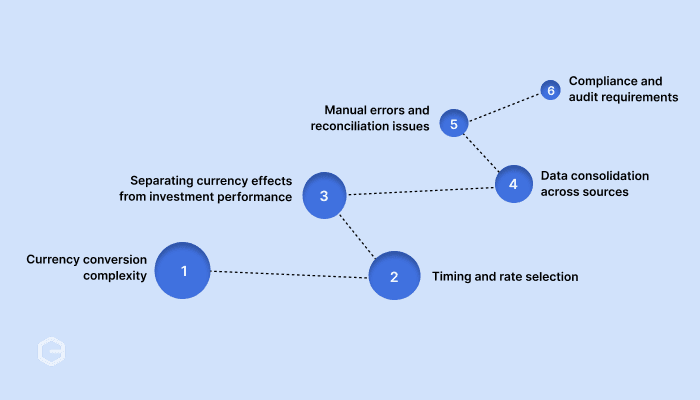
Even experienced finance teams can struggle with multi-currency investment reporting. The challenges go beyond simple math and affect accuracy, efficiency, and the quality of decision-making. Here are the main challenges you will face:
These challenges are the reasons why many firms struggle with multi-currency reporting despite having advanced investment tools. The solution is not just better spreadsheets but rethinking how you capture, convert, and consolidate currency data from the transaction stage forward.
Following proven practices for multi-currency reporting can save you from costly errors and give stakeholders confidence in your numbers. Whether you're managing a small portfolio or a large fund, these practices keep your data clean and your strategy on track:
Good reporting requires discipline, but it doesn't have to require a lot of manual labor. The right systems can automate these best practices, letting you focus on making the next big investment move.
Multi-currency investment reporting carries specific compliance obligations that vary by jurisdiction and investor type. While requirements differ globally, several common themes apply to most investment managers handling multi-currency portfolios.
Here are the key compliance areas you need to address.
The specific requirements that apply to your situation depend on factors like your fund structure, investor types, domicile jurisdiction, and the markets you invest in. Consult with compliance professionals familiar with your specific regulatory environment to ensure you meet all applicable requirements.
Note: Compliance requirements change regularly as regulations evolve. Build flexibility into your reporting systems so you can adapt to new requirements without rebuilding your entire infrastructure.
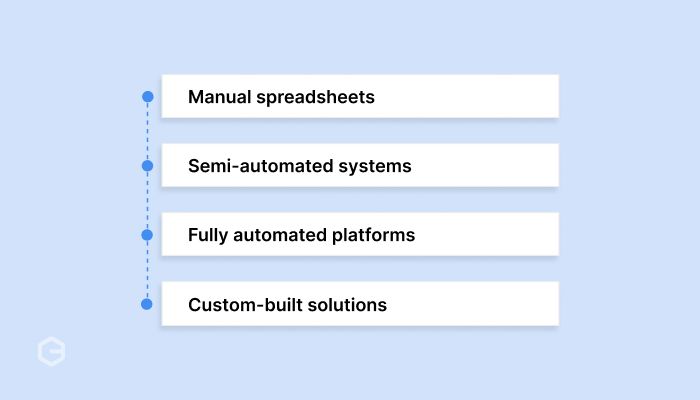
When choosing how to track your global investments, there is no one-size-fits-all answer. The right way usually depends on how many transactions you handle and how much time you’re willing to spend on math vs. strategy.
Here is a breakdown of the most common ways businesses handle their multi-currency reporting:
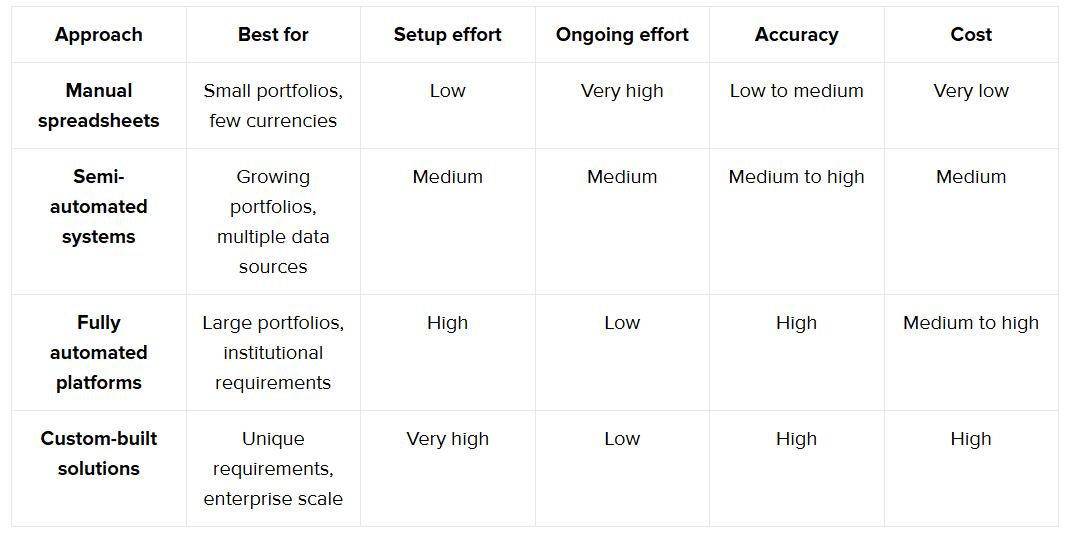
Tip: The right approach depends on portfolio complexity, growth trajectory, and whether you view reporting as a cost center or value driver. Many managers start with spreadsheets, migrate to semi-automated systems as they grow, and eventually adopt fully automated platforms when scale demands it.
Choosing the right multi-currency reporting solution can make the difference between spending hours on manual consolidation and having instant access to accurate portfolio views. Here are the essential features that actually matter in day-to-day use.
A great reporting tool doesn't just do the math; it gives you confidence. It ensures that when you present a report to your board or an auditor, you know the numbers are accurate, consistent, and tell the true story of your global performance.
Multi-currency investment reporting is only as good as the data you start with. If your collection process is messy, your reports will be too. PayGlocal simplifies the entire journey by making sure your currency data is clean, compliant, and easy to track from the second a payment is made.
Here’s how PayGlocal helps investment managers and finance teams stay ahead:
When your currency collection is organized and transparent from the transaction level, your reporting becomes faster and more accurate. You spend less time chasing down exchange rate information or reconciling unclear transactions and more time analyzing portfolio performance.
Multi-currency investment reporting is complex, but it does not have to be chaotic. The right approach combines consistent conversion methods, proper separation of currency effects from investment performance, and systems that give you accurate data without manual work.
Your reporting quality depends on having clean currency data from the transaction stage through final consolidation. When you get that foundation right, you can focus on analysis and decision-making instead of wrestling with spreadsheets and currency lookups.
If you manage investments across currencies and want to simplify how you collect and track international funds, the right payment infrastructure makes a measurable difference. Clean data at the source means better reports downstream.
Get started with PayGlocal to bring transparency and accuracy to your multi-currency payment processes.
Multi-currency investment reporting fixes this by tracking investment performance separately from exchange rate effects. With Indian investments reaching 34.8% of India's GDP and more portfolios expanding globally, proper reporting shows you which returns came from smart picks rather than just currency swings.
Key takeaways
- Track in local and base currency: Multi-currency investment reporting requires tracking assets in both their original currency and your chosen base currency for accurate consolidated views.
- Currency fluctuations affect returns: Exchange rate movements can significantly impact reported performance, making proper currency exposure tracking essential for true portfolio analysis.
- Automation reduces errors: Manual currency conversions and consolidations are time-consuming and prone to mistakes that can distort investment performance.
- Real-time rates improve accuracy: Access to current exchange rate data helps you generate reports that reflect actual market conditions rather than outdated valuations.
- Payment platforms can simplify reporting: Using solutions like PayGlocal that handle multi-currency collection and provide transparent tracking can reduce manual work and improve reporting accuracy from the transaction level.
What is multi-currency investment reporting?
Multi-currency investment reporting is the process of tracking, valuing, and consolidating investment portfolios that hold assets in different currencies.
When you manage investments across global markets, each asset is denominated in its local currency, like USD for US stocks, EUR for European bonds, or GBP for UK property funds. The reporting process converts and consolidates these holdings into a single base currency so you can see total portfolio value and make informed decisions.
This involves more than simple currency conversion. You need to track original transaction amounts, apply appropriate exchange rates at different points in time, account for currency gains or losses separately from investment returns, and present everything in a clear format.
For example, if you hold a US stock portfolio worth $500,000 and European bonds worth €300,000, your report will track their growth in their native currencies but also show their total value in INR. This prevents a false positive where a stock might be up in USD, but down in INR due to a strengthening Rupee.
Why multi-currency investment reporting matters?
Accurate multi-currency reporting is essential because without it, you won't know the real current value of your portfolio. You won't be able to track whether your returns came from good investments or just currency movements. Here's why getting this right matters for your business:
- True performance measurement: Investment returns look very different when you account for currency fluctuations. For instance, a fund that gained 10% in local currency might show only 5% in your base currency if exchange rates moved against you. Proper reporting separates these effects so you understand actual performance.
- Better investment decisions: When you can see consolidated positions and currency exposure clearly, you make smarter allocation decisions. You can identify when you are overexposed to certain currencies or when hedging makes sense.
- Client confidence and transparency: Investors want to know exactly how their money is performing. Multi-currency reports that clearly show both local and converted values build trust and make client conversations easier.
- Regulatory compliance: Many jurisdictions require specific reporting standards for multi-currency portfolios. Having proper reporting systems in place keeps you compliant and audit-ready.
- Operational efficiency: Manual currency conversions and consolidations eat up valuable time. Automated multi-currency reporting frees your team to focus on analysis and client relationships instead of spreadsheet work.
The difference between good and poor multi-currency reporting often shows up during market volatility. When currencies swing, you need immediate clarity on how those movements affect your portfolio value and whether you need to take action.
How does multi-currency investment reporting work?
Multi-currency reporting is like a translation service for your money. It takes a messy pile of different currencies and turns them into one clear story. Here is the typical step-by-step workflow:
- Track assets in original currencies: First, you record every investment in its home currency (like USD for Apple stocks). This is crucial because it preserves the actual price you paid before any exchange rates get involved.
- Apply exchange rates for conversion: You then convert those values into your base currency (like INR). You'll use different rates depending on what you're checking, like the price on the day you bought it vs. what's it's worth right now.
- Calculate currency gains and losses: This is where you separate your wins. You calculate how much profit came from the investment itself and how much came from the currency moving in your favor. This stops the exchange rate from hiding your true performance.
- Consolidate into unified reports: Finally, all those different assets are gathered into one single dashboard. You can see your total net worth in one currency, even if your money is spread across ten different countries.
- Generate performance and exposure analysis: The last step is seeing where you're most exposed. Use consolidated data to calculate overall returns, currency exposure percentages, and risk metrics. If 90% of your global wealth is in USD, you'll know exactly how much a drop in the dollar will hurt your bottom line.
Tip: The quality of your multi-currency reporting depends heavily on the quality of your transaction data. Using payment platforms that provide detailed currency tracking and transparent rate information from the collection stage reduces manual work and improves reporting accuracy downstream.
How does currency exposure affect investment portfolios?
Currency exposure is the risk that exchange rate movements will change your portfolio’s value, regardless of how the underlying investments perform. When you invest internationally, your returns are the sum of two distinct forces: the asset’s performance and the currency’s movement against your base currency (like INR).
This dual exposure can help or hurt you. For example, if you hold US stocks and the USD strengthens against the INR, your portfolio value increases in Rupee terms, even if the stocks themselves remain flat. If European stocks gain 5% in EUR but the euro weakens 3% against INR, your actual return drops to about 2% in rupee terms.
Here are the main types of currency exposure:
- Transaction exposure: Exchange rates change between when you commit to a trade and when you settle it, affecting the actual cash you pay or receive.
- Economic exposure: Currency movements affect your total portfolio value over time, with large currency positions creating a significant impact on overall returns.
- Translation exposure: When you convert foreign subsidiary financial statements into your reporting currency, exchange rate changes affect the reported book value even though no actual transaction occurred.
Once you know about which type of currency exposure affects your portfolio, you need strategies to manage it based on risk tolerance and investment goals.
How can you manage currency risk in multi-currency portfolios?
Currency movements can wipe out gains from solid investment decisions if you don't actively manage exposure. A portfolio that performed well in local currency terms can show losses when converted to your base currency. Here are some effective strategies for managing currency risk:
- Natural diversification: Holding assets across multiple currencies reduces the impact any single currency movement has on your total portfolio value.
- Active hedging: Using forward contracts or currency options protects against adverse movements but costs money and prevents you from benefiting if rates move favorably.
- Selective hedging approach: Many managers hedge their largest currency exposures while accepting smaller ones as part of portfolio diversification.
For example, you agree to buy a US stock at $100 when the rate is ₹91.00. By the time the trade settles 48 hours later, the rate hits ₹92.50. Without a hedge or a fast settlement system, you just paid an extra ₹150 per share purely due to a "timing leak."
The key is making conscious decisions about which exposures to keep and which to hedge, then reporting those decisions clearly to stakeholders.
What are the key challenges in multi-currency investment reporting?
Even experienced finance teams can struggle with multi-currency investment reporting. The challenges go beyond simple math and affect accuracy, efficiency, and the quality of decision-making. Here are the main challenges you will face:
- Currency conversion complexity: Choosing between spot rates, average rates, or historical rates affects your reported values differently, and many systems require multiple views simultaneously.
- Timing and rate selection: Exchange rates change constantly throughout the day, and using different rates for morning versus afternoon transactions or month-end versus transaction-date conversions produces different results.
- Separating currency effects from investment performance: Breaking down how much return came from the asset appreciating versus favorable currency movement requires tracking both local currency returns and exchange rate impacts separately.
- Data consolidation across sources: Investment data comes from multiple custodians and brokers with inconsistent formats, different rate sources, and varying detail levels that must be reconciled.
- Manual errors and reconciliation issues: Spreadsheet-based reporting is prone to formula errors, copy-paste mistakes, and outdated exchange rates that compound across dozens or hundreds of positions.
- Compliance and audit requirements: Different regulatory frameworks require specific reporting methods, currency hedging disclosures, and exposure limit calculations that must remain consistent across periods.
These challenges are the reasons why many firms struggle with multi-currency reporting despite having advanced investment tools. The solution is not just better spreadsheets but rethinking how you capture, convert, and consolidate currency data from the transaction stage forward.
What are the best practices for multi-currency investment reporting?
Following proven practices for multi-currency reporting can save you from costly errors and give stakeholders confidence in your numbers. Whether you're managing a small portfolio or a large fund, these practices keep your data clean and your strategy on track:
- Establish one base currency for all reporting: Choose a single base currency for your primary reports and stick to it consistently across all periods.
- Use real-time or near-real-time exchange rates: Set up systems that pull current rates automatically throughout the day to avoid distorted valuations from stale data.
- Separate currency effects from investment returns: Always break down returns into the portion from actual investment performance and the portion from currency movements.
- Reconcile positions regularly: Set a monthly schedule for reconciling your multi-currency positions against source data from custodians and brokers.
- Review currency exposure limits: Establish maximum exposure limits for each currency and monitor these limits regularly to stay within risk tolerance.
Good reporting requires discipline, but it doesn't have to require a lot of manual labor. The right systems can automate these best practices, letting you focus on making the next big investment move.
What compliance requirements apply to multi-currency investment reporting?
Multi-currency investment reporting carries specific compliance obligations that vary by jurisdiction and investor type. While requirements differ globally, several common themes apply to most investment managers handling multi-currency portfolios.
Here are the key compliance areas you need to address.
- Document your conversion methodology clearly: Write down which exchange rates you use for different purposes and make this documentation available to auditors and regulators.
- Maintain detailed audit trails: Keep records of every exchange rate you apply to every transaction with timestamps for traceability and regulatory examinations.
- Provide accurate valuations in multiple currencies: Show both local currency and base currency values in investor statements and regulatory filings as required by your jurisdiction.
- Report material currency gains and losses separately: Disclose significant gains or losses from currency movements during the reporting period in financial statements.
- Follow tax reporting requirements: Report capital gains and investment income using the specific exchange rate rules set by your local tax authority.
- Communicate currency risks clearly to clients: Show what percentage of the portfolio sits in each currency and how currency movements affected returns in plain language.
- Retain records for the required period: Keep all exchange rate data and supporting documentation for the timeframe mandated by your jurisdiction, typically several years.
The specific requirements that apply to your situation depend on factors like your fund structure, investor types, domicile jurisdiction, and the markets you invest in. Consult with compliance professionals familiar with your specific regulatory environment to ensure you meet all applicable requirements.
Note: Compliance requirements change regularly as regulations evolve. Build flexibility into your reporting systems so you can adapt to new requirements without rebuilding your entire infrastructure.
What are the different approaches to multi-currency investment reporting?
When choosing how to track your global investments, there is no one-size-fits-all answer. The right way usually depends on how many transactions you handle and how much time you’re willing to spend on math vs. strategy.
Here is a breakdown of the most common ways businesses handle their multi-currency reporting:
Tip: The right approach depends on portfolio complexity, growth trajectory, and whether you view reporting as a cost center or value driver. Many managers start with spreadsheets, migrate to semi-automated systems as they grow, and eventually adopt fully automated platforms when scale demands it.
What features should you look for in multi-currency reporting solutions?
Choosing the right multi-currency reporting solution can make the difference between spending hours on manual consolidation and having instant access to accurate portfolio views. Here are the essential features that actually matter in day-to-day use.
- Automated currency conversion and real-time rates: The system should pull exchange rates automatically throughout the day. If you have to type in a rate manually, the tool isn't doing its job.
- Multiple currency view options: You should be able to switch your entire portfolio view from INR to USD (or any other currency) with a single click. This is a lifesaver when you're on a call with an international partner.
- Separate tracking of currency gains and investment returns: Does the tool show you why you made money? Look for a side-by-side view that separates your investment gains from your currency gains.
- Consolidation across multiple sources: Your tool should be able to consolidate data from different brokers and banks and clean it up for you. You shouldn't have to copy-paste data from three different PDFs into one system.
- Audit trail and rate history: For audit and tax purposes, you need to be able to prove exactly which exchange rate you used on a specific Tuesday three years ago. Make sure the system keeps a permanent, unchangeable record.
- Customizable reporting templates: Different people want different views. Your tax auditor wants a technical breakdown; your investors want a simple summary. Look for a tool with templates that can be customized for both.
A great reporting tool doesn't just do the math; it gives you confidence. It ensures that when you present a report to your board or an auditor, you know the numbers are accurate, consistent, and tell the true story of your global performance.
Accept all multi-currency payments in one platform with PayGlocal
Multi-currency investment reporting is only as good as the data you start with. If your collection process is messy, your reports will be too. PayGlocal simplifies the entire journey by making sure your currency data is clean, compliant, and easy to track from the second a payment is made.
Here’s how PayGlocal helps investment managers and finance teams stay ahead:
- Multi-currency accounts: Collect payments in USD, GBP, EUR, and CAD through local accounts, making it easier for international clients to pay you and giving you clear records in each currency.
- Instant compliance documentation: Receive Foreign Inward Remittance Certificate (FIRC) automatically in your inbox after settlement, keeping your audit trail complete and your compliance requirements covered.
- Payment status notifications: Get real-time updates on fund status at every step, reducing reconciliation work and keeping your transaction records current.
- One platform for all currencies: View and manage all your multi-currency transactions from a single dashboard with downloadable records that integrate cleanly into your reporting workflows.
- Pay only when you transact: No monthly fees or setup costs, just transparent per-transaction pricing that scales with your business without adding fixed overhead.
When your currency collection is organized and transparent from the transaction level, your reporting becomes faster and more accurate. You spend less time chasing down exchange rate information or reconciling unclear transactions and more time analyzing portfolio performance.
Final Thoughts
Multi-currency investment reporting is complex, but it does not have to be chaotic. The right approach combines consistent conversion methods, proper separation of currency effects from investment performance, and systems that give you accurate data without manual work.
Your reporting quality depends on having clean currency data from the transaction stage through final consolidation. When you get that foundation right, you can focus on analysis and decision-making instead of wrestling with spreadsheets and currency lookups.
If you manage investments across currencies and want to simplify how you collect and track international funds, the right payment infrastructure makes a measurable difference. Clean data at the source means better reports downstream.
Get started with PayGlocal to bring transparency and accuracy to your multi-currency payment processes.