
A customer enters their card details on your checkout and clicks Pay.
What happens next?
The payment gateway securely passes the transaction into the payment-processing chain. But it does not, by itself, approve the card, move the money between banks or settle funds into your account.
Understanding where the gateway starts and stops makes it much easier to choose the right payment setup for your business.
What happens next?
The payment gateway securely passes the transaction into the payment-processing chain. But it does not, by itself, approve the card, move the money between banks or settle funds into your account.
Understanding where the gateway starts and stops makes it much easier to choose the right payment setup for your business.
TL;DR
- A payment gateway is the technology layer that routes and facilitates an online payment transaction; it does not itself handle merchant funds.
- The issuer ultimately approves or declines a card payment, while processors, acquirers and payment aggregators perform other parts of the transaction and settlement flow.
- Hosted, embedded and API-based checkouts are better understood as integration models, not completely different payment rails.
- For international payments, compare payment success, currencies/payment methods, fraud controls, settlement and regulatory coverage—not just the gateway fee.
Where does a payment gateway sit in the payment flow?
For a typical online card payment:
Customer → checkout → payment gateway → processor/acquirer → card network → issuer
Then the approval or decline travels back through the chain.
If approved, clearing and settlement happen through the relevant payment infrastructure afterward.
What the gateway does
A gateway can:
- securely capture payment information
- encrypt/transmit transaction data
- connect the checkout to payment-processing infrastructure
- return approval or decline responses
- support authentication and fraud tools depending on the integration
What the gateway does not do alone
A gateway does not independently:
- decide whether the issuer approves the card
- act as the customer's bank
- act as the merchant's acquiring bank
- guarantee settlement
- automatically perform currency conversion for every transaction
- eliminate a merchant's security/compliance responsibilities
This distinction matters because many providers bundle gateway, acquiring, payment aggregation, fraud screening and settlement under one commercial product.
Hosted, embedded or API: which integration model fits?
There is no single universal taxonomy for payment gateways, but three integration models are useful when comparing providers.
Hosted checkout
The customer is sent to a provider-hosted payment page.
Useful when: you want quicker integration and less direct handling of payment-page infrastructure.
Trade-off: less control over the end-to-end checkout experience.
Embedded checkout
Payment fields appear within the merchant's website or app while sensitive payment handling is managed through the provider's supported integration.
Useful when: checkout continuity and brand control matter.
Trade-off: implementation and security responsibilities depend on how the integration is designed.
API-based integration
The merchant uses APIs to create a more customised payment experience and connect payments deeply into its product stack.
Useful when: you have engineering resources and need greater control over checkout logic, payment flows and reporting.
Trade-off: more development and testing responsibility.
A mobile checkout is generally an implementation of one of these models rather than a separate category of gateway.
Payment gateway vs processor vs payment aggregator
| Layer | Primary job |
|---|---|
| Payment gateway | Routes/facilitates online payment information |
| Payment processor | Provides transaction-processing connectivity/functions |
| Acquirer | Merchant-side financial institution in card acceptance |
| Payment aggregator | Aggregates customer payments and settles merchants |
| Issuer | Customer's card-issuing bank; approves or declines |
One provider can perform or bundle several of these roles.
That is why comparing two products solely by asking, "Which gateway is cheaper?", can be misleading.
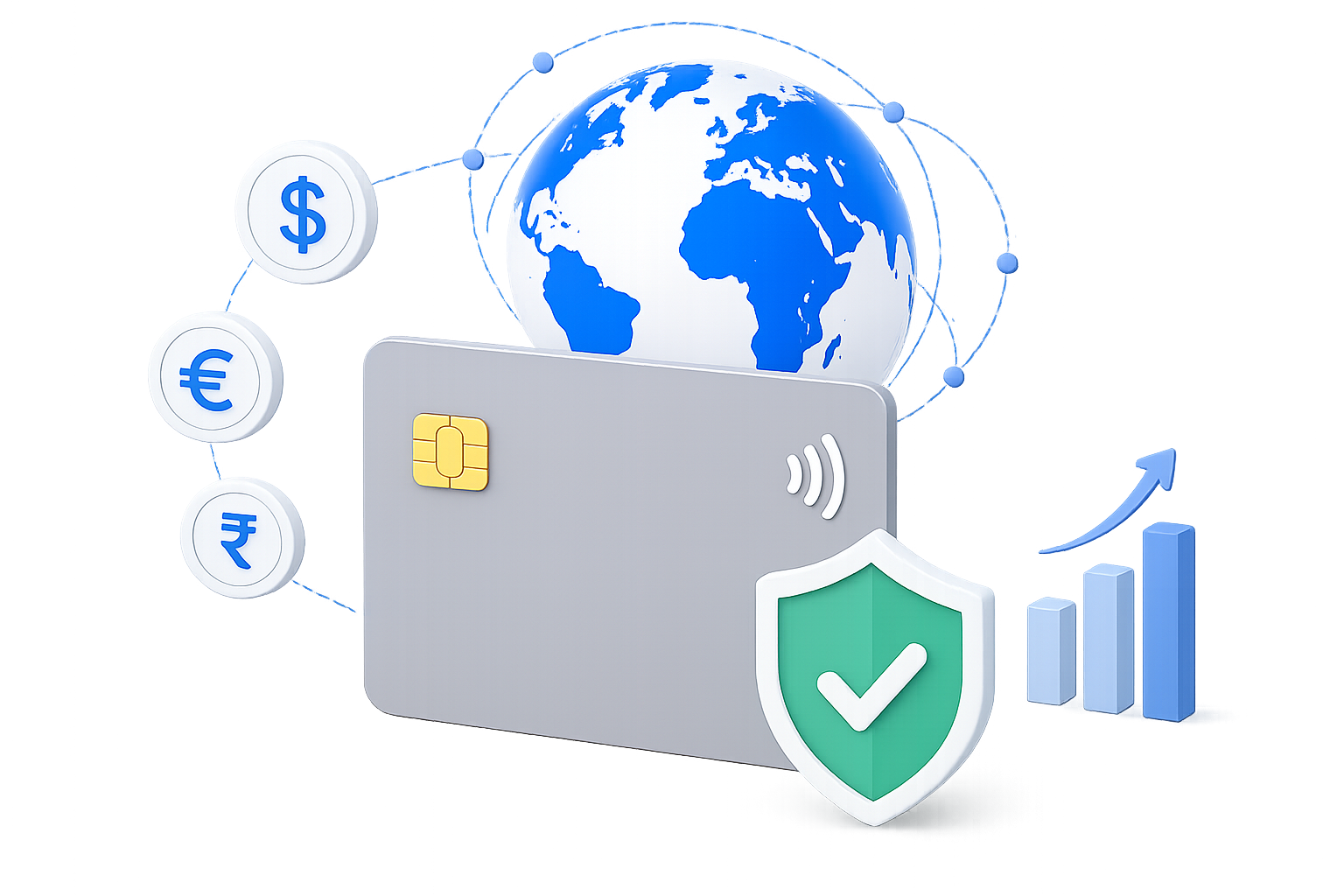
What changes for an international payment gateway?
Cross-border checkout adds more variables than a domestic transaction.
International issuer behaviour
A foreign-issued card may be treated differently based on issuer country, merchant location, authentication and risk signals.
Currency and localisation
Customers may convert better when they see familiar currencies and payment methods.
Fraud screening
Cross-border transactions can carry different fraud patterns, so screening should balance risk control with false-decline prevention.
Routing
A multi-acquirer or intelligent-routing setup can send transactions through different available routes based on payment and issuer conditions.
Settlement and compliance
For an Indian merchant, the provider must also support the appropriate cross-border payment and settlement framework. A gateway alone is not the regulatory collection layer.
What should you compare before choosing a payment gateway?
Use these six questions.
1. Which customers are paying you?
Domestic buyers, international buyers, or both?
2. Which methods do they expect?
Cards, wallets, UPI, bank methods or recurring payments?
3. How well do international cards succeed?
Look at approval/payment success performance, routing and authentication—not just supported-card logos.
4. How will you integrate?
Hosted page, embedded checkout, plugin or API?
5. What happens after approval?
Check settlement terms, refunds, chargebacks, reconciliation and reporting.
6. Who is the regulated payment entity?
For Indian merchants, understand whether the provider also operates through the applicable payment-aggregator authorisation for the payment flow.
Where PayGlocal fits
PayGlocal combines gateway technology with RBI-authorised payment aggregation for Indian businesses accepting global payments.
Its current international payment gateway includes:
- international cards
- Apple Pay and Google Pay
- alternate payment methods
- localised checkout
- intelligent routing
- 3DS optimisation
- real-time fraud scoring
- recurring payments
PayGlocal currently advertises up to 96% international payment success rate and INR settlement within 24 hours for its international payment-gateway offering.
The important distinction is that the gateway handles the checkout and transaction-routing layer, while PayGlocal's broader regulated payment infrastructure handles the collection and settlement flow.