
According to recent data, in the last decade, India’s export industry grew by 76% and services exports reached over twice their earlier level. Whether you're a freelancer getting paid by international clients or an e-commerce store expanding globally, you need a reliable way to collect money from customers anywhere in the world.
A payment gateway is the technology that makes this possible. It handles everything from security to currency conversion when customers pay you online. But with dozens of options available, choosing the right one can feel overwhelming.
In this guide, we break down everything you need to know about payment gateways, from how they work to choosing the right solution for your specific business needs. Let’s get started!
A payment gateway is a technology service that processes online payments between customers and businesses. When someone buys something online, the payment gateway handles the technical work, from verifying the payment method, checking for fraud, to moving money from the customer's account to yours.
Some of the best payment gateways in India include PayGlocal, Razorpay, and Paytm. Each offers different features, pricing, and specializations depending on your business needs.
The main difference between payment gateways and other payment tools is their role in the transaction flow. While payment processors handle the actual money movement and merchant accounts store the funds, payment gateways focus on the customer-facing experience and initial security checks.
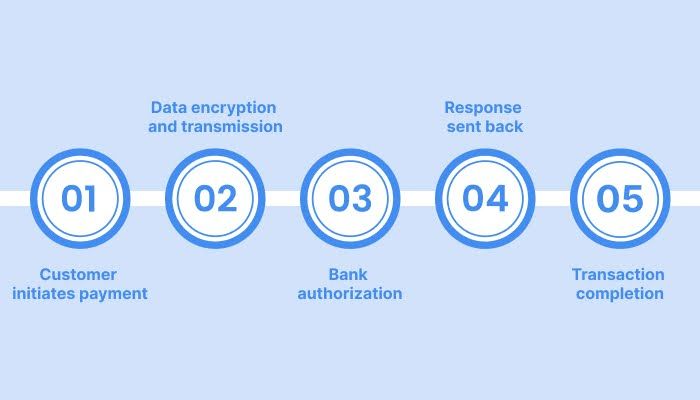
Payment gateway processing happens in just a few seconds but involves multiple processes. Here’s how it works:
Customer initiates payment: The customer enters payment details on your website or app checkout page.
Data encryption and transmission: The payment gateway encrypts the sensitive information and sends it to the payment processor.
Bank authorization: The processor forwards the request to the customer's bank, which checks if funds are available and the transaction is legitimate.
Response sent back: The bank sends an approval or decline message back through the same chain.
Transaction completion: If approved, the gateway displays a success message to the customer and initiates a fund transfer to your merchant account.
For instance, if someone in the US buys from your Indian business, the gateway handles currency conversion, international regulations, and ensures the payment reaches your account in INR.
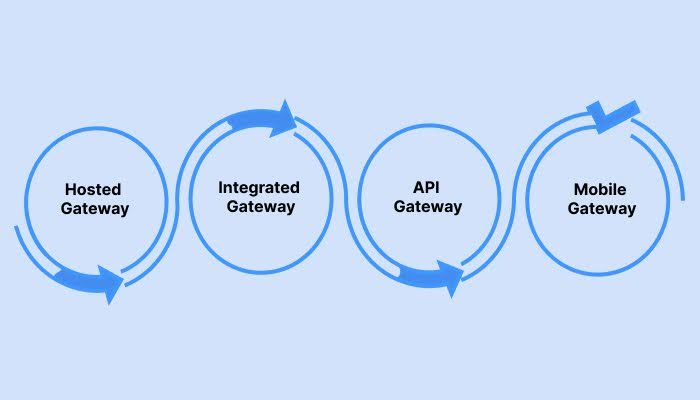
Different payment gateway types serve various business models and technical requirements. Here's how they compare:
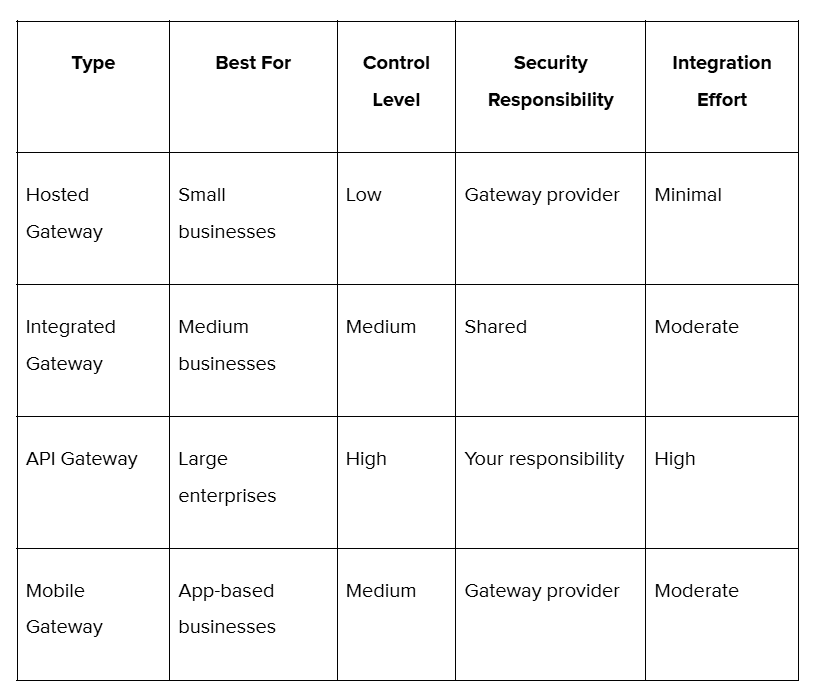
Each type offers different advantages depending on your business needs and technical capabilities.
Hosted payment gateways redirect customers to the gateway provider's secure page to complete payment. This reduces your security burden but gives you less control over the customer experience. PayPal and Razorpay's standard checkout are common examples.
Integrated payment gateways let customers pay directly on your website without leaving your page. This provides better branding control but requires you to meet higher security standards. Stripe's embedded checkout exemplifies this approach.
API-based payment gateways give developers complete control over the payment experience through programming interfaces. Large e-commerce platforms often use APIs to create custom checkout flows that match their brand perfectly. PayGlocal offers API-based integrations that let businesses build custom international payment experiences with multi-currency support.
Mobile payment gateways are optimized for smartphone transactions, supporting features like digital wallets and QR code payments. These work particularly well for businesses with significant mobile traffic.
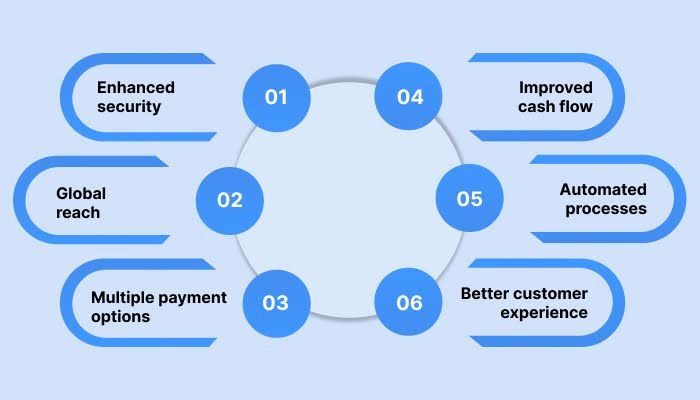
Payment gateways offer several advantages that can directly impact your revenue and customer satisfaction.
Enhanced security: Payment gateways use encryption and fraud detection to protect both you and your customers from data breaches and fraudulent transactions.
Global reach: Accept payments from customers worldwide without worrying about currency conversion or international banking complexities.
Multiple payment options: Support credit cards, debit cards, digital wallets, bank transfers, and local payment methods preferred by different customer segments.
Improved cash flow: Get faster access to your money compared to traditional bank transfers or checks, with many gateways offering next-day settlements.
Automated processes: Reduce manual work with automatic invoice generation, payment tracking, and reconciliation features.
Better customer experience: Provide smooth, professional checkout experiences that build trust and reduce cart abandonment.
Payment gateway pricing varies significantly based on your business size, transaction volume, and required features. Here's what you can expect:=
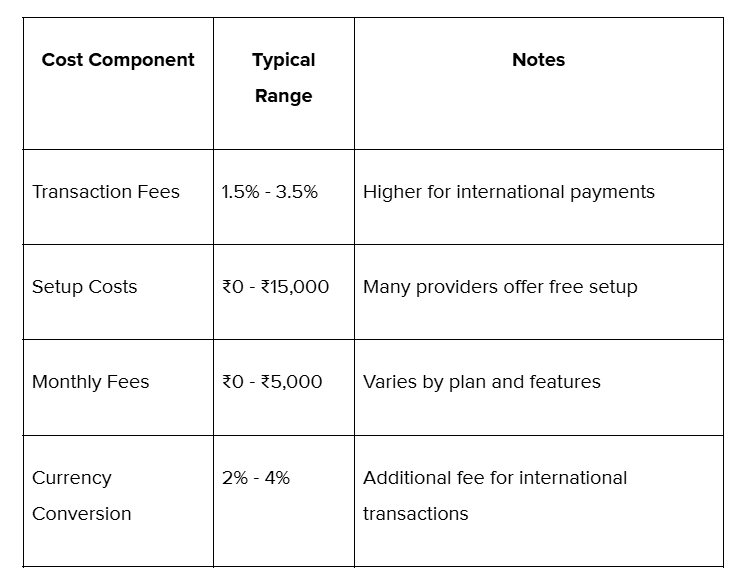
Consider these cost factors when evaluating different payment gateway options for your business.
Transaction fees: Typically range from 1.5% to 3.5% per transaction for domestic payments, with international payments often costing more.
Setup costs: Can include one-time integration fees, monthly subscription charges, or annual maintenance costs.
Additional charges: Might include currency conversion fees, chargeback handling fees, refund processing charges, and premium feature costs.
Hidden costs: To watch for include minimum transaction requirements, inactivity fees, early termination penalties, and charges for compliance documentation.
Tip: Before choosing a provider, calculate your total cost of ownership based on your expected transaction volume and average transaction size. A gateway with higher per-transaction fees might be cheaper overall if it has no monthly fees for low-volume businesses.
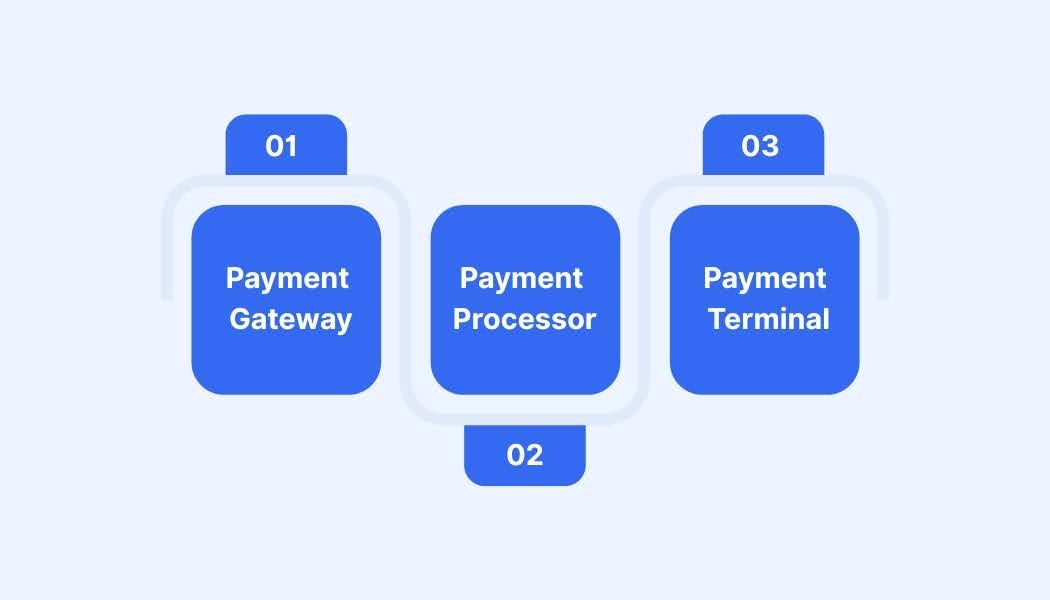
Payment gateways, processors, and terminals each play distinct roles in the payment ecosystem. While they often work together, knowing their differences helps you choose the right solutions for your business needs.
Here's how these payment components compare across key factors:
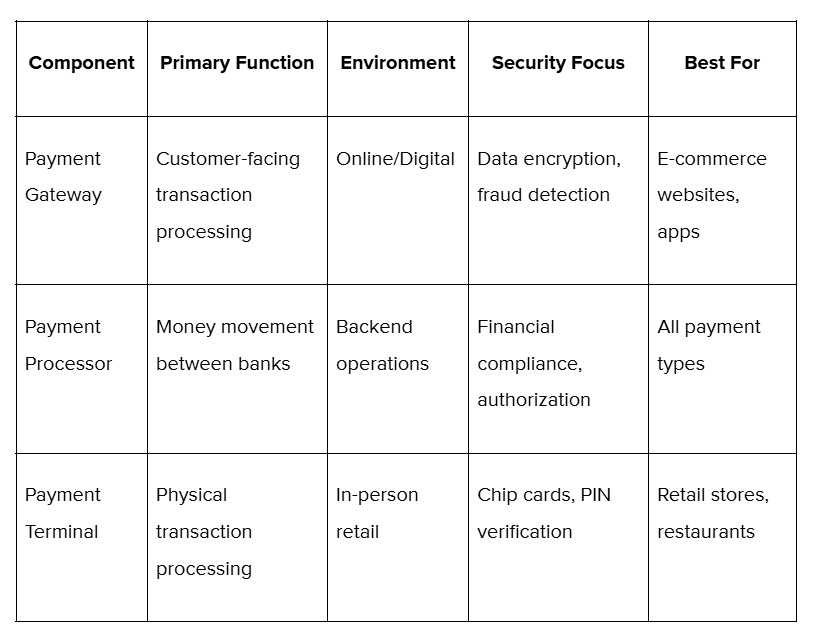
Each component serves specific business scenarios and customer interaction types.
Payment gateways handle the customer-facing part of transactions, including data encryption, fraud detection, and authorization requests. They capture payment information from your website or app and send it securely for processing. For example, when customers enter card details on your checkout page, the gateway encrypts this data and manages the authorization process.
Payment processors manage the actual money movement between banks and financial institutions. They receive authorization requests from gateways and facilitate the transfer of funds from customer accounts to merchant accounts. The processor works behind the scenes to ensure money reaches your business account after successful transactions.
Payment terminals are physical devices used for in-person transactions at retail locations, restaurants, and service businesses. They include card readers, POS (Point of Sale) systems, and contactless payment options. Terminals work in face-to-face settings where customers are physically present, using chip cards and secure verification methods.
Selecting the right payment gateway requires evaluating several factors based on your specific business needs and growth plans.
Security and compliance: Should be your top priority, looking for PCI DSS certification, fraud detection tools, and compliance with local regulations.
Supported payment methods: Matter for customer convenience, ensuring your gateway supports UPI payments, credit cards, or international payment methods your customers prefer.
Success rates and reliability: Directly impact your revenue, so check the gateway's uptime statistics and approval rates, especially for international transactions.
Integration complexity: Affects your time to market, considering whether you need simple plugins for platforms like WooCommerce or custom API integrations.
Customer support quality: Becomes crucial when payment issues arise, looking for providers offering 24/7 support, especially if you operate across time zones.
Pricing transparency: Helps avoid unexpected costs by comparing not just transaction fees but also setup costs, monthly charges, and additional feature pricing.
For example, a freelancer primarily serving US clients would prioritize low international transaction fees and easy USD collection, while a domestic e-commerce store might focus on supporting popular Indian payment methods and competitive domestic rates.
Managing international payments shouldn't slow down your business growth. Traditional payment gateways often struggle with global transactions, leaving you with failed payments, complicated compliance, and frustrated international customers.
PayGlocal solves these challenges with a payment platform designed specifically for businesses that work globally. Here’s how PayGlocal can help you:
Multi-currency accounts in USD, GBP, EUR, CAD: Collect payments locally in major currencies, making it easier for international clients to pay you.
40+ global payment methods: Accept payments through credit cards, digital wallets, bank transfers, and local payment methods preferred in different countries.
Instant compliance documentation: Receive FIRC and other required documents automatically after each settlement, keeping your export business compliant without manual paperwork.
Zero setup fees: Pay only when you transact, with no hidden charges or monthly minimums that eat into your profits.
Real-time tracking and notifications: Stay informed about every payment's status from initiation to settlement in your dashboard.
From businesses collecting their international payment to established exporters processing global transactions, PayGlocal provides the reliability and features you need to scale your business effectively.
Payment gateways are essential infrastructure for any business accepting online payments. The right choice can improve your conversion rates, expand your global reach, and simplify your financial operations, while the wrong one can cost you customers and revenue.
For businesses with international customers or global growth ambitions, specialized solutions like PayGlocal often provide better results than regular domestic payment gateways.
Growing businesses are already collecting payments globally while their competitors struggle with failed international transactions and compliance issues. Make your payments smarter, faster, and more reliable globally. Get started with PayGlocal today.
A payment gateway is the technology that makes this possible. It handles everything from security to currency conversion when customers pay you online. But with dozens of options available, choosing the right one can feel overwhelming.
In this guide, we break down everything you need to know about payment gateways, from how they work to choosing the right solution for your specific business needs. Let’s get started!
Key Takeaways:
- Payment gateways handle the technical side: Process transactions securely between customers and businesses without manual intervention.
- Different types serve different needs: Some work better for small businesses while other payment gateways suit large enterprises with complex requirements.
- Security and success rates matter most: Look for PCI DSS (Payment Card Industry Data Security Standard) compliance and high approval rates for international transactions.
- Global payments: PayGlocal offers a complete payment solution for businesses that want to collect payments globally with multi-currency accounts and instant compliance documentation.
What is a payment gateway?
A payment gateway is a technology service that processes online payments between customers and businesses. When someone buys something online, the payment gateway handles the technical work, from verifying the payment method, checking for fraud, to moving money from the customer's account to yours.
Some of the best payment gateways in India include PayGlocal, Razorpay, and Paytm. Each offers different features, pricing, and specializations depending on your business needs.
The main difference between payment gateways and other payment tools is their role in the transaction flow. While payment processors handle the actual money movement and merchant accounts store the funds, payment gateways focus on the customer-facing experience and initial security checks.
Payment gateway processing happens in just a few seconds but involves multiple processes. Here’s how it works:
Customer initiates payment: The customer enters payment details on your website or app checkout page.
Data encryption and transmission: The payment gateway encrypts the sensitive information and sends it to the payment processor.
Bank authorization: The processor forwards the request to the customer's bank, which checks if funds are available and the transaction is legitimate.
Response sent back: The bank sends an approval or decline message back through the same chain.
Transaction completion: If approved, the gateway displays a success message to the customer and initiates a fund transfer to your merchant account.
For instance, if someone in the US buys from your Indian business, the gateway handles currency conversion, international regulations, and ensures the payment reaches your account in INR.
What are the different types of payment gateways?
Different payment gateway types serve various business models and technical requirements. Here's how they compare:
Each type offers different advantages depending on your business needs and technical capabilities.
Hosted payment gateways
Hosted payment gateways redirect customers to the gateway provider's secure page to complete payment. This reduces your security burden but gives you less control over the customer experience. PayPal and Razorpay's standard checkout are common examples.
Integrated payment gateways
Integrated payment gateways let customers pay directly on your website without leaving your page. This provides better branding control but requires you to meet higher security standards. Stripe's embedded checkout exemplifies this approach.
API-based gateways
API-based payment gateways give developers complete control over the payment experience through programming interfaces. Large e-commerce platforms often use APIs to create custom checkout flows that match their brand perfectly. PayGlocal offers API-based integrations that let businesses build custom international payment experiences with multi-currency support.
Mobile payment gateways
Mobile payment gateways are optimized for smartphone transactions, supporting features like digital wallets and QR code payments. These work particularly well for businesses with significant mobile traffic.
What are the key benefits of using a payment gateway?
Payment gateways offer several advantages that can directly impact your revenue and customer satisfaction.
Enhanced security: Payment gateways use encryption and fraud detection to protect both you and your customers from data breaches and fraudulent transactions.
Global reach: Accept payments from customers worldwide without worrying about currency conversion or international banking complexities.
Multiple payment options: Support credit cards, debit cards, digital wallets, bank transfers, and local payment methods preferred by different customer segments.
Improved cash flow: Get faster access to your money compared to traditional bank transfers or checks, with many gateways offering next-day settlements.
Automated processes: Reduce manual work with automatic invoice generation, payment tracking, and reconciliation features.
Better customer experience: Provide smooth, professional checkout experiences that build trust and reduce cart abandonment.
How much do payment gateways cost?
Payment gateway pricing varies significantly based on your business size, transaction volume, and required features. Here's what you can expect:=
Consider these cost factors when evaluating different payment gateway options for your business.
Transaction fees: Typically range from 1.5% to 3.5% per transaction for domestic payments, with international payments often costing more.
Setup costs: Can include one-time integration fees, monthly subscription charges, or annual maintenance costs.
Additional charges: Might include currency conversion fees, chargeback handling fees, refund processing charges, and premium feature costs.
Hidden costs: To watch for include minimum transaction requirements, inactivity fees, early termination penalties, and charges for compliance documentation.
Tip: Before choosing a provider, calculate your total cost of ownership based on your expected transaction volume and average transaction size. A gateway with higher per-transaction fees might be cheaper overall if it has no monthly fees for low-volume businesses.
What is the difference between a payment gateway, a payment processor, and a payment terminal?
Payment gateways, processors, and terminals each play distinct roles in the payment ecosystem. While they often work together, knowing their differences helps you choose the right solutions for your business needs.
Here's how these payment components compare across key factors:
Each component serves specific business scenarios and customer interaction types.
Payment Gateway
Payment gateways handle the customer-facing part of transactions, including data encryption, fraud detection, and authorization requests. They capture payment information from your website or app and send it securely for processing. For example, when customers enter card details on your checkout page, the gateway encrypts this data and manages the authorization process.
Payment Processor
Payment processors manage the actual money movement between banks and financial institutions. They receive authorization requests from gateways and facilitate the transfer of funds from customer accounts to merchant accounts. The processor works behind the scenes to ensure money reaches your business account after successful transactions.
Payment Terminal
Payment terminals are physical devices used for in-person transactions at retail locations, restaurants, and service businesses. They include card readers, POS (Point of Sale) systems, and contactless payment options. Terminals work in face-to-face settings where customers are physically present, using chip cards and secure verification methods.
How to choose the right payment gateway for your business?
Selecting the right payment gateway requires evaluating several factors based on your specific business needs and growth plans.
Security and compliance: Should be your top priority, looking for PCI DSS certification, fraud detection tools, and compliance with local regulations.
Supported payment methods: Matter for customer convenience, ensuring your gateway supports UPI payments, credit cards, or international payment methods your customers prefer.
Success rates and reliability: Directly impact your revenue, so check the gateway's uptime statistics and approval rates, especially for international transactions.
Integration complexity: Affects your time to market, considering whether you need simple plugins for platforms like WooCommerce or custom API integrations.
Customer support quality: Becomes crucial when payment issues arise, looking for providers offering 24/7 support, especially if you operate across time zones.
Pricing transparency: Helps avoid unexpected costs by comparing not just transaction fees but also setup costs, monthly charges, and additional feature pricing.
For example, a freelancer primarily serving US clients would prioritize low international transaction fees and easy USD collection, while a domestic e-commerce store might focus on supporting popular Indian payment methods and competitive domestic rates.
Accept international payments efficiently with PayGlocal
Managing international payments shouldn't slow down your business growth. Traditional payment gateways often struggle with global transactions, leaving you with failed payments, complicated compliance, and frustrated international customers.
PayGlocal solves these challenges with a payment platform designed specifically for businesses that work globally. Here’s how PayGlocal can help you:
Multi-currency accounts in USD, GBP, EUR, CAD: Collect payments locally in major currencies, making it easier for international clients to pay you.
40+ global payment methods: Accept payments through credit cards, digital wallets, bank transfers, and local payment methods preferred in different countries.
Instant compliance documentation: Receive FIRC and other required documents automatically after each settlement, keeping your export business compliant without manual paperwork.
Zero setup fees: Pay only when you transact, with no hidden charges or monthly minimums that eat into your profits.
Real-time tracking and notifications: Stay informed about every payment's status from initiation to settlement in your dashboard.
From businesses collecting their international payment to established exporters processing global transactions, PayGlocal provides the reliability and features you need to scale your business effectively.
Final thoughts
Payment gateways are essential infrastructure for any business accepting online payments. The right choice can improve your conversion rates, expand your global reach, and simplify your financial operations, while the wrong one can cost you customers and revenue.
For businesses with international customers or global growth ambitions, specialized solutions like PayGlocal often provide better results than regular domestic payment gateways.
Growing businesses are already collecting payments globally while their competitors struggle with failed international transactions and compliance issues. Make your payments smarter, faster, and more reliable globally. Get started with PayGlocal today.