
When you collect payments from international clients, you'll notice an extra charge on every transaction. That's the platform fee, and it shows up whether you're receiving $5,000 or $50,000. These charges have become standard across digital payment services.
Recent data shows exports went up by 6%, demonstrating strong growth in international markets. As your business grows globally, knowing exactly what additional fees you pay to accept payments becomes essential.
This guide breaks down in detail what platform fees are, why they exist, and key things to consider before considering different payment services.
Platform fees are charges that digital platforms and online marketplaces add to transactions for using their services. You pay these fees on top of the base cost of your purchase, payment, or transaction.
These charges cover the costs of running the platform. This includes maintaining servers, ensuring security, processing payments, providing customer support, and developing new features. Platforms argue these fees let them improve services and stay operational without charging higher base prices.
Platform fees often hide behind different labels depending on the industry, but the underlying purpose remains the same. Whether you see it branded as a service charge, a convenience fee, or a handling fee, you are ultimately paying for the platform's digital infrastructure.
For example, when you collect a $10,000 payment from a US client through a payment gateway, you might pay 3-3.5% in platform fees. When you transfer funds internationally, investment platforms and financial service providers add similar charges for currency conversion and cross-border payment processing.
Platforms need revenue to operate, and platform charges help them stay sustainable while keeping their core services accessible. Here's what these fees typically cover:
While fee structures vary across industries, they have become the standard for any service that prioritizes long-term stability and security over a budget-first approach.
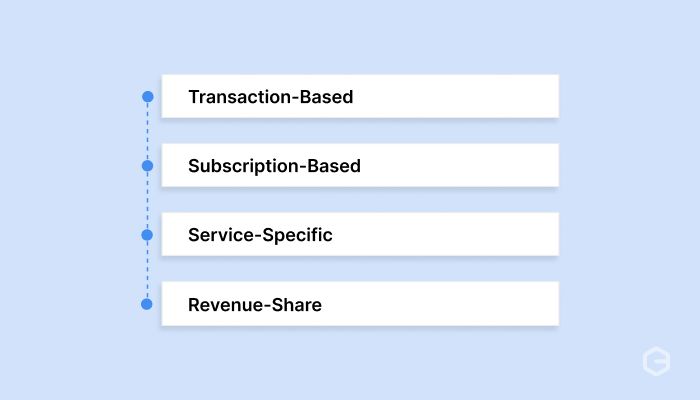
Platform fees come in different forms depending on the service, industry, and business model. Each type affects your costs differently based on how often you transact and how much you process.
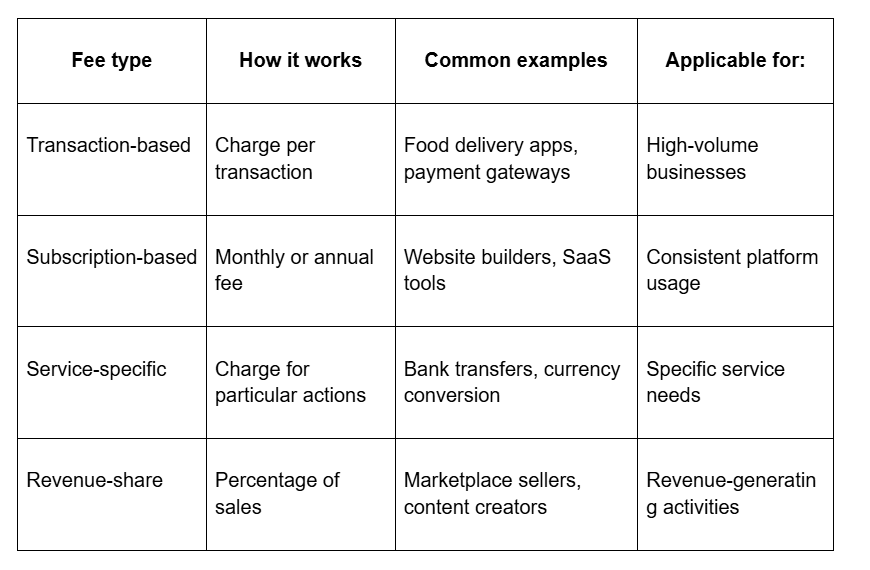
Here's what each type means for your business:
Transaction-based fees add a small charge to every order, payment, or booking you make through the platform. Food delivery apps typically charge per order. Payment gateways might also add 1-3% per transaction.
These fees work well for platforms with high transaction volumes. The more you transact, the more the platform earns. For businesses, this means costs scale directly with activity. For example, if you're an exporter collecting $10,000 monthly through a payment gateway charging 3%, you'll pay $300 in platform fees alone.
Some platforms skip per-transaction charges and instead charge monthly or annual subscriptions. Website builders like Wix or e-commerce platforms often use this model. You pay a fixed amount regardless of how many transactions you process.
This structure benefits businesses with predictable, high-volume needs. You know exactly what you'll pay each month. However, if your transaction volume varies significantly, you might overpay during slow periods.
Certain platforms charge fees only for specific services. Investment platforms, for instance, add platform fees when you transfer funds from your Indian bank account to your US investment account. International payment provider charges extra for currency conversion beyond its base transaction fee.
These fees appear when you use particular features, not on every transaction. For businesses doing international payments, currency conversion fees and cross-border transfer charges can add up quickly.
In revenue-share structures, the platform takes a percentage of your earnings. YouTube keeps 45% of ad revenue and gives creators 55%. Amazon charges sellers 8-15% of each sale, depending on the product category.
For businesses selling through marketplaces, these fees directly impact profit margins. A product sold for ₹1,000 with a 15% platform fee leaves you with ₹850 before considering other costs like shipping and taxes.
Platform fees differ significantly, and even small percentage differences add up fast. A platform charging 3% versus 3.5% might seem small until you're processing $100,000 monthly. That's $500 you could be saving.
Here's what you should consider before committing to any payment platform or service:
For businesses collecting international payments, these platform charges become especially important. A 3.5% platform fee on international cards plus a 2-3% currency conversion charge means you're paying 5.5-6.5% total. On a $50,000 monthly collection, that's $2,750-$3,250 in fees alone.
Platform fees on international transactions can quickly eat into your margins. When you're collecting payments from clients worldwide, every percentage point matters.
PayGlocal helps businesses collect international payments with transparent pricing and no surprise charges. Built specifically for Indian exporters, freelancers, and businesses doing cross-border commerce, PayGlocal offers a straightforward alternative to platforms with complex fee structures.
Here's what makes the difference:
PayGlocal removes the guesswork from international payment costs. You see exactly what you'll pay before you transact, with no hidden platform fees or surprise charges at settlement.
Platform fees have become standard across digital services, but they shouldn't be an unpredictable burden on your margins. While these charges fund the essential infrastructure of global trade, the responsibility lies with you to ensure that the value you receive far outweighs the cost you pay.
The most successful businesses don't just accept "standard" fees; they audit them. By looking past advertised rates to the total cost of every transaction, you can protect your profitability and choose partners that reward your growth rather than penalizing your scale. In a world where every percentage point counts, transparency is your most important financial strategy.
Ready to collect international payments without worrying about hidden platform fees? Get started with PayGlocal today and experience transparent pricing built for businesses that want to scale globally.
Recent data shows exports went up by 6%, demonstrating strong growth in international markets. As your business grows globally, knowing exactly what additional fees you pay to accept payments becomes essential.
This guide breaks down in detail what platform fees are, why they exist, and key things to consider before considering different payment services.
Key Takeaways
- Platform fee meaning: Extra charges by online platforms for using their services, covering operations, security, and improvements.
- Types vary widely: Transaction-based, subscription-based, service-specific, and revenue-share models exist across industries.
- Common across sectors: Food delivery, e-commerce, payment gateways, and financial platforms all use different fee structures.
- Costs add up: For businesses doing global transactions, platform charges can significantly impact profitability.
- Global payment platform: PayGlocal offers transparent pricing with zero fixed costs, no hidden platform fees, and competitive rates for collecting global payments.
What are Platform Fees?
Platform fees are charges that digital platforms and online marketplaces add to transactions for using their services. You pay these fees on top of the base cost of your purchase, payment, or transaction.
These charges cover the costs of running the platform. This includes maintaining servers, ensuring security, processing payments, providing customer support, and developing new features. Platforms argue these fees let them improve services and stay operational without charging higher base prices.
Platform fees often hide behind different labels depending on the industry, but the underlying purpose remains the same. Whether you see it branded as a service charge, a convenience fee, or a handling fee, you are ultimately paying for the platform's digital infrastructure.
For example, when you collect a $10,000 payment from a US client through a payment gateway, you might pay 3-3.5% in platform fees. When you transfer funds internationally, investment platforms and financial service providers add similar charges for currency conversion and cross-border payment processing.
Why do Platforms Charge These Fees?
Platforms need revenue to operate, and platform charges help them stay sustainable while keeping their core services accessible. Here's what these fees typically cover:
- Scaling and reliability: As your transaction volume grows, the platform must invest in server capacity and "uptime" to ensure your business never faces a technical blackout during peak hours.
- Security and fraud prevention: Sophisticated encryption and real-time fraud monitoring are expensive. These fees fund the "digital shield" that protects your revenue and customer data from breaches.
- Regulatory and global compliance: Staying compliant with changing laws (like PCI-DSS, GDPR, or local tax mandates) is a massive undertaking. The platform handles this legal complexity so you don't have to.
- Product innovation: To stay competitive, platforms constantly roll out new features, such as one-click checkouts, AI-driven analytics, or new payment methods, to help you convert more customers.
- Specialized Support: Maintaining a team of experts who understand cross-border nuances and technical troubleshooting ensures you have a safety net when a transaction hits a snag.
While fee structures vary across industries, they have become the standard for any service that prioritizes long-term stability and security over a budget-first approach.
What are the Types of Platform Fees?
Platform fees come in different forms depending on the service, industry, and business model. Each type affects your costs differently based on how often you transact and how much you process.
Here's what each type means for your business:
Transaction-based Platform Charges
Transaction-based fees add a small charge to every order, payment, or booking you make through the platform. Food delivery apps typically charge per order. Payment gateways might also add 1-3% per transaction.
These fees work well for platforms with high transaction volumes. The more you transact, the more the platform earns. For businesses, this means costs scale directly with activity. For example, if you're an exporter collecting $10,000 monthly through a payment gateway charging 3%, you'll pay $300 in platform fees alone.
Subscription-based Platform Fees
Some platforms skip per-transaction charges and instead charge monthly or annual subscriptions. Website builders like Wix or e-commerce platforms often use this model. You pay a fixed amount regardless of how many transactions you process.
This structure benefits businesses with predictable, high-volume needs. You know exactly what you'll pay each month. However, if your transaction volume varies significantly, you might overpay during slow periods.
Service-specific Charges
Certain platforms charge fees only for specific services. Investment platforms, for instance, add platform fees when you transfer funds from your Indian bank account to your US investment account. International payment provider charges extra for currency conversion beyond its base transaction fee.
These fees appear when you use particular features, not on every transaction. For businesses doing international payments, currency conversion fees and cross-border transfer charges can add up quickly.
Revenue-share Models
In revenue-share structures, the platform takes a percentage of your earnings. YouTube keeps 45% of ad revenue and gives creators 55%. Amazon charges sellers 8-15% of each sale, depending on the product category.
For businesses selling through marketplaces, these fees directly impact profit margins. A product sold for ₹1,000 with a 15% platform fee leaves you with ₹850 before considering other costs like shipping and taxes.
What to Consider When Evaluating Different Platforms?
Platform fees differ significantly, and even small percentage differences add up fast. A platform charging 3% versus 3.5% might seem small until you're processing $100,000 monthly. That's $500 you could be saving.
Here's what you should consider before committing to any payment platform or service:
- Total cost calculation: Look beyond the advertised rate and add up all charges, including transaction fees, currency conversion, settlement charges, and withdrawal fees to see what you'll actually pay.
- Hidden or variable charges: Some platforms show one rate upfront, but add extra fees for common actions like currency conversion, instant settlements, or refund processing that can significantly increase costs.
- Competitive comparison: Compare fee structures across similar platforms by running numbers based on your expected transaction volume and average ticket size to find the best value.
- Scalability considerations: Understand how fees scale with your business growth, whether platforms offer volume discounts, and if rates change as your transaction size increases.
- Currency conversion pricing: For international payments, examine how currency conversion is priced since some platforms offer competitive transaction rates but add a 2-3% markup on forex.
- Fee transparency: Choose platforms that provide complete fee schedules upfront with no surprises, making it easier to budget and plan your payment costs accurately.
For businesses collecting international payments, these platform charges become especially important. A 3.5% platform fee on international cards plus a 2-3% currency conversion charge means you're paying 5.5-6.5% total. On a $50,000 monthly collection, that's $2,750-$3,250 in fees alone.
Accept Global Payments Without Hidden Platform Fees with PayGlocal
Platform fees on international transactions can quickly eat into your margins. When you're collecting payments from clients worldwide, every percentage point matters.
PayGlocal helps businesses collect international payments with transparent pricing and no surprise charges. Built specifically for Indian exporters, freelancers, and businesses doing cross-border commerce, PayGlocal offers a straightforward alternative to platforms with complex fee structures.
Here's what makes the difference:
- Multi-currency accounts: Collect payments in USD, GBP, EUR, and CAD with local accounts. Accept global payments in 33+ currencies from 180+ countries.
- Transparent pricing: No monthly fees, no setup costs, no platform charges. Pay only when you transact, with clear rates you can plan around.
- Card payments: Process international credit and debit cards at competitive rates with enhanced payment orchestration for better approvals.
- Global payment methods: Offer 40+ local payment methods to increase trust and conversions with international customers.
- One platform: Manage all your international payments from a single dashboard with real-time tracking and instant notifications.
PayGlocal removes the guesswork from international payment costs. You see exactly what you'll pay before you transact, with no hidden platform fees or surprise charges at settlement.
Final Thoughts
Platform fees have become standard across digital services, but they shouldn't be an unpredictable burden on your margins. While these charges fund the essential infrastructure of global trade, the responsibility lies with you to ensure that the value you receive far outweighs the cost you pay.
The most successful businesses don't just accept "standard" fees; they audit them. By looking past advertised rates to the total cost of every transaction, you can protect your profitability and choose partners that reward your growth rather than penalizing your scale. In a world where every percentage point counts, transparency is your most important financial strategy.
Ready to collect international payments without worrying about hidden platform fees? Get started with PayGlocal today and experience transparent pricing built for businesses that want to scale globally.