
Indian businesses are increasingly growing international businesses, with total exports reaching $349.35 billion between April and August 2025, showing a 6.18% growth compared to the same period last year. But this expansion also brings challenges that can slow you down if you're not prepared well.
Recent data shows that over 31.6% of global product lines now face technical trade barriers, affecting more than two-thirds of worldwide trade. You're coordinating across time zones, currencies, regulations, and cultures while trying to maintain the same quality your customers expect.
In this guide, we break down the most common problems businesses face when going global, along with effective ways to solve them. Let’s get started.
Every market operates differently. What works in India won't work the same way in the US or Europe. You'll deal with different customer expectations, regulatory requirements, and payment preferences.
For instance, an Indian SaaS company expanding to the UK needs to handle GDPR compliance, offer local payment methods like direct debit, and price in GBP while managing currency conversion risk.
The faster you identify and solve these problems, the better your chances of scaling successfully. Each challenge affects your cash flow, operational efficiency, and customer experience in different ways.
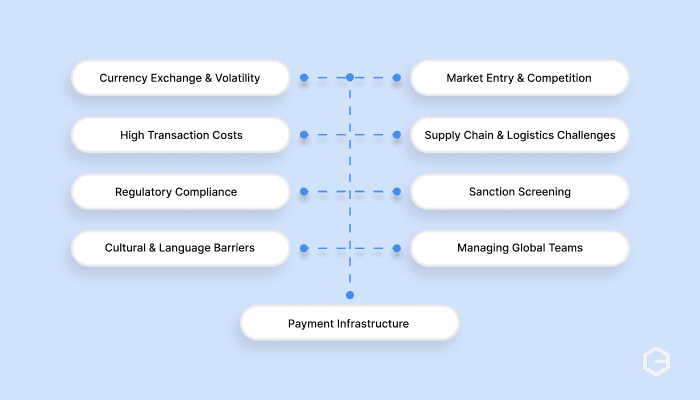
Here are the key challenges you'll face when taking your business across borders.
Currency exchange and volatility can eat into your profits without warning. If you invoice a client in USD and the rupee strengthens before settlement, you receive less than expected. This unpredictability makes financial planning difficult.
You also face conversion fees every time money moves across borders. Banks and intermediaries charge markups on exchange rates, which add up quickly when you're processing multiple transactions each month. For exporters working on thin margins, currency costs become a real problem.
How to solve:
Use multi-currency accounts to receive payments directly in the currencies your clients use. This removes friction from the payment process and gives clients familiar, local payment options.
Platforms like PayGlocal give you local accounts in USD, GBP, EUR, and CAD with transparent pricing. You collect payments from 180+ countries and settle in INR without the complexity of traditional banking layers.
Entering a new market means competing with local players who already have brand recognition and customer trust. You're starting from zero. You need to learn what customers expect, how they prefer to buy, and what price points make sense locally.
Distribution channels differ, too. In some markets, direct sales work best. In others, you need local partners or resellers. For example, selling B2B SaaS in India might work through direct outreach, but in Japan, relationships and referrals matter more. You need to adapt your go-to-market strategy for each region.
How to solve:
Research your target market before launching. Talk to potential customers, study local competitors, and test your messaging with small groups before scaling.
Offer payment methods that customers in your target market actually use. Supporting local payment options builds trust and removes friction from the buying process.
International payments take longer than domestic ones. Wire transfers can take three to five business days. If there's a compliance check or missing documentation, delays stretch even further. Your clients pay on time, but you wait weeks to access the funds.
Transaction fees for global payments are higher, as well. You're paying payment gateway fees, currency conversion charges, and intermediary bank costs. For example, receiving a $5,000 payment from a US client can cost you $150 to $200 in combined fees. These costs reduce your actual revenue and complicate pricing strategies.
How to solve:
Choose payment partners with direct routing and local accounts to reduce intermediary delays. Modern platforms settle payments faster without the usual banking layers.
Look for transparent pricing with no hidden charges. PayGlocal operates on a pay-per-transaction model with zero setup fees, so you know exactly what each payment costs.
Managing physical goods across borders involves customs, tariffs, and shipping delays. You need to track inventory across multiple locations, deal with import/export documentation, and plan for disruptions like port strikes or geopolitical tensions.
For service businesses, logistics means managing digital delivery across regions. You need to ensure uptime for customers in different time zones, provide local customer support, and handle refunds or disputes according to local consumer protection laws. Every region adds operational complexity.
How to solve:
Work with logistics partners who have experience in your target markets. They handle customs, documentation, and local regulations while you focus on your business.
For service businesses, invest in infrastructure that supports global delivery. This includes payment systems that work across borders and customer support that covers multiple time zones.
Every country has its own set of rules. You need to comply with local tax laws, employment regulations, data privacy standards, and industry-specific requirements. For instance, if you're processing customer data from the EU, you must follow GDPR. If you're hiring employees in the UK, you need to comply with UK employment law.
Compliance requires documentation, audits, and reporting. You need FIRC (Foreign Inward Remittance Certificate) documents for every international payment you receive in India. Missing or incorrect documentation can lead to penalties or frozen accounts.
How to solve:
Automate compliance documentation to reduce manual work and errors. Systems that generate required documents instantly keep you audit-ready without chasing banks.
PayGlocal sends FIRC directly to your inbox after every settlement. You get the documentation you need for tax compliance and export incentives without delays.
When you do business internationally, you need to verify that your customers and transactions don't involve sanctioned individuals, entities, or countries. Global regulatory bodies like OFAC, UN, and EU maintain sanction lists that change regularly. Failing to screen against these lists can result in heavy penalties, legal issues, and reputational damage.
Manual sanction screening is time-consuming and prone to errors. You need to check names, business details, and transaction information against multiple databases.
For instance, if you're receiving a payment from a new client in the Middle East, you need to verify they're not on any sanction lists before processing the transaction. Missing this step can expose your business to compliance violations.
How to solve:
Use automated sanction screening tools that check against global watchlists in real time. You stay compliant without manual lookups or outdated spreadsheets.
PayGlocal's SamruddhiX verifies customers and transactions against 300+ sources, including OFAC, UN, EU, and HM Treasury, instantly. The system uses zero-knowledge proof technology to protect customer data while keeping you compliant.
Business etiquette varies across regions. Communication styles that work in one country can come across as too direct or too vague in another. For example, German clients expect precision and detailed contracts, while clients in some Southeast Asian markets prefer relationship-building before formal agreements.
Language differences slow down communication. Even when everyone speaks English, nuances get lost. Misunderstandings around payment terms, delivery timelines, or product expectations can damage client relationships. You need localized content, customer support in local languages, and sensitivity to cultural norms.
How to solve:
Invest in cultural training for your team before entering new markets. Learn the communication styles, negotiation practices, and business etiquette that matter to your target customers.
Hire local talent who bring market knowledge and language skills. They help you avoid cultural missteps and build stronger relationships with clients in unfamiliar markets.
Coordinating a distributed workforce is harder than managing a local team. Time zone differences mean you can't always get real-time responses. Scheduling meetings that work for teams in India, the US, and Europe becomes a logistical puzzle.
You also need to think about local labor laws, benefits, payroll systems, and tax withholdings. Hiring a developer in Canada is different from hiring one in India. Each country has its own requirements for contracts, termination policies, and employee rights. Managing this complexity requires systems and local expertise.
How to solve:
Use collaboration tools designed for async work across time zones. Project management software, shared documentation, and clear communication processes matter more than real-time availability.
Set clear expectations around response times and working hours. Build workflows that let team members in different regions make progress without waiting for others to come online.
Different countries prefer different payment methods. Customers in the US expect credit cards. Customers in Europe use SEPA transfers or local wallets. In Southeast Asia, e-wallets and bank transfers dominate. If you don't support local payment methods, you lose conversions.
Fraud risk increases with cross-border transactions. You're dealing with customers you can't verify in person, using payment methods you're less familiar with. Chargebacks, fake invoices, and payment disputes are more common in international transactions. You need fraud detection systems and clear policies to protect your revenue.
How to solve:
Choose payment platforms that support multiple payment methods across regions. This gives customers familiar options and increases conversion rates.
Look for built-in fraud detection and risk management. PayGlocal offers 40+ payment methods across 180+ countries with advanced fraud screening to protect your revenue.
The problems of international business start adding up quickly, but payment complexity doesn't have to be one of them. When you're dealing with multiple currencies, delayed settlements, and compliance requirements, you need a system that works without constant oversight.
PayGlocal gives you the tools to collect payments from global customers and settle them in INR without the usual friction.
Here's how it helps:
Whether you're an exporter, a SaaS company, or a service provider, PayGlocal removes the payment barriers that slow you down. You focus on growing your business while we handle the complexities of cross-border transactions.
The problems of international business are real, but you can solve them with the right systems and partners in place. Currency volatility, payment delays, compliance requirements, and cultural differences will always be part of global expansion.
Start by identifying which problems impact your business most. If payment delays and high transaction costs are eating into your cash flow, fix that first. If compliance documentation is taking too much time, automate it. Solve the biggest friction points before moving to the next challenge.
Ready to make cross-border payments faster, affordable, and more reliable? Get started with PayGlocal today and collect from customers in 180+ countries worldwide.
Recent data shows that over 31.6% of global product lines now face technical trade barriers, affecting more than two-thirds of worldwide trade. You're coordinating across time zones, currencies, regulations, and cultures while trying to maintain the same quality your customers expect.
In this guide, we break down the most common problems businesses face when going global, along with effective ways to solve them. Let’s get started.
Key Takeaways
- Currency volatility: Exchange rate fluctuations can impact your profit margins and pricing strategies across different markets.
- Regulatory compliance: Each country has unique laws around taxation, employment, data protection, and business operations that you must follow.
- Sanction screening requirements: You need to verify customers and transactions against global sanction lists to stay compliant and avoid penalties.
- Team management challenges: Coordinating distributed teams across time zones requires clear systems.
- Secure global payment infrastructure with PayGlocal: With PayGlocal, you can accept payments in 33+ currencies, settle in INR, and manage compliance with zero setup fees.
What are the main problems of international business?
Every market operates differently. What works in India won't work the same way in the US or Europe. You'll deal with different customer expectations, regulatory requirements, and payment preferences.
For instance, an Indian SaaS company expanding to the UK needs to handle GDPR compliance, offer local payment methods like direct debit, and price in GBP while managing currency conversion risk.
The faster you identify and solve these problems, the better your chances of scaling successfully. Each challenge affects your cash flow, operational efficiency, and customer experience in different ways.
Here are the key challenges you'll face when taking your business across borders.
1. Currency exchange and volatility
Currency exchange and volatility can eat into your profits without warning. If you invoice a client in USD and the rupee strengthens before settlement, you receive less than expected. This unpredictability makes financial planning difficult.
You also face conversion fees every time money moves across borders. Banks and intermediaries charge markups on exchange rates, which add up quickly when you're processing multiple transactions each month. For exporters working on thin margins, currency costs become a real problem.
How to solve:
Use multi-currency accounts to receive payments directly in the currencies your clients use. This removes friction from the payment process and gives clients familiar, local payment options.
Platforms like PayGlocal give you local accounts in USD, GBP, EUR, and CAD with transparent pricing. You collect payments from 180+ countries and settle in INR without the complexity of traditional banking layers.
2. Market entry and competition
Entering a new market means competing with local players who already have brand recognition and customer trust. You're starting from zero. You need to learn what customers expect, how they prefer to buy, and what price points make sense locally.
Distribution channels differ, too. In some markets, direct sales work best. In others, you need local partners or resellers. For example, selling B2B SaaS in India might work through direct outreach, but in Japan, relationships and referrals matter more. You need to adapt your go-to-market strategy for each region.
How to solve:
Research your target market before launching. Talk to potential customers, study local competitors, and test your messaging with small groups before scaling.
Offer payment methods that customers in your target market actually use. Supporting local payment options builds trust and removes friction from the buying process.
3. Payment delays and high transaction costs
International payments take longer than domestic ones. Wire transfers can take three to five business days. If there's a compliance check or missing documentation, delays stretch even further. Your clients pay on time, but you wait weeks to access the funds.
Transaction fees for global payments are higher, as well. You're paying payment gateway fees, currency conversion charges, and intermediary bank costs. For example, receiving a $5,000 payment from a US client can cost you $150 to $200 in combined fees. These costs reduce your actual revenue and complicate pricing strategies.
How to solve:
Choose payment partners with direct routing and local accounts to reduce intermediary delays. Modern platforms settle payments faster without the usual banking layers.
Look for transparent pricing with no hidden charges. PayGlocal operates on a pay-per-transaction model with zero setup fees, so you know exactly what each payment costs.
4. Supply chain and logistics challenges
Managing physical goods across borders involves customs, tariffs, and shipping delays. You need to track inventory across multiple locations, deal with import/export documentation, and plan for disruptions like port strikes or geopolitical tensions.
For service businesses, logistics means managing digital delivery across regions. You need to ensure uptime for customers in different time zones, provide local customer support, and handle refunds or disputes according to local consumer protection laws. Every region adds operational complexity.
How to solve:
Work with logistics partners who have experience in your target markets. They handle customs, documentation, and local regulations while you focus on your business.
For service businesses, invest in infrastructure that supports global delivery. This includes payment systems that work across borders and customer support that covers multiple time zones.
5. Regulatory compliance
Every country has its own set of rules. You need to comply with local tax laws, employment regulations, data privacy standards, and industry-specific requirements. For instance, if you're processing customer data from the EU, you must follow GDPR. If you're hiring employees in the UK, you need to comply with UK employment law.
Compliance requires documentation, audits, and reporting. You need FIRC (Foreign Inward Remittance Certificate) documents for every international payment you receive in India. Missing or incorrect documentation can lead to penalties or frozen accounts.
How to solve:
Automate compliance documentation to reduce manual work and errors. Systems that generate required documents instantly keep you audit-ready without chasing banks.
PayGlocal sends FIRC directly to your inbox after every settlement. You get the documentation you need for tax compliance and export incentives without delays.
6. Sanction screening and compliance risks
When you do business internationally, you need to verify that your customers and transactions don't involve sanctioned individuals, entities, or countries. Global regulatory bodies like OFAC, UN, and EU maintain sanction lists that change regularly. Failing to screen against these lists can result in heavy penalties, legal issues, and reputational damage.
Manual sanction screening is time-consuming and prone to errors. You need to check names, business details, and transaction information against multiple databases.
For instance, if you're receiving a payment from a new client in the Middle East, you need to verify they're not on any sanction lists before processing the transaction. Missing this step can expose your business to compliance violations.
How to solve:
Use automated sanction screening tools that check against global watchlists in real time. You stay compliant without manual lookups or outdated spreadsheets.
PayGlocal's SamruddhiX verifies customers and transactions against 300+ sources, including OFAC, UN, EU, and HM Treasury, instantly. The system uses zero-knowledge proof technology to protect customer data while keeping you compliant.
7. Cultural and language barriers
Business etiquette varies across regions. Communication styles that work in one country can come across as too direct or too vague in another. For example, German clients expect precision and detailed contracts, while clients in some Southeast Asian markets prefer relationship-building before formal agreements.
Language differences slow down communication. Even when everyone speaks English, nuances get lost. Misunderstandings around payment terms, delivery timelines, or product expectations can damage client relationships. You need localized content, customer support in local languages, and sensitivity to cultural norms.
How to solve:
Invest in cultural training for your team before entering new markets. Learn the communication styles, negotiation practices, and business etiquette that matter to your target customers.
Hire local talent who bring market knowledge and language skills. They help you avoid cultural missteps and build stronger relationships with clients in unfamiliar markets.
8. Managing global teams
Coordinating a distributed workforce is harder than managing a local team. Time zone differences mean you can't always get real-time responses. Scheduling meetings that work for teams in India, the US, and Europe becomes a logistical puzzle.
You also need to think about local labor laws, benefits, payroll systems, and tax withholdings. Hiring a developer in Canada is different from hiring one in India. Each country has its own requirements for contracts, termination policies, and employee rights. Managing this complexity requires systems and local expertise.
How to solve:
Use collaboration tools designed for async work across time zones. Project management software, shared documentation, and clear communication processes matter more than real-time availability.
Set clear expectations around response times and working hours. Build workflows that let team members in different regions make progress without waiting for others to come online.
9. Payment infrastructure and fraud risk
Different countries prefer different payment methods. Customers in the US expect credit cards. Customers in Europe use SEPA transfers or local wallets. In Southeast Asia, e-wallets and bank transfers dominate. If you don't support local payment methods, you lose conversions.
Fraud risk increases with cross-border transactions. You're dealing with customers you can't verify in person, using payment methods you're less familiar with. Chargebacks, fake invoices, and payment disputes are more common in international transactions. You need fraud detection systems and clear policies to protect your revenue.
How to solve:
Choose payment platforms that support multiple payment methods across regions. This gives customers familiar options and increases conversion rates.
Look for built-in fraud detection and risk management. PayGlocal offers 40+ payment methods across 180+ countries with advanced fraud screening to protect your revenue.
Scale your global payment processes securely with PayGlocal
The problems of international business start adding up quickly, but payment complexity doesn't have to be one of them. When you're dealing with multiple currencies, delayed settlements, and compliance requirements, you need a system that works without constant oversight.
PayGlocal gives you the tools to collect payments from global customers and settle them in INR without the usual friction.
Here's how it helps:
- Multi-currency accounts: Collect payments in USD, GBP, EUR, and CAD with local accounts that make you look local to your clients.
- Global payment methods: Accept 40+ payment methods, including cards, wallets, and local bank transfers across 180+ countries.
- Automated sanction screening: Verify customers and transactions against 300+ global watchlists in real time with zero-knowledge proof technology for complete privacy.
- Instant compliance documentation: Get FIRC directly in your inbox after every settlement without manual follow-ups.
- Transparent pricing: Pay only when you transact with no setup fees, platform charges, or hidden costs.
Whether you're an exporter, a SaaS company, or a service provider, PayGlocal removes the payment barriers that slow you down. You focus on growing your business while we handle the complexities of cross-border transactions.
Final Thoughts
The problems of international business are real, but you can solve them with the right systems and partners in place. Currency volatility, payment delays, compliance requirements, and cultural differences will always be part of global expansion.
Start by identifying which problems impact your business most. If payment delays and high transaction costs are eating into your cash flow, fix that first. If compliance documentation is taking too much time, automate it. Solve the biggest friction points before moving to the next challenge.
Ready to make cross-border payments faster, affordable, and more reliable? Get started with PayGlocal today and collect from customers in 180+ countries worldwide.