
Scaling a massive infrastructure or energy project shouldn't mean risking your entire company's future on a single loan. While traditional corporate borrowing hits a ceiling quickly, project finance offers a smarter path: funding secured by the project's own potential, not your existing balance sheet.
With international project finance deals in India surging by 64%, the message is clear that the world's most ambitious builders are isolating risk to accelerate growth.
If you're ready to move beyond traditional debt, this guide will help you master the project finance structure.
Project finance is a funding structure where a large-scale project is financed based on its expected future cash flows rather than the credit or assets of the companies sponsoring it. The project operates through a separate entity, and lenders evaluate the project's viability independently.
Unlike traditional corporate loans, where your entire business serves as collateral, project finance isolates the investment. A Special Purpose Vehicle (SPV) is created specifically to own, develop, and operate the project. This SPV borrows money, signs contracts, and generates revenue independently from your main business operations.
For instance, if you're developing a wind farm, you'd establish an SPV to manage everything related to that wind farm. The SPV borrows funds from banks or financial institutions, signs contracts with equipment suppliers and energy buyers, and uses revenue from selling electricity to repay the debt. Your parent company's other assets remain protected if something goes wrong with the wind farm.
This structure is common in infrastructure, energy, utilities, and heavy industry, where projects require hundreds of millions or billions in upfront capital but generate steady, predictable cash flows over 20-30 years.
Project finance follows a structured process that balances risk and return among multiple parties. Here's how the process unfolds:
Payment management becomes complex when projects involve international parties. For instance, an infrastructure project in India might have equipment suppliers in Germany, consultants in the UK, and investors in the UAE. Managing these international payments while maintaining compliance requires specialized payment solutions.
Growing a massive project shouldn't put your entire company at risk. Project finance gives you a way to fund big ideas while keeping them separate from everything else you've built. Here are some of the main benefits:
These benefits make project finance attractive for large-scale ventures where traditional corporate financing would either be unavailable or would put too much strain on your company's balance sheet. The structure provides flexibility while managing risk effectively.
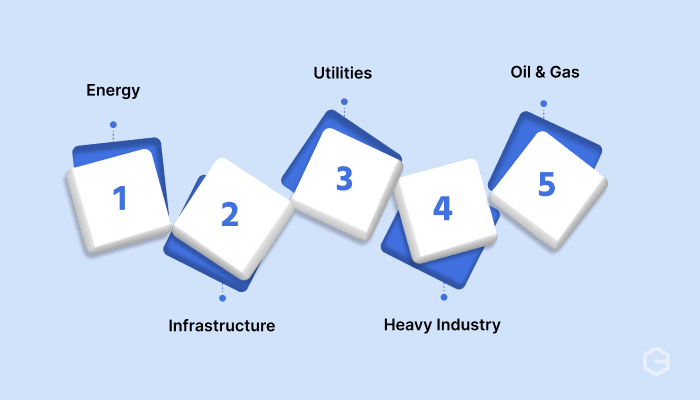
Project finance is particularly well-suited to industries with predictable cash flows and defined revenue models. Some of the main sectors include:
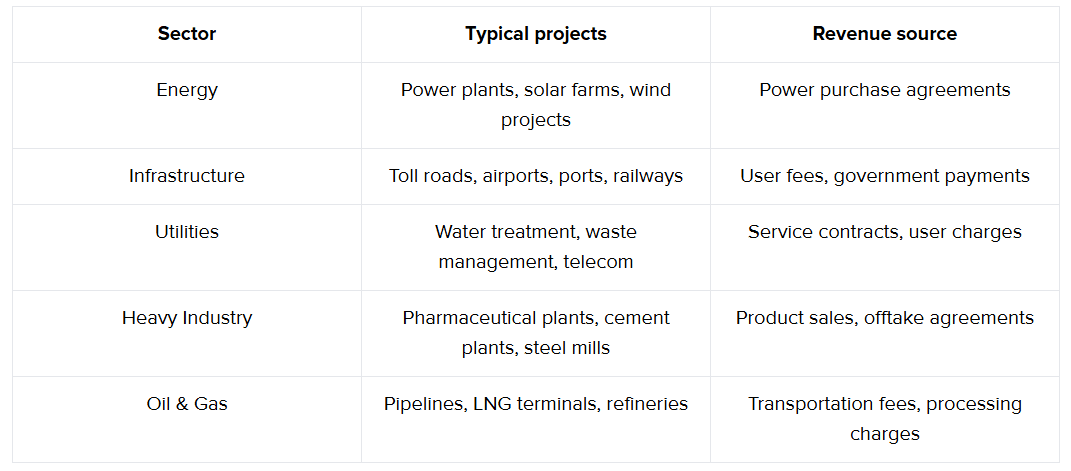
Let’s take a detailed look at the sectors where project finance is most common:
Power generation projects dominate project finance. Solar farms, wind projects, hydroelectric dams, and conventional power plants all use this structure. These projects sign long-term power purchase agreements with utilities or large consumers, creating predictable revenue streams that lenders can underwrite confidently.
For example, a solar power company developing a 500 MW project might create an SPV, secure a 25-year power purchase agreement with a state utility, and raise debt based on those guaranteed cash flows.
Roads, bridges, airports, seaports, and railway systems require massive upfront investment but generate steady toll revenues or usage fees over decades. Governments often partner with private sponsors through public-private partnerships structured as project finance.
For instance, a toll expressway project might collect fees from vehicles for 30 years, using that revenue to repay construction debt and provide returns to equity investors.
Water treatment plants, waste management facilities, and telecom networks serve essential needs with stable demand. These projects often have government offtake agreements or regulated pricing that provides revenue certainty.
For instance, a water treatment facility might operate under a 25-year agreement with a municipal government, guaranteeing payment for treated water at predetermined rates.
Large manufacturing facilities, pharmaceutical plants, cement plants, and steel mills use project finance when they have long-term supply contracts.
For example, a pharmaceutical company might develop a new manufacturing facility through an SPV backed by a 15-year supply agreement with healthcare distributors.
Pipelines, LNG terminals, refineries, and storage facilities rely on project finance for their capital-intensive development. These projects generate revenue through transportation fees, processing charges, or capacity leasing arrangements.
For instance, a cross-country gas pipeline might be financed based on long-term transportation agreements with energy companies.
Project finance and corporate finance serve different purposes and operate under different principles. Here's how they compare:
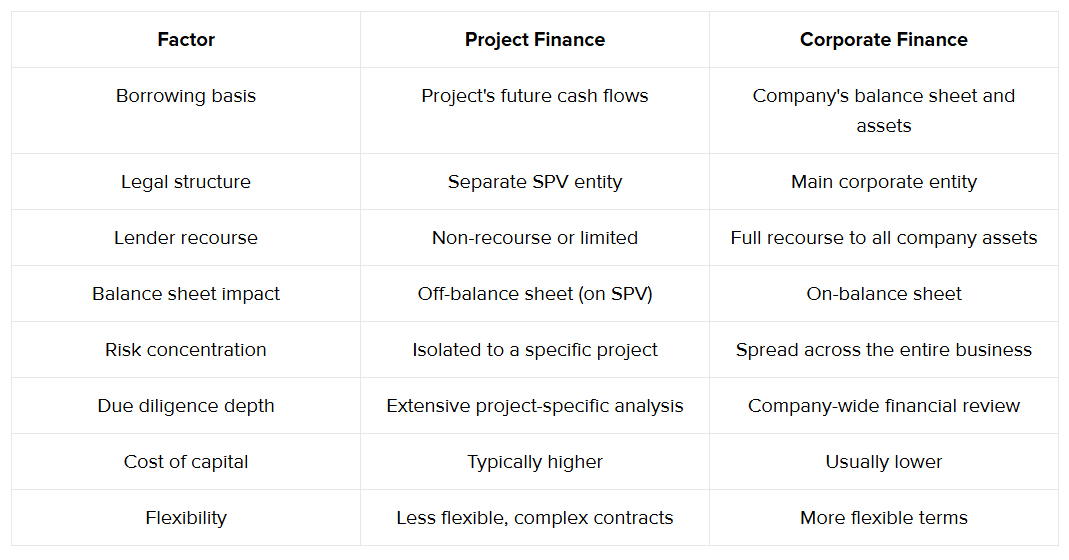
The key difference lies in how the financing is secured. Corporate finance relies on your company's overall creditworthiness, assets, and cash flows. Banks lend to you based on your balance sheet strength, business history, and ability to repay from any of your revenue sources.
Project finance, by contrast, evaluates one specific project in isolation. Lenders analyze whether that particular wind farm, toll road, or manufacturing plant can generate enough cash to repay the debt. Your company's other operations matter less.
As these financing structures grow more complex, managing payment flows across currencies and borders becomes increasingly important. International lenders, overseas contractors, and foreign investors all require efficient, compliant payment processing throughout the project lifecycle.
No large-scale venture is without its hurdles. Success in project finance isn't about avoiding these risks, but identifying them early and assigning them to the right partners before they affect your project's profitability.
Knowing these risks helps you structure deals more effectively:
Successful project finance structures address these risks through detailed contracts, insurance, performance guarantees, and careful risk allocation to parties best positioned to manage each type.
Large-scale projects involve complex payment flows across multiple currencies, countries, and stakeholders. When you're coordinating with international equipment suppliers, overseas contractors, foreign consultants, and global investors, traditional payment methods create delays, compliance headaches, and tracking difficulties.
PayGlocal provides the payment infrastructure project sponsors need to operate efficiently across borders. Whether you're collecting milestone payments from international partners or managing vendor payments across currencies, PayGlocal simplifies the entire process.
Here's how PayGlocal supports project finance operations:
PayGlocal helps project sponsors reduce transaction costs, maintain compliance across jurisdictions, and gain complete visibility into their global payment flows. As projects scale and complexity increases, having a reliable payment infrastructure becomes as important as the project finance structure itself.
Project finance gives you a proven path to fund large-scale ventures without putting your entire business at risk. The SPV structure, separate project lending, and careful risk allocation create a framework where ambitious projects become financially viable.
Whether you're developing energy infrastructure, building industrial facilities, or launching utility projects, project finance offers the capital access and risk management you need. The key is planning properly, structuring contracts carefully, and working with experienced advisors who know this specialized field.
As you manage these complex projects across borders and currencies, having the right payment infrastructure makes a real difference. PayGlocal helps you collect from international clients, manage compliance seamlessly, and track every transaction with complete transparency.
Ready to manage your project's global payments more efficiently? Get started with PayGlocal today and see how easy international payment collection can be.
With international project finance deals in India surging by 64%, the message is clear that the world's most ambitious builders are isolating risk to accelerate growth.
If you're ready to move beyond traditional debt, this guide will help you master the project finance structure.
Key takeaways
- Project finance definition: Project finance is a funding method where lenders rely on a project's future cash flows for repayment, not the sponsor's balance sheet.
- Special Purpose Vehicle (SPV) structure: Projects are housed in separate entities called SPVs that isolate financial risk from parent companies.
- Risk allocation framework: Construction, operational, and market risks are distributed among sponsors, lenders, contractors, and off-takers through contracts.
- Long-term capital structure: Project finance suits capital-intensive ventures with high upfront costs and extended operational periods, like energy and infrastructure.
- Payment infrastructure solution: PayGlocal helps project sponsors manage multi-currency collections, compliance documentation, and transparent payment tracking across 180+ countries.
What is project finance?
Project finance is a funding structure where a large-scale project is financed based on its expected future cash flows rather than the credit or assets of the companies sponsoring it. The project operates through a separate entity, and lenders evaluate the project's viability independently.
Unlike traditional corporate loans, where your entire business serves as collateral, project finance isolates the investment. A Special Purpose Vehicle (SPV) is created specifically to own, develop, and operate the project. This SPV borrows money, signs contracts, and generates revenue independently from your main business operations.
For instance, if you're developing a wind farm, you'd establish an SPV to manage everything related to that wind farm. The SPV borrows funds from banks or financial institutions, signs contracts with equipment suppliers and energy buyers, and uses revenue from selling electricity to repay the debt. Your parent company's other assets remain protected if something goes wrong with the wind farm.
This structure is common in infrastructure, energy, utilities, and heavy industry, where projects require hundreds of millions or billions in upfront capital but generate steady, predictable cash flows over 20-30 years.
How does project finance work?
Project finance follows a structured process that balances risk and return among multiple parties. Here's how the process unfolds:
- Project identification and feasibility: Sponsors evaluate whether the project can generate sufficient cash flows to cover costs and repay debt.
- SPV creation: A new legal entity is formed specifically to develop, own, and operate the project as an independent company.
- Funding structure development: The SPV raises capital through equity from sponsors and debt from banks, typically using 70-80% debt and 20-30% equity.
- Contract negotiation: The SPV enters detailed agreements with contractors, suppliers, off-takers, and operators to lock in costs and revenues.
- Construction execution: The project is built according to plan, with contractors managing construction risk through fixed-price contracts.
- Revenue generation: Once operational, the project generates cash flows from contracted buyers or users at predetermined rates.
- Payment waterfall management: Cash flows follow a strict priority, operating expenses first, then debt service, then equity returns to sponsors.
Payment management becomes complex when projects involve international parties. For instance, an infrastructure project in India might have equipment suppliers in Germany, consultants in the UK, and investors in the UAE. Managing these international payments while maintaining compliance requires specialized payment solutions.
What are the benefits of project finance?
Growing a massive project shouldn't put your entire company at risk. Project finance gives you a way to fund big ideas while keeping them separate from everything else you've built. Here are some of the main benefits:
- Risk limitation for sponsors: Separate financing means your exposure is limited to your equity investment, protecting your other business assets if the project underperforms.
- Balance sheet preservation: Keeping project debt off your main balance sheet maintains your credit ratios and borrowing capacity for other opportunities.
- Access to larger capital pools: The project finance structure attracts specialized lenders and investors who wouldn't necessarily fund your corporate borrowing.
- Disciplined project execution: The rigorous due diligence, contracting, and monitoring requirements that lenders demand often lead to better project outcomes.
- Tax optimization opportunities: SPV structures can be designed to maximize tax efficiency across jurisdictions where the project operates or where investors are based.
- Risk transfer mechanisms: Contractual arrangements let you transfer specific risks to parties with expertise in managing them, like construction risk to experienced contractors.
- Long-term financing alignment: Debt repayment schedules match the project's cash flow generation timeline, avoiding mismatches between obligations and revenues.
- Multiple project capacity: You can pursue several project finance deals simultaneously without straining your corporate balance sheet.
These benefits make project finance attractive for large-scale ventures where traditional corporate financing would either be unavailable or would put too much strain on your company's balance sheet. The structure provides flexibility while managing risk effectively.
What sectors commonly use project finance?
Project finance is particularly well-suited to industries with predictable cash flows and defined revenue models. Some of the main sectors include:
Let’s take a detailed look at the sectors where project finance is most common:
Energy sector
Power generation projects dominate project finance. Solar farms, wind projects, hydroelectric dams, and conventional power plants all use this structure. These projects sign long-term power purchase agreements with utilities or large consumers, creating predictable revenue streams that lenders can underwrite confidently.
For example, a solar power company developing a 500 MW project might create an SPV, secure a 25-year power purchase agreement with a state utility, and raise debt based on those guaranteed cash flows.
Infrastructure development
Roads, bridges, airports, seaports, and railway systems require massive upfront investment but generate steady toll revenues or usage fees over decades. Governments often partner with private sponsors through public-private partnerships structured as project finance.
For instance, a toll expressway project might collect fees from vehicles for 30 years, using that revenue to repay construction debt and provide returns to equity investors.
Utilities and telecommunications
Water treatment plants, waste management facilities, and telecom networks serve essential needs with stable demand. These projects often have government offtake agreements or regulated pricing that provides revenue certainty.
For instance, a water treatment facility might operate under a 25-year agreement with a municipal government, guaranteeing payment for treated water at predetermined rates.
Heavy industrial projects
Large manufacturing facilities, pharmaceutical plants, cement plants, and steel mills use project finance when they have long-term supply contracts.
For example, a pharmaceutical company might develop a new manufacturing facility through an SPV backed by a 15-year supply agreement with healthcare distributors.
Oil and gas infrastructure
Pipelines, LNG terminals, refineries, and storage facilities rely on project finance for their capital-intensive development. These projects generate revenue through transportation fees, processing charges, or capacity leasing arrangements.
For instance, a cross-country gas pipeline might be financed based on long-term transportation agreements with energy companies.
What is the difference between project finance and corporate finance?
Project finance and corporate finance serve different purposes and operate under different principles. Here's how they compare:
The key difference lies in how the financing is secured. Corporate finance relies on your company's overall creditworthiness, assets, and cash flows. Banks lend to you based on your balance sheet strength, business history, and ability to repay from any of your revenue sources.
Project finance, by contrast, evaluates one specific project in isolation. Lenders analyze whether that particular wind farm, toll road, or manufacturing plant can generate enough cash to repay the debt. Your company's other operations matter less.
As these financing structures grow more complex, managing payment flows across currencies and borders becomes increasingly important. International lenders, overseas contractors, and foreign investors all require efficient, compliant payment processing throughout the project lifecycle.
What are the main risks in project finance?
No large-scale venture is without its hurdles. Success in project finance isn't about avoiding these risks, but identifying them early and assigning them to the right partners before they affect your project's profitability.
Knowing these risks helps you structure deals more effectively:
- Construction risk: Projects might face delays, cost overruns, or technical failures during the building phase before any revenue begins.
- Operational risk: Even well-built projects can underperform due to equipment failures, management issues, or higher-than-expected operating costs.
- Market risk: Revenue assumptions might not materialize if demand is lower than projected, prices fall, or competition increases.
- Regulatory risk: Government policy changes, permit revocations, or political instability can disrupt project operations or revenue streams.
- Financial risk: Interest rate fluctuations, currency movements, or refinancing challenges can affect project economics.
- Completion risk: The project might not reach the operational stage at all due to unforeseen technical, financial, or regulatory obstacles.
- Counterparty risk: Key parties like off-takers, suppliers, or operators might default on their contractual obligations.
- Force majeure risk: Natural disasters, pandemics, or other extraordinary events can halt operations temporarily or permanently.
Successful project finance structures address these risks through detailed contracts, insurance, performance guarantees, and careful risk allocation to parties best positioned to manage each type.
Manage project payments efficiently with PayGlocal
Large-scale projects involve complex payment flows across multiple currencies, countries, and stakeholders. When you're coordinating with international equipment suppliers, overseas contractors, foreign consultants, and global investors, traditional payment methods create delays, compliance headaches, and tracking difficulties.
PayGlocal provides the payment infrastructure project sponsors need to operate efficiently across borders. Whether you're collecting milestone payments from international partners or managing vendor payments across currencies, PayGlocal simplifies the entire process.
Here's how PayGlocal supports project finance operations:
- Multi-currency accounts: Collect payments in 33+ currencies from 180+ countries, giving you flexibility to work with global stakeholders.
- Instant compliance documentation: Receive Foreign Inward Remittance Certificate (FIRC) automatically in your inbox after settlement, eliminating paperwork delays and compliance concerns.
- Sanction screening: Verify business partners and vendors against global sanction lists with privacy-first zero-knowledge-proof technology for compliance and risk management.
- Recurring payments for ongoing contracts: Automate regular payment collection from clients with subscription or milestone-based billing.
- One platform for complete visibility: Manage all your international payment operations, reporting, and compliance from a single dashboard.
PayGlocal helps project sponsors reduce transaction costs, maintain compliance across jurisdictions, and gain complete visibility into their global payment flows. As projects scale and complexity increases, having a reliable payment infrastructure becomes as important as the project finance structure itself.
Final thoughts
Project finance gives you a proven path to fund large-scale ventures without putting your entire business at risk. The SPV structure, separate project lending, and careful risk allocation create a framework where ambitious projects become financially viable.
Whether you're developing energy infrastructure, building industrial facilities, or launching utility projects, project finance offers the capital access and risk management you need. The key is planning properly, structuring contracts carefully, and working with experienced advisors who know this specialized field.
As you manage these complex projects across borders and currencies, having the right payment infrastructure makes a real difference. PayGlocal helps you collect from international clients, manage compliance seamlessly, and track every transaction with complete transparency.
Ready to manage your project's global payments more efficiently? Get started with PayGlocal today and see how easy international payment collection can be.