
Handling recurring payments can quickly become one of the most frustrating parts of running a business. For many companies, managing subscriptions, memberships, or recurring billing involves dealing with inconsistent payment cycles and missed transactions. This complexity only increases as businesses grow and expand into new markets.
Research shows that payment failures can cost businesses significantly, with false declines putting as much as $157 billion in U.S. payment revenue at risk.
In this blog, we’ll explore what recurring billing is, the different types of businesses that use it, and the benefits that come with adopting an organized approach. We’ll also look at a case study of how real companies are using this model to enhance their payment processes, reduce friction, and improve cash flow.
Recurring billing is a payment model that allows businesses to automatically charge customers at regular intervals for a product or service. Unlike one-time transactions, recurring payments are processed consistently.
This approach is commonly used for subscription-based services, memberships, and utility payments. It simplifies cash flow management by providing predictable, automated revenue, reducing the need for manual invoicing and follow-ups.
For businesses, this model helps in improving efficiency and minimizing payment delays, while for customers, it offers convenience and uninterrupted access to the service or product.
Recurring payments are all about making things easier for both businesses and customers. The goal is to set up automatic, repeat transactions so you don’t have to worry about handling payments manually every time.
Understanding how they work and when to use them can help you take full advantage of the system. Here’s a quick breakdown:
1. Customer Setup: The customer subscribes to a service or product and provides their payment details just once.
2. Authorization: The payment system securely stores the details and receives authorization to charge the customer at regular intervals.
3. Automated Billing: On the agreed schedule, whether it's monthly, quarterly, or annually, the payment transaction processing is automatically done, reducing manual tracking and invoicing.
4. Ongoing Management: The system also handles renewals, cancellations, or changes to the subscription. This cycle continues until the customer cancels the service or the business modifies the terms of the agreement.
After setup, the system automatically processes payments, thereby minimizing friction for both businesses and customers and reducing administrative overhead. The different models allow businesses to align their pricing strategy with how customers consume their products or services.
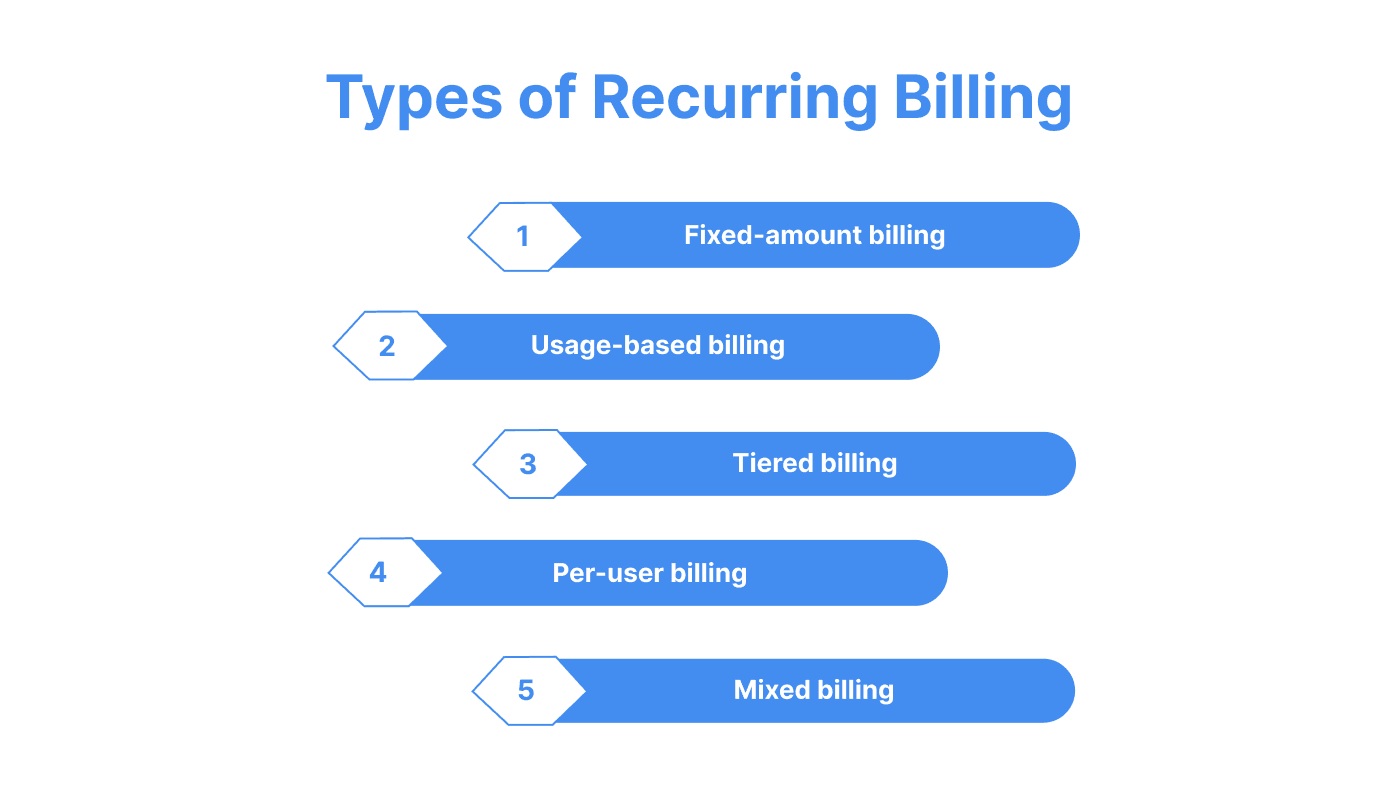
Recurring billing models vary based on business needs, customer expectations, and the nature of the service being offered. Let’s explore the most common types, with examples that align with real-world business scenarios across different industries:
In this model, customers are charged a set amount at regular intervals. It's often used for subscription-based services where the pricing is straightforward and predictable.
Example: A travel agency offering an annual subscription for VIP travel deals, where customers pay a fixed amount each year for access to exclusive discounts and services.
This type of billing charges customers based on how much service they use. It's ideal for services where usage varies from customer to customer.
Example: Cloud storage services like Dropbox or Amazon Web Services (AWS), where the customer is billed based on how much data is stored or used.
Tiered billing involves offering several pricing plans that scale with usage, volume, or features. Each tier provides a specific set of services, and customers pay according to the tier they choose.
Example: An exporter expanding into new global markets might choose a payment processing service that offers tiered pricing based on the number of countries they are selling to or the volume of international transactions processed each month.
This model charges based on the number of users accessing the service, and it's commonly used in SaaS platforms or collaborative services where each user requires an individual license.
Example: A project management tool like Asana or Slack, where businesses are billed for each team member using the service.
Mixed billing combines multiple types of billing models. This allows businesses to offer a base service for a fixed price, then charge extra for additional usage or premium features.
Example: An enterprise-level business that uses a global payments platform might pay a fixed monthly fee for basic payment processing services, but additional fees could apply for features like fraud detection, risk screening, or multi-currency for high-volume international transactions.
Beyond the flexibility in billing structures, implementing recurring payments delivers measurable advantages that extend far beyond simple payment automation.
Switching to recurring billing shifts payments from one-off transactions to automated, “set-and-forget” charges. This transition brings a range of strategic, operational, and customer-focused benefits, helping businesses grow faster than ever before.
Automated renewals create a stable, annuity-like income stream that’s far easier to forecast than unpredictable sales. Businesses can model Monthly/Annual Recurring Revenue, identify seasonal trends early, and plan key operations like hiring, inventory, and capital needs with more confidence.
Regular, automated payments provide a steady cash flow, reducing reliance on working capital. This lower-risk, predictable model makes the business more appealing to lenders and investors.
Automating billing reduces manual tasks like invoice creation, chasing payments, and bank reconciliation. Merchants also lower card-processing fees with tokenized transactions and bulk authorizations.
Stored payment details, account-updater services, and retry logic reduce declines, ensuring businesses capture revenue that would otherwise be lost to late or failed payments.
Recurring billing generates detailed data on customer behavior, allowing businesses to run pricing experiments, segment audiences, and proactively address churn.
A single system can support thousands of subscribers without adding extra workload. When business grows, the billing engine absorbs the volume, not your back-office staff.
These benefits depend heavily on having a solid payment infrastructure that can reliably process transactions, handle edge cases, and adapt to global requirements.
Also Read: Payment Tokenization: How It Works and Its Benefits
The payment processor is crucial to the success of any recurring billing system, directly influencing revenue security, customer retention, and business scalability.
1. Payment Success Rates and Revenue Protection: The right processor offers high transaction approval rates, protecting businesses from the financial losses caused by payment failures.
2. Involuntary Churn Prevention: Payment processors with intelligent retry mechanisms and account updater services reduce churn by recovering failed payments and safeguarding customer relationships.
3. Security and Compliance: A processor handles sensitive customer data securely, adhering to PCI DSS compliance standards and employing advanced fraud detection systems like tokenization and 3D Secure.
4. Scalability and Integration: As businesses grow, a flexible processor with strong APIs and integration helps scale recurring billing operations without added complexity.
5. Global Reach and Multi-Currency Support: A good processor supports multiple currencies and local payment methods (like Giropay, SOFORT), which facilitate smooth cross-border transactions and global business expansion.
6. Subscription Management and Advanced Features: Features like automated billing cycles, collection of overdue payments, and customer self-service portals streamline operations and improve customer experiences.
Let’s now take a look at an example that demonstrates how the right payment processor can transform a company's international growth path and customer satisfaction metrics.
PayGlocal has had significant success in implementing recurring payment solutions for various businesses in cross-border scenarios. Their recurring payments platform supports both fixed and variable billing models for international transactions.
Codeyoung Partnership Success Story: One of PayGlocal's most notable implementations involved partnering with Codeyoung, an ed-tech company providing live coding and STEM classes to students globally.
Challenge: Codeyoung was experiencing payment success rate issues with international customers, achieving only a 75% success rate for international payments, which was impacting their ability to serve parents worldwide who wanted to enroll their children in classes.
PayGlocal Solution: By integrating PayGlocal's advanced payment infrastructure, including its recurring payment subscriptions, Codeyoung was able to:
Results: The partnership enabled Codeyoung to focus on its core mission of empowering young learners while PayGlocal handled the complexities of cross-border payment processing, fraud management, and settlements.
Recurring billing offers businesses a streamlined, efficient approach to managing subscriptions and payments. With benefits like predictable revenue, reduced churn, and improved cash flow, it has become an essential model for businesses aiming to scale.
Choosing the right payment processor is key to ensuring seamless transaction management, security, and growth potential. With the right tools in place, businesses can enhance customer experience and operational efficiency, all while driving sustainable growth.
Ready to streamline your recurring billing and boost revenue predictability? Get started with PayGlocal today and simplify your payment processes for seamless, scalable growth.
Research shows that payment failures can cost businesses significantly, with false declines putting as much as $157 billion in U.S. payment revenue at risk.
In this blog, we’ll explore what recurring billing is, the different types of businesses that use it, and the benefits that come with adopting an organized approach. We’ll also look at a case study of how real companies are using this model to enhance their payment processes, reduce friction, and improve cash flow.
Key Takeaways
- Recurring Billing Supports Predictable Revenue: Automates payments, providing steady cash flow and reducing manual invoicing.
- Payment Processors Impact Success: Choosing the right processor ensures higher payment success rates and reduces fraud.
- Flexible Billing Models: Fixed, usage-based, and tiered billing options help businesses align with customer needs and maximize profit.
- Dunning Systems Recover Failed Payments: Automated systems reduce churn and recover up to 70% of failed transactions.
- Multi-Currency Drives Global Growth: Payment processors with multi-currency support streamline international transactions and expansion.
What Is Recurring Billing?
Recurring billing is a payment model that allows businesses to automatically charge customers at regular intervals for a product or service. Unlike one-time transactions, recurring payments are processed consistently.
This approach is commonly used for subscription-based services, memberships, and utility payments. It simplifies cash flow management by providing predictable, automated revenue, reducing the need for manual invoicing and follow-ups.
For businesses, this model helps in improving efficiency and minimizing payment delays, while for customers, it offers convenience and uninterrupted access to the service or product.
How Does Recurring Payment Work?
Recurring payments are all about making things easier for both businesses and customers. The goal is to set up automatic, repeat transactions so you don’t have to worry about handling payments manually every time.
Understanding how they work and when to use them can help you take full advantage of the system. Here’s a quick breakdown:
1. Customer Setup: The customer subscribes to a service or product and provides their payment details just once.
2. Authorization: The payment system securely stores the details and receives authorization to charge the customer at regular intervals.
3. Automated Billing: On the agreed schedule, whether it's monthly, quarterly, or annually, the payment transaction processing is automatically done, reducing manual tracking and invoicing.
4. Ongoing Management: The system also handles renewals, cancellations, or changes to the subscription. This cycle continues until the customer cancels the service or the business modifies the terms of the agreement.
After setup, the system automatically processes payments, thereby minimizing friction for both businesses and customers and reducing administrative overhead. The different models allow businesses to align their pricing strategy with how customers consume their products or services.
Types of Recurring Billing
Recurring billing models vary based on business needs, customer expectations, and the nature of the service being offered. Let’s explore the most common types, with examples that align with real-world business scenarios across different industries:
1. Fixed-Amount Billing
In this model, customers are charged a set amount at regular intervals. It's often used for subscription-based services where the pricing is straightforward and predictable.
Example: A travel agency offering an annual subscription for VIP travel deals, where customers pay a fixed amount each year for access to exclusive discounts and services.
2. Usage-Based Billing
This type of billing charges customers based on how much service they use. It's ideal for services where usage varies from customer to customer.
Example: Cloud storage services like Dropbox or Amazon Web Services (AWS), where the customer is billed based on how much data is stored or used.
3.Tiered Billing
Tiered billing involves offering several pricing plans that scale with usage, volume, or features. Each tier provides a specific set of services, and customers pay according to the tier they choose.
Example: An exporter expanding into new global markets might choose a payment processing service that offers tiered pricing based on the number of countries they are selling to or the volume of international transactions processed each month.
4. Per-User Billing
This model charges based on the number of users accessing the service, and it's commonly used in SaaS platforms or collaborative services where each user requires an individual license.
Example: A project management tool like Asana or Slack, where businesses are billed for each team member using the service.
5. Mixed Billing
Mixed billing combines multiple types of billing models. This allows businesses to offer a base service for a fixed price, then charge extra for additional usage or premium features.
Example: An enterprise-level business that uses a global payments platform might pay a fixed monthly fee for basic payment processing services, but additional fees could apply for features like fraud detection, risk screening, or multi-currency for high-volume international transactions.
Beyond the flexibility in billing structures, implementing recurring payments delivers measurable advantages that extend far beyond simple payment automation.
What Are the Benefits of Recurring Billing?
Switching to recurring billing shifts payments from one-off transactions to automated, “set-and-forget” charges. This transition brings a range of strategic, operational, and customer-focused benefits, helping businesses grow faster than ever before.
1. Predictable, Compound Revenue
Automated renewals create a stable, annuity-like income stream that’s far easier to forecast than unpredictable sales. Businesses can model Monthly/Annual Recurring Revenue, identify seasonal trends early, and plan key operations like hiring, inventory, and capital needs with more confidence.
2. Higher Customer Lifetime Value (CLV)
- Reduced churn: Since customers must actively cancel, attrition rates drop.
- Easier upsell/cross-sell: With payment details already on file, adding new tiers or services becomes a one-click process, increasing average order value.
- Loyalty flywheel: Continuous service combined with hassle-free payments strengthens brand loyalty and customer retention.
3. Superior Cash Flow & Investor Appeal
Regular, automated payments provide a steady cash flow, reducing reliance on working capital. This lower-risk, predictable model makes the business more appealing to lenders and investors.
4. Lower Operating Costs
Automating billing reduces manual tasks like invoice creation, chasing payments, and bank reconciliation. Merchants also lower card-processing fees with tokenized transactions and bulk authorizations.
5. Fewer Failed or Late Payments
Stored payment details, account-updater services, and retry logic reduce declines, ensuring businesses capture revenue that would otherwise be lost to late or failed payments.
6. Rich Usage & Revenue Analytics
Recurring billing generates detailed data on customer behavior, allowing businesses to run pricing experiments, segment audiences, and proactively address churn.
7. Scalability Without Friction
A single system can support thousands of subscribers without adding extra workload. When business grows, the billing engine absorbs the volume, not your back-office staff.
8. Customer-Side Benefits
- Convenience: One-time sign-up with no need for monthly reminders.
- Budget Control: Transparent charges, whether fixed or variable, help customers better manage their budgets.
- Service Continuity: Auto-renewal provides uninterrupted service, preventing accidental loss (e.g., streaming services or utilities).
These benefits depend heavily on having a solid payment infrastructure that can reliably process transactions, handle edge cases, and adapt to global requirements.
Also Read: Payment Tokenization: How It Works and Its Benefits
Why Does Choosing the Right Payment Processor Matter for Recurring Billing?
The payment processor is crucial to the success of any recurring billing system, directly influencing revenue security, customer retention, and business scalability.
Critical Impact Areas of Payment Processor Selection
1. Payment Success Rates and Revenue Protection: The right processor offers high transaction approval rates, protecting businesses from the financial losses caused by payment failures.
2. Involuntary Churn Prevention: Payment processors with intelligent retry mechanisms and account updater services reduce churn by recovering failed payments and safeguarding customer relationships.
3. Security and Compliance: A processor handles sensitive customer data securely, adhering to PCI DSS compliance standards and employing advanced fraud detection systems like tokenization and 3D Secure.
4. Scalability and Integration: As businesses grow, a flexible processor with strong APIs and integration helps scale recurring billing operations without added complexity.
5. Global Reach and Multi-Currency Support: A good processor supports multiple currencies and local payment methods (like Giropay, SOFORT), which facilitate smooth cross-border transactions and global business expansion.
6. Subscription Management and Advanced Features: Features like automated billing cycles, collection of overdue payments, and customer self-service portals streamline operations and improve customer experiences.
Let’s now take a look at an example that demonstrates how the right payment processor can transform a company's international growth path and customer satisfaction metrics.
PayGlocal: Enhancing Recurring Payments
PayGlocal has had significant success in implementing recurring payment solutions for various businesses in cross-border scenarios. Their recurring payments platform supports both fixed and variable billing models for international transactions.
Codeyoung Partnership Success Story: One of PayGlocal's most notable implementations involved partnering with Codeyoung, an ed-tech company providing live coding and STEM classes to students globally.
Challenge: Codeyoung was experiencing payment success rate issues with international customers, achieving only a 75% success rate for international payments, which was impacting their ability to serve parents worldwide who wanted to enroll their children in classes.
PayGlocal Solution: By integrating PayGlocal's advanced payment infrastructure, including its recurring payment subscriptions, Codeyoung was able to:
- Increase payment success rates from 75% to an impressive 95%
- Implement features like standing instructions for automated recurring card payments
- Achieve faster settlements
- Enable dynamic checkout processes for international customers
Results: The partnership enabled Codeyoung to focus on its core mission of empowering young learners while PayGlocal handled the complexities of cross-border payment processing, fraud management, and settlements.
Final Thoughts
Recurring billing offers businesses a streamlined, efficient approach to managing subscriptions and payments. With benefits like predictable revenue, reduced churn, and improved cash flow, it has become an essential model for businesses aiming to scale.
Choosing the right payment processor is key to ensuring seamless transaction management, security, and growth potential. With the right tools in place, businesses can enhance customer experience and operational efficiency, all while driving sustainable growth.
Ready to streamline your recurring billing and boost revenue predictability? Get started with PayGlocal today and simplify your payment processes for seamless, scalable growth.