

As a freelancer or nonresident earning income from U.S. clients, the threat of excessive tax deductions can be a major concern for your hard-earned money. Without the right tools and knowledge, the standard 30% withholding tax can chip away at your profits, leaving you frustrated and underpaid. But here's the good news: the W-8 form can help you take control.
In this blog, we’ll break down what W-8 forms are, why they matter, and how understanding these forms can help you minimize U.S. tax withholding.
Global Tax Treaty Advantages: The U.S. has treaties with 67 countries, offering reduced or zero withholding rates on various income types.
W-8 forms are IRS documents used by non-U.S. individuals and entities that receive income from U.S. sources. These forms certify that the individual or business is not a U.S. person, helping them claim reduced withholding tax rates or exemptions under tax treaties between the U.S. and their home country.
For Example, Raj, a freelancer from India, is hired by a U.S. client for consulting services. Without submitting a W-8 form, his U.S. client would withhold 30% of his payment. By completing the form and citing the India-U.S. tax treaty, Raj can claim a 0% withholding tax. This allows him to avoid unnecessary tax deductions and retain a larger portion of his earnings.
The primary purpose of W-8 forms is to ensure that U.S. payers (such as clients or financial institutions) withhold the correct amount of tax. By submitting the appropriate W-8 form, non-residents can legally reduce or eliminate tax deductions.
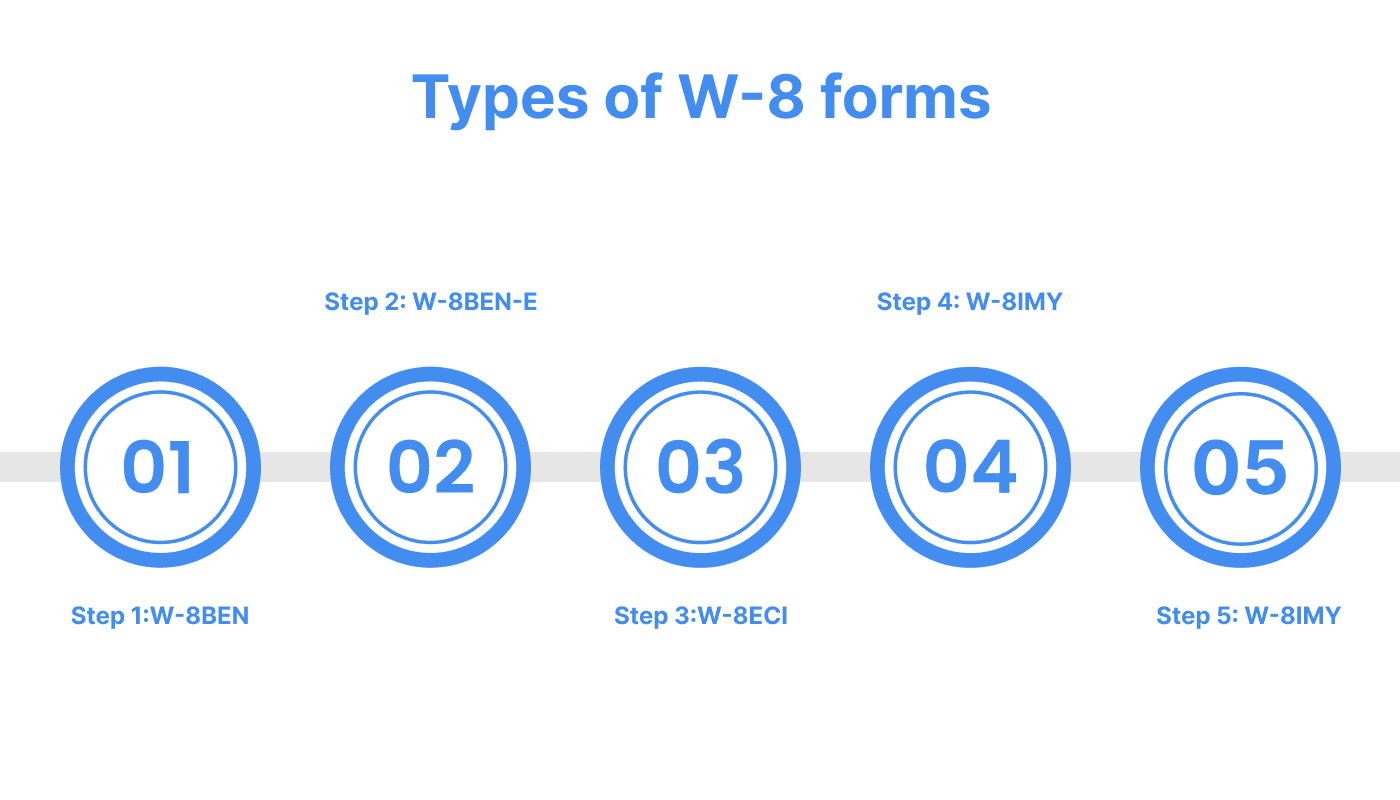
The W-8 series consists of five distinct forms, each designed for specific types of foreign persons and income situations. Foreign individuals or businesses that fail to submit the appropriate W-8 form may face the full 30% withholding rate on eligible income types, even if they qualify for reduced rates under tax treaties.
-
-
Also Read: Opening a Bank Account in the U.S. as a Foreigner or Non-Resident
Identifying the correct form is only half the battle. The real challenge lies in completing it accurately and submitting it properly. Even minor errors or omissions can result in the default 30% withholding rate being applied.
To file a W-8 form, the version you use depends on whether you're an individual or a business, as well as the type of income you receive.
For freelancers or non-US residents, Form W-8BEN is used, while businesses or entities use Form W-8BEN-E. After selecting the appropriate form, complete it with accurate details such as the following:
Once filled out, submit the form directly to your U.S. withholding agent or payer, not the IRS. Ensure the form is signed and dated, as unsigned forms are invalid. If your details change, submit an updated form within 30 days to avoid potential issues.
Also Read: How to file Income Tax Returns (ITR) for freelancers in India
While the filling process is straightforward, many freelancers make critical errors that can delay or invalidate their applications.
Filing W-8 forms correctly is crucial for foreign individuals and entities to ensure proper tax withholding and compliance. Here are some common mistakes to watch out for:
Beyond avoiding these pitfalls, it's worth understanding why proper W-8 form submission matters so much. The advantages extend far beyond simple tax savings.
The W-8 form is essential for confirming foreign status, claiming tax treaty benefits, and more. Filing the correct W-8 form offers several advantages, including:
The extent of these benefits depends on your country of residence and the specific tax treaty provisions in place. Different countries have negotiated varying levels of tax relief with the United States.
According to the official IRS and Treasury Department, the United States has income tax treaties with 67 countries/jurisdictions that are currently in effect. These treaties provide reduced tax rates or exemptions from U.S. taxes on certain types of income for residents of treaty countries. Here are some top countries:
Refer to the complete list of countries in case it is not in the top 10.
The India-U.S. Income Tax Treaty, effective from January 1, 1991, is a bilateral agreement aimed at preventing double taxation and fostering cross-border economic cooperation. This treaty ensures that individuals and entities are not taxed twice on the same income earned in both countries.
As a freelancer or non-U.S. resident, receiving payments from U.S. clients can be costly and slow due to bank fees and foreign exchange markups. With PayGlocal, you can avoid these hassles.
After filling out the W-8 form, you can receive payments directly into your PayGlocal account with no SWIFT charges. We offer real-time forex rates with no markups and provide instant FIRAs for every transaction.
Additionally, PayGlocal supports local payment methods, giving your clients flexible payment options while ensuring quick and seamless transfers to you.
Dealing with U.S. tax withholding can be complicated for freelancers and non-U.S. residents. However, understanding and filing the correct W-8 form helps reduce tax deductions and keeps you compliant with U.S. tax laws. By filing the right W-8 form, you can take advantage of tax treaty benefits, avoid double taxation, and retain more of your income.
PayGlocal makes it easier for freelancers and non-residents to receive payments. With multi-currency support, real-time forex rates, and low fees, you can get paid faster and keep more of your earnings. Get started today and simplify your global payments!
In this blog, we’ll break down what W-8 forms are, why they matter, and how understanding these forms can help you minimize U.S. tax withholding.
Key takeaways:
- W-8 Forms are Crucial for Non-U.S. Freelancers and Businesses: These forms help claim tax treaty benefits, reducing the standard 30% U.S. withholding tax on income.
- Different Forms for Different Entities: Freelancers use W-8BEN, while businesses may need W-8BEN-E, W-8ECI, or others, depending on income type and status.
- Accurate Completion is Key: Ensure correct details, tax IDs, and signatures to avoid delays or invalid forms that could result in full withholding tax.
- Tax Benefits through W-8 Forms: Submitting these forms helps reduce or eliminate tax withholding based on applicable tax treaties.
Global Tax Treaty Advantages: The U.S. has treaties with 67 countries, offering reduced or zero withholding rates on various income types.
What is the meaning and purpose of W-8 forms?
W-8 forms are IRS documents used by non-U.S. individuals and entities that receive income from U.S. sources. These forms certify that the individual or business is not a U.S. person, helping them claim reduced withholding tax rates or exemptions under tax treaties between the U.S. and their home country.
For Example, Raj, a freelancer from India, is hired by a U.S. client for consulting services. Without submitting a W-8 form, his U.S. client would withhold 30% of his payment. By completing the form and citing the India-U.S. tax treaty, Raj can claim a 0% withholding tax. This allows him to avoid unnecessary tax deductions and retain a larger portion of his earnings.
The primary purpose of W-8 forms is to ensure that U.S. payers (such as clients or financial institutions) withhold the correct amount of tax. By submitting the appropriate W-8 form, non-residents can legally reduce or eliminate tax deductions.
Types of W-8 forms
The W-8 series consists of five distinct forms, each designed for specific types of foreign persons and income situations. Foreign individuals or businesses that fail to submit the appropriate W-8 form may face the full 30% withholding rate on eligible income types, even if they qualify for reduced rates under tax treaties.
W-8BEN (Individuals)
- Who Uses It: Non-U.S. residents receiving income from U.S. sources, including freelancers, independent contractors, and consultants.
- Purpose: Certifies foreign status and claims reduced withholding tax rates under tax treaties.
- Key Features: Requires foreign tax ID (e.g., PAN), date of birth, and U.S. TIN for treaty claims. Used for passive income like interest, dividends, and royalties.
W-8BEN-E (Entities)
- Who Uses It: Foreign entities (corporations, partnerships, etc.).
- Purpose: Similar to W-8BEN but for entities claiming reduced withholding tax rates.
- Key Features: More complex with FATCA compliance, requires detailed business info, and a foreign tax ID.
-
W-8ECI (Effectively Connected Income)
- Who Uses It: Indian individuals or entities with U.S. business operations, like exporters and enterprise owners.
- Purpose: Claims exemption from 30% withholding on income connected to U.S. business activities.
- Key Features: Income taxed at graduated rates; requires U.S. income tax returns.
W-8EXP (Foreign Governments and Exempt Organizations)
- Who Uses It: Foreign governments, international organizations, and tax-exempt entities.
- Purpose: Claims tax exemption or reduction based on IRS code sections.
- Key Features: Must qualify under specific IRS sections for exemption.
W-8IMY (Intermediaries and Flow-Through Entities)
- Who Uses It: Foreign intermediaries or entities receiving payments on behalf of others.
- Purpose: Certifies intermediary status and documents FATCA (Foreign Account Tax Compliance Act) status.
- Key Features: Does not claim tax exemptions; used for partnerships, trusts, and U.S. branches of foreign financial institutions.
-
Also Read: Opening a Bank Account in the U.S. as a Foreigner or Non-Resident
Identifying the correct form is only half the battle. The real challenge lies in completing it accurately and submitting it properly. Even minor errors or omissions can result in the default 30% withholding rate being applied.
How to fill out the W-8 form for an Indian freelancer or non-US resident
To file a W-8 form, the version you use depends on whether you're an individual or a business, as well as the type of income you receive.
For freelancers or non-US residents, Form W-8BEN is used, while businesses or entities use Form W-8BEN-E. After selecting the appropriate form, complete it with accurate details such as the following:
- Enter your full name and country of citizenship (e.g., India).
- Provide your permanent address and, if different, your mailing address.
- Enter your U.S. Taxpayer ID or foreign tax ID. If you don’t have a U.S. TIN, you can use your PAN as your foreign tax ID.
- Write "India" as your tax residence country.
- Specify the treaty article and reduce the tax withholding rate.
- Review, sign, date, and print your name.
Once filled out, submit the form directly to your U.S. withholding agent or payer, not the IRS. Ensure the form is signed and dated, as unsigned forms are invalid. If your details change, submit an updated form within 30 days to avoid potential issues.
Also Read: How to file Income Tax Returns (ITR) for freelancers in India
While the filling process is straightforward, many freelancers make critical errors that can delay or invalidate their applications.
Common mistakes when filing W-8 forms and how to avoid them
Filing W-8 forms correctly is crucial for foreign individuals and entities to ensure proper tax withholding and compliance. Here are some common mistakes to watch out for:
- Incomplete or Abbreviated Legal Entity Name: The entity name must match official formation documents. Avoid abbreviations unless they are commonly recognized (e.g., Ltd., S.A.).
- Incorrect Entity Type Selection: Choose the correct entity type (e.g., Corporation, Partnership) based on U.S. tax principles.
- Missing or Incorrect FATCA Status: Select the appropriate FATCA classification and provide the required information.
- Incomplete Address Information: Provide a complete address, including street, city, state/province, postal code, and country.
- Omitting Foreign Tax Identification Number (TIN): Include the foreign TIN unless exempted by your country's regulations.
- Failure to Sign and Date the Form: The form must be signed and dated by an authorized person.
- Providing Altered or Modified Forms: Avoid making alterations or modifications to mandatory information or certification language.
- Incorrectly Reporting Disregarded Entities: If filing for a disregarded entity, the single owner's name should be correctly reported.
- Providing Incorrect GIIN for Financial Institutions: For financial institutions, ensure the Global Intermediary Identification Number (GIIN) is accurate.
- Not Updating the Form After Changes in Circumstances: Notify the withholding agent within 30 days if any information on the form becomes incorrect.
Beyond avoiding these pitfalls, it's worth understanding why proper W-8 form submission matters so much. The advantages extend far beyond simple tax savings.
What are the benefits of W-8 forms?
The W-8 form is essential for confirming foreign status, claiming tax treaty benefits, and more. Filing the correct W-8 form offers several advantages, including:
- Establishing Foreign Status: The W-8 form confirms that the individual or entity is a foreign person, which is critical to claim any benefits from income tax treaties between the U.S. and the foreign country. Without this confirmation, you cannot access reduced tax rates.
- Claiming Tax Benefits: By submitting the W-8 form, you can reduce or eliminate the U.S. withholding tax, which is possible because of tax treaties between the U.S. and other countries (like India, Bangladesh, Australia, and others).
- Avoiding Double Taxation: The W-8 form helps avoid the standard 30% U.S. withholding tax and instead applies the tax treaty benefits that reduce or eliminate taxes.
- Compliance with U.S. Regulations: Filing the W-8 form is a requirement for non-U.S. persons earning income from the U.S. It ensures that the taxpayer complies with U.S. regulations by confirming their foreign status, allowing them to apply any applicable tax treaty benefits, and avoid penalties for non-compliance.
The extent of these benefits depends on your country of residence and the specific tax treaty provisions in place. Different countries have negotiated varying levels of tax relief with the United States.
List of countries having income tax treaties with the United States
According to the official IRS and Treasury Department, the United States has income tax treaties with 67 countries/jurisdictions that are currently in effect. These treaties provide reduced tax rates or exemptions from U.S. taxes on certain types of income for residents of treaty countries. Here are some top countries:
- India
- Japan
- Bangladesh
- Australia
- Germany
- Philippines
- South Africa
- Sri Lanka
- Thailand
- Turkey
Refer to the complete list of countries in case it is not in the top 10.
The India-U.S. Income Tax Treaty, effective from January 1, 1991, is a bilateral agreement aimed at preventing double taxation and fostering cross-border economic cooperation. This treaty ensures that individuals and entities are not taxed twice on the same income earned in both countries.
Simplify U.S. payments for freelancers with PayGlocal
As a freelancer or non-U.S. resident, receiving payments from U.S. clients can be costly and slow due to bank fees and foreign exchange markups. With PayGlocal, you can avoid these hassles.
After filling out the W-8 form, you can receive payments directly into your PayGlocal account with no SWIFT charges. We offer real-time forex rates with no markups and provide instant FIRAs for every transaction.
Additionally, PayGlocal supports local payment methods, giving your clients flexible payment options while ensuring quick and seamless transfers to you.
Final Thoughts
Dealing with U.S. tax withholding can be complicated for freelancers and non-U.S. residents. However, understanding and filing the correct W-8 form helps reduce tax deductions and keeps you compliant with U.S. tax laws. By filing the right W-8 form, you can take advantage of tax treaty benefits, avoid double taxation, and retain more of your income.
PayGlocal makes it easier for freelancers and non-residents to receive payments. With multi-currency support, real-time forex rates, and low fees, you can get paid faster and keep more of your earnings. Get started today and simplify your global payments!