
TL;DR
- ACH is the primary bank-to-bank payment network in the US, used for payroll, vendor payments, subscriptions, and customer payments because it is secure, reliable, and more cost-effective than wire transfers.
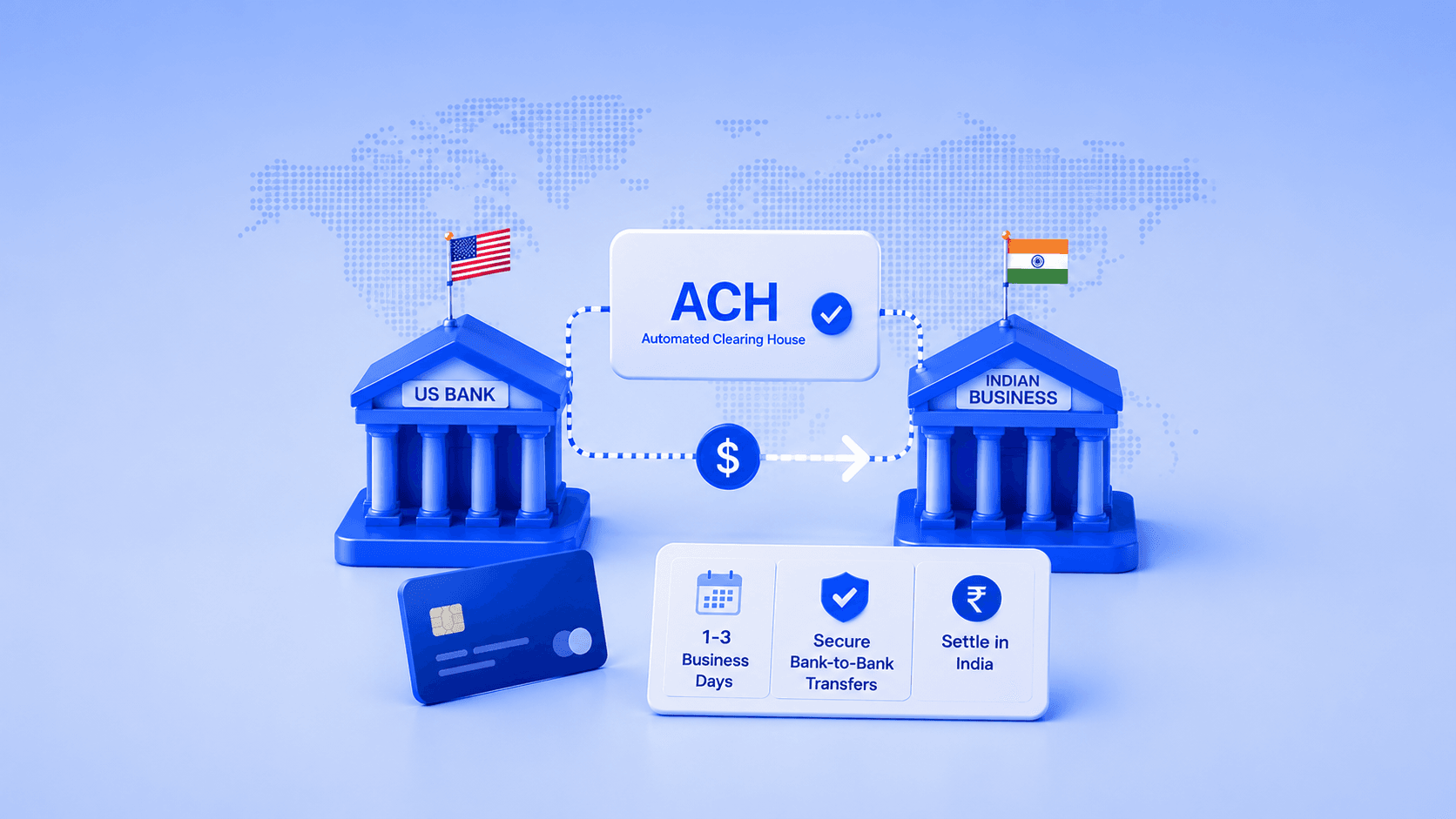
- For Indian exporters, ACH credit is what matters most. US customers can pay you directly from their US bank account, but ACH only works between US bank accounts, so you'll need a USD collection account to receive these payments.
- With a PayGlocal Multi-Currency Account, you get a USD collection account in your business name, enabling local ACH collections from US customers while funds are settled to your Indian bank account with compliant inward remittance documentation.
Priya runs a design studio in Pune. Half her clients are in the US, and most of them want to pay her the way they pay everyone else: straight from their US bank account. That method has a name, ACH, and if you sell to American customers, it is worth understanding how it works and how the money reaches you in India.
This guide keeps it simple. We will cover what ACH is, how ACH debit and credit differ, how long settlement takes, and how an Indian business can receive these payments cleanly at home.
An ACH payment is an electronic transfer of money between two bank accounts, moved through the Automated Clearing House (ACH) network. The network is run in the United States and governed by Nacha (the National Automated Clearing House Association). It is one of the main ways funds move from one US bank account to another.
Because ACH transfers are fully electronic and processed in batches, they are cheaper than wires and reliable for repeated payments. That makes them a default choice for payroll, vendor payments, and any transaction a business runs on a schedule.
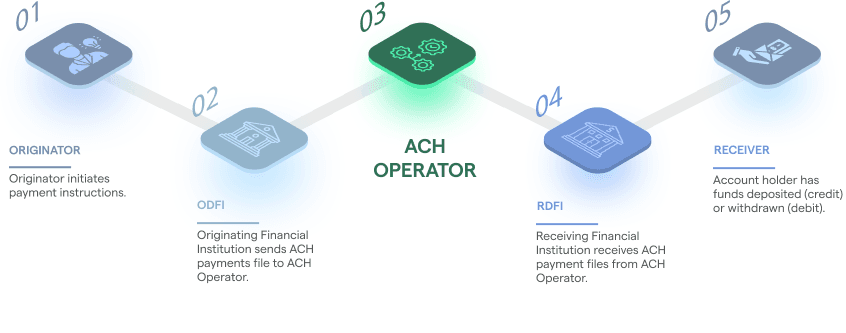
An ACH payment passes through a fixed set of participants. The names sound technical, so here is each one in plain terms:
Take a utility bill as an example. When a customer authorises payment on the biller's website, the biller is the originator. The payment instruction goes to the biller's bank, the ODFI, which collates it into a batch and sends it to the ACH Operator. The operator passes it to the customer's bank, the RDFI, which moves the funds to complete the payment.
The direction of the money is the difference. Both use the same network and the same participants; they just start from opposite ends.
ACH debit *pulls* money. Funds are withdrawn from an account to make a payment, usually with the account holder's prior authorisation. The utility bill above is an ACH debit: the biller pulls the amount from the customer's account.
ACH credit *pushes* money. Funds are sent into a recipient's account. Payroll, vendor payments, and direct deposits are ACH credits, because the payer is pushing money out to someone else. ACH credits are what let US businesses replace paper checks for routine payouts.
For an Indian exporter, the type that matters most is the ACH credit, because that is how a US client pushes payment to you.
Standard ACH settles in one to three business days. Same Day ACH clears on the same business day, but usually costs more. The trade-off is speed against price, and most routine payments happily use the standard timeline.
The network itself runs on a batch schedule. It operates about 23 hours each business day and settles multiple times a day while the Federal Reserve's settlement service is open. Batch processing is what keeps ACH cheap, and it is also why ACH is slower than a real-time rail like Fedwire, which businesses reach for only when a payment truly cannot wait.
ACH is the backbone of US electronic payments. By way of scale, ACH volume in 2022 was USD 76.7 trillion:
Broken down by use:
The network has kept growing since. Nacha reported that the ACH Network moved 35.2 billion payments worth USD 93 trillion in 2025, with business-to-business volume alone near 8.1 billion payments. For an Indian business, the takeaway is simple: a very large share of US money movement runs on this one rail, so being able to receive it well matters.
ACH earns its place for three practical reasons:
The main limit is speed. Because ACH batches payments, it is slower than a real-time settlement rail such as Fedwire. If a single payment must land instantly, Fedwire is the choice, at a higher cost. For most recurring business flows, ACH remains the sensible default.
Here is the catch for Indian exporters: ACH runs between US bank accounts. It does not reach an Indian bank account directly. So if your US client wants to pay you by ACH, you need a way to collect that payment locally in the US and then bring it home to India.
That is where a virtual foreign currency account helps. PayGlocal provisions a USD collection account in your own business name, so your US customers can pay you locally, the way they would pay any US vendor. The funds are then settled to you in India, with the compliance paperwork handled along the way.
The benefit is straightforward: your American clients pay the way they already prefer, and you receive clean, trackable USD collection without asking every buyer to arrange an international wire.
PayGlocal is an RBI-authorised cross-border payments provider (a Payment Aggregator, Cross Border, Inward and Outward) and part of the ICICI Bank Group, so money movement and inward-remittance compliance are handled to a bank-grade standard.
Explore multi-currency accounts to collect USD from your US customers
This guide keeps it simple. We will cover what ACH is, how ACH debit and credit differ, how long settlement takes, and how an Indian business can receive these payments cleanly at home.
What is an ACH payment?
An ACH payment is an electronic transfer of money between two bank accounts, moved through the Automated Clearing House (ACH) network. The network is run in the United States and governed by Nacha (the National Automated Clearing House Association). It is one of the main ways funds move from one US bank account to another.
Because ACH transfers are fully electronic and processed in batches, they are cheaper than wires and reliable for repeated payments. That makes them a default choice for payroll, vendor payments, and any transaction a business runs on a schedule.
How do ACH payments work?
An ACH payment passes through a fixed set of participants. The names sound technical, so here is each one in plain terms:
- Originator: the party that starts the payment (a biller, an employer, or a buyer).
- Originating Depository Financial Institution (ODFI): the originator's bank, which submits the payment into the network.
- ACH Operator: the central processor that routes the payment. In the US this is either the Federal Reserve or The Clearing House.
- Receiving Depository Financial Institution (RDFI): the recipient's bank, which receives the payment from the network.
- Receiver: the party whose account is finally credited or debited.
Take a utility bill as an example. When a customer authorises payment on the biller's website, the biller is the originator. The payment instruction goes to the biller's bank, the ODFI, which collates it into a batch and sends it to the ACH Operator. The operator passes it to the customer's bank, the RDFI, which moves the funds to complete the payment.
ACH debit vs ACH credit
The direction of the money is the difference. Both use the same network and the same participants; they just start from opposite ends.
ACH debit *pulls* money. Funds are withdrawn from an account to make a payment, usually with the account holder's prior authorisation. The utility bill above is an ACH debit: the biller pulls the amount from the customer's account.
ACH credit *pushes* money. Funds are sent into a recipient's account. Payroll, vendor payments, and direct deposits are ACH credits, because the payer is pushing money out to someone else. ACH credits are what let US businesses replace paper checks for routine payouts.
For an Indian exporter, the type that matters most is the ACH credit, because that is how a US client pushes payment to you.
How long does an ACH payment take to settle?
Standard ACH settles in one to three business days. Same Day ACH clears on the same business day, but usually costs more. The trade-off is speed against price, and most routine payments happily use the standard timeline.
The network itself runs on a batch schedule. It operates about 23 hours each business day and settles multiple times a day while the Federal Reserve's settlement service is open. Batch processing is what keeps ACH cheap, and it is also why ACH is slower than a real-time rail like Fedwire, which businesses reach for only when a payment truly cannot wait.
How big is the ACH network?
ACH is the backbone of US electronic payments. By way of scale, ACH volume in 2022 was USD 76.7 trillion:
- Credits: USD 50.22 trillion
- Debits: USD 26.5 trillion
Broken down by use:
- Business to business payments: USD 52.53 trillion
- Person to person payments: USD 448.53 billion
- Consumer bill payments and other debits: USD 9.49 trillion
- Direct deposits: USD 13.67 trillion
The network has kept growing since. Nacha reported that the ACH Network moved 35.2 billion payments worth USD 93 trillion in 2025, with business-to-business volume alone near 8.1 billion payments. For an Indian business, the takeaway is simple: a very large share of US money movement runs on this one rail, so being able to receive it well matters.
Advantages and limits of ACH
ACH earns its place for three practical reasons:
- Cost: far cheaper than wires, especially at volume.
- Security: governed rules and bank-to-bank movement reduce exposure compared with paper checks.
- Convenience: ideal for recurring and scheduled payments, with no manual step each cycle.
The main limit is speed. Because ACH batches payments, it is slower than a real-time settlement rail such as Fedwire. If a single payment must land instantly, Fedwire is the choice, at a higher cost. For most recurring business flows, ACH remains the sensible default.
How can an Indian business receive ACH payments?
Here is the catch for Indian exporters: ACH runs between US bank accounts. It does not reach an Indian bank account directly. So if your US client wants to pay you by ACH, you need a way to collect that payment locally in the US and then bring it home to India.
That is where a virtual foreign currency account helps. PayGlocal provisions a USD collection account in your own business name, so your US customers can pay you locally, the way they would pay any US vendor. The funds are then settled to you in India, with the compliance paperwork handled along the way.
The benefit is straightforward: your American clients pay the way they already prefer, and you receive clean, trackable USD collection without asking every buyer to arrange an international wire.
PayGlocal is an RBI-authorised cross-border payments provider (a Payment Aggregator, Cross Border, Inward and Outward) and part of the ICICI Bank Group, so money movement and inward-remittance compliance are handled to a bank-grade standard.
Explore multi-currency accounts to collect USD from your US customers