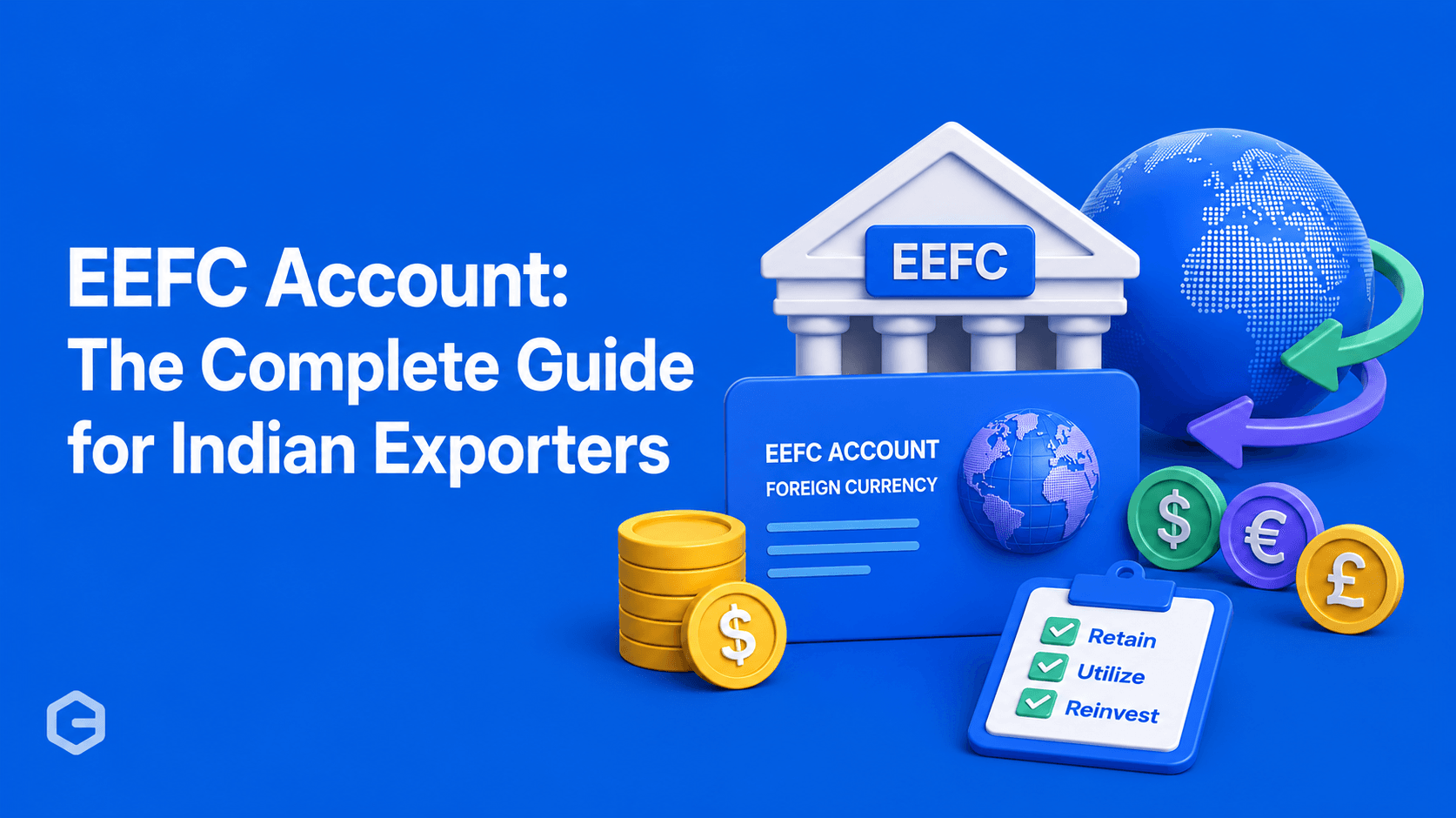

You worked hard to earn that international payment. The last thing you want is to lose a chunk of it to currency conversion every single time. That is exactly the problem the Exchange Earner's Foreign Currency (EEFC) account was built to solve, and yet most exporters either do not have one or are not using it optimally.
TL;DR
- An EEFC (Exchange Earner's Foreign Currency) account is a non-interest-bearing current account, regulated by RBI under FEMA 1999, that lets Indian exporters, freelancers, and startups hold up to 100% of their forex earnings without immediate INR conversion, so they can convert on their own timing or pay overseas costs directly.
- Key rule to watch: accruals in a calendar month must be converted to INR by the end of the next month if unused for approved purposes, and balances earn no interest (RBI directive since May 2012).
- PayGlocal can settle international collections directly into your EEFC account in the original currency (minus MDR and taxes), available for merchants holding a Multi-Currency Account, giving you full control over when and how much to convert.
What Is an EEFC Account?
An Exchange Earner's Foreign Currency (EEFC) account is a non-interest-bearing current account held in a foreign currency, maintained with an authorized dealer essentially a bank authorized by the Reserve Bank of India (RBI) in India. The account enables exporters, service providers, and other foreign exchange earners to retain their foreign currency earnings without immediately converting them to Indian Rupees (INR).
Think of it as your 'forex parking account'. Instead of converting every dollar, euro, or pound you receive into INR the moment it hits your bank, you can hold that foreign currency in the EEFC account for a definite period of time and convert it when the rate is favorable, or use it directly for permissible foreign currency expenses without conversion altogether.
The operation of this account is governed by the Foreign Exchange Management Act (FEMA) 1999 and regulatory frameworks prescribed by RBI's Foreign Exchange Management (Deposit) Regulations.
Quick Snapshot
- EEFC Full form is Exchange Earner's Foreign Currency Account
- Account type: Current (non-interest-bearing)
- Regulatory body: Reserve Bank of India (RBI) under FEMA 1999
- Who can open it: Any person resident in India earning foreign exchange
- Retention allowed: Up to 100% of foreign exchange receipts
Advantages and Limitations at a Glance
Before you rush to open one, here is the honest picture. EEFC accounts are powerful — but they are not for everyone or every situation.
| ✅ Advantages | ⚠️ Limitations |
|---|---|
| Retain foreign currency without immediate conversion | Non-interest-bearing current accounts |
| Reduce exposure to exchange rate fluctuations by choosing when to convert funds | Subject to FEMA and RBI regulatory compliance requirements |
| Avoid repeated currency conversion costs where both inflows and outflows are in foreign currency | Cannot be used for transactions not permitted under FEMA |
| Pay overseas vendors, consultants, cloud service providers, travel expenses, and other permissible foreign currency obligations directly | Banks may levy account maintenance and transaction charges |
| Improve treasury management and foreign currency liquidity planning | Exchange rate risk remains if retained currencies depreciate against INR |
| Hold up to 100% of eligible foreign exchange earnings in the account | Available only to eligible resident foreign exchange earners |
| Facilitate seamless reinvestment into exports and international business operations | Requires appropriate documentation and audit trail for regulatory purposes |
| Reduce operational friction for businesses with recurring international receipts and payments | Not a savings or investment product; designed primarily for transaction purposes |
The bottom line: if you have recurring foreign currency expenses, such as paying overseas vendors, SaaS subscriptions, travel, or reinvesting in imports — an EEFC account can save you real money. If your entire income gets converted to INR and reinvested domestically, the advantage diminishes.
Key Rules and RBI Guidelines You Must Know
EEFC accounts are tightly regulated. Not knowing the rules is not just a compliance risk — it can result in penalties under FEMA. Here is what you need to keep in mind:
| Parameter | RBI Rule / Guideline |
|---|---|
| Retention Limit | Up to 100% of foreign exchange receipts can be held in the EEFC account |
| Currency Types | USD, EUR, GBP, JPY, and other freely convertible currencies permitted by RBI |
| Account Type | Non-interest-bearing current account (as per RBI directive since May 2012) |
| Transfer to INR | The sum of the accruals in the account during a calendar month should be converted into Rupees on or before the last day of the succeeding calendar month after adjusting for utilization of the balances for approved purposes or forward commitments. |
| Eligible Entities | Individuals, firms, companies, and other persons resident in India earning forex. |
| Who Regulates | Governed under FEMA 1999 and regulations, guidelines and circulars issued by RBI |
| Fund Usage | Permissible debits include import payments, overseas business expenses, foreign travel expenses, external debt servicing, overseas investments (where permitted under FEMA), and other eligible foreign currency transactions. |
| Conversion Rule | Conversion only at account holder's request. But automatic conversion happens if funds are not used in given timeline by the regulator |
| Nomination | Resident account holders may maintain EEFC accounts singly or jointly, subject to RBI and bank-specific requirements. |
What Can You Use EEFC Funds For?
RBI permits debit from an EEFC account for the following purposes:
- Payments for imports of goods and services
- Repayment of foreign currency obligations
- Trade related loans and advances
- Travel-related expenses (business or personal)
- Investments abroad — equity, debt, or otherwise (subject to LRS/ODI regulations)
- Customs duty payments
Important: The 30-Day Rule
The sum of the accruals in the account during a calendar month should be converted into Rupees on or before the last day of the succeeding calendar month after adjusting for utilisation of the balances for approved purposes or forward commitments.
How to open an EEFC Account?
Any authorized dealer bank in India — basically any scheduled commercial bank — can open an EEFC account for you. There is no shortage of options; what matters is choosing a bank with strong trade finance infrastructure and competitive forex spreads.
| Bank / Institution | Key Highlight (Illustrative) |
|---|---|
| HDFC Bank | End-to-end online opening, strong forex trade desk support |
| ICICI Bank | Multiple currency options, integrated with trade finance products |
| State Bank of India (SBI) | Widest branch network, preferred by SME exporters |
| Axis Bank | Fast processing, dedicated relationship managers for exporters |
| Kotak Mahindra Bank | Digital-first, competitive forex rates |
| Yes Bank | Quick onboarding for startups and digital businesses |
| RBL Bank | Flexible account structuring for new-age exporters |
| Bank of Baroda | Strong NRI and global banking ecosystem |
Documents You Will Typically Need
- Business registration certificate (GST, COI, or equivalent)
- KYC documents — PAN card, Aadhaar or passport
- Proof of foreign exchange earnings
- Import-Export Code (IEC) issued by DGFT
- Existing current account details with the bank
- Board resolution (for companies) authorizing account opening
- FEMA declaration and account opening forms
- Beneficial ownership and constitutional documents
* Document requirement may vary from bank to bank.
Most private sector banks now allow you to initiate the EEFC account application online. Processing time typically ranges from 2 to 5 working days once all documents are in order.
How PayGlocal Works with Your EEFC Account
By default, PayGlocal settles your international collections into your INR current account. That works perfectly for most merchants — but if you already have an EEFC account, you have a better option.
Settle Directly to Your EEFC Account: If you already hold an EEFC account, simply share your EEFC account details with PayGlocal, and we will settle your international payments directly to that account — in the original foreign currency minus the MDR & taxes, no conversion required.
Note: EEFC settlement through PayGlocal is available only for merchants who hold a Multi-Currency Account. PayGlocal enables this settlement under its RBI-regulated Payment Aggregator – Cross Border license framework.
This means you keep full control of your forex — when to convert, how much to convert, and at what rate.
Why This Matters for Your Business
- Eliminate forced conversions: Receive USD/EUR/GBP in their original form
- Consolidate all forex in one place: Aggregate PayGlocal settlements with other export receipts in your EEFC account
- Time your conversions strategically: Convert when rates are favorable, not when your payment arrives
- Simplify accounting: Fewer conversion entries, cleaner reconciliation between your PayGlocal dashboard and bank statement
- Pay international vendors instantly: Use your EEFC balance to pay overseas suppliers without routing through INR
How to Set It Up
- Log in to your PayGlocal merchant dashboard
- Go to Settlement Settings or contact your PayGlocal relationship manager
- Provide your EEFC account details
- PayGlocal verifies the account and activates EEFC settlement for your profile
- From the next settlement cycle, international payments will credit directly to your EEFC account
It is that straightforward. No re-routing, no double handling, no unnecessary conversions of eating into your hard-earned export revenue.
The Takeaway
If you are an exporter, a freelancer for billing an international client, or a startup receiving payments in foreign currency, an EEFC account is not just a compliance checkbox — it is a genuine business tool. Paired with PayGlocal's ability to settle directly to your EEFC account, you gain a clean, efficient, and cost-effective path from international invoice to forex management.
Stop leaving money on the table with every forced conversion. Set up your EEFC account, link it with PayGlocal, and let your export earnings work for you.