
India’s startup ecosystem has grown substantially, now being a home to nearly 1.59 lakh startups and ranking third worldwide. This growth highlights increasing entrepreneurial activity across the country.
But startup growth brings its own challenges. In fact, many startups operate at a loss initially while they build products, acquire customers, and establish market presence. The challenge is ensuring your cash reserves last long enough to reach profitability or get additional funding.
Cash burn rate tells you exactly how fast you're spending money and how much time you have left. In this guide, you’ll get a detailed breakdown of cash burn rate, how to calculate it, and reduce it effectively. Let’s get into it.
Cash burn rate is the speed at which your business spends its cash reserves each month. It measures how much money leaves your bank account to cover operating expenses before you generate enough revenue to sustain operations.
For instance, if you start January with $500,000 and end with $450,000, you burned $50,000 that month. Your monthly burn rate is $50,000. This metric applies primarily to startups and growth-stage companies that aren't yet profitable or are reinvesting all revenue back into expansion.
The term "burn" reflects the reality that you're consuming a limited resource. Your cash reserve is like fuel. Burn rate tells you how fast you're using it. The faster you burn, the sooner you'll need to refuel through fundraising, loans, or profitability.
Calculating burn rate requires basic financial data from your bank statements or accounting system. You can calculate it monthly or average it over several months for a clearer trend.
Here’s what you need to do:
For example, you had $600,000 on January 1 and $520,000 on January 31. You burned $80,000 in January. Your monthly burn rate is $80,000.
Your business actually has two burn rate figures. Each serves a different purpose. One shows total spending, the other shows actual cash loss after revenue. Here's how they compare:
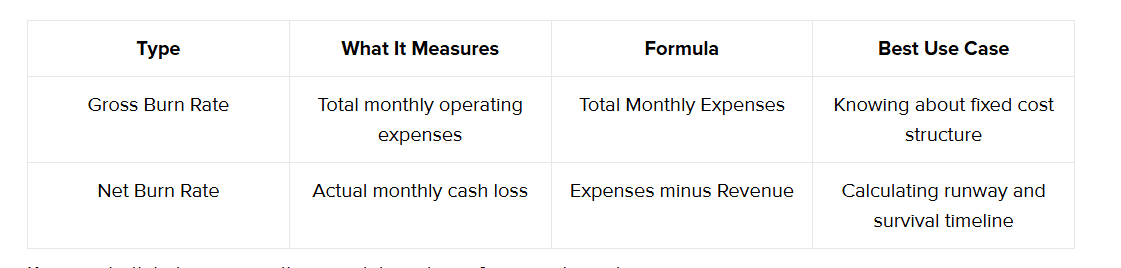
Knowing both helps you see the complete picture of your cash position.
Gross burn rate measures total monthly operating costs regardless of revenue. It includes salaries, rent, software subscriptions, marketing spend, cloud hosting, and every other expense your business incurs.
For instance, if you spend $40,000 on salaries, $15,000 on marketing, $8,000 on software tools, and $7,000 on other costs, your gross burn rate is $70,000 per month. This figure shows your baseline spending level.
Gross burn matters because it reveals your cost structure. Even if revenue grows, you need to know what it costs to keep operations running.
Net burn rate shows actual monthly cash loss after accounting for revenue. It subtracts your monthly revenue from your gross burn to reveal how much cash you're actually losing.
The formula is simple. Net Burn Rate equals Gross Burn Rate minus Monthly Revenue. For example, if your gross burn is $70,000 and you earn $30,000 in revenue, your net burn is $40,000. You’re losing $40,000 in cash each month.
Net burn determines your runway. It’s the number investors care about most. It tells you how long you can survive.
Cash runway is how many months you can operate before running out of money. It’s calculated by dividing your remaining cash by your net burn rate.
The formula is straightforward. Cash Runway equals Total Cash Available divided by Net Burn Rate. For instance, you have $400,000 in the bank and your net burn is $50,000 per month. Your runway is 8 months. You have 8 months to reach profitability, reduce burn, or raise more funding.
Runway gives you a deadline. Most investors typically want to see at least 12 to 18 months of runway. This gives you time to hit milestones, adjust strategy, and fundraise without desperation.
Cash burn rate determines whether your business survives or shuts down. It’s the most critical metric for non-profitable companies. Here’s why it matters so much:
* Risk management: High burn with low revenue creates existential risk. Burn rate quantifies that risk and forces honest evaluation.
* Unit economics validation: Burn rate combined with customer acquisition cost and lifetime value shows if your business model is sustainable.
Companies that ignore burn rate often realize too late they're weeks from insolvency. Tracking it weekly keeps you honest and proactive.
There’s no universal good burn rate. It depends on your stage, industry, business model, and growth strategy. What matters is whether your burn rate aligns with your revenue trajectory and funding timeline.
Early-stage startups often have high burn rates because they’re investing heavily in product development and customer acquisition before generating significant revenue. A pre-revenue SaaS startup might burn $100,000 monthly while building its platform. That’s acceptable if they have 18 months of runway and a clear path to revenue.
Growth-stage companies should see burn rate decrease as a percentage of revenue. If you’re burning $200,000 monthly but earning $150,000 in revenue, your net burn is $50,000. If revenue grows to $180,000 next month without increasing gross burn, your net burn drops to $20,000. That’s healthy progress.
Investors often look for a monthly burn between 10% to 30% of total raised capital for seed-stage companies. For instance, if you raised $1 million, burning $100,000 to $300,000 monthly is typical in the first year. Beyond that, you should show improving unit economics and declining burn rate relative to revenue growth.
Reducing burn rate without affecting growth requires strategic cost optimization. You need to cut waste while preserving investments that drive revenue. Here are some practical ways to lower burn:
For example, if you’re paying 3.5% in international payment processing fees on $50,000 monthly, that’s $1,750 in monthly burn. Switching to a provider with 2% fees saves $750 monthly or $9,000 annually.
Managing burn rate means controlling every dollar that leaves your account. Payment processing costs often go unnoticed, but they add up fast. International transaction fees, FX markups, delayed settlements, and hidden charges can drain thousands monthly.
If you're collecting payments from global clients or paying international vendors, you need a payment solution that reduces costs, speeds up settlement, and gives you complete visibility over every transaction. That’s where PayGlocal comes in.
Here’s what you get with PayGlocal:
PayGlocal helps globally growing businesses collect payments efficiently, reduce transaction costs, and extend cash runway. Lower fees mean less cash burned monthly. Faster settlements mean better cash flow. Complete transparency means smarter financial planning.
Cash burn rate tells you how long you can operate, when you need to fundraise, and whether your spending aligns with your growth trajectory. You need to track this metric properly as it shapes every strategic decision you make for your company.
Start by calculating both gross and net burn rate monthly, so you know your exact runway down to the week. Make spending decisions based on how they impact your burn rate. Cut costs that don’t directly drive revenue or improve your product. Focus your investments on areas that improve unit economics and get you closer to profitability.
Smart financial management starts with knowing where your money goes. PayGlocal helps you control one of your largest operational costs with transparent pricing, faster settlements, and zero hidden fees. Every dollar saved on transactions is a dollar that extends your runway.
Get started with PayGlocal today and take control of your payment costs.
But startup growth brings its own challenges. In fact, many startups operate at a loss initially while they build products, acquire customers, and establish market presence. The challenge is ensuring your cash reserves last long enough to reach profitability or get additional funding.
Cash burn rate tells you exactly how fast you're spending money and how much time you have left. In this guide, you’ll get a detailed breakdown of cash burn rate, how to calculate it, and reduce it effectively. Let’s get into it.
Key takeaways
- Cash burn rate definition: Cash burn rate measures how quickly your business spends its cash reserves each month before reaching profitability.
- Two types matter: Gross burn rate shows total monthly spending, while net burn rate accounts for revenue and shows actual cash loss.
- Runway calculation: Divide your remaining cash by net burn rate to find how many months you can operate before running out of money.
- Early-stage reality: Higher burn rates are common for startups prioritizing growth, but sustainability requires constant monitoring and adjustment.
- Payment efficiency impact: Transaction costs, high processing fees, and delayed settlements directly affect burn rate. PayGlocal helps reduce these costs through transparent pricing and faster fund access.
What is cash burn rate?
Cash burn rate is the speed at which your business spends its cash reserves each month. It measures how much money leaves your bank account to cover operating expenses before you generate enough revenue to sustain operations.
For instance, if you start January with $500,000 and end with $450,000, you burned $50,000 that month. Your monthly burn rate is $50,000. This metric applies primarily to startups and growth-stage companies that aren't yet profitable or are reinvesting all revenue back into expansion.
The term "burn" reflects the reality that you're consuming a limited resource. Your cash reserve is like fuel. Burn rate tells you how fast you're using it. The faster you burn, the sooner you'll need to refuel through fundraising, loans, or profitability.
How to calculate cash burn rate?
Calculating burn rate requires basic financial data from your bank statements or accounting system. You can calculate it monthly or average it over several months for a clearer trend.
Here’s what you need to do:
- Identify the time period: Choose a specific month or calculate an average across three to six months for more accuracy.
- Find starting cash balance: Record how much cash you had at the beginning of the period.
- Find ending cash balance: Record how much cash remains at the end of the period.
- Calculate the difference: Subtract the ending balance from the starting balance to find total cash burned.
- Determine monthly rate: If using multiple months, divide the total burned by the number of months.
For example, you had $600,000 on January 1 and $520,000 on January 31. You burned $80,000 in January. Your monthly burn rate is $80,000.
What are the types of cash burn rate?
Your business actually has two burn rate figures. Each serves a different purpose. One shows total spending, the other shows actual cash loss after revenue. Here's how they compare:
Knowing both helps you see the complete picture of your cash position.
Gross burn rate
Gross burn rate measures total monthly operating costs regardless of revenue. It includes salaries, rent, software subscriptions, marketing spend, cloud hosting, and every other expense your business incurs.
For instance, if you spend $40,000 on salaries, $15,000 on marketing, $8,000 on software tools, and $7,000 on other costs, your gross burn rate is $70,000 per month. This figure shows your baseline spending level.
Gross burn matters because it reveals your cost structure. Even if revenue grows, you need to know what it costs to keep operations running.
Net burn rate
Net burn rate shows actual monthly cash loss after accounting for revenue. It subtracts your monthly revenue from your gross burn to reveal how much cash you're actually losing.
The formula is simple. Net Burn Rate equals Gross Burn Rate minus Monthly Revenue. For example, if your gross burn is $70,000 and you earn $30,000 in revenue, your net burn is $40,000. You’re losing $40,000 in cash each month.
Net burn determines your runway. It’s the number investors care about most. It tells you how long you can survive.
How to calculate cash runway?
Cash runway is how many months you can operate before running out of money. It’s calculated by dividing your remaining cash by your net burn rate.
The formula is straightforward. Cash Runway equals Total Cash Available divided by Net Burn Rate. For instance, you have $400,000 in the bank and your net burn is $50,000 per month. Your runway is 8 months. You have 8 months to reach profitability, reduce burn, or raise more funding.
Runway gives you a deadline. Most investors typically want to see at least 12 to 18 months of runway. This gives you time to hit milestones, adjust strategy, and fundraise without desperation.
Why does cash burn rate matter?
Cash burn rate determines whether your business survives or shuts down. It’s the most critical metric for non-profitable companies. Here’s why it matters so much:
- Survival timeline: Burn rate tells you exactly how long you can operate before running out of money and needing to shut down or raise funds.
- Investor confidence: Investors evaluate burn to assess financial discipline, growth efficiency, and whether you’ll hit milestones before needing more capital.
- Strategic planning: Knowing your burn helps you time hiring, product launches, market expansion, and other investments based on cash availability.
- Fundraising timing: You should start fundraising when you have 6 to 9 months of runway left, giving you time to close deals without pressure.
* Risk management: High burn with low revenue creates existential risk. Burn rate quantifies that risk and forces honest evaluation.
* Unit economics validation: Burn rate combined with customer acquisition cost and lifetime value shows if your business model is sustainable.
Companies that ignore burn rate often realize too late they're weeks from insolvency. Tracking it weekly keeps you honest and proactive.
What is a good cash burn rate?
There’s no universal good burn rate. It depends on your stage, industry, business model, and growth strategy. What matters is whether your burn rate aligns with your revenue trajectory and funding timeline.
Early-stage startups often have high burn rates because they’re investing heavily in product development and customer acquisition before generating significant revenue. A pre-revenue SaaS startup might burn $100,000 monthly while building its platform. That’s acceptable if they have 18 months of runway and a clear path to revenue.
Growth-stage companies should see burn rate decrease as a percentage of revenue. If you’re burning $200,000 monthly but earning $150,000 in revenue, your net burn is $50,000. If revenue grows to $180,000 next month without increasing gross burn, your net burn drops to $20,000. That’s healthy progress.
Investors often look for a monthly burn between 10% to 30% of total raised capital for seed-stage companies. For instance, if you raised $1 million, burning $100,000 to $300,000 monthly is typical in the first year. Beyond that, you should show improving unit economics and declining burn rate relative to revenue growth.
How to reduce cash burn rate?
Reducing burn rate without affecting growth requires strategic cost optimization. You need to cut waste while preserving investments that drive revenue. Here are some practical ways to lower burn:
- Negotiate vendor contracts: Contact software providers, service vendors, and suppliers to negotiate better rates or annual discounts instead of monthly billing.
- Optimize payment processing: High transaction fees and FX costs drain cash. Switching to lower-cost payment solutions can save thousands monthly.
- Reduce non-revenue headcount: Delay non-critical hires and focus on roles that directly generate or support revenue until you reach profitability.
- Cut underperforming marketing: Analyze marketing channel ROI and stop campaigns with poor customer acquisition costs or low conversion rates.
- Automate manual processes: Replace time-intensive manual work with automation tools to reduce operational costs and improve efficiency.
- Extend payment terms: Negotiate longer payment terms with vendors while shortening terms with customers to improve cash flow timing.
- Reduce software bloat: Audit all subscriptions and cancel tools with low usage or overlapping functionality.
For example, if you’re paying 3.5% in international payment processing fees on $50,000 monthly, that’s $1,750 in monthly burn. Switching to a provider with 2% fees saves $750 monthly or $9,000 annually.
Reduce payment costs and extend your runway with PayGlocal
Managing burn rate means controlling every dollar that leaves your account. Payment processing costs often go unnoticed, but they add up fast. International transaction fees, FX markups, delayed settlements, and hidden charges can drain thousands monthly.
If you're collecting payments from global clients or paying international vendors, you need a payment solution that reduces costs, speeds up settlement, and gives you complete visibility over every transaction. That’s where PayGlocal comes in.
Here’s what you get with PayGlocal:
- Multi-currency accounts: Accept payments in 33+ currencies from 180+ countries with local accounts in USD, GBP, EUR, and CAD, with no hidden fees.
- Transparent pricing: Pay only 0.75% for multi-currency accounts and 3% for international cards (plus GST). Significantly lower than traditional payment processors.
- Instant compliance: Auto-generate Foreign Inward Remittance Certificate (FIRC) after settlement, eliminating paperwork delays and manual compliance costs that drain operational budgets.
- Complete payment status tracking: Monitor fund status at every step with instant notifications and downloadable reports from a single dashboard.
- Recurring payments: Automate subscription billing and recurring charges with network-compliant solutions. Predictable revenue collection reduces cash flow uncertainty.
PayGlocal helps globally growing businesses collect payments efficiently, reduce transaction costs, and extend cash runway. Lower fees mean less cash burned monthly. Faster settlements mean better cash flow. Complete transparency means smarter financial planning.
Final thoughts
Cash burn rate tells you how long you can operate, when you need to fundraise, and whether your spending aligns with your growth trajectory. You need to track this metric properly as it shapes every strategic decision you make for your company.
Start by calculating both gross and net burn rate monthly, so you know your exact runway down to the week. Make spending decisions based on how they impact your burn rate. Cut costs that don’t directly drive revenue or improve your product. Focus your investments on areas that improve unit economics and get you closer to profitability.
Smart financial management starts with knowing where your money goes. PayGlocal helps you control one of your largest operational costs with transparent pricing, faster settlements, and zero hidden fees. Every dollar saved on transactions is a dollar that extends your runway.
Get started with PayGlocal today and take control of your payment costs.