
TL;DR
- India has moved beyond simply accepting international payments—today, the focus is on helping businesses scale globally with faster, smoother commerce experiences.
- Clearer RBI regulations, mature payment platforms, and a stronger fintech ecosystem have transformed cross-border payments into a robust commerce infrastructure.
- The next decade of growth will be driven by seamless onboarding, embedded compliance, payment orchestration, and merchant intelligence—not payment connectivity alone.
Every industry has defining moments. Looking back over the past decade, I believe India's cross-border payments ecosystem has lived through one of the most profound transformations in its history.
Nearly ten years ago, I worked on some of India's early cross-border merchant payment initiatives. The ambition then was clear, but the ecosystem was still finding its feet. Returning to this space through PayGlocal, I get to see a landscape that is fundamentally different.
The biggest difference is not technology. It is ecosystem readiness.
The shortest way to show the shift is to put the two eras side by side. Reading the table alone tells the story.
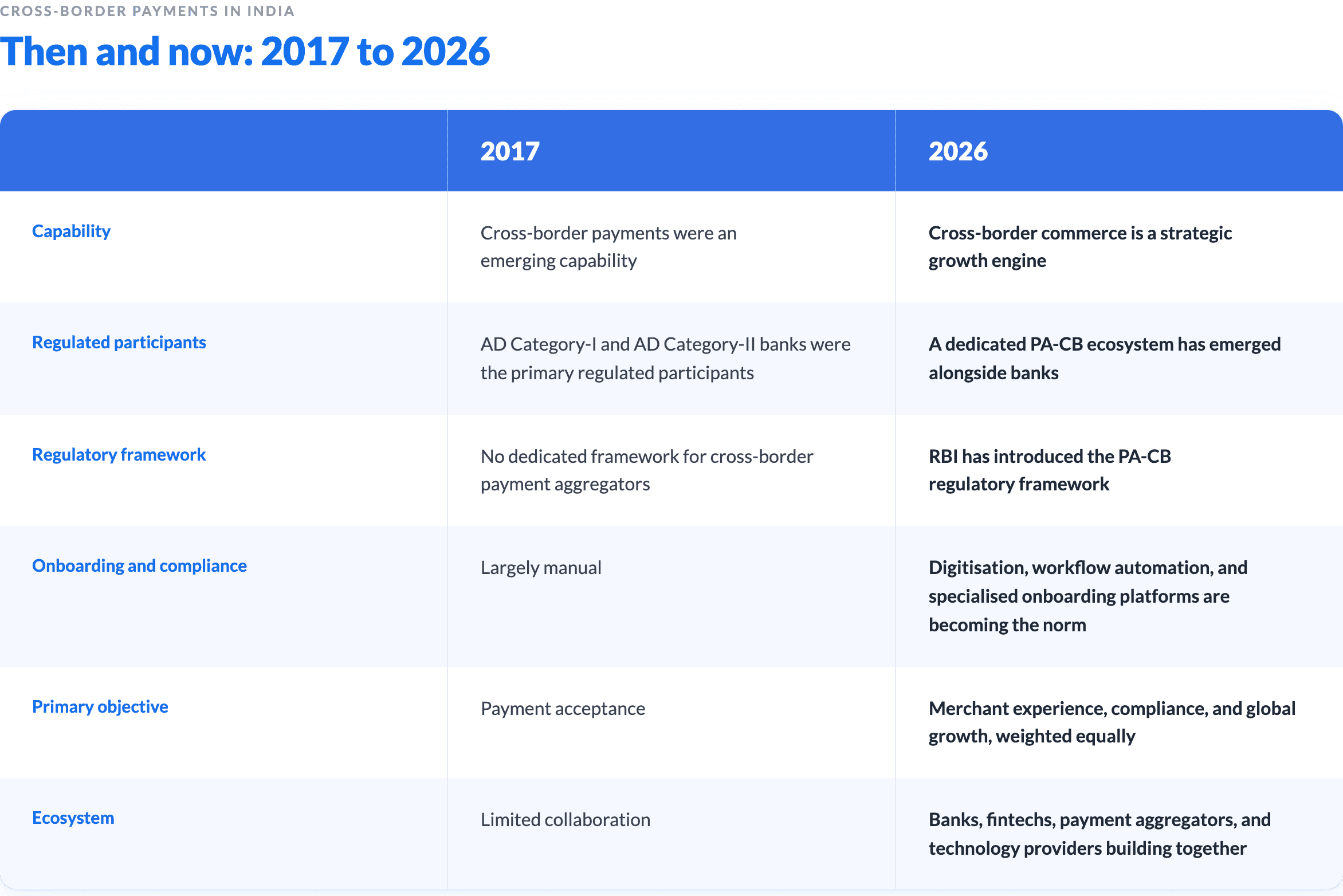
Illustrative comparison based on industry evolution.
Two of those rows matter more than the rest. AD Category-I and AD Category-II banks (banks authorised by the RBI to handle foreign-exchange transactions) were once almost the only regulated route for cross-border money movement. Now a dedicated PA-CB ecosystem sits alongside them. And where there was no dedicated rulebook for cross-border payment aggregators, there is now the PA-CB framework. That single change reset the foundations.
When we started on cross-border merchant payments nearly a decade ago, the challenge was narrow: how do we let an Indian merchant accept an international payment?
That question has since split into several sharper ones:
The conversation has moved past payment acceptance. It has moved toward commerce enablement. In one line: the merchant used to ask "can I accept an international payment?" and now asks "can I scale globally with less friction?"
India's digital economy looks nothing like it did ten years ago. The demand for cross border payments in India is now coming from a wider, more global-first set of businesses:
At the same time, regulatory clarity has improved through frameworks such as RBI's PA-CB directions, which gives innovation and investment stronger ground to stand on.
For the first time, four things are maturing together:
Any one of these arriving alone would be interesting. All four arriving together is what makes this a genuine inflection point.
Here is the thesis. The industry's next opportunity is not to build better payment products. It is to build better commerce infrastructure.
The next generation of platforms will differentiate not on payment connectivity, but on what surrounds the payment:
The frame I keep coming back to: the job is shifting from *moving money* to *removing friction*. Payment completion was the old finish line. Global commerce enablement is the new one.
This is one of the reasons joining PayGlocal has been exciting. Over the years, the team has built deep, specialised expertise across cross-border merchant onboarding, compliance, payment optimisation, and merchant enablement. As the ecosystem enters this phase, the companies that have accumulated real operational knowledge, the unglamorous kind you only get by processing live cross-border flows, have a chance to contribute well beyond payment processing.
The opportunity is no longer just to enable transactions. It is to help shape the infrastructure that powers India's next decade of global commerce. A cross-border payment aggregator that treats itself as pure payment plumbing will miss that. One that treats itself as commerce infrastructure will define it.
It helps to plot the trajectory rather than freeze a single moment:
India transformed domestic digital payments over the last decade. The next decade offers an equally exciting task: to build trusted, intelligent, and globally connected cross-border commerce infrastructure. You can see how that infrastructure looks in practice on PayGlocal's [international payments platform](/international-payments-platform).
This article begins PayGlocal Insights, a thought leadership series on the ideas shaping the future of cross-border commerce. In the future I plan to explore:
I look forward to exploring that journey with you.
Nearly ten years ago, I worked on some of India's early cross-border merchant payment initiatives. The ambition then was clear, but the ecosystem was still finding its feet. Returning to this space through PayGlocal, I get to see a landscape that is fundamentally different.
The biggest difference is not technology. It is ecosystem readiness.
The shortest way to show the shift is to put the two eras side by side. Reading the table alone tells the story.
Illustrative comparison based on industry evolution.
Two of those rows matter more than the rest. AD Category-I and AD Category-II banks (banks authorised by the RBI to handle foreign-exchange transactions) were once almost the only regulated route for cross-border money movement. Now a dedicated PA-CB ecosystem sits alongside them. And where there was no dedicated rulebook for cross-border payment aggregators, there is now the PA-CB framework. That single change reset the foundations.
The biggest shift isn't payments, it's the question merchants ask
When we started on cross-border merchant payments nearly a decade ago, the challenge was narrow: how do we let an Indian merchant accept an international payment?
That question has since split into several sharper ones:
- How quickly can I go live?
- How do I make compliance simpler?
- How do I improve payment success?
- How do I reconcile faster?
- How do I scale globally without adding operational complexity?
The conversation has moved past payment acceptance. It has moved toward commerce enablement. In one line: the merchant used to ask "can I accept an international payment?" and now asks "can I scale globally with less friction?"
A new phase of India's digital economy
India's digital economy looks nothing like it did ten years ago. The demand for cross border payments in India is now coming from a wider, more global-first set of businesses:
- Software companies serving customers across continents.
- MSMEs joining global trade through digital channels.
- AI startups launching with global ambition from day one.
- Creators monetising international audiences.
- Digital service exporters whose whole market is offshore.
At the same time, regulatory clarity has improved through frameworks such as RBI's PA-CB directions, which gives innovation and investment stronger ground to stand on.
For the first time, four things are maturing together:
- Technology: mature platforms rather than stitched-together workarounds.
- Regulation: a clearer operating framework through PA-CB.
- Merchant demand: global-first businesses that expect to sell everywhere.
- Ecosystem: banks, PA-CBs, and fintechs building in the same direction.
Any one of these arriving alone would be interesting. All four arriving together is what makes this a genuine inflection point.
From payment infrastructure to commerce infrastructure
Here is the thesis. The industry's next opportunity is not to build better payment products. It is to build better commerce infrastructure.
The next generation of platforms will differentiate not on payment connectivity, but on what surrounds the payment:
- Intelligent merchant onboarding, so a business goes live in days, not weeks.
- Embedded compliance (compliance built into the flow rather than bolted on afterward).
- Payment orchestration and dynamic routing, sending each transaction down the path most likely to be approved.
- Risk and fraud intelligence.
- Treasury enablement.
- Merchant analytics.
- AI-assisted merchant operations.
The frame I keep coming back to: the job is shifting from *moving money* to *removing friction*. Payment completion was the old finish line. Global commerce enablement is the new one.
This is one of the reasons joining PayGlocal has been exciting. Over the years, the team has built deep, specialised expertise across cross-border merchant onboarding, compliance, payment optimisation, and merchant enablement. As the ecosystem enters this phase, the companies that have accumulated real operational knowledge, the unglamorous kind you only get by processing live cross-border flows, have a chance to contribute well beyond payment processing.
The opportunity is no longer just to enable transactions. It is to help shape the infrastructure that powers India's next decade of global commerce. A cross-border payment aggregator that treats itself as pure payment plumbing will miss that. One that treats itself as commerce infrastructure will define it.
Where this goes next: India's cross-border commerce evolution
It helps to plot the trajectory rather than freeze a single moment:
- 2017, Payment acceptance: AD banks, manual onboarding.
- 2020, Digital commerce: SaaS and D2C sellers, global MSMEs.
- 2024, Regulatory foundation: the PA-CB framework, greater clarity.
- 2026, Ecosystem readiness: banks, PA-CBs, fintechs, and technology providers building together.
- 2030 and beyond, Commerce infrastructure: intelligence and embedded operations as the default.
India transformed domestic digital payments over the last decade. The next decade offers an equally exciting task: to build trusted, intelligent, and globally connected cross-border commerce infrastructure. You can see how that infrastructure looks in practice on PayGlocal's [international payments platform](/international-payments-platform).
Looking ahead
This article begins PayGlocal Insights, a thought leadership series on the ideas shaping the future of cross-border commerce. In the future I plan to explore:
- Why merchant onboarding is becoming the next competitive advantage.
- Commerce infrastructure as the next evolution beyond payment gateways.
- AI's role in merchant operations and compliance.
- Merchant intelligence as a strategic asset.
- Cross-border commerce 2030: a vision for the next decade.
I look forward to exploring that journey with you.