
TL;DR
- Most Indian SaaS companies sell globally but rely on payment systems designed for domestic transactions, leading to lower international payment success rates.
- A global payment stack should support international card acceptance, subscription renewals, and compliance through features like network tokenization, smart retries, and automated documentation.
- PayGlocal enables Indian SaaS businesses to accept payments from 180+ countries, improve recurring payment success, and receive automatic eFIRA for every export payment—all on a single platform.
Quick Answers
- Can an Indian SaaS company accept international cards? Yes. PayGlocal accepts Visa, Mastercard and RuPay from 180+ countries, with local acquiring that reduces cross-border declines.
- How do I stop failed subscription renewals? Network tokenization keeps the card-on-file valid through reissues and expiries; smart retry and failover recover renewals that would otherwise churn.
- Do I get FIRA for software exports? Yes. eFIRA is generated automatically and free, usually within 24 hours.
- How many currencies are supported? 32 currencies, with multi-currency accounts for platforms and marketplaces.
- What success rate can I expect? Up to 90%+ authorization on international payments; a 96–97% peak has been delivered for a marquee enterprise merchant.*
- How fast is onboarding? Because PayGlocal is built on India's Digital Public Infrastructure (DPI), onboarding is measured in days, not weeks.
*Authorization rates vary by business type, geography and transaction mix. The 96–97% peak was delivered for a marquee enterprise merchant; your rate will depend on your specific payment profile.
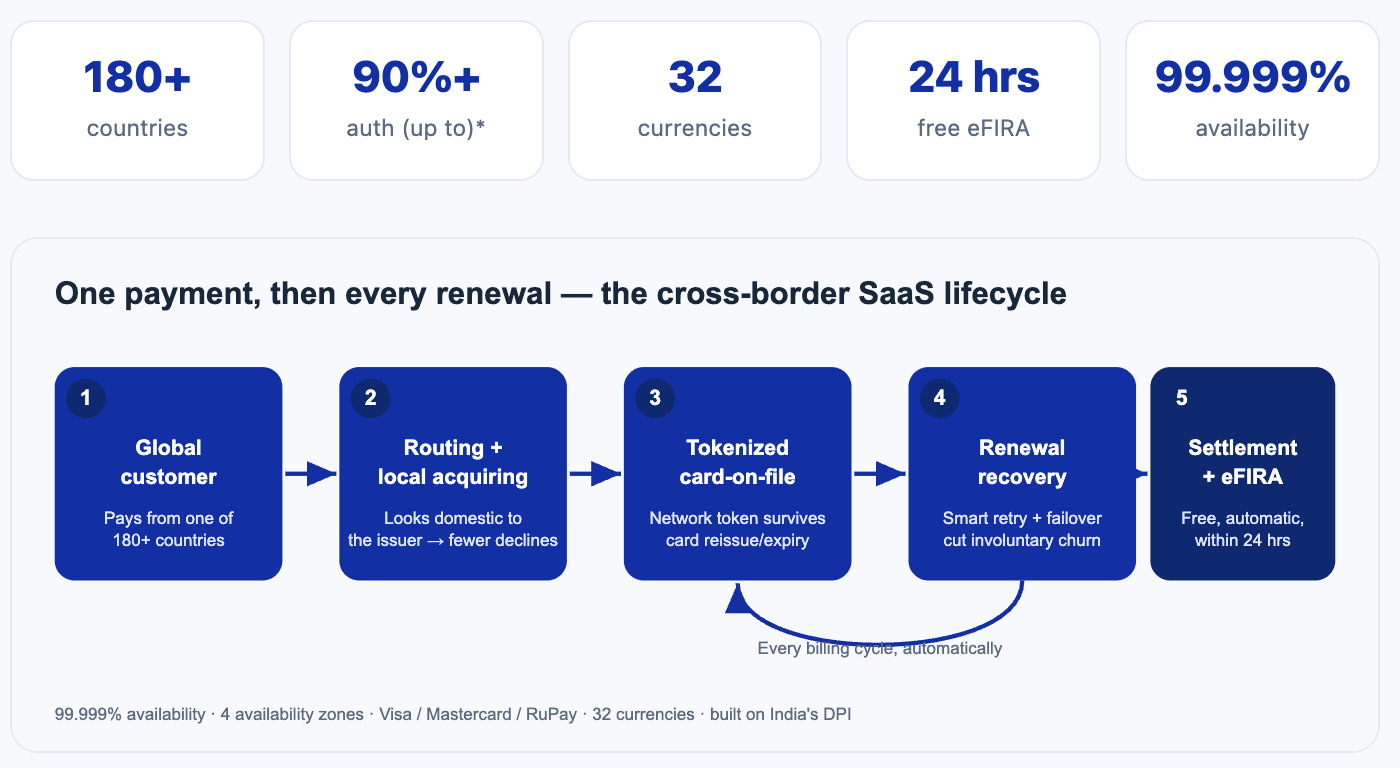
This is how a global SaaS payment succeeds and renews on PayGlocal — from a customer in one of 180+ countries through routing, tokenized card-on-file, renewal recovery, and settlement with automatic eFIRA.
Why India builds the SaaS the world buys
India is one of the world's largest SaaS ecosystems, and it is export-led by design. The Indian SaaS market has crossed roughly $15 billion in annual revenue, around 250 Indian SaaS companies have passed $10 million in ARR — with dozens above $100 million — and most of that revenue is earned outside India. Software and IT services already contribute close to a tenth of national GDP, and SaaS is its fastest-growing, highest-margin slice.
That success creates a specific problem. A SaaS company in Bengaluru or Pune signs its first customer in the US, then the EU, then Southeast Asia, often in the same quarter. The product is global on day one. The payment stack usually is not: it was set up for Indian cards and starts to strain the moment a foreign-issued card, a foreign currency, or a subscription renewal enters the picture.
PayGlocal exists to close that gap. The idea is simple. SaaS teams should spend their energy on the software and the customer, and let a specialist run global payments, success rates and compliance underneath them.
How PayGlocal helps Indian SaaS accept payments from 180+ countries
Three things decide whether a foreign customer's payment succeeds: who acquires the transaction, how it is routed, and how the renewal is handled later. PayGlocal is built around all three.
Local acquiring for foreign cards. When an Indian gateway sends a US or EU card through a domestic acquirer, the issuer often sees a cross-border transaction and declines it. PayGlocal uses local acquiring so the transaction looks domestic to the issuing bank, which materially cuts cross-border declines.
Intelligent, dynamic routing. Not every acquirer performs equally for every issuer, geography or card type. PayGlocal's routing is tuned for foreign issuers, picks the path most likely to authorize, and fails over automatically if the first attempt does not land.
Full card and currency coverage. Visa, Mastercard and RuPay across 180+ countries and 32 currencies, with 3DS2 and native-OTP where required, and AI-based fraud pre-screening so genuine customers are not blocked.
This is where success rate comes from. PayGlocal delivers up to 90%+ authorization on international payments, and a 96–97% peak for a marquee enterprise merchant.* For a subscription business, every point of authorization is recurring revenue, not a one-time sale.
How do you protect subscription renewals and stop involuntary churn?
For SaaS, the first payment is the easy one. The revenue leak is the renewal.
Cards expire, get reissued after fraud, or change numbers. When a renewal hits a stale card, the charge fails and the customer churns — not because they wanted to leave, but because the payment quietly broke. This is involuntary churn, and it is one of the largest hidden costs in any subscription business.
PayGlocal attacks it on three fronts:
- Network tokenization (Visa, Mastercard, RuPay) replaces the stored card number with a network token that updates automatically when the underlying card is reissued, so card-on-file keeps working.
- Smart retry re-attempts failed renewals at the times and on the paths most likely to succeed, instead of hammering the same declined route.
- Failover moves a transaction to an alternate acquirer when one path is down, so a single outage does not become a wave of failed renewals.
The result: fewer broken renewals, higher lifetime value, and less silent churn you never see in the funnel.
What about compliance — FIRA and eFIRA for software exports?
Selling software abroad is an export of services, and Indian regulations expect proof of inward remittance. Chasing FIRC/FIRA from a bank is one of the most common operational headaches for SaaS finance teams.
PayGlocal issues eFIRA automatically, free, usually within 24 hours of settlement, so every export payment is documented for GST, RBI and audit purposes without a manual request. Multi-currency accounts let platforms hold and reconcile in the currency they earned in, and the whole flow sits under PayGlocal's RBI authorisations — PA-CB-I&O (cross-border, Import & Export) and PA-O (domestic).
Is PayGlocal's infrastructure built for SaaS reliability?
SaaS runs on uptime, and a payment outage during a renewal cycle is lost revenue you cannot re-run later. PayGlocal is engineered for that standard:
- 99.999% availability, on multi-region cloud across 4 availability zones.
- Automatic failover and smart retry, so a single component failure does not stop collections.
- One platform for both your global customers and your Indian users (cards, Payment Links, UPI and RuPay), so you are not stitching together two stacks and two reconciliations.
The mental model: you carry an SLA to your customers; PayGlocal carries the payment SLA to you.
What does PayGlocal cost, and how should SaaS founders think about pricing?
The honest answer for any cross-border business is that a single sticker rate rarely tells the story. Your real cost is set by the fee model, the FX markup, whether FIRA is included, card coverage, and how many renewals actually succeed.
PayGlocal pricing for SaaS. International cards are priced at 2.75% to 2.99%, with no setup fee and no annual maintenance charge, and volume, platform and multi-product discounts are published so your effective rate drops as you scale.
For larger invoices collected by bank transfer, multi-currency account transfers are a flat $10 up to $2,000, $18 from $2,000 to $7,500, and 0.25% above that. Your Indian customers stay on the same platform at 0% MDR on UPI and a 1.25% blended domestic-card fee.
Rather than chase a competitor's headline number, compare on the dimensions that move your P&L:
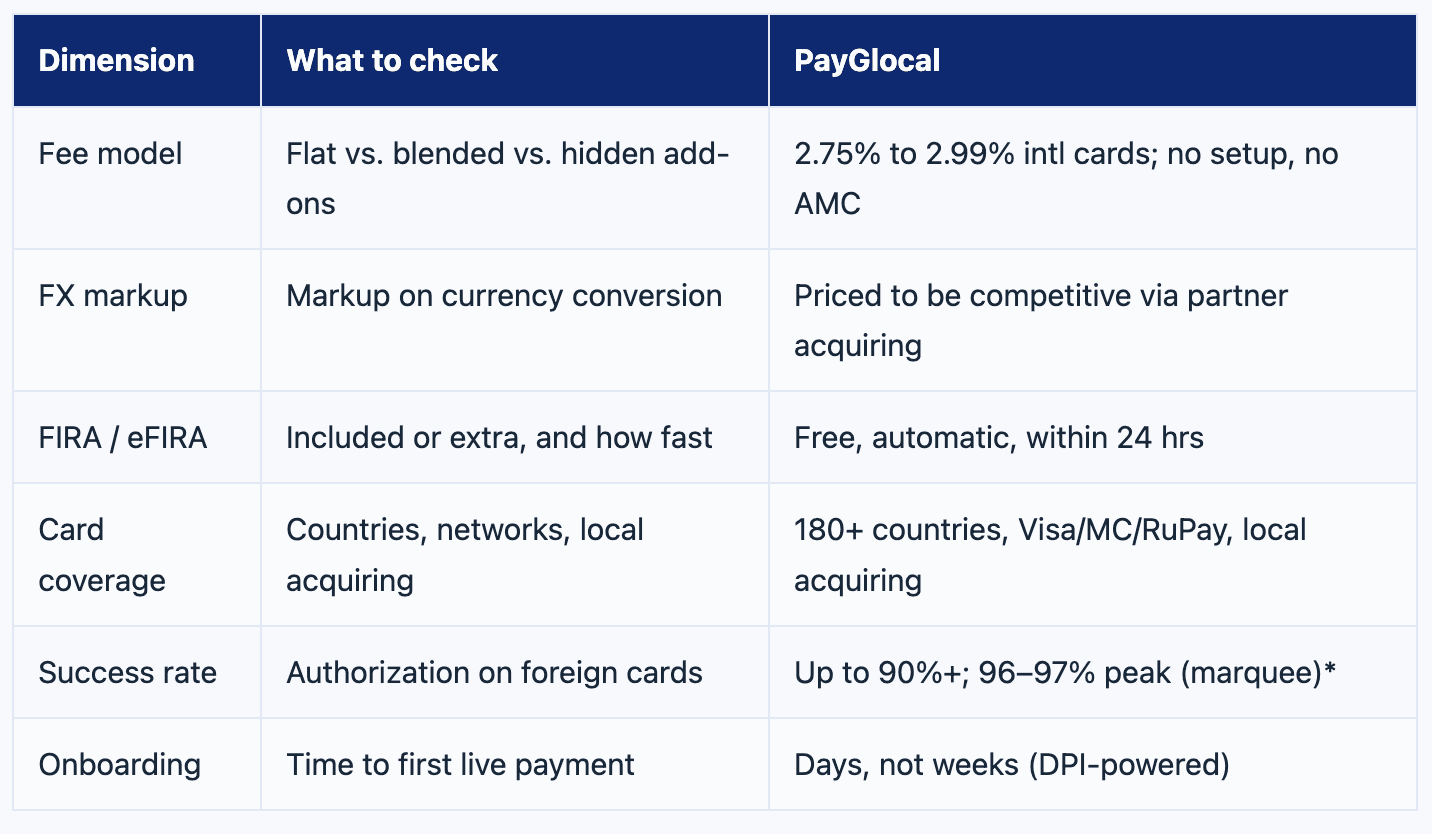
Because we understand the cross-border SaaS profile specifically, and work with acquiring partners to price for it, the aim is not to be one more line on a comparison sheet. It is to be the lowest effective cost once declines and failed renewals are counted.
Why does onboarding move faster on PayGlocal?
Speed to first live payment is itself a competitive advantage. Every week a SaaS company cannot collect internationally is deferred revenue.
PayGlocal is built natively on India's Digital Public Infrastructure (DPI) — the same rails that made UPI instant and ubiquitous. Being close to that infrastructure, and RBI-authorised on it, means verification, account setup and go-live are compressed. Onboarding is measured in days rather than the weeks a traditional cross-border banking setup takes. (For context, individual freelancers onboard in under two hours on the same machinery.)
That is the whole positioning in one line: the UPI-simple experience, made global.