

TL;DR
- Trust drives international payments. Regulatory compliance builds merchant confidence, but buyers decide whether to complete a payment based on how fast and secure the checkout feels.
- Edge computing overcomes the limits of distance. Since cross-border latency is constrained by physics, processing key parts of the checkout closer to the buyer reduces delays, improves the payment experience, and keeps security checks fast.
- Faster checkouts mean more successful payments. By reducing latency and running security at the edge, merchants can lower cart abandonment, improve payment gateway success rates, and recover more international revenue.
Trust is the product
Every payments company eventually works out that it is not really in the business of moving money. Moving money is easy. It is in the business of being trusted to move money.
And in cross-border payments, trust is a much harder thing to earn, because you are asking for it from someone who has no reason to give it.
Consider the actual moment. A buyer in London, or Dubai, or New York, reaches a checkout page. They are about to hand their card details to a business in India they have never heard of, processed by infrastructure they cannot see, under a legal system they do not know. Every instinct they have is asking one question, and they are answering it in under two seconds, mostly unconsciously.
Do I trust this page with my money?
There are two honest ways to answer that question, and a serious payments company needs both.
The first way is regulatory
You get licensed. PayGlocal holds the Reserve Bank of India's authorisation as a Payment Aggregator - Cross Border - Inward & Outward (PA-CB-I&O), which permits us to move money both into and out of India as an authorised payment aggregator, under audit, with net-worth requirements and a compliance regime behind it. That is a real answer, and it is the one that satisfies a merchant's legal and finance teams.
But it is not the answer that satisfies the buyer at the checkout. They are not reading our licence. They are having an experience.
The second way is engineering
The buyer's trust is decided by two things they can actually perceive: how fast the page is, and how safe it feels. Speed and security. And the reason this is a hard engineering problem, rather than a design problem, is that for a cross-border payment, speed is constrained by physics.
This is also where the checkout experience stops being a design concern and becomes an infrastructure one. A buyer does not separate "the page felt slow" from "the company felt untrustworthy." The two arrive as a single impression, and that impression is where edge computing payments earn or lose the sale.
You cannot negotiate with the speed of light
This is the part of cross-border payments that no amount of clever code will fix.
Light travels roughly 300,000 kilometres per second in a vacuum, and appreciably slower through glass fibre. London to Mumbai is about 7,200 kilometres in a straight line, and network paths are not straight lines.
That gives a single round trip between a buyer's browser in London and a server in Mumbai a hard floor: a physical minimum latency that no optimisation, no caching, no faster CPU and no amount of engineering effort can go below.
And a checkout is never one round trip. It is a sequence, and every step pays the same tax:
- A TLS handshake
- Then the page
- Then the assets
- Then a risk check
- Then an authorisation call
- Often then a 3D Secure challenge
The delays compound.
We measured this directly, on a real payment endpoint. The connection itself, the first handshake between a buyer's browser and the nearest edge node, is fast everywhere, typically a few milliseconds, whether the buyer is in Frankfurt, Singapore or Bangalore.
But once a request needs a real round trip to our origin in India, the picture changes sharply with distance. Same request, same endpoint, the only variable is how far the buyer's city sits from India:
- Frankfurt or Singapore: full response lands in under 230 milliseconds
- London: roughly 520 milliseconds
- New York: roughly 860 milliseconds
To see the full shape of this, not just an average, we measured response time against our own production API, from a network of independent probes physically located in each city, and looked at the distribution rather than a single sample:
London (47 measurements): Half of all requests came back within 182 milliseconds, three quarters within 238 milliseconds, and even the slowest one percent stayed within 918 milliseconds.
New York (50 measurements): The median was 241 milliseconds, three quarters came back within 305 milliseconds, and the slowest one percent stayed within 900 milliseconds, a consistent tail rather than a single outlier.
Dubai (few measurement points): The median was roughly 344 milliseconds and the slowest case roughly 587 milliseconds, though with only a handful of samples this is a directional figure rather than a statistically settled one.
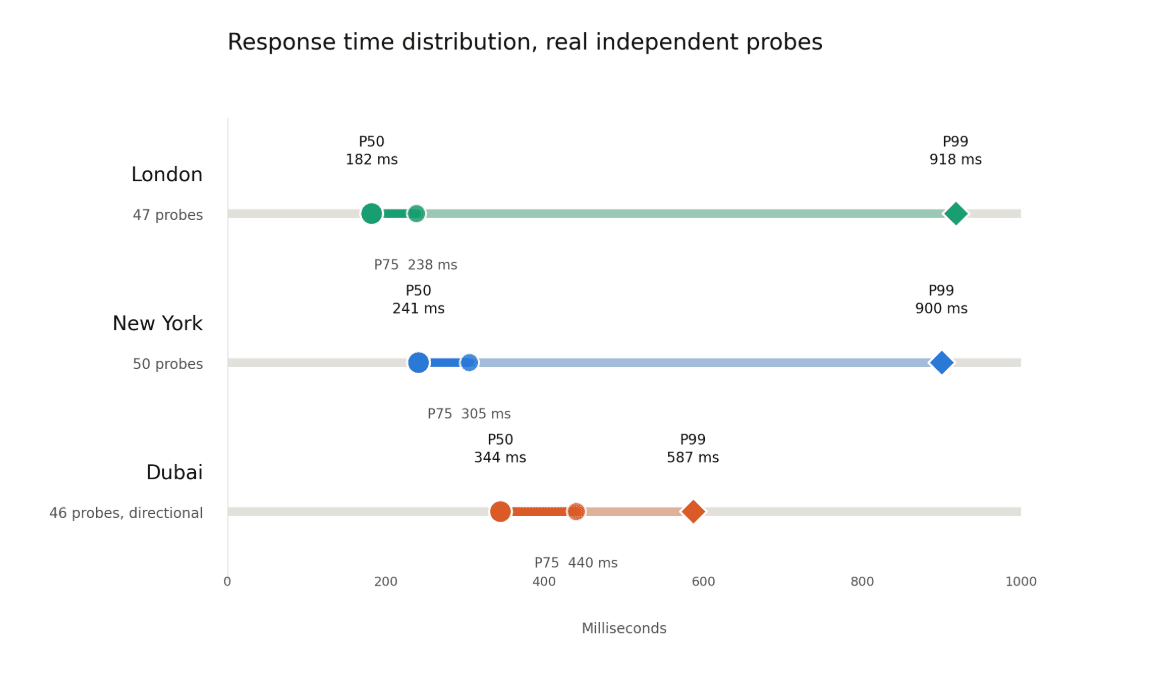
Figure 1. Response time distribution from real independent probes against our production API, London, New York and Dubai.
A centralised payment stack does not have a latency problem. It has a geography problem. You cannot make Mumbai closer to London.
So you stop trying. You go to London instead.
The edge: be close, or be slow
Edge computing is usually explained as a caching optimisation, which badly undersells it. For international payments it is the only available answer to a physical constraint. If the round trip is the problem, the fix is to shorten the trip, to terminate, evaluate and serve as much of the transaction as possible within a few hundred kilometres of the person paying.
We run behind a global edge network spanning over 330 cities across more than 100 countries. Ninety five percent of the world's internet connected population sits within 50 milliseconds of one of these nodes, and most are within 20 milliseconds. For a buyer in London, Dubai or New York, that means the nearest edge node is almost always a short local hop away, not an international one.
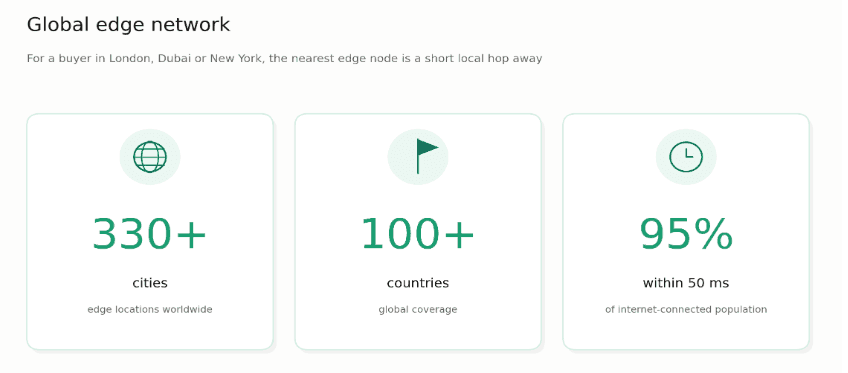
Figure 2. Global edge network coverage.
What we actually do at the edge
The point of the edge is not simply that content arrives faster. It is that the expensive, latency-multiplying parts of a checkout stop crossing an ocean.
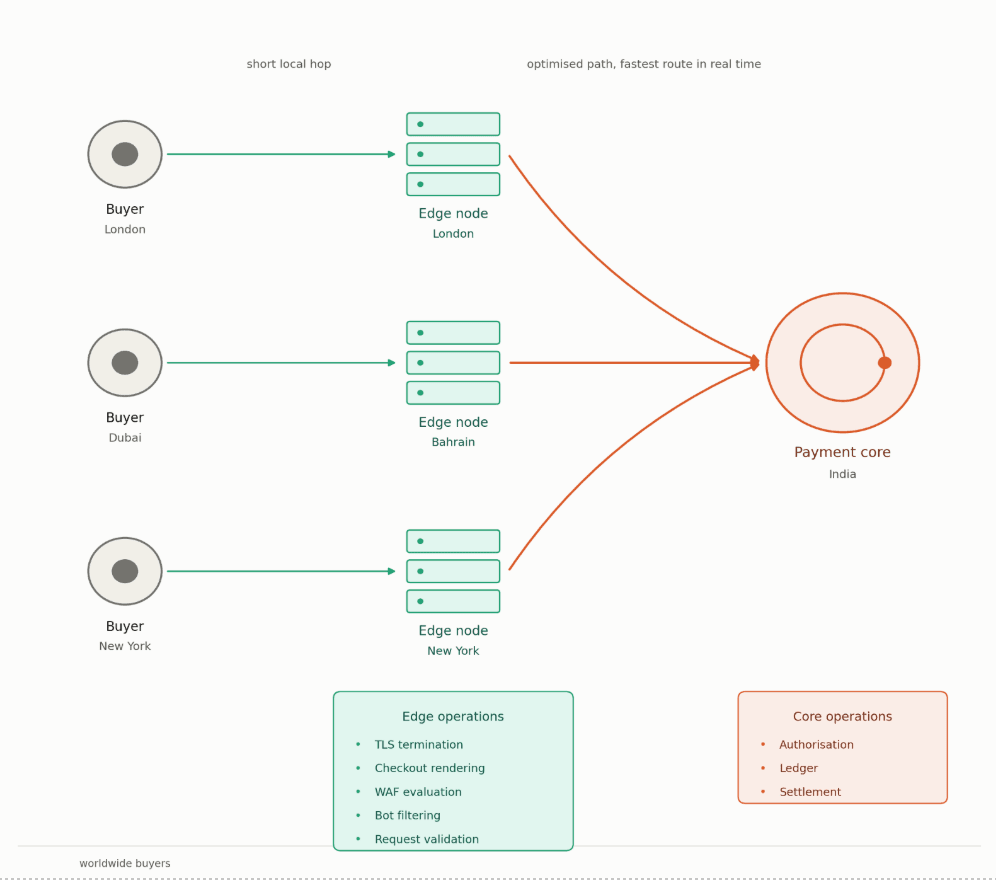
Figure 3. Edge routing architecture: buyer to nearest edge node to payment core, with edge and core operations shown.
The transaction still terminates in India, it must, because that is where the regulated rails and the ledger live. But instead of the buyer's browser making six long-haul round trips, it makes its round trips to a node down the road, and we make one optimised journey home.
The path back to India matters too. Rather than relying on the default network route, our infrastructure continuously selects the fastest available path from edge to origin in real time, which cuts the average edge-to-origin response time roughly in half, from 342 milliseconds down to 151 milliseconds. This is a global average across all countries and all requests, and it is response time, the full time to receive a first byte back from origin, not the raw network round trip alone, but it is still a real, measured improvement on the leg of the journey between the edge and India.
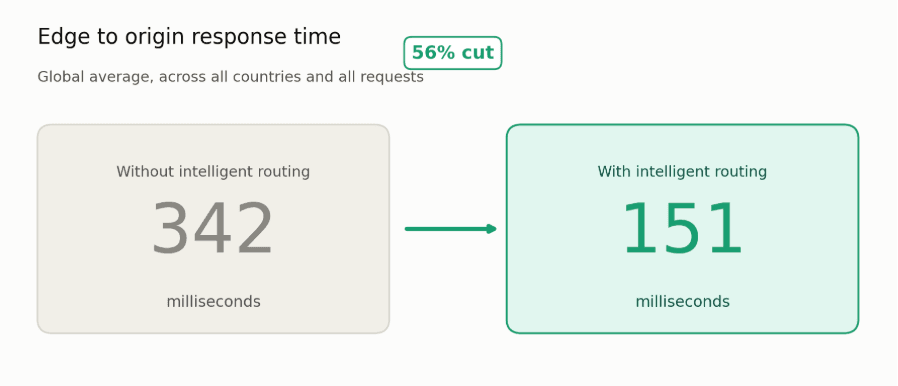
Figure 4. Edge to origin response time, before and after intelligent routing.
Speed without trading away security
Here is the trap, and it is the reason this is worth writing about at all.
In most systems, speed and security are a trade. Every additional check, bot detection, WAF evaluation, fraud signals, 3D Secure, adds latency. So the tempting move is to strip checks out to make the checkout feel fast, and quietly accept more risk. That is a bad trade to make in payments, and a catastrophic one to make in cross-border payments, where the fraud exposure is highest and the recourse is weakest.
The edge is what lets us refuse the trade. Because the security checks run at the edge too, close to the buyer, before the request has travelled anywhere, they cost a few milliseconds instead of a few hundred. We are not choosing between a fast checkout and a screened one. We run the screening in the space where the latency used to be.
Edge computing is not a latency optimisation with a security cost. It is what removes the choice between the two.
This is not just an internal belief. Edge providers who publish their own engineering benchmarks report that threat and rule matching at the edge runs as a constant time lookup, so the overhead stays effectively negligible, measured in single digit microseconds, regardless of how many threat signals are being checked against. That is the entire basis for running screening at the edge rather than at origin: the checks do not get slower as they get more thorough.
Why this matters for international payments
This is where physics turns into revenue.
The gap between a mediocre international payments setup and an optimised one is the gap between roughly an 85% and a 96% payment gateway success rate. That is not a technical statistic. It is eleven percent of a merchant's international revenue, disappearing silently, sometimes at an overseas card issuer, and sometimes long before that, in a buyer who gave up on a checkout that felt slow and therefore felt unsafe.
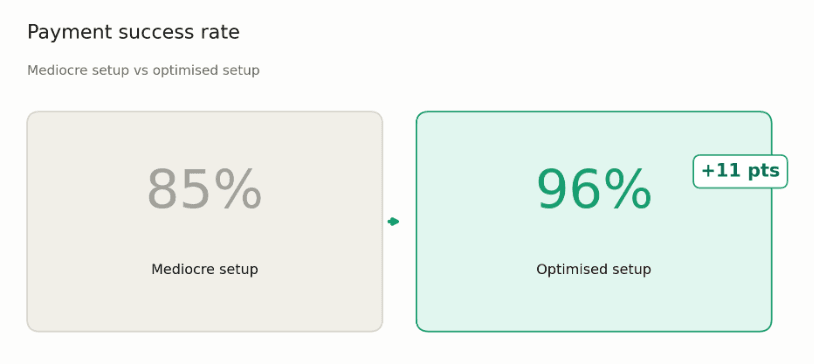
Figure 5. Payment gateway success rate: mediocre setup versus optimised setup.
An abandoned checkout is not a neutral event. That buyer was the most expensive visitor the merchant will ever have, acquired, convinced, card in hand. And unlike a domestic shopper, an international buyer rarely comes back to try again. To reduce cart abandonment on a cross-border checkout is not a cosmetic win, it is the difference between collecting revenue you already earned and watching it evaporate at the last step.
Latency is not a user-experience concern in cross-border payments. It is a conversion concern, a success-rate concern, and ultimately a trust concern, because a slow page and an untrustworthy page feel identical to someone about to enter a card number.
What this costs, and what it means for the merchant
The commercial argument for the edge is usually made on reliability. The stronger argument is on economics.
The economics make the case on their own. Running the edge layer costs a small fraction of what the origin infrastructure costs to operate over the same period, roughly twenty-five times less, in fact. Filtering traffic before it reaches paid compute is simply cheaper than paying to reject it after it arrives.
Traffic filtered at an edge node never consumes origin compute, never crosses a cloud provider's egress meter, and never occupies a database connection. The security checks that protect a merchant's checkout cost us less precisely because they run close to the buyer rather than close to the ledger.
A lower cost per transaction is not an internal metric. It is what allows an Indian exporter to collect from a customer in London at a price a bank cannot match, while that customer gets a checkout that is faster and better protected than the bank could offer them.
Trust, in the end, is the thing being sold. The regulator gives us the right to ask for it. The engineering is what earns it.
Closing
PayGlocal runs international and domestic payments on one RBI-authorised stack, with acceptance across 180+ countries. We build at the edge because trust is decided in the first two seconds of a checkout experience, and because the speed of light is the one constraint we are not permitted to argue with.
If your checkout is losing international buyers to latency, our [Dynamic Checkout](/dynamic-checkout) runs at the edge by default, and it is built to reduce cart abandonment and lift your payment gateway success rate on exactly these cross-border flows.
APIs and documentation: docs.payglocal.in